


Here's one to help the NY-NC corridor get through the next few days:

Happy Fourth of July
It is going on 40 years since Phil Ochs composed some of the quintessential songs of the folk era. The creator of The War Is Over would be appalled, though, that I Ain't Marching Anymore and What Are You Fighting For? have lost none of their relevance. I still miss Phil.
Born on the Fourth of July:
Marine Cpl. Jacob C. Leicht of Kerrville, Texas, the 1,000th American serviceman killed in Afghanistan, would have turned 25 this July 4.
Marine Cpl. Jacob C. Leicht of Kerrville, Texas, the 1,000th American serviceman killed in Afghanistan, would have turned 25 this July 4.
Politics: Those Wacky Republicans - a series
"Saturday Catchup" is still on vacation. The whackos in the GOP, on the other hand, never sleep.
See, also: In Search of the Craziest GOP Policy Proposal by Seyward Darby (The New Republic 2010-07-08).
See, also: In Search of the Craziest GOP Policy Proposal by Seyward Darby (The New Republic 2010-07-08).
Immigration Reform: You pick potaytoes & I pick potahtoes
The Long War: "...a fool’s errand." - Rep. Jerrold Nadler
Congressman Jerrold Nadler (D-NY) has joined the Out of Afghanistan Congressional Caucus in opposing the war in Afghanistan and speaking out against the war’s continued funding.
“Every dollar we spend in Afghanistan, every life we waste there, is a waste,” said Nadler. “An intelligent policy is not to try to remake a country that nobody since Genghis Khan has managed to conquer. What makes us think, what arrogance gives us the right to assume that we can succeed where the Moguls, the British, the Soviets, failed.…It will take tens of years, hundreds of billions of dollars, tens of thousands of American lives, and we don’t need to do it. We don’t need to do it. We, frankly, have no right to do it. It’s a fool’s errand, and I just hope and pray that we get wise enough to stop sending our young men and women to waste their lives there, and our money that could be used to prop up our own people.”
Below is the text of Nadler’s remarks, as delivered:
“Every dollar we spend in Afghanistan, every life we waste there, is a waste,” said Nadler. “An intelligent policy is not to try to remake a country that nobody since Genghis Khan has managed to conquer. What makes us think, what arrogance gives us the right to assume that we can succeed where the Moguls, the British, the Soviets, failed.…It will take tens of years, hundreds of billions of dollars, tens of thousands of American lives, and we don’t need to do it. We don’t need to do it. We, frankly, have no right to do it. It’s a fool’s errand, and I just hope and pray that we get wise enough to stop sending our young men and women to waste their lives there, and our money that could be used to prop up our own people.”
Below is the text of Nadler’s remarks, as delivered:
I am Congressman Jerry Nadler of New York. I got started in politics in opposition to the war in Vietnam because we thought that it was a mistake. I don’t think that too many historians would disagree today – that every dollar spent and every life wasted in Vietnam was just that – a waste. It did not enhance the security of this country by one bit because it was based on a false premise.
Afghanistan is the same. Every dollar we spend, every life we waste, is a waste. It does not enhance the security of the United States, which is what ought to be our goal. We were attacked on 9/11 by Al Qaeda. Al Qaeda is our enemy and we must fight them. Al Qaeda had bases in Afghanistan; it made sense to go in and destroy those bases, and we did. We have every right, we have every duty to destroy bases, to take out bases that are being used to plot attacks on the United States. But we are told today that there are fewer than one hundred Al Qaeda personnel in all of Afghanistan – their bases are in Pakistan, but we are not invading Pakistan. They have bases in Somalia and Yemen, but we are not invading Somalia and Yemen, G-d forbid we should.
An intelligent policy might be to attack the bases from which mayhem is being plotted against the United States wherever they are. An intelligent policy is not to try to remake a country that nobody since Genghis Khan has managed to conquer. What makes us think, what arrogance gives us the right to assume that we can succeed where the Moguls, the British, the Soviets, failed. No government in Afghanistan, no government in Kabul, has ever been able to make its run and rule the country.
Why have we undertaken to invent a government that is not supported by the majority of the people, that is corrupt, and to impose its will, to impose it on the country? Afghanistan is in the middle of what is, at this point, a 35 year civil war. We have no business intervening in that civil war, we have no ability to win it for one side or the other, and we have no necessity to win it for one side or the other. We have the duty to make sure that bases are not used, but bases can be attacked, specific bases. We don’t have to – this whole idea of counter-insurgency, that we are going to persuade the people, those left alive after our firepower is applied, to love the government that we like is absurd.
It will take tens of years, hundreds of billions of dollars, tens of thousands of American lives, and we don’t need to do it. We don’t need to do it. We, frankly, have no right to do it. It’s their country. If they want to have a civil war, we can’t stop them. We can’t choose the rulers that they have, we don’t have to like the rulers that they have, we don’t have to like their choices. It’s not up to us.
We should not be spending – aside from making sure that specific bases are not being used against us – we should not be spending a nickel, should not be wasting a life. And the lives that are being spent there by our brave men and women are being wasted, because they’re being spent in pursuit of an unintelligent, unthought-through, unachievable, and unnecessary goal.
So we ought to pull our troops out as rapidly as possible, and I don’t mean by as rapidly as possible as soon as the Afghans can take over. Why are all the Afghans fighting on the other side? We can’t train the Afghans on our side to fight, why? Not because they’re not bright, not because they’re any less literate or more literate than the Taliban. Because the people fighting on our side have no will. They don’t have the motive. You can’t instill that. If they had the will and the motive they wouldn’t need our help. Without the will and the motive, our help cannot help.
So, it’s a fool’s errand, and I just hope and pray that we get wise enough to stop sending our young men and women to waste their lives there, and our money that could be used to prop up our own people.
Priorities: Guns or butter? Wall Street or Main Street?
The mid-term elections are around the corner. Time to ask whether your congressperson stands with you or the corporations when it comes to federal spending.
See, also: Budget Deficit and Wars’ Cost Draw Fire on the Home Front by David Herszenhorn (New York Times 2010-07-02).
In Cleveland, where I come from, unemployment is devastating our community. People are demanding that their government, our government, recognize the suffering of families who have lost jobs and can't find work.-- Statement on the floor of the House of Representatives by Rep. Dennis Kucinich in support of legislation to extend emergency unemployment benefits.
Will Washington tell my constituents and people like them, all over America, 'We have money for war but no money for the unemployed? We have money for military contractors but no money for the unemployed? We have money, billions, for corrupt foreign governments but no money for our unemployed in the United States? We havemoney for tax cuts for the wealthiest of Americans but no money for the unemployed? Hundreds of billions for Wall Street but no money for the unemployed?'
Instead, the out-of-work, poor, and middle class get lectures on balancing the budget, lectures on pay-fors. What are people supposed to do when they don't have budgets because they don't have money? When they can't pay for food, shelter, and clothing? Yes, we need jobs, but people out of work can't find a job and they have to survive. People need unemployment benefits because they have to pay for their mortgage, their rent, their utility bills. So many Americans are hanging on by their fingertips. Some exhort our constituents, 'pull yourselves up by your boot straps.' What if you don't have money to buy boots?
See, also: Budget Deficit and Wars’ Cost Draw Fire on the Home Front by David Herszenhorn (New York Times 2010-07-02).
Stimulus or Austerity: The People vs. the Banks
The most powerful nations in the world met recently at the G-20 in Toronto and managed to agree on only one thing of significance: the need to reduce deficits, "half by 2013." Implied by the statement is the need to lower deficits via "austerity," meaning eliminating or reducing social programs. Stimulus or Austerity: The People vs. the Banks by Shamus Cooke (Buzzflash 2010-07-02).
Politics: Those Wacky Republicans - a series
Although it looks like wealthy businessman William Binnie will unload a ton of his own money into his bid for the GOP nomination for U.S. Senate in New Hampshire, the state's attorney general, Kelly Ayotte, still seems a safe bet to eke out a win. One thing she probably doesn't need to worry about, though, is this guy:
The Federal Deficit: First, do no harm
Here are "Eight Keys To Addressing The Deficit" offered to the White House National Commission on Fiscal Responsibility and Reform, a presidential advisory body that has the Obama administration has stacked with Wall Street apologists, by AFL-CIO president Richard Trumka,
First, stabilizing the national debt is a means to an end, not an end in itself. "...stabilizing the debt is simply a means to achieve our goal of sustainable, broadly shared prosperity, and we should reject approaches to debt stabilization that take us away from that goal."
Second, we should be honest about will cause deficits over the next ten years: The tax cuts enacted under President George W. Bush, the wars in Afghanistan and Iraq, and the economic downturn (and not a crisis of entitlement spending generally, caused by the retirement of the Baby Boomers).
Third, premature withdrawal of economic stimulus threatens to throw the global economy into a double-dip recession, or worse. "By withdrawing economic stimulus, we run the risk not only of prolonging the jobs crisis for several more years, but also of bringing about a “double-dip” recession—or even what Nobel Laureate Paul Krugman calls 'a third Depression.'”
Fourth, stronger economic growth, job growth, and wage growth are needed to stabilize the debt. "...[W]e must have a job-centered approach to stabilizing the national debt, which would bring us closer to our goal of sustainable, broadly shared prosperity."
Fifth, Wall Street should pay to build a 21st century infrastructure that will lead to long-term economic growth by investing heavily in public infrastructure that has been badly neglected over the past 30 years, not only to roads and bridges but also to airports and air traffic control systems, urban transit, high-speed rail, schools and university facilities, national laboratories, national parks, ‘smart’ electric grids, broadband networks, green generating plants, and health information networks.
Seventh, we must reduce health care costs even further—without cutting benefits or compromising the quality of care. "Reducing excess cost growth can and should be accomplished without cutting benefits. Approaches that should be considered include (1) Medicare drug price negotiation; (2) easing restrictions on imports of prescription drugs; (3) expanding proven Medicare payment and delivery reforms; and (4) offering the choice of a public health insurance plan option that would offer premiums 10% below private insurance and would reportedly reduce the federal deficit by $110 billion over 10 years."
Eighth, Social Security benefits are not the problem and must not be cut. "In fact, Social Security should be strengthened to compensate for the decline of traditional pensions and for the stock market losses of retirement savings plans. Social Security benefits are about one third lower than the average of 30 OECD countries.
See, also, commission testimony Dr. Margaret Flowers for Physicians for a National Health Program: "The alternative scenario of a national improved Medicare for All will save lives and save money. National improved Medicare for All will place our nation on the path of becoming one of the best health systems in the world - something of which we can all be proud. This commission has the ability to recommend creating a financially sustainable universal health system. I urge the members of this commission to recommend addressing the deficit through adopting this most popular approach: national improved Medicare for All. Don't cut Medicare. Protect it, improve it and expand it to cover everyone." -- Improve and strengthen Medicare by expanding it to all (PNHP 2010-02-01).
First, stabilizing the national debt is a means to an end, not an end in itself. "...stabilizing the debt is simply a means to achieve our goal of sustainable, broadly shared prosperity, and we should reject approaches to debt stabilization that take us away from that goal."
Second, we should be honest about will cause deficits over the next ten years: The tax cuts enacted under President George W. Bush, the wars in Afghanistan and Iraq, and the economic downturn (and not a crisis of entitlement spending generally, caused by the retirement of the Baby Boomers).
Third, premature withdrawal of economic stimulus threatens to throw the global economy into a double-dip recession, or worse. "By withdrawing economic stimulus, we run the risk not only of prolonging the jobs crisis for several more years, but also of bringing about a “double-dip” recession—or even what Nobel Laureate Paul Krugman calls 'a third Depression.'”
Fourth, stronger economic growth, job growth, and wage growth are needed to stabilize the debt. "...[W]e must have a job-centered approach to stabilizing the national debt, which would bring us closer to our goal of sustainable, broadly shared prosperity."
Fifth, Wall Street should pay to build a 21st century infrastructure that will lead to long-term economic growth by investing heavily in public infrastructure that has been badly neglected over the past 30 years, not only to roads and bridges but also to airports and air traffic control systems, urban transit, high-speed rail, schools and university facilities, national laboratories, national parks, ‘smart’ electric grids, broadband networks, green generating plants, and health information networks.
We believe it is only fitting to ask Wall Street to pay to rebuild the economy it helped destroy. One way to do that would be through a Financial Speculation Tax (FST) — a tiny 0.05% tax on transactions of stocks, options, futures, credit default swaps, and other derivative instruments. The $100 to $300 billion in additional tax revenue per year that this tax would generate could be used to fund higher levels of public investment, and the tax itself would curb unproductive speculation that is harmful to the economy.Sixth, efforts to stabilize the national debt should not include approaches that increase income inequality, such as prolonged unemployment, which would permanently cripple the earnings potential of millions of workers, exert downward pressure on workers’ wages, and condemn millions of children to poverty unnecessarily; cuts to Social Security benefits; and cuts to Medicare benefits.
It would also be fitting to ask the wealthiest Americans who benefited most from the failed economic policies of the past 30 years to pay their fair share for rebuilding the 21st century economy and stabilizing the national debt. For example, a surtax of 1%-5.4% on earnings over $350,000 would raise close to $600 billion over 10 years.
Seventh, we must reduce health care costs even further—without cutting benefits or compromising the quality of care. "Reducing excess cost growth can and should be accomplished without cutting benefits. Approaches that should be considered include (1) Medicare drug price negotiation; (2) easing restrictions on imports of prescription drugs; (3) expanding proven Medicare payment and delivery reforms; and (4) offering the choice of a public health insurance plan option that would offer premiums 10% below private insurance and would reportedly reduce the federal deficit by $110 billion over 10 years."
Eighth, Social Security benefits are not the problem and must not be cut. "In fact, Social Security should be strengthened to compensate for the decline of traditional pensions and for the stock market losses of retirement savings plans. Social Security benefits are about one third lower than the average of 30 OECD countries.
In the short term, we have a jobs crisis—not a debt crisis. The best way to improve our fiscal situation is through stronger job growth. However, given the massive shortfall of aggregate demand, additional deficit spending is necessary in the short term to bring down unemployment and avert a double dip recession, which would only make deficits worse.Drawn from Eight Keys To Addressing The Deficit by Richard Trumka (Campaign for America's Future 2010-06-30).
After the jobs crisis is behind us, we will need more tax revenues to pay for the higher levels of public investment in 21st century infrastructure that are necessary to create good jobs, ensure long-term economic growth, and improve our global competitiveness. Additional health reforms will also be necessary to further reduce excess health care cost growth.
Stabilizing the national debt over the long term can be a means of achieving sustainable, broadly shared prosperity. But exaggerated fears of deficits and the debt should not be used as a pretext to increase inequality and thereby repeat the mistakes of the past that brought us to the precipice of global depression.
See, also, commission testimony Dr. Margaret Flowers for Physicians for a National Health Program: "The alternative scenario of a national improved Medicare for All will save lives and save money. National improved Medicare for All will place our nation on the path of becoming one of the best health systems in the world - something of which we can all be proud. This commission has the ability to recommend creating a financially sustainable universal health system. I urge the members of this commission to recommend addressing the deficit through adopting this most popular approach: national improved Medicare for All. Don't cut Medicare. Protect it, improve it and expand it to cover everyone." -- Improve and strengthen Medicare by expanding it to all (PNHP 2010-02-01).
Militarism: Unanimous Conformity in the Senate
by Norman Solomon, t r u t h o u t | Op-Ed
For the warfare state, it doesn't get any better than 99 to 0.
Every living senator voted Wednesday to approve Gen. David Petraeus as the top U.S. commander in Afghanistan.
Call it the unanimity of lemmings - except the senators and their families aren't the ones who'll keep plunging into the sea.
No, the killing and suffering and dying will be left to others: American soldiers who, for the most part, had scant economic opportunities in civilian life, and Afghans trapped between terrible poverty and escalating violence.
The senatorial conformity, of course, won't lack for rationales. It rarely does.
An easy default position is that the president has the right to select his top military officers. (Then why is Senate confirmation required?) Or: This is a pivotal time for the war in Afghanistan. (All the more reason for senators to take responsibility instead of serving as a rubber stamp for the White House.)
In today's Senate, the conformity is so thick that it's almost enough to make you nostalgic for the Senate of four and a half decades ago. At least there were a couple of clear dissenters from the outset - first and foremost, Wayne Morse of Oregon and Ernest Gruening of Alaska, who in August 1964 voted against the Gulf of Tonkin resolution that "authorized" the horrors of the U.S. war on Vietnam.
Within a couple of years, appreciable dissent was coming from William Fulbright, chair of the Senate Foreign Relations Committee, as well as Frank Church and George McGovern. Then Eugene McCarthy, Robert Kennedy and other senators.
The process of getting off the war train was pitifully slow, in view of the wholesale deadly ferocity of the Vietnam War - and in view of the fact that Congress, like the U.S. news media, lagged so far behind the clarity of opposition emerging from many millions of Americans. Whatever good happened on Capitol Hill was a direct result of the anti-war movement and more generalized public sentiment against continuing the war.
In the Senate of 2010, the baseline of conscience and courage is at an abysmally low level.
When the chair of the Senate Armed Services Committee, Carl Levin, said he's "deeply concerned" about the course of the Afghan war, his tactical objections dodged the fundamentals of the escalating conflagration. And so, Levin dutifully declared that Petraeus will "bring highly experienced leadership and a profound understanding of the president's strategy in Afghanistan."
Chiming in was Sen. John McCain, who lauded the general as "one of the finest military leaders our country has ever produced." McCain has long been appreciative of Petraeus' record, including his services as a military spinmeister for President George W. Bush's Iraq war policies midway through the decade.
In 2007, a notable ad from MoveOn.org described Petraeus as "a military man constantly at war with the facts." There's no reason to believe that Petraeus is more candid these days. At any rate, the policy from the White House is what really matters, not the proclivities of any particular general.
Like mice who won't try to bell the chief-executive cat, senators complain but keep on purring. That explains their unanimous vote for a general pledging to stay the course in Afghanistan.
Every few months, I take another look at footage of Sen. Morse, directly challenging the war president, a man of his own party. It's inspiring - yet painful to watch, because of the sharp contrast with today's mealy-mouthed senators.
A growing number of House members are lining up against the Afghanistan war, although they're far short of a majority. Meanwhile, the Senate is a bastion of bluster. The overarching congressional problem is a pattern of doing what the war machinery requires - most importantly, voting to pay for the war. Until that stops, the war won't.

This work by Truthout is licensed under a Creative Commons Attribution-Noncommercial 3.0 United States License.
I don't know about you, but I'm always "nostalgic for the Senate of four and a half decades ago." That was before militarization and before the corporate takeover of the nation's political apparatus. The Congress in those days was populated by titans (for all their flaws} compared to the moral and intellectual pipsqueaks we have now. Then we worried about improving democracy; today we have to worry if democracy can survive. -- JG
For the warfare state, it doesn't get any better than 99 to 0.
Every living senator voted Wednesday to approve Gen. David Petraeus as the top U.S. commander in Afghanistan.
Call it the unanimity of lemmings - except the senators and their families aren't the ones who'll keep plunging into the sea.
No, the killing and suffering and dying will be left to others: American soldiers who, for the most part, had scant economic opportunities in civilian life, and Afghans trapped between terrible poverty and escalating violence.
The senatorial conformity, of course, won't lack for rationales. It rarely does.
An easy default position is that the president has the right to select his top military officers. (Then why is Senate confirmation required?) Or: This is a pivotal time for the war in Afghanistan. (All the more reason for senators to take responsibility instead of serving as a rubber stamp for the White House.)
In today's Senate, the conformity is so thick that it's almost enough to make you nostalgic for the Senate of four and a half decades ago. At least there were a couple of clear dissenters from the outset - first and foremost, Wayne Morse of Oregon and Ernest Gruening of Alaska, who in August 1964 voted against the Gulf of Tonkin resolution that "authorized" the horrors of the U.S. war on Vietnam.
Within a couple of years, appreciable dissent was coming from William Fulbright, chair of the Senate Foreign Relations Committee, as well as Frank Church and George McGovern. Then Eugene McCarthy, Robert Kennedy and other senators.
The process of getting off the war train was pitifully slow, in view of the wholesale deadly ferocity of the Vietnam War - and in view of the fact that Congress, like the U.S. news media, lagged so far behind the clarity of opposition emerging from many millions of Americans. Whatever good happened on Capitol Hill was a direct result of the anti-war movement and more generalized public sentiment against continuing the war.
In the Senate of 2010, the baseline of conscience and courage is at an abysmally low level.
When the chair of the Senate Armed Services Committee, Carl Levin, said he's "deeply concerned" about the course of the Afghan war, his tactical objections dodged the fundamentals of the escalating conflagration. And so, Levin dutifully declared that Petraeus will "bring highly experienced leadership and a profound understanding of the president's strategy in Afghanistan."
Chiming in was Sen. John McCain, who lauded the general as "one of the finest military leaders our country has ever produced." McCain has long been appreciative of Petraeus' record, including his services as a military spinmeister for President George W. Bush's Iraq war policies midway through the decade.
In 2007, a notable ad from MoveOn.org described Petraeus as "a military man constantly at war with the facts." There's no reason to believe that Petraeus is more candid these days. At any rate, the policy from the White House is what really matters, not the proclivities of any particular general.
Like mice who won't try to bell the chief-executive cat, senators complain but keep on purring. That explains their unanimous vote for a general pledging to stay the course in Afghanistan.
Every few months, I take another look at footage of Sen. Morse, directly challenging the war president, a man of his own party. It's inspiring - yet painful to watch, because of the sharp contrast with today's mealy-mouthed senators.
A growing number of House members are lining up against the Afghanistan war, although they're far short of a majority. Meanwhile, the Senate is a bastion of bluster. The overarching congressional problem is a pattern of doing what the war machinery requires - most importantly, voting to pay for the war. Until that stops, the war won't.
This work by Truthout is licensed under a Creative Commons Attribution-Noncommercial 3.0 United States License.
I don't know about you, but I'm always "nostalgic for the Senate of four and a half decades ago." That was before militarization and before the corporate takeover of the nation's political apparatus. The Congress in those days was populated by titans (for all their flaws} compared to the moral and intellectual pipsqueaks we have now. Then we worried about improving democracy; today we have to worry if democracy can survive. -- JG
The Long War: American Wealth & Well-Being Squandered in Afghanistan
On Monday, Ohio Democratic Congressman Dennis Kucinich made the following statement on the floor of the House concerning an expected vote on a $33 billion supplemental war funding bill:
Understatement of the week: Corruption Suspected in Airlift of Billions in Cash From Kabul by Matthew Rosenberg (Wall Street Journal 2010-06-25).
In a little more than a year the United States flew $12 billion in cash to Iraq, much of it in $100 bills, shrink wrapped and loaded onto pallets. Vanity Fair reported in 2004 that ‘at least $9 billion' of the cash had ‘gone missing, unaccounted for.' $9 billion.See the video here.
Today, we learned that suitcases of $3 billion in cash have openly moved through the Kabul airport. One U.S. official quoted by the Wall Street Journal said, ‘A lot of this looks like our tax dollars being stolen.' $3 billion. Consider this as the American people sweat out an extension of unemployment benefits.
Last week, the BBC reported that "the US military has been giving tens of millions of dollars to Afghan security firms who are funneling the money to warlords." Add to that a corrupt Afghan government underwritten by the lives of our troops.
And now reports indicate that Congress is preparing to attach $10 billion in state education funding to a $33 billion spending bill to keep the war going.
Back home millions of Americans are out of work, losing their homes, losing their savings, their pensions, and their retirement security. We are losing our nation to lies about the necessity of war.
Bring our troops home. End the war. Secure our economy.
Understatement of the week: Corruption Suspected in Airlift of Billions in Cash From Kabul by Matthew Rosenberg (Wall Street Journal 2010-06-25).
Politics: The role of the Supreme Court
Sen. Sheldon Whitehouse's riveting opening at Kagan SCOTUS nomination hearing:
Don't be fooled by false deficit prophets:
More Klein: "'Debt' isn't a buzzword, it's a math problem. And it's instructive to try to solve it. The 'Stabilize the Debt' game allows you to cut, tax and spend your way to a better budget outlook. So go ahead. Choose your own deficit."
Many policies that sound impressive when a politician promotes them don't actually save much money. Cutting foreign aid in half, for instance, will save $210 billion by 2022. That would get us 3 percent of the way there. Cutting earmarks in half is even less effective: It would save $130 billion by 2022. -- Choose your own deficit by Ezra Klein (Ezra Klein's Wonkbook/Washington Post 2010-06-27).Cut military spending -- $1,449 billion last year! -- cut that in half and it begins to add up to real money....
More Klein: "'Debt' isn't a buzzword, it's a math problem. And it's instructive to try to solve it. The 'Stabilize the Debt' game allows you to cut, tax and spend your way to a better budget outlook. So go ahead. Choose your own deficit."
Third Parties: He who laughs last...
In what appears to be a massive protest vote, Iceland's satirical Best Party won the most votes in the recent elections in Reykjavik, propelling the party's founder, comedian Jon Gnarr into the mayor’s office and winning 6 seats on the 15-member city council. Now that they have won the election, will they take their new jobs seriously? Here's how Gnarr tried to calm fears that it's all a big joke:
No one has to be afraid of the Best Party, because it is the best party. If it wasn’t, it would be called the Worst Party or the Bad Party. We would never work with a party like that.-- Adapted from Political Irony: Humor and Hypocrisy from the World of Politics (The Best Party, The Best Quote 2010-06-27).
Music break: 12-String Bliss
 Katie's Been Gone So Long: Surprising -- amazing, really -- to hear the incomparable but neglected Karen Dalton, a god of my Village days, amid the superstars and one-hit-wonders at Starbucks today (that's her and Fred Neil at Café Wha? in 1961 with some new kid on harp).
Her best album, In My Own Time
 , at Amazon.
The Economy: Do Republicans in Congress know the meaning of the word "insurance"?
Republicans To Unemployed: You're Spoiled, Drug-Taking Hobos & Animals, Who Shouldn't Breed.
GOP nihilism not only hurts most the least among us and helps most those who need help least, but it is also damaging the country as a whole in ways that will take generations to repair, if it can be repaired at all.
Action: Join the nonprofit Center for Economic Justice.
GOP nihilism not only hurts most the least among us and helps most those who need help least, but it is also damaging the country as a whole in ways that will take generations to repair, if it can be repaired at all.
Action: Join the nonprofit Center for Economic Justice.
Musical Interlude: Black Water on the Gulf
Musical satirist Steve Goodie does his own (oil) slick version of the Doobie Brothers's Black Water
as heard on an interview with Dr. Demento this ayem on NPR (Morning Edition 2010-06-22).
Bonus: You'll find one of Steve's greatest hits here: "(I'm thinkin' 'bout nailin') Sarah Palin" (Impractical Proposals 2008-09-07).
as heard on an interview with Dr. Demento this ayem on NPR (Morning Edition 2010-06-22).
Bonus: You'll find one of Steve's greatest hits here: "(I'm thinkin' 'bout nailin') Sarah Palin" (Impractical Proposals 2008-09-07).
Here's a more worthwhile topic than the future of General McChrystal's command:
The Long War: Warlord, Inc.
“The U.S. military is funding a massive protection racket in Afghanistan, indirectly paying tens of millions of dollars to warlords, corrupt public officials and the Taliban to ensure safe passage of its supply convoys throughout the country,” according to a congressional report. The security arrangements “violate laws on the use of private contractors, as well as Defense Department regulations.” -- Warlord, Inc. Extortion and Corruption Along the U.S. Supply Chain in Afghanistan (pdf) (House of Representatives 2010-06).
The Long War: Warlord, Inc.
“The U.S. military is funding a massive protection racket in Afghanistan, indirectly paying tens of millions of dollars to warlords, corrupt public officials and the Taliban to ensure safe passage of its supply convoys throughout the country,” according to a congressional report. The security arrangements “violate laws on the use of private contractors, as well as Defense Department regulations.” -- Warlord, Inc. Extortion and Corruption Along the U.S. Supply Chain in Afghanistan (pdf) (House of Representatives 2010-06).
Happy Birthday: Honeyboy Edwards turns 95
Not only an authentic blues great in his own right, David "Honeyboy" Edwards is also a living connection to the legendary delta-blues master Robert Johnson.
If you missed Meatless Monday, doesn't mean you can't do a meatless Tuesday on your own.
"In 2009, a landmark National Cancer Institute study of 500,000 Americans between the ages of 50 and 71 found that people who eat a quarter-pound of red meat or processed meat every day were 30 percent more likely to die in the 10 years of the study than those who ate 5 ounces of red meat or less per week. Compare that to research about vegetarian Seventh-Day Adventists, many of whom live significantly longer than the average American." -- Death by Hamburger? by Kiera Butler (Mother Jones 2010-06-21).
"In 2009, a landmark National Cancer Institute study of 500,000 Americans between the ages of 50 and 71 found that people who eat a quarter-pound of red meat or processed meat every day were 30 percent more likely to die in the 10 years of the study than those who ate 5 ounces of red meat or less per week. Compare that to research about vegetarian Seventh-Day Adventists, many of whom live significantly longer than the average American." -- Death by Hamburger? by Kiera Butler (Mother Jones 2010-06-21).
Analysis: Send in the Clowns
"China is a great big country that needs lots of stuff."
Stephen Colbert finds reasons for remaining in Afghanistan:
And Jon Stewart is pretty sure now is the moment to finally achieve energy independence:
Makes you think we should replace the clowns running things with professionals.
Stephen Colbert finds reasons for remaining in Afghanistan:
| The Colbert Report | Mon - Thurs 11:30pm / 10:30c | |||
| The Word - $tay the Cour$e | ||||
| ||||
| The Daily Show With Jon Stewart | Mon - Thurs 11p / 10c | |||
| An Energy-Independent Future | ||||
| ||||
Environment: Metastasizing Oil Rigs in the Gulf of Mexico 1942-2005
This video by the Swordpress shows graphically how the Gulf of Mexico has been transformed from a wilderness to an urban ocean in only six decades.
Gulf of Mexico Oil Rigs: 1942-2005 from tsinn on Vimeo.
Gulf of Mexico Oil Rigs: 1942-2005 from tsinn on Vimeo.
Happy Fathers' Day
Speaking of fathers, every artist, whether contentiously or harmoniously, is in a patrimonial relationship with the artists who came before. Here's a video, from the 1962 Newport Jazz Festival, of the masterful jazz vocalist Joe Williams at the top of his game. But watch Joe's reaction when the father of the jazz vocal, Jimmy Rushing -- Mr. Five by Five, takes control of the mic midway though the tune:
While we're at it:
While we're at it:
Saturday Catchup: 2010-06-19
Saturday Catchup is traveling, but to tide you over til next week here's an uplifting story from the Miami Herald involving a blurry undersea video that looks like crime footage, a feisty sea creature not mired in oil, and a Coast Guard sleuth named Paul Schultz:
Of course, by now the turtle has probably washed up on a beach somewhere, but it's for sure he or she went down fighting.
There were photos of two men preparing to scuba dive and a towheaded family nestled together on a couch. There was a mysterious relic settled deep into the sea floor. And even a puzzling video clip of splashing water that appeared to have been taken as the camera thrashed around under the control of something that wasn’t human.
“There was nothing on the pictures that said this camera belongs to so and so,” Shultz said.
After looking through the pictures, Shultz adopted the screen name of “Aquahound” and took his hunt online.
He uploaded the images on Scubaboard.com, hoping some diving aficionados could help identify where they were taken. Within days, the Internet sleuths had parsed the pictures and found some clues all pointing to Aruba, a Dutch island off Venezuela’s coast that’s 1,100 miles from Key West.
There was a plane’s tail number – and a computer search showed the aircraft was in Aruba the day the photo was taken. There was a blue-roofed building that searchers pinpointed to the island using Google Earth. And there was a school poster written in Dutch.
But could the camera make such a trip? Villy Kourafalou, an associate professor of physical oceanography at the University of Miami, said such an odyssey is possible. The buoyancy of the plastic case combined with various currents could have taken the camera to Key West, she told The Associated Press in an e-mail.
With Shultz’s search narrowed, the resolution came quickly. He posted the pictures on the travel websites Cruisecritic and Aruba.com, and within two days was contacted by an Aruban woman who said she recognized the children in some of the photos as classmates of her son.
She contacted the family, the de Bruins, and all the pieces came together.
“I have a smile on my face … I can’t stop laughing about it,” Dick de Bruin said in a phone interview from Aruba. “It’s really big news (on the island) and in Europe.”
Of course, by now the turtle has probably washed up on a beach somewhere, but it's for sure he or she went down fighting.
"The guillotine ... is the quickest way to sever a life that we know of, but no one would dare use it today. As long as it's not messy, we're OK with it." -- Dr. Jonathan Groner on the shooting to death of convicted murderer Ronnie Lee Gardner by the state of Utah. Death by firing squad spotlights old execution method by Nicholas Riccardi (Los Angeles Times 2010-06-18).
The Media: Don't Get Even. Get Mad!
Here's one of Ben Craw's daily mashups of cable news coverage from HuffPost, this one on the ridiculous calls for an Emobama who can demonstrate that he feels our pain over BP's poisoning of the Gulf of Mexico. Partly a result of the news media's hunger for controversy, partly a reflection of the Right's deep well of cynicism -- had the president gotten emotional Fox would be polling on whether he was too much the girlyman, the controversy has sucked the oxygen out of more substantive discussions about how BP can be made to pay for its crimes, whether future disasters can be prevented by meaningful regulations, and how we can be weaned permanently, if we can, from the oil tit. As always, though, cable news coverage is good for a laugh: watch to the end if you don't believe me.
Politics: The long-term prospects of the two major parties
A new study -- “Demographic Change and the Future of the Parties” -- argues that, in the long term, electoral advantage belongs to the Democrats. The country is becoming more diverse, the author says -- younger and more educated and less religious, and these trends are all ominous for the GOP. The underlying assumption, though, seems to be that the Democratic Party trolling the waters of the new demographics will be one with an "ambitious agenda in areas such as health care, financial reform, education, energy, and global relations," in other words, one resembling the party of FDR and LBJ. It's hard to imagine, on the other hand, that the party of Bill Clinton and Barack Obama, representing, as it does, Wall Street and international capitalism and the Pentagon, will hold any special appeal to the emerging majority of minorities and Millennials. “Demographic Change and the Future of the Parties” by Ruy Teixeira (The Center for American Progress Action Fund
Read the full report (pdf)
Download the executive summary (pdf)
Read the full report (pdf)
Download the executive summary (pdf)
Talking Turkey
"...take population out of the equation -- an admittedly big variable -- and Turkey promptly becomes a likely candidate for future superpower. It possesses the 17th top economy in the world and, according to Goldman Sachs, has a good shot at breaking into the top 10 by 2050. Its economic muscle is also well defended: after decades of NATO assistance, the Turkish military is now a regional powerhouse. Perhaps most importantly, Turkey occupies a vital crossroads between Europe, the Middle East, and Central Asia. A predominantly Muslim democracy atop the ruins of Byzantium, it bridges the Islamic and Judeo-Christian traditions, even as it sits perched at the nexus of energy politics. All roads once led to Rome; today all pipelines seem to lead to Turkey. If superpower status followed the rules of real estate -- location, location, location -- then Turkey would already be near the top of the heap." -- Stealth Superpower: How Turkey Is Chasing China to Become the Next Big Thing by John Feffer (Guernica 2010-06-14).
The Long War: Endless. Pointless.
"Ultimately, the public is at fault for this catastrophe in Afghanistan, where more than 1,000 G.I.’s have now lost their lives. If we don’t have the courage as a people to fight and share in the sacrifices when our nation is at war, if we’re unwilling to seriously think about the war and hold our leaders accountable for the way it is conducted, if we’re not even willing to pay for it, then we should at least have the courage to pull our valiant forces out of it." -- The Courage to Leave by Bob Herbert (New York Times 2010-06-11)
Politics: "I Want Roosevelt Again" -- 1944 campaign button
On C-Span's Washington Journal, syndicated columnist Norman Solomon of Progressive Democrats of America discusses Barack Obama's arms-length relationship with the Democratic wing of the Democratic Party, unaffiliated liberals, and the political Left. 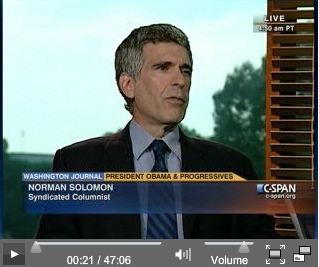
The Right: Where is the Man on the White Horse when you need him?
Or is that, Where is the White Man on the Horse when you need him?
Modern American conservatism is based on an almost endless series of grievances. Author Thomas Frank coined a term for it: the conservative "plenty-plaint" -- a long and ever-evolving list of personal and cultural gripes dressed up as an ideology. But there's also fear! And while it spans the breadth of the movement, this is the year of the Tea Party revolt, when the grassroots right, disgusted with the idea of semi-affordable health-care and tepid financial reforms is rebelling against even its own establishment. And the divide between the grassroots base and its leadership extends to the very fears that animate them. As we'll see, the conservative movement's business-attired hacks and the hard-Right tea Party types waving misspelled signs out in the streets have some very different causes for alarm. So, here are ten of the most interesting things that absolutely terrify Wingnuttia. First, a few terrors of the real hard-core Right. For the Tea Partier, the midterm GOP primary voter, it's not just the anxiety over social change that typifies more traditional conservatism. A broad chunk of the GOP base today is animated by wildly unrealistic terrors -- monsters stalking them as the sun sets, perhaps hovering just beyond their peripheral vision. -- from 10 Things That Terrify Right-Wingers by Joshua Holland (AlterNet 2010-06-12).
Modern American conservatism is based on an almost endless series of grievances. Author Thomas Frank coined a term for it: the conservative "plenty-plaint" -- a long and ever-evolving list of personal and cultural gripes dressed up as an ideology. But there's also fear! And while it spans the breadth of the movement, this is the year of the Tea Party revolt, when the grassroots right, disgusted with the idea of semi-affordable health-care and tepid financial reforms is rebelling against even its own establishment. And the divide between the grassroots base and its leadership extends to the very fears that animate them. As we'll see, the conservative movement's business-attired hacks and the hard-Right tea Party types waving misspelled signs out in the streets have some very different causes for alarm. So, here are ten of the most interesting things that absolutely terrify Wingnuttia. First, a few terrors of the real hard-core Right. For the Tea Partier, the midterm GOP primary voter, it's not just the anxiety over social change that typifies more traditional conservatism. A broad chunk of the GOP base today is animated by wildly unrealistic terrors -- monsters stalking them as the sun sets, perhaps hovering just beyond their peripheral vision. -- from 10 Things That Terrify Right-Wingers by Joshua Holland (AlterNet 2010-06-12).
Design: BP BS
LogoMyWay is sponsoring a contest to design a logo for BP, appropriate to its changed fortunes. Six hundred and sixty six entries so far, and there is still plenty of time to get your design in:
Musical Interlude:
Passing through Lexington, Massachusetts today caused me to remark to my traveling companion that Lady Gaga is not the only thing happening in pop music. There is, for example, Lexington-born Amanda Palmer, former lead singer, pianist, and songwriter of the "Brechtian punk cabaret" Dresden Dolls duo, presently half of the conceptual music act Evelyn Evelyn, and the perpetrator of the essential solo album Who Killed Amanda Palmer.
Passing through Lexington, Massachusetts today caused me to remark to my traveling companion that Lady Gaga is not the only thing happening in pop music. There is, for example, Lexington-born Amanda Palmer, former lead singer, pianist, and songwriter of the "Brechtian punk cabaret" Dresden Dolls duo, presently half of the conceptual music act Evelyn Evelyn, and the perpetrator of the essential solo album Who Killed Amanda Palmer.
How did 'Yes We Can' Get Reduced from a Quality of the American Character to a Political Slogan?
"Oh, to revel in the days when we could fix anything with duct tape and American self-confidence! Sad to say, it looks like a time capsule." -- How Failure Became an Option by Timothy Egan (New York Times 2010-06-10).
Accountability: To avoid a repeat of the current disaster, it is important apportion responsibility accurately
Here's the inside story of how the administration of Barack Obama failed to crack down on the corruption of the Bush years – and let the world's most dangerous oil company get away with murder: "It's tempting to believe that the Gulf spill, like so many disasters inherited by Obama, was the fault of the Texas oilman who preceded him in office. But, though George W. Bush paved the way for the catastrophe, it was Obama who gave BP the green light to drill. 'Bush owns eight years of the mess,' says Rep. Darrell Issa, a Republican from California. 'But after more than a year on the job, [Interior Secretary Ken] Salazar owns it too.'" -- The Spill, The Scandal and the President by Tim Dickinson (Rolling Stone 2010-05-08).
Resource: The War Scholar
A Military History of War and Conflict Across the Globe 3000 B.C. to A.D. 2008: This timeline offers the user the ability to see what major conflicts were going on around the world in any given year or time period. Of the thousands of conflicts that man has been engaged in over the past 5,000+ years of recorded history, the site includes not only the major struggles but a sobering number of minor ones. This is an ongoing project which will take a great deal of time to finish but, in the meanwhile, it still does present some very interesting information. Most of the listings are color coded according to the continent or continents on which the conflict occurred. The primary source of information is George C. Kohn's Dictionary of Wars Please note that most of the dates for events that occurred prior to about 400 B.C. are only approximate; the relative dearth of historical data for many of these events does not allow for exact dating.
Please note that most of the dates for events that occurred prior to about 400 B.C. are only approximate; the relative dearth of historical data for many of these events does not allow for exact dating.
Change Watch: Obama is craking down on whistleblowers
The Obama administration's tough investigative stance on unauthorized press leaks goes against the president's campaign promises to bring back openness and transparency. Is the government under Obama mounting an attack on press freedom?
Politics: California Democrats should write in peace
On primary day, one symptom of the dysfunction of the California Left is the free ride given to generally liberal representatives, such as Brad Sherman in the 27th CD, who support the security state. It's not that a peace candidate would be expected to prevail, but that voters should have the opportunity to express their opinions on our militarized foreign policy.
Although, like his Valley colleague Howard Berman, he is too liberal to pledge the fraternity of congressional Blue Dogs (whose past and present members, for context, include the likes of former Richard Nixon aid Walter Minnick, Travis Childers, Heath Shuler, Harold Ford Jr., Kirsten Gillibrand, Gary Condit, GOP converts Parker Griffith, Ralph Hall and Blue Dog-founder now mega-lobbyist Billy Tauzin), on foreign affairs and military issues Sherman's record is practically indistinguishable from other Democratic supporters of the military-industrial complex, such as Jane Harman, who are more frank about their political allegiances. On a press call last week with a right-wing pro-Israel organization he revealed his plan to seek the prosecution of any Americans on board the aid flotilla that attempted to break the Israeli siege of Gaza. Citing the Antiterrorism and Effective Death Penalty Act of 1996, Sherman said he’ll ask “the Attorney General to prosecute any American involved in what was clearly an effort to give items of value to a terrorist organization.” Gee, does that apply to U.S.citizens who enlist in the IDF, too?
As they go to the polls today to try to shoot down such corporate-sponsored mischief as Props 16 and 17, liberal voters, especially in precincts represented by dogs, might consider writing in protest votes for persons, such as MLK or Gandhi, identified with non-violence. Only in the 36th CD, where Marcy Winograd is campaigning hard against Jane Harman, does a dog face a serious challenge, but it would be news if other BDs such as Adam Schiff, Jim Costa, Dennis Cardoza, Loretta Sanchez, Joe Baca and Mike Thompson inspired measurable peace tallies. Also, it's worth remembering that so-called progressives like Lynn Woolsey, Henry Waxman and others in the Incumbent Self-Protection League went out of their way to endorse Harman over Winograd. As long as the Obama administration and Congressional leadership continue to pursue illegal, ill-conceived and counter-productive actions in Iraq, Afghanistan and Pakistan, withholding votes from all but the handful of actively anti-war Democrats makes political sense.
Although, like his Valley colleague Howard Berman, he is too liberal to pledge the fraternity of congressional Blue Dogs (whose past and present members, for context, include the likes of former Richard Nixon aid Walter Minnick, Travis Childers, Heath Shuler, Harold Ford Jr., Kirsten Gillibrand, Gary Condit, GOP converts Parker Griffith, Ralph Hall and Blue Dog-founder now mega-lobbyist Billy Tauzin), on foreign affairs and military issues Sherman's record is practically indistinguishable from other Democratic supporters of the military-industrial complex, such as Jane Harman, who are more frank about their political allegiances. On a press call last week with a right-wing pro-Israel organization he revealed his plan to seek the prosecution of any Americans on board the aid flotilla that attempted to break the Israeli siege of Gaza. Citing the Antiterrorism and Effective Death Penalty Act of 1996, Sherman said he’ll ask “the Attorney General to prosecute any American involved in what was clearly an effort to give items of value to a terrorist organization.” Gee, does that apply to U.S.citizens who enlist in the IDF, too?
As they go to the polls today to try to shoot down such corporate-sponsored mischief as Props 16 and 17, liberal voters, especially in precincts represented by dogs, might consider writing in protest votes for persons, such as MLK or Gandhi, identified with non-violence. Only in the 36th CD, where Marcy Winograd is campaigning hard against Jane Harman, does a dog face a serious challenge, but it would be news if other BDs such as Adam Schiff, Jim Costa, Dennis Cardoza, Loretta Sanchez, Joe Baca and Mike Thompson inspired measurable peace tallies. Also, it's worth remembering that so-called progressives like Lynn Woolsey, Henry Waxman and others in the Incumbent Self-Protection League went out of their way to endorse Harman over Winograd. As long as the Obama administration and Congressional leadership continue to pursue illegal, ill-conceived and counter-productive actions in Iraq, Afghanistan and Pakistan, withholding votes from all but the handful of actively anti-war Democrats makes political sense.
quote unquote: James Madison on freedom's enemies
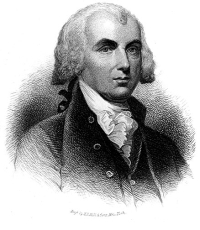 "I believe
there are more instances
of the abridgment of
the freedom of the people
by gradual and silent encroachments of those in power,
than by violent and sudden usurpations."
-- James Madison
Gaza: Hotlinks & Commentary
From today's Media Fix on Greg Mitchell's blog at The Nation: NYT today assesses, gasp, some new sentiment in D.C. that, surprise, maybe Israel is hurting us these days...; IDF admits it doctored audio of boat capture to make passengers seems like anti-Semites. Max Blumenthal: Glenn Kessler of Wash Post must correct story...; Foreign Policy: Must-read account of effects of blockade in Gaza....; As usual, more tough analysis and critical opinion on Israel at Israeli paper Haaretz than in American media....; Horrid: AP interviews Portland, Maine, filmmaker who was on flotilla ship -- first-hand account of attack, then to prison and beatings there.
Saturday Catchup 2010-05-29
"This week, we reached a grim milestone in Afghanistan: 1,000 U.S. troops killed since the war began in 2001. It is a sober reminder of the cost of the conflict, and every new military casualty will test the patience and resolve of the American public. But it’s another casualty list – the unknown number of Afghan civilians killed in our operations there – that is much more central to the ultimate outcome of the war. If we want to win – defeating the Taliban and dealing a decisive blow to Al Qaeda in the region – our troops must pursue a new strategy to minimize them. Specifically, we should borrow a page from two unlikely people: a little-known military officer and the world leader nobody today seems to trust, Afghan president Hamid Karzai." -- How to turn the tide in Afghanistan by Eric Blehm (Special Force 2010-05-23).
"We need a much deeper, more pervasive realization that we are radically interdependent, that we are all in this together, not only all human 'allies' and 'enemies,' but also coral reefs and infant fish. It hardly matters whether the momentum of our technological advance is driven by wonder, possibility and the thrill of risk, or by greed and fear, or a mix of all these. Absent a deep ethical reorientation toward what is best for the whole planet, that momentum will - will, not may - end in disaster. When might this realization begin to influence decisions taken by corporate boards, or supreme courts, or adversarial diplomats jockeying for national advantage?" -- Hubris: Techoil, Techweapons by Winslow (truthout 2010-05-28). Also, Case for a Moral Imperative by Eugene Robinson (truthout 2010-05-28).
Musical break: the masterful Billy Joe Shaver does "Black Rose" on Austin City Limits:
On YouTube.
The Maoster had no use for politicians who talk Left as they move Right. -- Is The President The Kind of Leader Chairman Mao Warned Us About? by Danny Schechter (CommonDreams.Org 2010-05-29).
Ron Paul is another kind of leader entirely. Last week, he voted to repeal the Clinton-era Don't Ask, Don't Tell policy (or, more accurately, he voted to allow the Pentagon to repeal it if and when it chooses to) -- while 26 mainstream House Democrats voted to retain that bigoted policy; He changed his mind on DADT because gay constituents of his who were forced out of the military convinced him of the policy's wrongness. In 2003, he vehemently opposed the invasion of Iraq, while countless Democrats -- including the current Vice President, Secretary of State, Secretary of Defense, Senate Majority Leader, House Majority Leader, the 2004 Democratic presidential nominee, and many of the progressive pundits who love to scorn him -- supported the monstrous attack on that country. In 2008, he opposed the legalization of Bush's warrantless eavesdropping program and the granting of retroactive immunity to lawbreaking telecoms, while the Democratic Congress -- led by the current U.S. President, his Chief of Staff, the Senate Majority Leader, the Speaker of the House, and the House Majority Leader -- overwhelmingly voted it into law. He vehemently condemned America's use of torture from the start, while many leading Democrats were silent (or even supportive). Compare his February, 2010 emphatic condemnation of America's denial of habeas corpus, lawless detentions and presidential assassinations of U.S. citizens to what the current U.S. Government is doing. He also opposes the war in Afghanistan, while the Democratic Congress continues to fund it and even to reject timetables for withdrawal. He is an outspoken opponent of the nation's insane, devastating and oppressive "drug war". What a nutbag. -- Who are the real "crazies" in our political culture? by Glenn Greenwald (Salon 2010-05-28).
Outside the gulag known as "the Industry," rarely has popular music been more original and dynamic than it is presently (I'll argue for the 30s or the 50s, you'll say the 60s or the 80s, somebody will even try to make a case for the 70s, but in the here and now technological changes in the way music is reproduced and distributed have unleashed a maelstrom of creativity). Here's a small example: Mad World Imagine Eleanor Rigby Numb.
(On YouTube)
Because, in contrast to its death grip on film, music and software, copyright law's hold on the fashion industry is nearly non-existent, fashion benefits in both innovation and sales. Johanna Blakley's argument that the creative industries can learn from fashion's free culture deserves to be part of the debate.
(On YouTube.)
Michael L. "Mikey" Weinstein shares his hate mail with both friends and strangers the way elderly people show off photos of their grandkids. He has plenty of it to share. For the past four years, the founder of the Military Religious Freedom Foundation has been doing battle with a Christian subculture that, he believes, is trying to Christianize the U.S. armed forces with the help of a complicit Pentagon brass. He calls it the "fundamentalist Christian parachurch-military-corporate-proselytizing complex," a mouthful by which he means holy warriors in contempt of the constitutional barrier between church and state. Mikey Weinstein's Crusade: Meet the man who's trying to purge evangelical Christianity from the Pentagon by Stephen Glain (Foreign Policy 2010-05-24)
It must be something in the water. Coming in the wake of Carly Fiorina's batty Barbara Boxer As Blimp ad come comes this commercial for one of her rivals, avid lawn mower Chuck DeVore, suggesting that he is Jack Bauer's choice for Senate. Should someone clue him in that Jack Bauer is made up?
Can it be true that the U.S. government abandoned American POWs in Vietnam? "The CIA officials said their intelligence indicated strongly that the remaining men -- those who had not died from illness or hard labor or torture -- were eventually executed." -- Vietnam MIAs: Ghosts Return to Haunt McCain by Alexander Cockburn (truthout 2010-05-28).
Must read: Wall Street Journal story on the decisions BP made that led to the eruption at the Deepwater Horizon rig: "It was a difficult drill from the start. API Well No. 60-817-44169 threw up many challenges to its principal owner, BP PLC, swallowing expensive drilling fluid and burping out dangerous gas. Those woes put the Gulf of Mexico project over budget and behind schedule by April 20, the day the well erupted, destroying the Deepwater Horizon rig and killing 11 men." -- BP Decisions Set Stage for Disaster by Ben Casselman and Russell Gold (Wall Street Journal 2010-05-27).
"If you listen to the mainstream media long enough, you just might be tempted to believe that the United States has emerged from the recession and is now in the middle of a full-fledged economic recovery. In fact, according to Obama administration officials, the great American economic machine has roared back to life, stronger and more vibrant than ever before. But is that really the case? Of course not. You would have to be delusional to believe that. What did happen was that all of the stimulus packages and government spending and new debt that Obama and the U.S. Congress pumped into the economy bought us a little bit of time. But they have also made our long-term economic problems far worse. The reality is that the U.S. cannot keep supporting an economy on an ocean of red ink forever. At some point the charade is going to come crashing down." -- 25 Questions To Ask Anyone Who Is Delusional Enough To Believe That This Economic Recovery Is Real by Michael Snyder (BLN 2010-05-25).
Book review: Capitalism isn’t working. Not in the US and not in other parts of the world. In fact, virtually anywhere one goes, suffering is pervasive. Almost half the world’s population - more than three billion people, the equivalent of the population of ten United States - live on less than $2.50 a day. A billion people are undernourished and go to bed hungry each night. Two in five people around the world lack access to clean water, and one in four lacks basic electricity. Here in the US, whole communities are being decimated by evictions and foreclosures, health care is a shambles, and hunger and homelessness are at near-record levels. Twenty percent of children are born into poverty, and illnesses correlating with inadequate nutrition are epidemic. In 2009, the world’s 793 billionaires had a combined worth of $2.4 trillion; this translates into twice the combined gross domestic product of all the countries in sub-Saharan Africa: the three billion human beings at the bottom of the economic food chain have fewer resources than the 793 people at the top. -- Alan Maass' The Case for Socialism, reviewed by Eleanor J. Bader (truthout 2010-05-26).
Book review: "In reacting to the economic insecurities of the past forty years, the nation's colleges and universities have adopted corporate practices that degrade undergraduate instruction, marginalize faculty members, and threaten the very mission of the academy as an institution devoted to the common good."-- Ellen Schrecker's The Lost Soul of Higher Education: Corporatization, the Assault on Academic Freedom and the End of the American University, reviewed by Eleanor J. Bader (truthout 2010-05-28).
Finally, why it's so hard to build a Tea Party:
As seen on YouTube. Also, How Dummies Respond to an Oil Spill.
"We need a much deeper, more pervasive realization that we are radically interdependent, that we are all in this together, not only all human 'allies' and 'enemies,' but also coral reefs and infant fish. It hardly matters whether the momentum of our technological advance is driven by wonder, possibility and the thrill of risk, or by greed and fear, or a mix of all these. Absent a deep ethical reorientation toward what is best for the whole planet, that momentum will - will, not may - end in disaster. When might this realization begin to influence decisions taken by corporate boards, or supreme courts, or adversarial diplomats jockeying for national advantage?" -- Hubris: Techoil, Techweapons by Winslow (truthout 2010-05-28). Also, Case for a Moral Imperative by Eugene Robinson (truthout 2010-05-28).
Musical break: the masterful Billy Joe Shaver does "Black Rose" on Austin City Limits:
On YouTube.
The Maoster had no use for politicians who talk Left as they move Right. -- Is The President The Kind of Leader Chairman Mao Warned Us About? by Danny Schechter (CommonDreams.Org 2010-05-29).
Ron Paul is another kind of leader entirely. Last week, he voted to repeal the Clinton-era Don't Ask, Don't Tell policy (or, more accurately, he voted to allow the Pentagon to repeal it if and when it chooses to) -- while 26 mainstream House Democrats voted to retain that bigoted policy; He changed his mind on DADT because gay constituents of his who were forced out of the military convinced him of the policy's wrongness. In 2003, he vehemently opposed the invasion of Iraq, while countless Democrats -- including the current Vice President, Secretary of State, Secretary of Defense, Senate Majority Leader, House Majority Leader, the 2004 Democratic presidential nominee, and many of the progressive pundits who love to scorn him -- supported the monstrous attack on that country. In 2008, he opposed the legalization of Bush's warrantless eavesdropping program and the granting of retroactive immunity to lawbreaking telecoms, while the Democratic Congress -- led by the current U.S. President, his Chief of Staff, the Senate Majority Leader, the Speaker of the House, and the House Majority Leader -- overwhelmingly voted it into law. He vehemently condemned America's use of torture from the start, while many leading Democrats were silent (or even supportive). Compare his February, 2010 emphatic condemnation of America's denial of habeas corpus, lawless detentions and presidential assassinations of U.S. citizens to what the current U.S. Government is doing. He also opposes the war in Afghanistan, while the Democratic Congress continues to fund it and even to reject timetables for withdrawal. He is an outspoken opponent of the nation's insane, devastating and oppressive "drug war". What a nutbag. -- Who are the real "crazies" in our political culture? by Glenn Greenwald (Salon 2010-05-28).
Outside the gulag known as "the Industry," rarely has popular music been more original and dynamic than it is presently (I'll argue for the 30s or the 50s, you'll say the 60s or the 80s, somebody will even try to make a case for the 70s, but in the here and now technological changes in the way music is reproduced and distributed have unleashed a maelstrom of creativity). Here's a small example: Mad World Imagine Eleanor Rigby Numb.
(On YouTube)
Because, in contrast to its death grip on film, music and software, copyright law's hold on the fashion industry is nearly non-existent, fashion benefits in both innovation and sales. Johanna Blakley's argument that the creative industries can learn from fashion's free culture deserves to be part of the debate.
(On YouTube.)
Michael L. "Mikey" Weinstein shares his hate mail with both friends and strangers the way elderly people show off photos of their grandkids. He has plenty of it to share. For the past four years, the founder of the Military Religious Freedom Foundation has been doing battle with a Christian subculture that, he believes, is trying to Christianize the U.S. armed forces with the help of a complicit Pentagon brass. He calls it the "fundamentalist Christian parachurch-military-corporate-proselytizing complex," a mouthful by which he means holy warriors in contempt of the constitutional barrier between church and state. Mikey Weinstein's Crusade: Meet the man who's trying to purge evangelical Christianity from the Pentagon by Stephen Glain (Foreign Policy 2010-05-24)
It must be something in the water. Coming in the wake of Carly Fiorina's batty Barbara Boxer As Blimp ad come comes this commercial for one of her rivals, avid lawn mower Chuck DeVore, suggesting that he is Jack Bauer's choice for Senate. Should someone clue him in that Jack Bauer is made up?
Can it be true that the U.S. government abandoned American POWs in Vietnam? "The CIA officials said their intelligence indicated strongly that the remaining men -- those who had not died from illness or hard labor or torture -- were eventually executed." -- Vietnam MIAs: Ghosts Return to Haunt McCain by Alexander Cockburn (truthout 2010-05-28).
Must read: Wall Street Journal story on the decisions BP made that led to the eruption at the Deepwater Horizon rig: "It was a difficult drill from the start. API Well No. 60-817-44169 threw up many challenges to its principal owner, BP PLC, swallowing expensive drilling fluid and burping out dangerous gas. Those woes put the Gulf of Mexico project over budget and behind schedule by April 20, the day the well erupted, destroying the Deepwater Horizon rig and killing 11 men." -- BP Decisions Set Stage for Disaster by Ben Casselman and Russell Gold (Wall Street Journal 2010-05-27).
"If you listen to the mainstream media long enough, you just might be tempted to believe that the United States has emerged from the recession and is now in the middle of a full-fledged economic recovery. In fact, according to Obama administration officials, the great American economic machine has roared back to life, stronger and more vibrant than ever before. But is that really the case? Of course not. You would have to be delusional to believe that. What did happen was that all of the stimulus packages and government spending and new debt that Obama and the U.S. Congress pumped into the economy bought us a little bit of time. But they have also made our long-term economic problems far worse. The reality is that the U.S. cannot keep supporting an economy on an ocean of red ink forever. At some point the charade is going to come crashing down." -- 25 Questions To Ask Anyone Who Is Delusional Enough To Believe That This Economic Recovery Is Real by Michael Snyder (BLN 2010-05-25).
Book review: Capitalism isn’t working. Not in the US and not in other parts of the world. In fact, virtually anywhere one goes, suffering is pervasive. Almost half the world’s population - more than three billion people, the equivalent of the population of ten United States - live on less than $2.50 a day. A billion people are undernourished and go to bed hungry each night. Two in five people around the world lack access to clean water, and one in four lacks basic electricity. Here in the US, whole communities are being decimated by evictions and foreclosures, health care is a shambles, and hunger and homelessness are at near-record levels. Twenty percent of children are born into poverty, and illnesses correlating with inadequate nutrition are epidemic. In 2009, the world’s 793 billionaires had a combined worth of $2.4 trillion; this translates into twice the combined gross domestic product of all the countries in sub-Saharan Africa: the three billion human beings at the bottom of the economic food chain have fewer resources than the 793 people at the top. -- Alan Maass' The Case for Socialism, reviewed by Eleanor J. Bader (truthout 2010-05-26).
Book review: "In reacting to the economic insecurities of the past forty years, the nation's colleges and universities have adopted corporate practices that degrade undergraduate instruction, marginalize faculty members, and threaten the very mission of the academy as an institution devoted to the common good."-- Ellen Schrecker's The Lost Soul of Higher Education: Corporatization, the Assault on Academic Freedom and the End of the American University, reviewed by Eleanor J. Bader (truthout 2010-05-28).
Finally, why it's so hard to build a Tea Party:
As seen on YouTube. Also, How Dummies Respond to an Oil Spill.
The Long War: Will the international community stop the drones?
A senior United Nations official is expected to call on the United States next week to stop Central Intelligence Agency drone strikes against people suspected of belonging to Al Qaeda, complicating the Obama administration’s growing reliance on that tactic in Pakistan. -- U.N. Official to Ask U.S. to End C.I.A. Drone Strikes by Charlie Savage (New York Times 2010-05-27).
Apps: A homeless person on your iPhone
With charitable donations plummeting because of the state of the economy, the fundraising efforts of nonprofits have needed a creative boost. Just how creative is demonstrated by iHobo, a Tamagotchi-like iTunes application that lets you interact with your very own homeless person, shows just how creative. In just a week, iHobo shot to the top of the iTunes chart, with over 200,000 downloads. Although at first glance it may sound exploitative, the thinking behind it, the app's creators claim, is as serious as it is provocative. Although it's generating significant word of mouth, innovative marketing ploy's success won't ultimately be measured by publicity or even download volumes, but by the uplift in donations it produces. iHobo: No 1 on the street by Meg Carter (Guardian UK 2010-05-24).
Reminder: Fraser & DeBolt documentary airs today
Vancouver writer and photographer Rachel Sanders interviewed me for her documentary tribute to the legendary "lost album" Fraser & DeBolt with Ian Guenther. The show will broadcast Sunday May 23 on the program Inside the Music (CBC Radio 2 at 3 pm, CBC Radio 1 at 9 pm, with five time zones to catch it in). Both stations are streamed online at the CBC Radio website, and the doc will also be posted here a few days later and be available indefinitely, so there'll be time to catch it after it airs. This video is the only performance I could find from back in the Fraser & DeBolt's heyday:
Saturday Catchup 2010-05-22
Nicole Belle on CrooksAndLiars.com: Many people "...didn't think things could get worse than jingoism and dishonesty of the Bush/Cheney years....that more than a year into the Obama presidency that things like the 1964 Civil Rights Act and 1968 Fair Housing Act would be considered less than settled matters....that thinking that the world's superpower should be able to offer health care to its citizens would make one a Maoist/Stalinist/Communist, despite the fact that most Americans want it too...Or that suddenly the existence of undocumented workers has become so intolerable that we must address them with huge fences, detention camps, moats and all other matter of law enforcement, despite the fact that there have always been an underclass of undocumented workers and not one person has proposed focusing energy on reducing demand by going after the employers of said workers. What I came away with from all these conversations is that the dialogue in this country is fundamentally dishonest, just as these members of the People's Front of Judea are. I mean, honestly, apart from the sanitation, medicine, education, wine, public order, irrigation, roads, the fresh water system and public health, what have the Romans ever done for us? Change PFJ to 'Tea Party' and change Romans to 'government' and you've got an idea of the intellectual dishonesty rampant:
An OA meeting. The setting is a dingy meeting room in a church basement. Seated in a circle on rickety folding chairs are LP Record, VHS Tape, 8-Track, Cassette Tape, Compact Disc, Video Rental Store, SLR Camera, Instant Camera, TV Antenna, Dot Matrix Printer, Copy Machine, Fold-Out Map, Typewriter, others.
Moderator: Welcome to Obsoletes Anonymous! I've gathered you all here to welcome our latest member, the Print Industry.
Print Industry: Hello, everyone. But there's been a mistake. I don't belong here.
(chuckles all around)
Print Industry (continues): I'm serious. I'm not obsolete. I'm relevant. Print books have been around for hundreds of years. They're never going to be replaced.
VHS Tape: Yeah, we all thought like that once.
LP Record: It's called denial. It's tough to deal with at first. -- Is Print Dead? by J.A. Konrath (Huffington Post 2010-05-21).
R.I.P.: Martin Gardner, 1914-2010 (Discover 2010/05/22)
The Nature of Things / Martin Gardner from Wagner Brenner on Vimeo.
All of the survivors feel hatred toward the United States. It is a real problem,this rising hatred: "People who have seen an air strike live on a monitor described it as both awe-inspiring and horrifying. 'You could see these little figures scurrying, and the explosion going off, and when the smoke cleared there was just rubble and charred stuff,' a former CIA officer who was based in Afghanistan after September 11th says of one attack....Human beings running for cover are such a common sight that they have inspired a slang term: 'squirters.'" -- Drones and Democracy by Kathy Kelly and Joshua Brollier (truthout 2010-05-20).
WalMart isn't the only American organization to have brought something home from China: With rendition, suspension of habeas corpus, and other Bush-era human rights violations continuing and worsening under Obama, the report by Think Progress, Why Bush’s ‘Enhanced Interrogation’ Program Failed, has taken on new relevance and urgency.
Oops!: Arizona seems about to say it's sorry.
Watch on YouTube.
We have a dream, too, and it's nothing like Dr. King's: "To understand Rand Paul's agonized contortions over America's civil rights consensus, let's review the tainted pedigree of the movement that reared him. Specifically, both the Kentucky Republican Senate nominee and his father, Ron Paul, have been closely associated over the past two decades with a faction that described itself as 'paleolibertarian,' led by former Ron Paul aide Lew Rockwell and the late writer Murray Rothbard. They eagerly forged an alliance with the 'paleoconservatives' behind Patrick Buchanan, the columnist and former presidential candidate whose trademarks are nativism, racism and anti-Semitism." -- The roots of Rand Paul's civil rights resentment by Joe Conason (Salon 2010-05-21). Or as Bill Maher put it the other night: "The shit doesn't fall far from the bat."
Change Watch: "Over the past couple years, I've written numerous times about the serious left-right coalition that had emerged in Britain -- between the Tories and Liberal Democrats -- in opposition to the Labour Government's civil liberties abuses, many (thought not all) of which were justified by Terrorism. In June of 2008, David Davis, a leading Tory MP, resigned from Parliament in protest of the Government's efforts to expand its power of preventive detention to 42 days (and was then overwhelmingly re-elected on a general platform of opposing growing surveillance and detention authorities). Numerous leading figures from both the Right and Left defied their party's establishment to speak out in support of Davis and against the Government's growing powers. Back then, the Liberal Democrats' Leader, Nick Clegg, notably praised the right-wing Davis' resignation, and to show his support for Davis' positions, Clegg even refused to run a LibDem candidate for that seat because, as he put it, "some issues 'go beyond party politics'." Now that this left-right, Tory/Lib-Dem alliance has removed the Labour Party from power and is governing Britain, these commitments to restoring core liberties -- Actual Change -- show no sign of retreating. Rather than cynically tossing these promises of restrained government power onto the trash pile of insincere campaign rhetoric, they are implementing them into actual policy. Clegg, now the Deputy Prime Minister, gave an extraordinary speech last week in which he vowed "the biggest shake-up of our democracy since 1832." -- The Tory/Lib-Dem Government endorses actual change by Glenn Greenwald (Salon 2010-05-21).
Time saver: Eclectic Method remixes all of Phish’s list of "99 Albums":
Eclectic Method Goes Phish :: 99 Albums in 4:20 from Eclectic Method on Vimeo.
"It's alive!" As a non-believer educated by Jesuits and likeminded cultivators of inquiring minds, I've never understood the objection to "playing god." Why would a higher being be irked by his creatures' clumsy efforts to figure out what he had in mind? So I don't see it as a moral or ethical dilemma that researchers at the J. Craig Venter Institute have created a new organism by injecting man-made genetic material into the empty body of a cell. Artificial organisms almost certainly will provide solutions to many serious health and environmental difficulties, from cancer to oil spills. The only real question, just as it is with other scientific developments such as nuclear power and genetically modified food and life-prolonging drugs and technology, is whether "synthetic life" is worth the risks as a matter of public safety. Constructing artificial creatures "has unimaginable potential risks," naysays Oxford ethics professor Julian Savulescu, since by "engineering organisms that could never naturally exist," we expose ourselves to possible calamities — from bio-weapon terrorism to environmental catastrophes — so destructive they could wipe out life as we know it. Such an outcome is certainly undesired, but, counters Ken MacLeod in the Guardian, worries about blowback from playing god are entirely "misguided:" our "biosphere comes up with natural resistance to entirely new organisms every day;" and while the threat of bio-terrorism "may be great," it's "not in principle greater than those posed by natural organisms" that already exist; besides, the potential upsides are so phenomenal, practical benefits ought to trump whatever squeamishness anyone may have over theoretical disasters. One can more easily imagine a bacterium that sucks carbon from the air than one that leeches poison into our water supply. I'm with David Ropeik, author of How Risky Is It, Really?: Why Our Fears Don't Always Match the Facts, that the "almost unimaginable promise" of being able to create life "to our specifications" shouldn't be sacrificed just because we've seen too many movies about Dr. Frankenstein, although his caution is well taken that "far less of that promise will be realized if the people doing this work" treat it, as Venter seems to, simply as a race to fame and fortune, and "fail to recognize and address [the public's concerns] about what they are doing."
Editorial: The debt that the public owes to police officers for taking the risks that they take can never be repaid. -- Growing risk for the police -- Extreme views behind the West Memphis tragedy: Two officers are dead after a shootout with a delusional conspiracy theorist (The Commercial Appeal, Memphis TN 2010-05-22).
Resource: The earliest gangs of New York were not criminal groups. Many street gang members were employed, mostly as common laborers. Some were bouncers in saloons and dance halls, as well as longshoremen. A few were apprentice butchers, carpenters, sailmakers, and shipbuilders. “They engaged in violence, but violence was a normal part of their always-contested environment; turf warfare was a condition of the neighborhood." Gangs formed the “basic unit of social life among the young males in New York in the nineteenth century.” More dangerous street gangs than previously seen emerged around 1820 from the persistent disorder that gripped the city slums, tenements, saloons, and dance halls. The Forty Thieves gang was characterized as “the first important and decisively dangerous gang of the quarter century.” It and other new groups of gangs that emerged in this period were centered in criminal enterprises as much as in territorial disputes. “It is axiomatic that the more sophisticated the gangs became, the more violent they grew as well.” -- History of Street Gangs in the United States (pdf) by James C. Howell and John P. Moore (National Gang Center Bulletin 2010-04).
Cartoon Beatles do the Dead Kennedys' California über alles:
The truth is out there: The only way to debunk an enshrined falsehood is with maximum reportorial firepower. Toting big guns and an itchy trigger-finger is American University professor W. Joseph Campbell, whose new book, Getting It Wrong: Ten of the Greatest Misreported Stories in American Journalism, flattens established myths that you were brought up to believe were true: that Orson Welles sparked a national panic with his 1938 War of the Worlds broadcast; that the New York Times suppressed news of the Bay of Pigs invasion of Cuba at the request of the White House; that Edward R. Murrow destroyed Sen. Joseph McCarthy; that publishing magnate William Randolph Hearst told an illustrator, "You furnish the pictures, I'll furnish the war," before the Spanish-American war started; and more. -- The Master of Debunk: W. Joseph Campbell corrects the record on 10 important misreported stories by Jack Shafer (Slate 2010-05-21).
Here comes the sun: One year ago this Friday, U.S. chief information officer Vivek Kundra launched an ambitious website called Data.gov to make the government’s vast stores of data available to the public. The thinking behind the site then, as now, was to give app developers access to these rich, comprehensive datasets on all sorts of topics — health care, education, energy, the environment and so on — in the hope that they would create useful tools for analyzing a range of information, from air quality by county to crime statistics by neighborhood and foreign aid by nation. To make good on incoming president Barack Obama's promise of transparency and open government, Data.gov launched with 47 datasets. By its first anniversary on Friday, Data.gov had ballooned to more than 250,000 datasets and racked up 97.6 million hits — not bad for a website whose main attractions are massive databases and wonky graphs. However, the sailing has not been entirely smooth. Federal Computer Week complained that Data.gov was a demonstration of “how not to do open government” because it didn’t pass “the ‘mom test.’” By that, FCW meant it was too hard for the average person to figure out what to do on the site and where everything was. Kundra’s team redesigned the entire Data.gov with that sort of feedback in mind, and the new homepage is markedly more intuitive and user-friendly. -- Sneak Peek: Obama Administration’s Redesigned Data.gov by Eliot Van Buskirk (Epicenter 2010-05-19).
This is about all you need to know about Lost:
An OA meeting. The setting is a dingy meeting room in a church basement. Seated in a circle on rickety folding chairs are LP Record, VHS Tape, 8-Track, Cassette Tape, Compact Disc, Video Rental Store, SLR Camera, Instant Camera, TV Antenna, Dot Matrix Printer, Copy Machine, Fold-Out Map, Typewriter, others.
Moderator: Welcome to Obsoletes Anonymous! I've gathered you all here to welcome our latest member, the Print Industry.
Print Industry: Hello, everyone. But there's been a mistake. I don't belong here.
(chuckles all around)
Print Industry (continues): I'm serious. I'm not obsolete. I'm relevant. Print books have been around for hundreds of years. They're never going to be replaced.
VHS Tape: Yeah, we all thought like that once.
LP Record: It's called denial. It's tough to deal with at first. -- Is Print Dead? by J.A. Konrath (Huffington Post 2010-05-21).
R.I.P.: Martin Gardner, 1914-2010 (Discover 2010/05/22)
The Nature of Things / Martin Gardner from Wagner Brenner on Vimeo.
All of the survivors feel hatred toward the United States. It is a real problem,this rising hatred: "People who have seen an air strike live on a monitor described it as both awe-inspiring and horrifying. 'You could see these little figures scurrying, and the explosion going off, and when the smoke cleared there was just rubble and charred stuff,' a former CIA officer who was based in Afghanistan after September 11th says of one attack....Human beings running for cover are such a common sight that they have inspired a slang term: 'squirters.'" -- Drones and Democracy by Kathy Kelly and Joshua Brollier (truthout 2010-05-20).
WalMart isn't the only American organization to have brought something home from China: With rendition, suspension of habeas corpus, and other Bush-era human rights violations continuing and worsening under Obama, the report by Think Progress, Why Bush’s ‘Enhanced Interrogation’ Program Failed, has taken on new relevance and urgency.
Oops!: Arizona seems about to say it's sorry.
Watch on YouTube.
We have a dream, too, and it's nothing like Dr. King's: "To understand Rand Paul's agonized contortions over America's civil rights consensus, let's review the tainted pedigree of the movement that reared him. Specifically, both the Kentucky Republican Senate nominee and his father, Ron Paul, have been closely associated over the past two decades with a faction that described itself as 'paleolibertarian,' led by former Ron Paul aide Lew Rockwell and the late writer Murray Rothbard. They eagerly forged an alliance with the 'paleoconservatives' behind Patrick Buchanan, the columnist and former presidential candidate whose trademarks are nativism, racism and anti-Semitism." -- The roots of Rand Paul's civil rights resentment by Joe Conason (Salon 2010-05-21). Or as Bill Maher put it the other night: "The shit doesn't fall far from the bat."
Change Watch: "Over the past couple years, I've written numerous times about the serious left-right coalition that had emerged in Britain -- between the Tories and Liberal Democrats -- in opposition to the Labour Government's civil liberties abuses, many (thought not all) of which were justified by Terrorism. In June of 2008, David Davis, a leading Tory MP, resigned from Parliament in protest of the Government's efforts to expand its power of preventive detention to 42 days (and was then overwhelmingly re-elected on a general platform of opposing growing surveillance and detention authorities). Numerous leading figures from both the Right and Left defied their party's establishment to speak out in support of Davis and against the Government's growing powers. Back then, the Liberal Democrats' Leader, Nick Clegg, notably praised the right-wing Davis' resignation, and to show his support for Davis' positions, Clegg even refused to run a LibDem candidate for that seat because, as he put it, "some issues 'go beyond party politics'." Now that this left-right, Tory/Lib-Dem alliance has removed the Labour Party from power and is governing Britain, these commitments to restoring core liberties -- Actual Change -- show no sign of retreating. Rather than cynically tossing these promises of restrained government power onto the trash pile of insincere campaign rhetoric, they are implementing them into actual policy. Clegg, now the Deputy Prime Minister, gave an extraordinary speech last week in which he vowed "the biggest shake-up of our democracy since 1832." -- The Tory/Lib-Dem Government endorses actual change by Glenn Greenwald (Salon 2010-05-21).
Time saver: Eclectic Method remixes all of Phish’s list of "99 Albums":
Eclectic Method Goes Phish :: 99 Albums in 4:20 from Eclectic Method on Vimeo.
"It's alive!" As a non-believer educated by Jesuits and likeminded cultivators of inquiring minds, I've never understood the objection to "playing god." Why would a higher being be irked by his creatures' clumsy efforts to figure out what he had in mind? So I don't see it as a moral or ethical dilemma that researchers at the J. Craig Venter Institute have created a new organism by injecting man-made genetic material into the empty body of a cell. Artificial organisms almost certainly will provide solutions to many serious health and environmental difficulties, from cancer to oil spills. The only real question, just as it is with other scientific developments such as nuclear power and genetically modified food and life-prolonging drugs and technology, is whether "synthetic life" is worth the risks as a matter of public safety.
Constructing artificial creatures "has unimaginable potential risks," naysays Oxford ethics professor Julian Savulescu, since by "engineering organisms that could never naturally exist," we expose ourselves to possible calamities — from bio-weapon terrorism to environmental catastrophes — so destructive they could wipe out life as we know it. Such an outcome is certainly undesired, but, counters Ken MacLeod in the Guardian, worries about blowback from playing god are entirely "misguided:" our "biosphere comes up with natural resistance to entirely new organisms every day;" and while the threat of bio-terrorism "may be great," it's "not in principle greater than those posed by natural organisms" that already exist; besides, the potential upsides are so phenomenal, practical benefits ought to trump whatever squeamishness anyone may have over theoretical disasters. One can more easily imagine a bacterium that sucks carbon from the air than one that leeches poison into our water supply. I'm with David Ropeik, author of How Risky Is It, Really?: Why Our Fears Don't Always Match the Facts, that the "almost unimaginable promise" of being able to create life "to our specifications" shouldn't be sacrificed just because we've seen too many movies about Dr. Frankenstein, although his caution is well taken that "far less of that promise will be realized if the people doing this work" treat it, as Venter seems to, simply as a race to fame and fortune, and "fail to recognize and address [the public's concerns] about what they are doing." Editorial: The debt that the public owes to police officers for taking the risks that they take can never be repaid. -- Growing risk for the police -- Extreme views behind the West Memphis tragedy: Two officers are dead after a shootout with a delusional conspiracy theorist (The Commercial Appeal, Memphis TN 2010-05-22).
Resource: The earliest gangs of New York were not criminal groups. Many street gang members were employed, mostly as common laborers. Some were bouncers in saloons and dance halls, as well as longshoremen. A few were apprentice butchers, carpenters, sailmakers, and shipbuilders. “They engaged in violence, but violence was a normal part of their always-contested environment; turf warfare was a condition of the neighborhood." Gangs formed the “basic unit of social life among the young males in New York in the nineteenth century.” More dangerous street gangs than previously seen emerged around 1820 from the persistent disorder that gripped the city slums, tenements, saloons, and dance halls. The Forty Thieves gang was characterized as “the first important and decisively dangerous gang of the quarter century.” It and other new groups of gangs that emerged in this period were centered in criminal enterprises as much as in territorial disputes. “It is axiomatic that the more sophisticated the gangs became, the more violent they grew as well.” -- History of Street Gangs in the United States (pdf) by James C. Howell and John P. Moore (National Gang Center Bulletin 2010-04).
Cartoon Beatles do the Dead Kennedys' California über alles:
The truth is out there: The only way to debunk an enshrined falsehood is with maximum reportorial firepower. Toting big guns and an itchy trigger-finger is American University professor W. Joseph Campbell, whose new book, Getting It Wrong: Ten of the Greatest Misreported Stories in American Journalism, flattens established myths that you were brought up to believe were true: that Orson Welles sparked a national panic with his 1938 War of the Worlds broadcast; that the New York Times suppressed news of the Bay of Pigs invasion of Cuba at the request of the White House; that Edward R. Murrow destroyed Sen. Joseph McCarthy; that publishing magnate William Randolph Hearst told an illustrator, "You furnish the pictures, I'll furnish the war," before the Spanish-American war started; and more. -- The Master of Debunk: W. Joseph Campbell corrects the record on 10 important misreported stories by Jack Shafer (Slate 2010-05-21).
Here comes the sun: One year ago this Friday, U.S. chief information officer Vivek Kundra launched an ambitious website called Data.gov to make the government’s vast stores of data available to the public. The thinking behind the site then, as now, was to give app developers access to these rich, comprehensive datasets on all sorts of topics — health care, education, energy, the environment and so on — in the hope that they would create useful tools for analyzing a range of information, from air quality by county to crime statistics by neighborhood and foreign aid by nation. To make good on incoming president Barack Obama's promise of transparency and open government, Data.gov launched with 47 datasets. By its first anniversary on Friday, Data.gov had ballooned to more than 250,000 datasets and racked up 97.6 million hits — not bad for a website whose main attractions are massive databases and wonky graphs. However, the sailing has not been entirely smooth. Federal Computer Week complained that Data.gov was a demonstration of “how not to do open government” because it didn’t pass “the ‘mom test.’” By that, FCW meant it was too hard for the average person to figure out what to do on the site and where everything was. Kundra’s team redesigned the entire Data.gov with that sort of feedback in mind, and the new homepage is markedly more intuitive and user-friendly. -- Sneak Peek: Obama Administration’s Redesigned Data.gov by Eliot Van Buskirk (Epicenter 2010-05-19).
This is about all you need to know about Lost:
Subscribe to:
Posts (Atom)


