Showing posts with label democracy. Show all posts
Beauty is in the eye of the officeholder
The folks at UglyJerry made a font out of congressional districts, many of them twisted into alphabetical shapes by gerrymandering.
They want you to urge your congressperson to do something about it.
Labels:
democracy,
gerrymander,
politics
Building Economic Democracy One Worker Co-op at a Time
A worker cooperative is a business that is owned and democratically governed by the people who work in it.Own the Change, a 22 minute, free documentary produced by TESA Collective and the Laura Flanders Show, is a guide to starting worker co-ops. The video lays out the the real-world challenges of launching a co-op and the transformative benefits co-ops offer to workers. It includes interviews with people who have launched their own co-ops.
Available since 2015, Own the Change has been watched nearly 35,000 times on YouTube, and has been screened in community centers and at organizing events around the country. There is also an accompanying education guide.
TESA collaborates with organizations to develop educational projects big or small from start to finish, and to improve existing programs, tools and curricula. The group can build custom games for a campaign, organization or company, merging cause with play. In addition to making games and programs for others, they design and produce their own games, including Rise up: The Game of People & Power, Co-opoly: The Game of Co-operatives, Loud & Proud: A Fast-Paced Social Justice Word Association Game, and Space Cats Fight Fascism: The Board Game.
Extra credit:
✓ What Is a Worker Cooperative? (Democracy At Work Institute/US Federation of Worker Cooperatives)
✓ When maximizing profits isn’t the only goal, companies can actually work better: Worker Cooperatives Are More Productive Than Normal Companies by Michelle Chen (The Nation)
✓ With new tools and political policies now in place to support them, there could be a boom in employee-owned business ahead as baby boomers retire and sell their companies to their workers: More U.S. businesses are becoming worker co-ops. Here’s why. by Eillie Anzilotti (FastCompany)
✓ Getting Rid of Bosses: Can a company succeed if no one is in charge? by Alana Semuels (The Atlantic)
✓ Why are we told a broken system that creates vast inequality is the only choice? Spain's amazing co-op is living proof otherwise: Yes, there is an alternative to capitalism. Mondragon shows the way Richard Wolff (The Guardian)
Labels:
capitalism,
cooperatives,
coops,
democracy,
organizing,
workplace
This morning, someone said to me...,
"If we can survive this stupid, ignorant, corrupt dictator-wannabe, we can survive anything." I'm not so sure. What if he was an intelligent, informed, personally ethical dictator-wannabe? Take away Donald Trump's creepiness, avarice and racism, teach him to read and write and hold a coherent thought, and you have Barack Obama, ruling by executive order, conducting endless wars because he can. We have stood by as representative legislative government has become enfeebled, fossilized, barely functional, nearly useless; watched as power has increasingly vested in our serial kings. Isn't there a significant (and probably growing) number of us that would be happy to bring the curtain down on political theater that offers no happy endings, to bring an end to kleptocracy and dysfunction? Aren't there more than few voters who would respond readily to someone who promised convincingly to make the trains run on time?
Labels:
autocracy,
democracy,
dictatorship,
Donald Trump
Party poopers
“Nothing could be more ill-judged than that intolerant spirit which has, at all times, characterized political parties.” -- Alexander Hamilton, 1787While at present political parties are practical mechanisms for the expression of political intentions, for average citizens allegiance to party -- partisanship -- is self-defeating.
It was the existence of independent concentrations of power and influence, especially labor unions, national associations (such as the NAACP) and, on the local level, social clubs, that gave ordinary people muscle in the long struggle for economic and social justice.
Restoring such organizations must be part of any long-term reform of our democracy.
“If I could not go to heaven but with a party, I would not go there at all.” -- Thomas Jefferson, 1789
Some choice
Who was right, George Orwell or Aldous Huxley?
"What Orwell feared were those who would ban books. What Huxley feared was that there would be no reason to ban a book, for there would be no one who wanted to read one.
"Orwell feared those who would deprive us of information. Huxley feared those who would give us so much that we would be reduced to passivity and egoism.
"Orwell feared that the truth would be concealed from us. Huxley feared the truth would be drowned in a sea of irrelevance.
"Orwell feared we would become a captive culture. Huxley feared we would become a trivial culture, preoccupied with some equivalent of the feelies, the orgy porgy, and the centrifugal bumblepuppy.
"As Huxley remarked in Brave New World Revisited, the civil libertarians and rationalists who are ever on the alert to oppose tyranny 'failed to take into account man’s almost infinite appetite for distractions.' In 1984, Huxley added, people are controlled by inflicting pain. In Brave New World, they are controlled by inflicting pleasure.
"In short, Orwell feared that what we hate will ruin us. Huxley feared that what we love will ruin us." -- Neil Postman, Amusing Ourselves to Death (Penguin).
Labels:
1984,
Aldous Huxley,
Brave New World,
democracy,
fascism,
George Orwell
Demockracy
Money buys elections. The media covers the horse race, not the issues, and routinely deems threats to the status quo "unelectable." There is no party discipline. Gerrymandering and voter suppression are rampant. The Electoral College devalues some votes and enhances others. A vote in one state for the U.S. Senate is worth 100 times what the same vote is worth in another. Judges sit for life. The operatives of money and power routinely rotate in and out of legislative and executive positions, enriching themselves and their cohort as they go. Huge amounts of public wealth are transferred continuously to private hands and trillions of dollars are spent in secret. Wars are conducted without following constitutional procedures.
On Us
The problems we face as a nation are much bigger than, as most Democrats see it, "this horrible Republican President and Congress."
Distorted spending decisions, selective application of free market economic policies and militarized foreign policy pursued by both parties over the last 30+ years are what fueled the anger that permitted "this horrible Republican President" to ascend, but it is the permanent conservative majority in Congress, made up of both Republicans and Democrats, that has sent this country into its long, slow decline.
The one positive of the Donald Trump presidency is that it has ripped the happy face off the deadly fiction of American exceptionalism.
Electing in 2020 another personable and integrous but unimpassioned abettor of the best and the brightest, such as Barack Obama, won't be nearly up to the job of bringing about the fundamental changes needed (we mustn't allow ourselves to forget that the number of poor and the number of wars increased under the last president). It will require a radicalized congress and an aggressively pro-change executive to fix what ails us, to get us back on the difficult path toward economic and social justice. We must either accomplish a radical course correction or resign ourselves to further decline.
“Well, Doctor," Ben Franklin was asked outside Independence Hall on the final day of deliberations, "what have we got -- a Republic or a Monarchy?”
“A Republic," he replied, "if you can keep it.”
It's on us to keep it.
Extra credit:
>>Thirty years ago, the old deal that held US society together started to unwind, with social cohesion sacrificed to greed. Was it an inevitable process – or was it engineered by self-interested elites?: Decline and fall: how American society unravelled by George Packer (The Guardian)
>>Domestic and global trends suggest that in 2025, now just 8 years from now, the American century could all be over except for the shouting: The Decline and Fall of the American Empire by Alfred W. McCoy (Tom Dispatch)
>>Austerity is riskier than stimulus. The Big Question on the Economy: Is This Really Full Employment? by J.W. Mason (Roosevelt Institute)
>>What went wrong and what comes next?: Capitalism in Crisis by Mark Blyth (Foreign Affairs) >>Putting community needs at the center of society rather than those of the individual: An Economic Alternative to Exploitative Free Market Capitalism by Thomas Hedges (Truthdig)
Distorted spending decisions, selective application of free market economic policies and militarized foreign policy pursued by both parties over the last 30+ years are what fueled the anger that permitted "this horrible Republican President" to ascend, but it is the permanent conservative majority in Congress, made up of both Republicans and Democrats, that has sent this country into its long, slow decline.
The one positive of the Donald Trump presidency is that it has ripped the happy face off the deadly fiction of American exceptionalism.
Electing in 2020 another personable and integrous but unimpassioned abettor of the best and the brightest, such as Barack Obama, won't be nearly up to the job of bringing about the fundamental changes needed (we mustn't allow ourselves to forget that the number of poor and the number of wars increased under the last president). It will require a radicalized congress and an aggressively pro-change executive to fix what ails us, to get us back on the difficult path toward economic and social justice. We must either accomplish a radical course correction or resign ourselves to further decline.
“Well, Doctor," Ben Franklin was asked outside Independence Hall on the final day of deliberations, "what have we got -- a Republic or a Monarchy?”
“A Republic," he replied, "if you can keep it.”
It's on us to keep it.
Extra credit:
>>Thirty years ago, the old deal that held US society together started to unwind, with social cohesion sacrificed to greed. Was it an inevitable process – or was it engineered by self-interested elites?: Decline and fall: how American society unravelled by George Packer (The Guardian)
>>Domestic and global trends suggest that in 2025, now just 8 years from now, the American century could all be over except for the shouting: The Decline and Fall of the American Empire by Alfred W. McCoy (Tom Dispatch)
>>Austerity is riskier than stimulus. The Big Question on the Economy: Is This Really Full Employment? by J.W. Mason (Roosevelt Institute)
>>What went wrong and what comes next?: Capitalism in Crisis by Mark Blyth (Foreign Affairs) >>Putting community needs at the center of society rather than those of the individual: An Economic Alternative to Exploitative Free Market Capitalism by Thomas Hedges (Truthdig)
Labels:
american exceptionalism,
capitalism,
democracy,
economy,
Long War,
market,
militarism,
socialism
Body slamming the electorate
Absentee balloting, as it was originally conceived, is a good and necessary thing. There is no reason that people away from home, disabled or living in nursing facilities should be denied their franchise. But the abuse of absentee voting by both parties has reached a point where in many districts the outcome of elections are determined by party loyalists who have not bothered to consider and compare the actual candidates.
A dramatic example of this is happening this week in Montana's special congressional election, where the local sheriff’s office cited GOP candidate Greg Gianforte on a charge of misdemeanor assault for “body slamming” journalist Ben Jacobs after he asked the Republican about the GOP's recently passed health-care bill. It is more than likely that at least some voters undecided or leaning toward Gianforte will reconsider their vote in light of his seeming inability to control himself under pressure. How likely do you think it is that the outcome of the race will be changed, however, when you consider that election analysts estimate that roughly two-thirds of early votes had already been cast before one of the candidates faced an assault charge?
One possible way of fixing early voting abuse would be to permit absentee ballots to be mailed no sooner than three days before election day; ballots with earlier postmarks would be disqualified. To keep party operatives from rounding up ballots weeks in advance and bulk mailing them within the deadline, absentee ballots would also be required under penalty of law to be signed on the day they were mailed. Such a deadline would not seriously inconvenience any of the intended users of absentee voting, those actually absent from their precincts, while allowing campaigns to play out to the fullest extent possible.
A dramatic example of this is happening this week in Montana's special congressional election, where the local sheriff’s office cited GOP candidate Greg Gianforte on a charge of misdemeanor assault for “body slamming” journalist Ben Jacobs after he asked the Republican about the GOP's recently passed health-care bill. It is more than likely that at least some voters undecided or leaning toward Gianforte will reconsider their vote in light of his seeming inability to control himself under pressure. How likely do you think it is that the outcome of the race will be changed, however, when you consider that election analysts estimate that roughly two-thirds of early votes had already been cast before one of the candidates faced an assault charge?
One possible way of fixing early voting abuse would be to permit absentee ballots to be mailed no sooner than three days before election day; ballots with earlier postmarks would be disqualified. To keep party operatives from rounding up ballots weeks in advance and bulk mailing them within the deadline, absentee ballots would also be required under penalty of law to be signed on the day they were mailed. Such a deadline would not seriously inconvenience any of the intended users of absentee voting, those actually absent from their precincts, while allowing campaigns to play out to the fullest extent possible.
Labels:
Absentee voting,
democracy,
election reform
“Inside the polling booth, every American man and woman stands as the equal of every other American man and woman. There they have no superiors. There they have no masters save their own minds and consciences.” -- Franklin D. Roosevelt
It is not a horse race. The lesser of two evils is still evil.
Tomorrow, vote with your conscience.
Labels:
democracy,
politics,
presidential campaign
From the Makes Sense To Me Desk:
“Unpledged delegates exist really to make sure that party leaders and elected officials don’t have to be in a position where they are running against grassroots activists.” -- Debbie Wasserman Schultz
Labels:
activism,
democracy,
Democratic Party,
oligarchy,
privilege
quote unquote: James Madison on war
"No nation could preserve its freedom in the midst of continual warfare."
"Of all the enemies to public liberty war is, perhaps, the most to be dreaded, because it comprises and develops the germ of every other.
War is the parent of armies; from these proceed debts and taxes; and armies, and debts, and taxes are the known instruments for bringing the many under the domination of the few. In war, too, the discretionary power of the Executive is extended; its influence in dealing out offices, honors, and emoluments is multiplied; and all the means of seducing the minds, are added to those of subduing the force, of the people. The same malignant aspect in republicanism may be traced in the inequality of fortunes, and the opportunities of fraud, growing out of a state of war, and in the degeneracy of manners and of morals engendered by both. No nation could preserve its freedom in the midst of continual warfare.” – James Madison
(Political Observations (1795-04-20); also in Letters and Other Writings of James Madison (1865), Vol. IV, p. 491.)
Labels:
democracy,
freedom,
James Madison,
Long War,
militarism,
quote unquote,
war
In a democracy, it's no one's "turn." In politics, nothing is "inevitable."
Hillary Clinton was the inevitable candidate in 2008.
But the more progressive elements of the Democratic Party united on Super Tuesday to stop her; nearly accidentally -- nobody really knew who Barack Obama was, we ended up with a better candidate and arguably a better chief executive. There's no reason this can't happen again, and, this time, because of Bernie Sanders' consistent thirty-year record of service, we know that we'd get not only a better candidate but also an immeasurably better president.
We are told we must support Clinton because it is "her turn," and because she will inevitably win (of course, the same promise was made for John Kerry and Mike Dukakis). But, since she is a militarist and a prime defender of her class' interests, how is that even a good thing?
Izzy Stone on Earth Day
Thanks to Naomi Klein for unearthing this:
I.F. Stone: “Con Games,” speech delivered at Sylvan Theater, Washington, D.C., April 22, 1970
In the ancient world, the Caesars did it with bread and circuses. And tonight, I’m afraid, is the first time that our Caesars have learned to do it with rock and roll, and idealism, and noninflammatory social issues. In some ways, I’m sorry to say, we here tonight are being conned. This has many of the aspects of a beautiful snow job. The country is slipping into a wider war in southeast Asia, and we’re talking about litterbugs. The secretary of defense, on Monday, made a speech to the Associated Press sabotaging the SALT talks, presenting a completely false picture of the world balance of power, ending what little hope we had of progress in those talks, preparing the way for a bigger, more expensive arms race at the expensive of mankind, and we’re talking as if we needed more wastebaskets.
The divisions of white and black in this country are getting to the point where they threaten our future, and we’re talking about pollution. And it’s not that pollution is not an important subject, but if the Nixon administration feels so deeply about it, why don’t they do something substantial about it?
One important thing about this town is that you can never take very seriously what the officials say. They’re the prisoners of a vast bureaucracy. Much of what they say is merely rationalization of their lack of momentum. But in particular, the president said, and I think quite rightfully and quite truthfully, that in the next ten years it’s now or never for the air we breathe and the water we drink. And then, after making that speech, he put in a budget in which 52 cents out of every general revenue dollar goes to the military, and barely four-tenths of one cent goes to air and water pollution. And that’s a real con game. And that’s a real snow job.
We are spending, on new weapons systems alone, more than ten times as much, in this coming fiscal year, in the Nixon budget, than we’re going to spend on air and water. We’re spending a billion dollars more a year on space than all our expenditure on natural resources. The priorities of this government are lunatic—absolutely lunatic. And we’re not going to save the air we breathe and the water we drink without very many fundamental changes in governmental policy and governmental structure.
Before I came down here tonight, I heard a TV announcer say with great satisfaction that he hadn’t heard a word said about Vietnam all day. Well, I’m going to say a word about Vietnam. We’re not going to be able to save our air and our water, and the resources of our country, for our children and our grandchildren, until we end the militarization of our society, until we bring to an end the effort of American imperialism to rule the world and to waste our resources and our honor and our kids on a futile and murderous and insane task.
The problem of pollution is not going to be solved in isolation. The basic and most important pollution problem that we have to deal with is to prevent the pollution of the atmosphere of free discussion by the Nixon-Agnew-Mitchell administration. A society can only progress and deal with its evils if it is prepared to allow the widest measure of free speech, including free speech for radicals who are completely opposed to the basis of that society. Any society allows you to agree with the government. A free society allows you to disagree fundamentally. And it takes a lot of disagreement, and a lot of hollering and a lot of demonstration, to shake any establishment out of its accustomed ways. And the main menace to the solution of these problems is an administration that thinks they will go away if they just put a few radicals in jail.
The problems are enormous. The source of pollution is man. And man’s technology. And the enormous institutions he has built up that make him a prisoner. And somehow we’ve got to shake loose. And the biggest menace—the institution that ties us down most—that wastes our substance—that threatens to waste more of our youth—is that great big, five-sided building across the Potomac—the Pentagon. They are preparing to do to us at home what they tried to do in Vietnam.
Only this week, General Wheeler, the retiring chairman of the joint chiefs of staff, gave an interview to U.S. News and World Report in which he said that criticism of the military was due to a Communist plot. This is an effort of the military to revive McCarthyism, to preserve its enormous power and privileges in our society. And until its power is broken, until the military is reduced sharply in size, we’re not going to be able to solve these problems.
You know, there is no use talking about Earth Day unless we are prepared to make these fundamental changes. Everybody’s talking about Earth Day, and it comes out of the mouths of so many hypocrites it turns your stomach. What kind of an Earth Day can we celebrate in a country that is spending so much of its money to destroy the Earth? How can we talk of reverence for life when we’re spending so much on our enemy, our genius, our money, and our youth on building up new means of destroying life?
What’s the use of talking about the pollution of air and water when we live under a precarious balance of terror which can, in an hour’s time, make the entire Northern Hemisphere of our planet unlivable? There’s no use talking about Earth Day until we begin to think like Earthmen. Not as Americans and Russians, not as blacks and whites, not as Jews and Arabs, but as fellow travelers on a tiny planet in an infinite universe. All that we can muster of kindness, of compassion, of patience, of thoughtfulness, is necessary if this tiny planet of ours is not to go down to destruction. Until we have a leadership willing to make the enormous changes—psychological, military, and bureaucratic—to end the existing world system, a system of hatred, of anarchy, of murder, of war and pollution, there is no use talking about buying more wastebaskets or spending a couple of hundred million dollars on the Missouri River. If we do not challenge these fundamental causes of peril, we will be conned by the establishment while basic decisions are being made over which we have very little control, though they endanger everything on which our future and the world’s depend.
More at The Website of I.F. Stone.
I.F. Stone: “Con Games,” speech delivered at Sylvan Theater, Washington, D.C., April 22, 1970
In the ancient world, the Caesars did it with bread and circuses. And tonight, I’m afraid, is the first time that our Caesars have learned to do it with rock and roll, and idealism, and noninflammatory social issues. In some ways, I’m sorry to say, we here tonight are being conned. This has many of the aspects of a beautiful snow job. The country is slipping into a wider war in southeast Asia, and we’re talking about litterbugs. The secretary of defense, on Monday, made a speech to the Associated Press sabotaging the SALT talks, presenting a completely false picture of the world balance of power, ending what little hope we had of progress in those talks, preparing the way for a bigger, more expensive arms race at the expensive of mankind, and we’re talking as if we needed more wastebaskets.
The divisions of white and black in this country are getting to the point where they threaten our future, and we’re talking about pollution. And it’s not that pollution is not an important subject, but if the Nixon administration feels so deeply about it, why don’t they do something substantial about it?
One important thing about this town is that you can never take very seriously what the officials say. They’re the prisoners of a vast bureaucracy. Much of what they say is merely rationalization of their lack of momentum. But in particular, the president said, and I think quite rightfully and quite truthfully, that in the next ten years it’s now or never for the air we breathe and the water we drink. And then, after making that speech, he put in a budget in which 52 cents out of every general revenue dollar goes to the military, and barely four-tenths of one cent goes to air and water pollution. And that’s a real con game. And that’s a real snow job.
We are spending, on new weapons systems alone, more than ten times as much, in this coming fiscal year, in the Nixon budget, than we’re going to spend on air and water. We’re spending a billion dollars more a year on space than all our expenditure on natural resources. The priorities of this government are lunatic—absolutely lunatic. And we’re not going to save the air we breathe and the water we drink without very many fundamental changes in governmental policy and governmental structure.
Before I came down here tonight, I heard a TV announcer say with great satisfaction that he hadn’t heard a word said about Vietnam all day. Well, I’m going to say a word about Vietnam. We’re not going to be able to save our air and our water, and the resources of our country, for our children and our grandchildren, until we end the militarization of our society, until we bring to an end the effort of American imperialism to rule the world and to waste our resources and our honor and our kids on a futile and murderous and insane task.
The problem of pollution is not going to be solved in isolation. The basic and most important pollution problem that we have to deal with is to prevent the pollution of the atmosphere of free discussion by the Nixon-Agnew-Mitchell administration. A society can only progress and deal with its evils if it is prepared to allow the widest measure of free speech, including free speech for radicals who are completely opposed to the basis of that society. Any society allows you to agree with the government. A free society allows you to disagree fundamentally. And it takes a lot of disagreement, and a lot of hollering and a lot of demonstration, to shake any establishment out of its accustomed ways. And the main menace to the solution of these problems is an administration that thinks they will go away if they just put a few radicals in jail.
The problems are enormous. The source of pollution is man. And man’s technology. And the enormous institutions he has built up that make him a prisoner. And somehow we’ve got to shake loose. And the biggest menace—the institution that ties us down most—that wastes our substance—that threatens to waste more of our youth—is that great big, five-sided building across the Potomac—the Pentagon. They are preparing to do to us at home what they tried to do in Vietnam.
Only this week, General Wheeler, the retiring chairman of the joint chiefs of staff, gave an interview to U.S. News and World Report in which he said that criticism of the military was due to a Communist plot. This is an effort of the military to revive McCarthyism, to preserve its enormous power and privileges in our society. And until its power is broken, until the military is reduced sharply in size, we’re not going to be able to solve these problems.
You know, there is no use talking about Earth Day unless we are prepared to make these fundamental changes. Everybody’s talking about Earth Day, and it comes out of the mouths of so many hypocrites it turns your stomach. What kind of an Earth Day can we celebrate in a country that is spending so much of its money to destroy the Earth? How can we talk of reverence for life when we’re spending so much on our enemy, our genius, our money, and our youth on building up new means of destroying life?
What’s the use of talking about the pollution of air and water when we live under a precarious balance of terror which can, in an hour’s time, make the entire Northern Hemisphere of our planet unlivable? There’s no use talking about Earth Day until we begin to think like Earthmen. Not as Americans and Russians, not as blacks and whites, not as Jews and Arabs, but as fellow travelers on a tiny planet in an infinite universe. All that we can muster of kindness, of compassion, of patience, of thoughtfulness, is necessary if this tiny planet of ours is not to go down to destruction. Until we have a leadership willing to make the enormous changes—psychological, military, and bureaucratic—to end the existing world system, a system of hatred, of anarchy, of murder, of war and pollution, there is no use talking about buying more wastebaskets or spending a couple of hundred million dollars on the Missouri River. If we do not challenge these fundamental causes of peril, we will be conned by the establishment while basic decisions are being made over which we have very little control, though they endanger everything on which our future and the world’s depend.
More at The Website of I.F. Stone.
Won't be fooled again?
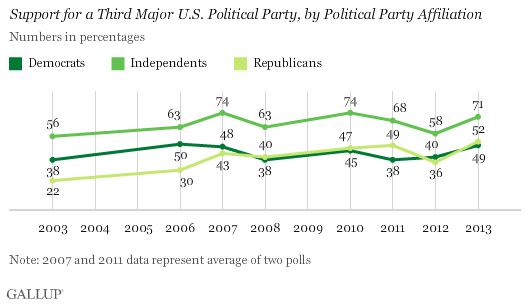
According to Gallup, 60% of Americans want a third party candidate for 2016. Even so, in the fall of 2016, we will be warned once again (by The Nation, Daily Kos and their ilk) that -- once again -- we must must must vote for the Lesser-of-Two-Evils -- a Wall Street-militarist-security state Democrat -- or face Catastrophe -- a Wall Street-militarist-security state Republican.
Doing the same thing over and over again and expecting a different result isn't really the definition of insanity. But it is the definition of stupidity.
See, In U.S., Perceived Need for Third Party Reaches New High: Twenty-six percent believe Democratic and Republican parties do adequate job (Gallup).
The United States of America is at moral crossroads
The CIA should be shut down.
The spy work, if there was any, can be carried on gamely by the National Security Agency, the Defense Intelligence Agency, the State Department's Bureau of Intelligence and Research, Air Force Intelligence, the FBI's National Security Branch, the Army Intelligence and Security Command, the Department of Energy's Office of Intelligence and Counterintelligence, Coast Guard Intelligence, the Treasury's Office of Intelligence and Analysis, the Drug Enforcement Administration, the Marine Corps Intelligence Activity, the National Geospatial-Intelligence Agency (sic), the National Reconnaissance Office, the Office of Naval Intelligence, the Department of Homeland Security Office of Intelligence and Analysis, and the Office of the Director of National Intelligence, to say nothing of all the state and local police spooks.
Military operations should have been handled by the Department of Defense all along.
But it will be a further crime if all that happens now is that a few relatively-low level functionaries, however blood-soaked their uniforms, are scape-goated, Abu Graib-style. This fish was rotting from the head. The only way that these and other crimes can be prevented from happening in the future is to hold the perpetrators accountable. If this were some failing garrison in the Third World, instead of the failing Leader of the World, the State Department would be piously scolding them to clean-house. The United States needs to be live up to its ideals. If we can't clean our house, if we can't prosecute the criminals ourselves, as domestic and international law requires, then we should turn Bush, Cheney, and their co-conspirators over to the International Criminal Court and let the world community help us out.
More:
CIA tortured, misled, U.S. report finds, drawing calls for action by Mark Hosenball (Reuters)
Return of the CIA's 'Rogue Elephants': The Senate's report on torture shows U.S. intelligence agencies need to be reined in again by Peter Fenn (US News)
There Is Something Worse Than Torture in the Senate Torture Report: It's not the torture—it's the CIA lying by David Corn (Mother Jones)
U.S. under fire over Senate's report on CIA torture by Bill Trott (Reuters UK)
Labels:
accountability,
CIA,
democracy,
Dick Cheney,
espionage,
George W. Bush,
intelligence,
rendition,
spies,
spy
Arab Sprung
Liberals are barely more tolerant of democracy than conservatives. John Kerry didn't screw up in praising the Egyptian military; he spoke the truth. Democracy is okay only in so far as it delivers desired outcomes. Generals and dictators are useful for making sure electorates don't make what their betters regard as wrong choices.
Labels:
democracy
Rational but impractical
We will never have a truly representative democracy as long as 350,000 people in one state have the same voting power as 35,000,000 people in another state. Here's what the states would like if they had equal populations. Note that some states are drawn to take account of socioeconomic factors; for example, western PA and western NY are joined together because they have they have more in common with each other than with the other parts of their current states.
Labels:
democracy
Subscribe to:
Posts (Atom)