


Who wins and who loses when we forget American history:
Ignorance of Things Past by Lewis H. Lapham (Harper's)
Showing posts with label 2008. Show all posts
Showing posts with label 2008. Show all posts
Must read:

The Franchise: Making every vote count
The long lines at the polls become even more puzzling when you consider this:
According to Curtis Gans,
Although a greater interest among voters concentrated in particular precincts -- areas with large populations of black voters or students, for example -- might have created enough congestion at those polls to satisfy the media's expectation of a big turnout, isn't it more likely that the impact of the electoral college, leading as it does to the disenfranchisement of minority party voters in non-competitive states and the focus of campaigns on a handful of constituencies, led to longer lines in those few locales where voters knew their vote would count. I know people in California and New York, for example, who stayed home because they felt their choice for president was moot.
Some of the advance voting problems can be attributed to the limited number of polling places in most jurisdictions. Nevada, an exception, allowed voting in some grocery stores -- it would be helpful to know how that worked out, but most states required early voters to travel to some remote county office or isolated post office to drop off ballots. If unprecedented numbers of people voted in advance, it must have eased the pressure on election day; and repeated warnings over many months of an impending deluge of ballots gave election officials plenty of opportunity to get ready; so it still seems odd that there were the number of problems there were on voting day.
Not being much of a conspiracy theorist, I'm reluctant to sign on to the theory that there was a plot to depress the tally. But it would be useful to the proper management of future efforts of this sort if we knew what did happen this time. Even if it was only a matter of increased turnout in districts where voting mattered, there might be ways to prepare for such eventualities in coming elections.
In any event, if it is not going to continue to distort campaigns and alter outcomes of elections, we have to get rid of the electoral college. It's past time for every citizen's vote to count equally.
According to Curtis Gans,
Despite lofty predictions by some academics, pundits, and practitioners that voter turnout would reach levels not seen since the turn of the last century, the percentage of eligible citizens casting ballots in the 2008 presidential election stayed at virtually the same relatively high level as it reached in the polarized election of 2004....The percentage of eligible citizens voting Republican declined to 28.7 percent down 1.3 percentage points from 2004. Democratic turnout increased by 2.6 percentage points from 28.7 percent of eligibles to 31.3 percent. It was the seventh straight increase in the Democratic share of the eligible vote since the party's share dropped to 22.7 percent of eligibles in 1980.Increased absentee voting. Increased early voting. The Democrats up a little. The Republicans down a little. But overall, only a marginal increase in the number of voters. So why the long lines?
Although a greater interest among voters concentrated in particular precincts -- areas with large populations of black voters or students, for example -- might have created enough congestion at those polls to satisfy the media's expectation of a big turnout, isn't it more likely that the impact of the electoral college, leading as it does to the disenfranchisement of minority party voters in non-competitive states and the focus of campaigns on a handful of constituencies, led to longer lines in those few locales where voters knew their vote would count. I know people in California and New York, for example, who stayed home because they felt their choice for president was moot.
Some of the advance voting problems can be attributed to the limited number of polling places in most jurisdictions. Nevada, an exception, allowed voting in some grocery stores -- it would be helpful to know how that worked out, but most states required early voters to travel to some remote county office or isolated post office to drop off ballots. If unprecedented numbers of people voted in advance, it must have eased the pressure on election day; and repeated warnings over many months of an impending deluge of ballots gave election officials plenty of opportunity to get ready; so it still seems odd that there were the number of problems there were on voting day.
Not being much of a conspiracy theorist, I'm reluctant to sign on to the theory that there was a plot to depress the tally. But it would be useful to the proper management of future efforts of this sort if we knew what did happen this time. Even if it was only a matter of increased turnout in districts where voting mattered, there might be ways to prepare for such eventualities in coming elections.
In any event, if it is not going to continue to distort campaigns and alter outcomes of elections, we have to get rid of the electoral college. It's past time for every citizen's vote to count equally.
God must love the Clintonites...
...he made so many of them.
From the apparent intention to drag every Clinton administration veteran back to Washington from the lobbying company, law firm, brokerage house, or outpost of the academic gulag where eight years of exile were endured, to the perplexing consideration of Hillary Clinton and John Kerry as secretary of state, President Change has become President StatusQuo more swiftly than you can say, Yes we can.
The absence of a strong set of political beliefs was part of candidate Obama's appeal. It allowed every supporter to project his own ambitions for the country on the blank face of "change." But now, that same absence of political agenda is enabling the center-right coalition that has run this country for its own benefit since Reagan to seize control of the next administration. Call it Clintonism with a new face.
The incoming White House chief of staff is Rahm Emmanuel, who was a staff assistant to President Clinton (and, not incidentally, as head of the last several Democratic House election efforts, the hatchet man who systematically undermined the candidacies of progressives in the Democratic primaries). Former Clinton chief of staff John Podesta is in overall charge of the transition team. Overseeing the selection of the foreign policy corps is former Clinton secretary of state Warren Christopher. And staffing defense is up to former senator Sam Nunn, not a Clinton intimate, exactly, but as head of the Senate armed services committee in the Clinton years intimately involved in crafting the militarized foreign policy of that era. The first important picks after Biden and Emmanuel: Clinton's impeachment attorney Gregory Craig as White House counsel and Ronald Klain, a former lobbyist who was a lawyer on Al Gore's vice presidential staff, as the new veep's legal adviser.
Bowles, Ian; Mathews Burwell, Sylvia; Campbell, Kurt; Cunningham, Nelson; Danzig, Richard; Downey, Mortimer; Garvey, Jane; Gensler, Gary; Hochberg, Fred; Johnson, James; Lake, Anthony; McGinty, Kathleen; Ness, Susan; Rice, Susan; Sperling, Gene; Steinberg, James; Talbot, Strobe; Thompson, Mozelle; Witt, James Lee; Zoellick, Robert...the nice thing about this return of the politically undead is that lobbyists won't be compelled to waste a lot of energy updating their speed dialers. If he didn't throw out his old business cards, Lawrence Summers is really set; treasury under secretary Clinton, and partly responsible for our current economic mess, he is likely to get the same job from Obama.
Then there are short-list names one prays are no more than the latest examples of the Obama crew's mastery of political symbolism. John Kerry or Hillary Clinton at the state department (and what happened to Bill Richardson, anyway?). Al Gore as secretary of interior. Bill freaking Clinton at the UN. Excuse me, but wasn't getting rid of the Clintons the whole point of the rush to endorse Obama on SuperTuesday?
It's not that many of these people are not admirable in their own right, it's just that in their massed numbers, and in conjunction with other appointment rumors -- retaining defense secretary Robert "The Surge Is Working" Gates; bringing back former Federal Reserve chairman Paul Volcker as treasury secretary; putting GOP stalwarts Chuck Hagel and Richard Lugar in charge, respectively, of defense and state (no, really, what did happen to Bill Richardson?); sending Jane Harman, the scary Democratic representative from Venice CA, to homeland security; giving education to Colin "Mea Culpa" Powell, as if he doesn't have enough to apologize for already -- they make it seem increasingly likely that the only change we're going to see is the kind that is confusingly difficult to distinguish from la même chose.
We thought we were throwing the bums out. Silly us.
From the apparent intention to drag every Clinton administration veteran back to Washington from the lobbying company, law firm, brokerage house, or outpost of the academic gulag where eight years of exile were endured, to the perplexing consideration of Hillary Clinton and John Kerry as secretary of state, President Change has become President StatusQuo more swiftly than you can say, Yes we can.
The absence of a strong set of political beliefs was part of candidate Obama's appeal. It allowed every supporter to project his own ambitions for the country on the blank face of "change." But now, that same absence of political agenda is enabling the center-right coalition that has run this country for its own benefit since Reagan to seize control of the next administration. Call it Clintonism with a new face.
The incoming White House chief of staff is Rahm Emmanuel, who was a staff assistant to President Clinton (and, not incidentally, as head of the last several Democratic House election efforts, the hatchet man who systematically undermined the candidacies of progressives in the Democratic primaries). Former Clinton chief of staff John Podesta is in overall charge of the transition team. Overseeing the selection of the foreign policy corps is former Clinton secretary of state Warren Christopher. And staffing defense is up to former senator Sam Nunn, not a Clinton intimate, exactly, but as head of the Senate armed services committee in the Clinton years intimately involved in crafting the militarized foreign policy of that era. The first important picks after Biden and Emmanuel: Clinton's impeachment attorney Gregory Craig as White House counsel and Ronald Klain, a former lobbyist who was a lawyer on Al Gore's vice presidential staff, as the new veep's legal adviser.
Bowles, Ian; Mathews Burwell, Sylvia; Campbell, Kurt; Cunningham, Nelson; Danzig, Richard; Downey, Mortimer;
Garvey, Jane; Gensler, Gary; Hochberg, Fred; Johnson, James; Lake, Anthony; McGinty, Kathleen; Ness, Susan; Rice, Susan; Sperling, Gene; Steinberg, James; Talbot, Strobe; Thompson, Mozelle; Witt, James Lee; Zoellick, Robert...the nice thing about this return of the politically undead is that lobbyists won't be compelled to waste a lot of energy updating their speed dialers. If he didn't throw out his old business cards, Lawrence Summers is really set; treasury under secretary Clinton, and partly responsible for our current economic mess, he is likely to get the same job from Obama.Then there are short-list names one prays are no more than the latest examples of the Obama crew's mastery of political symbolism. John Kerry or Hillary Clinton at the state department (and what happened to Bill Richardson, anyway?). Al Gore as secretary of interior. Bill freaking Clinton at the UN. Excuse me, but wasn't getting rid of the Clintons the whole point of the rush to endorse Obama on SuperTuesday?
It's not that many of these people are not admirable in their own right, it's just that in their massed numbers, and in conjunction
with other appointment rumors -- retaining defense secretary Robert "The Surge Is Working" Gates; bringing back former Federal Reserve chairman Paul Volcker as treasury secretary; putting GOP stalwarts Chuck Hagel and Richard Lugar in charge, respectively, of defense and state (no, really, what did happen to Bill Richardson?); sending Jane Harman, the scary Democratic representative from Venice CA, to homeland security; giving education to Colin "Mea Culpa" Powell, as if he doesn't have enough to apologize for already -- they make it seem increasingly likely that the only change we're going to see is the kind that is confusingly difficult to distinguish from la même chose.We thought we were throwing the bums out. Silly us.
More "New and Not Improved"
Okay. I was wrong. There was a lot more anger building up on the left than was evident when I wrote the piece below (see, Obama's Online Muscle Flexes Against Him, Chicago Tribune 2008-07-08). The problem, of course, is that the senator's progressive supporters can whine and pule all they want but it won't change anything. They already gave away the store when they threw their support to him without getting anything in return. Without the availability of an alternative (Hillary Clinton and John Edwards come to mind), they have nothing to hold over him. John McCain? I don't think so. The only shocking thing is that anybody's shocked. You can only be surprised if you haven't been paying attention. BHO has been saying most of this stuff all along (well, okay, not the campaign financing stuff). This may be why Ralph Nader is doing so well in the polls, a steady 5% -- certainly enough to make the difference in a close race -- at a time when the tide is most favorable to Obama. The question remains, as it has throughout this race, what it will take to get the Democrats to end the war, establish single-payer national health, rein in the military, restore progressive taxation, and start the long, slow, costly job of rebuilding the nation's tattered infrastructure. If Obama isn't the answer, what's Plan B?
"New and Not Improved" (New York Times headline -- July 4, 2008)
The Times is shocked -- shocked! -- to discover that Barack Obama is a conventional, middle-of-the-road politician, not the second coming of Abe Lincoln and Bobby Kennedy. You may not think it's any surprise that, having safely disposed of the evil Clintons in the primaries, the Democrats' candidate has tacked right on a few issues for the general election, but the Times is deeply disappointed in the junior legislator from Illinois.
"Senator Barack Obama stirred his legions of supporters, and raised our hopes," the paper lamented in an Independence Day editorial, "promising to change the old order of things. He spoke with passion about breaking out of the partisan mold of bickering and catering to special pleaders, promised to end President Bush’s abuses of power and subverting of the Constitution and disowned the big-money power brokers who have corrupted Washington politics....Now there seems to be a new Barack Obama on the hustings....Mr. Obama’s shifts are striking, because he was the candidate who proposed to change the face of politics, the man of passionate convictions who did not play old political games."
If the paper's editorial writers really took seriously Obama's posturing about change, they are more naive even than the senator's converts on the left. Progressive idealists have an excuse in falling for his pitch. After all, if the nation doesn't find salvation by anointing the Chicago pol in November, they will be forced to fall back on the tougher job of electing a progressive majority to Congress and organizing an apparently terminally apathetic citizenry.
You have to wonder what campaign the Times has been following, though. Obama has never made a secret of who he is. Beyond the rhetoric of change and his campaign's grasp of the Internet's organizing and fund-raising capacities, he has presented himself throughout the primaries as dependably moderate -- pro-military, pro-death penalty, anti-gun control, ready to reach across the aisle -- when he has shown any interest in policy at all.
It is certainly true, as the Times says, that Obama stirred his legions of supporters by promising to change the old order of things. But this was almost entirely a matter of speechifying. In fact (and ironically, when you consider the passion with which the anti-Clinton forces hugged him to their bosoms), throughout the campaign Obama has sounded remarkably like the Bill Clinton of 1996. He did indeed speak "with passion about breaking out of the partisan mold of bickering and catering to special pleaders," but like Bill Clinton's, the likeliest outcome of Barack Obama's brand of bipartisanship will be the adoption of the conservative agenda.
Obama, the Times adds, "promised to end President Bush’s abuses of power and subverting of the Constitution" -- as who didn't? -- "and disowned the big-money power brokers who have corrupted Washington politics." It's true that Hillary Clinton couldn't find it in herself to bite the hands that fed her, but -- not to beat a dead horse -- if the Times really wanted to enlist in the fight for economic justice they wouldn't have joined the media pack in minimizing John Edwards' insurgency. In any case, about the "new" Obama the Times continues, "First,
That raises a question, however: Doesn't your willingness to kill someone in order to become president automatically disqualify you from the job? In the U.S., there are on average around 30,000 deaths annually from firearms and over 200,000 non-fatal injuries. If, as Obama wishes, handguns are easier to acquire, there will be more fatalities and more injuries . If additional crimes are made capital offenses, there will be more executions. But no one will be able to say Barack Obama is soft on crime. There will be no Willie Horton for him, if he can help it.
In any case, I hold Barack Obama in higher regard than many of his supporters. To me, his campaign makes more sense if you take him at his word that he is an ambitious moderate with little interest in policy, that he is another Democratic presidential candidate whose most attractive attribute is that he is not the other guy. There is no question that there are reasons to prefer Barack Obama to John McCain, those pesky Supreme Court appointments among them. But keeping in mind the outcome of the Clinton years, whether this makes his election the more desirable remains to be seen.
"Senator Barack Obama stirred his legions of supporters, and raised our hopes," the paper lamented in an Independence Day editorial, "promising to change the old order of things. He spoke with passion about breaking out of the partisan mold of bickering and catering to special pleaders, promised to end President Bush’s abuses of power and subverting of the Constitution and disowned the big-money power brokers who have corrupted Washington politics....Now there seems to be a new Barack Obama on the hustings....Mr. Obama’s shifts are striking, because he was the candidate who proposed to change the face of politics, the man of passionate convictions who did not play old political games."
If the paper's editorial writers really took seriously Obama's posturing about change, they are more naive even than the senator's converts on the left. Progressive idealists have an excuse in falling for his pitch. After all, if the nation doesn't find salvation by anointing the Chicago pol in November, they will be forced to fall back on the tougher job of electing a progressive majority to Congress and organizing an apparently terminally apathetic citizenry.
You have to wonder what campaign the Times has been following, though. Obama has never made a secret of who he is. Beyond the rhetoric of change and his campaign's grasp of the Internet's organizing and fund-raising capacities, he has presented himself throughout the primaries as dependably moderate -- pro-military, pro-death penalty, anti-gun control, ready to reach across the aisle -- when he has shown any interest in policy at all.
It is certainly true, as the Times says, that Obama stirred his legions of supporters by promising to change the old order of things. But this was almost entirely a matter of speechifying. In fact (and ironically, when you consider the passion with which the anti-Clinton forces hugged him to their bosoms), throughout the campaign Obama has sounded remarkably like the Bill Clinton of 1996. He did indeed speak "with passion about breaking out of the partisan mold of bickering and catering to special pleaders," but like Bill Clinton's, the likeliest outcome of Barack Obama's brand of bipartisanship will be the adoption of the conservative agenda.
Obama, the Times adds, "promised to end President Bush’s abuses of power and subverting of the Constitution" -- as who didn't? -- "and disowned the big-money power brokers who have corrupted Washington politics." It's true that Hillary Clinton couldn't find it in herself to bite the hands that fed her, but -- not to beat a dead horse -- if the Times really wanted to enlist in the fight for economic justice they wouldn't have joined the media pack in minimizing John Edwards' insurgency. In any case, about the "new" Obama the Times continues, "First,
he broke his promise to try to keep both major parties within public-financing limits for the general election. His team explained that, saying he had a grass-roots-based model and that while he was forgoing public money, he also was eschewing gold-plated fund-raisers. These days he’s on a high-roller hunt.Hard not to agree that this is a switcheroo worthy of a three-card monte hustler in Times Square. But the biggest surprise is how easily he is getting away with it. The Times deserves credit for taking him to task for what is a major sellout of reform politics; imagine the howls that would be emanating from progressive circles if John McCain or Hillary Clinton pulled a stunt like this.
Even his own chief money collector, Penny Pritzker, suggests that the magic of $20 donations from the Web was less a matter of principle than of scheduling. “We have not been able to have much of the senator’s time during the primaries, so we have had to rely more on the Internet,” she explained as she and her team busily scheduled more than a dozen big-ticket events over the next few weeks at which the target price for quality time with the candidate is more than $30,000 per person.
The new Barack Obama has abandoned his vow to filibuster an electronic wiretapping bill if it includes an immunity clause for telecommunications companies that amounts to a sanctioned cover-up of Mr. Bush’s unlawful eavesdropping after 9/11.Again, Obama has consistently backed the Patriot Act and military spending, on occasion has gone so far as to advocate missile attacks on Iran and military action in Pakistan, and has made it clear that he is no threat to the entitlements of the military state. It's more likely he was pandering in January than July.
In January, when he was battling for Super Tuesday votes, Mr. Obama said that the 1978 law requiring warrants for wiretapping, and the special court it created, worked. “We can trace, track down and take out terrorists while ensuring that our actions are subject to vigorous oversight and do not undermine the very laws and freedom that we are fighting to defend,” he declared.
Now, he supports the immunity clause as part of what he calls a compromise but actually is a classic, cynical Washington deal that erodes the power of the special court, virtually eliminates “vigorous oversight” and allows more warrantless eavesdropping than ever.
The Barack Obama of the primary season used to brag that he would stand before interest groups and tell them tough truths. The new Mr. Obama tells evangelical Christians that he wants to expand President Bush’s policy of funneling public money for social spending to religious-based organizations — a policy that violates the separation of church and state and turns a government function into a charitable donation.If you think back to the Clinton presidency, you will remember that he, too, succeeded a failed Republican administration. If George Bush had been reelected would the Congress have funded expansion of the military? Would we have had NAFTA and trade reform, welfare reform, banking reform, telecom reform? (You are permitted to assume there are quotation marks around any appearance of the word reform on these pages.) Would the Democratic Party have abandoned its four-decade-old commitment to achieving single-payer health insurance? It requires no stretch of imagination to recognize that an Obama administration will be equally inclined to bridle any liberal excesses of the next Congress.
He says he would not allow those groups to discriminate in employment, as Mr. Bush did, which is nice. But the Constitution exists to protect democracy, no matter who is president and how good his intentions may be.
On top of these perplexing shifts in position, we find ourselves disagreeing powerfully with Mr. Obama on two other issues: the death penalty and gun control.Me, too. But it's a little after the fact to bring it up now.
Mr. Obama endorsed the Supreme Court’s decision to overturn the District of Columbia’s gun-control law. We knew he ascribed to the anti-gun-control groups’ misreading of the Constitution as implying an individual right to bear arms. But it was distressing to see him declare that the court provided a guide to “reasonable regulations enacted by local communities to keep their streets safe.”In 1996, Bill Clinton suspended his presidential campaign to return to Arkansas to preside as governor over the execution of a retarded man. When someone like George Bush or John McCain favors the death penalty, you think they know not what they do. But Bill Clinton is a policy wonk. He has read the same studies you have about the negative effects of the death penalty on public policy. He knows it has no deterrent effect. He knows it is wrongly applied much of the time. He knows that innocent people die. But he had seen Mike Dukakis get Willie Hortoned, and he wasn't going to let it happen to him.
What could be more reasonable than a city restricting handguns, or requiring that firearms be stored in ways that do not present a mortal threat to children?
We were equally distressed by Mr. Obama’s criticism of the Supreme Court’s barring the death penalty for crimes that do not involve murder.
That raises a question, however: Doesn't your willingness to kill someone in order to become president automatically disqualify you from the job? In the U.S., there are on average around 30,000 deaths annually from firearms and over 200,000 non-fatal injuries. If, as Obama wishes, handguns are easier to acquire, there will be more fatalities and more injuries . If additional crimes are made capital offenses, there will be more executions. But no one will be able to say Barack Obama is soft on crime. There will be no Willie Horton for him, if he can help it.
We are not shocked when a candidate moves to the center for the general election. But Mr. Obama’s shifts are striking because he was the candidate who proposed to change the face of politics, the man of passionate convictions who did not play old political games.Obama partisans who are bothered by any of this offer the reassurance that he doesn't mean what he says. He is just saying what he must to get elected. Aside from the questionable wisdom of this as practical politics (viz., the candidacies of Al Gore and John Kerry), it is a little disheartening to be asked to trust that a candidate is lying.
There are still vital differences between Mr. Obama and Senator John McCain on issues like the war in Iraq, taxes, health care and Supreme Court nominations. We don’t want any “redefining” on these big questions. This country needs change it can believe in.
In any case, I hold Barack Obama in higher regard than many of his supporters. To me, his campaign makes more sense if you take him at his word that he is an ambitious moderate with little interest in policy, that he is another Democratic presidential candidate whose most attractive attribute is that he is not the other guy. There is no question that there are reasons to prefer Barack Obama to John McCain, those pesky Supreme Court appointments among them. But keeping in mind the outcome of the Clinton years, whether this makes his election the more desirable remains to be seen.
2008: Why West Virginia is more important than you think
Lost in the coverage of the West Virginia primary is the fact that John Edwards received 7% of the vote, suggesting a growing dissatisfaction with both Hillary Clinton and Barack Obama. Not that Obama's campaign will go off the rails before the convention, but for the party's front runner to be clobbered in the final days of the nominating process is one more piece of evidence that the outcome in November is not a lock.
The Democrats have a real problem, one with a long history. There is a certain type of candidate -- brainy, nuanced in policy discussions, aloof, often impatient with the blood, sweat and tears of retail politics, who is beloved of academics and Hollywood liberals -- think Mike Dukakis, Al Gore and John Kerry, but who fails to connect with the average voter with an intensity sufficient to carry the day.
The Obama team can blame racism and Hillary's negative campaigning for the outcome in West Virginia if they want to, but they'd be better to take heed: it repeats a pattern that has been apparent throughout the campaign -- many white working class voters are not warming to Barack Obama.
And that's not all, as the late night cable ads like to say. More than half the voters in WVa said they'd be less than happy if Obama was the nominee. Half believe he shares the views of the Rev. Wright (as, no doubt, in general, he does), and more than half think he does not share their values (expect to hear a lot more about lapel pins between now and November). Just under half of Clinton's supporters said they would not support the very junior senator from Illinois in the fall. Plus, more than half also hold the opinion, and this is huge, that he is not honest and trustworthy. Obama may have kicked off his extraordinary run for the roses with that out-of-nowhere win in 94%-white Iowa, but he is winding it up in 94%-white WVa with a potentially going-nowhere trouncing.
The Obama people should be thanking Clinton whose victory in West Virginia is an early-warning signal of what might happen in the fall. This is information to be addressed, not argued with or dismissed; if it is not addressed, soon and forthrightly, before it becomes set in stone that he is dishonest and untrustworthy, Obama stands a better than average chance of losing the general election.
If the public is suffering Obama-Clinton burnout, then nominating Clinton for vice, even if it is achievable over Michelle Obama's objections, may not be the smartest move. Writing for Political Insider, Taegan Goddard makes the case for John Edwards as the Democratic vice presidential candidate.
6. The choice of Edwards would reassure the Democrats' left-leaning activists, who have been worried that the party's core tenets are about to be sacrificed -- again -- to the ambitions of an administration -- whether led by Obama or Clinton matters not -- bent on portraying itself as a Third Way.
Party activists have been bemused by the Clinton-Obama domination of the debate. Clinton was never acceptable to the Left -- some progressives are so repelled by the Clintons that they rushed into Obama's arms, although Barack's relentless gassification of the issues has made Hillary's working class hero act nearly palatable. Progressives who are not sitting on their hands while they figure out what to do next have embraced Obama hoping they can get some cred with the young voters he's turned on; all are crossing their fingers that he is not the corporatist shill he appears to be.
Edwards selection as Obama's running mate would be a step toward mollifying the doubters, at least more so than adding any of the others on the short list to the ticket as veep. Apparently, Edwards will endorse Obama tonight. Too soon, John, unless the deal is already done.
(See, Edwards Endorsement Boosts Obama's Campaign, CQPolitics, 2008-05-14).
The Democrats have a real problem, one with a long history. There is a certain type of candidate -- brainy, nuanced in policy discussions, aloof, often impatient with the blood, sweat and tears of retail politics, who is beloved of academics and Hollywood liberals -- think Mike Dukakis, Al Gore and John Kerry, but who fails to connect with the average voter with an intensity sufficient to carry the day.
The Obama team can blame racism and Hillary's negative campaigning for the outcome in West Virginia if they want to, but they'd be better to take heed: it repeats a pattern that has been apparent throughout the campaign -- many white working class voters are not warming to Barack Obama.
The West Virginia exit polls, TalkLeft reports, indicate that he lost white voters 69-28. Astounding? Not really. In Ohio, Clinton won white voters 64-34. In Pennsylvania, Clinton won whites 63-37. Indiana? Whites went for Clinton 60-40. Massachusetts? Whites went for Clinton 58-40. Rhode Island? 63-31 for Clinton. North Carolina? 61-37. And the same in Arkansas, Tennessee, Maryland, Alabama, Mississippi, Georgia, Florida, Oklahoma, Arizona, Missouri and so on.Nor did Obama lose only among those sectors of the population -- older voters, white women -- unusually resistant to his charm. In West Virginia, he was also edged out in blocs that are normally in his corner -- the 18-30s, the educated and the affluent. The West Virginia outcome is not an anomaly: Obama’s white working class problem isn't limited to Appalachia; it's in the entire half of the country east of the Mississippi.
Obama has won the white vote in Iowa, Kansas, Wisconsin, Virginia, Colorado, Washington, Idaho, Utah, North Dakota, Nebraska, etc. West of the Mississippi all of them EXCEPT Wisconsin and VA.
And that's not all, as the late night cable ads like to say. More than half the voters in WVa said they'd be less than happy if Obama was the nominee. Half believe he shares the views of the Rev. Wright (as, no doubt, in general, he does), and more than half think he does not share their values (expect to hear a lot more about lapel pins between now and November). Just under half of Clinton's supporters said they would not support the very junior senator from Illinois in the fall. Plus, more than half also hold the opinion, and this is huge, that he is not honest and trustworthy. Obama may have kicked off his extraordinary run for the roses with that out-of-nowhere win in 94%-white Iowa, but he is winding it up in 94%-white WVa with a potentially going-nowhere trouncing.
The Obama people should be thanking Clinton whose victory in West Virginia is an early-warning signal of what might happen in the fall. This is information to be addressed, not argued with or dismissed; if it is not addressed, soon and forthrightly, before it becomes set in stone that he is dishonest and untrustworthy, Obama stands a better than average chance of losing the general election.
If the public is suffering Obama-Clinton burnout, then nominating Clinton for vice, even if it is achievable over Michelle Obama's objections, may not be the smartest move. Writing for Political Insider, Taegan Goddard makes the case for John Edwards as the Democratic vice presidential candidate.
Ironically, by not choosing between Sen. Barack Obama and Sen. Hillary Clinton in their tough primary battle, Edwards stands as a potential healer of the Democratic party. And by remaining neutral in the race, he's also best positioned to be Sen. Barack Obama's running mate.Except for number 4 (does Edwards really have a "southern" identity?), this is a fairly compelling case, to which I would add one additional point:
Here's the case for picking Edwards:1. He's already been tested on the national stage and not likely to cause a distracting scandal.
2. He appeals to the same working class white voters that back Clinton.
3. He favors Obama's new brand of politics.
4. He could put North Carolina and possibly other Southern states in play.
5. Sen. Hillary Clinton would probably support him. With more than 1,700 delegates in Clinton's pocket, Obama needs to at least get her tacit approval if he wants to have a unified party.
6. The choice of Edwards would reassure the Democrats' left-leaning activists, who have been worried that the party's core tenets are about to be sacrificed -- again -- to the ambitions of an administration -- whether led by Obama or Clinton matters not -- bent on portraying itself as a Third Way.
Party activists have been bemused by the Clinton-Obama domination of the debate. Clinton was never acceptable to the Left -- some progressives are so repelled by the Clintons that they rushed into Obama's arms, although Barack's relentless gassification of the issues has made Hillary's working class hero act nearly palatable. Progressives who are not sitting on their hands while they figure out what to do next have embraced Obama hoping they can get some cred with the young voters he's turned on; all are crossing their fingers that he is not the corporatist shill he appears to be.
Edwards selection as Obama's running mate would be a step toward mollifying the doubters, at least more so than adding any of the others on the short list to the ticket as veep. Apparently, Edwards will endorse Obama tonight. Too soon, John, unless the deal is already done.
(See, Edwards Endorsement Boosts Obama's Campaign, CQPolitics, 2008-05-14).
Stand-up Comity: Chuck Hagel vs Lambchop for Vice-President
It is rumored that Chuck Hagel, the departing senator from Nebraska, one of the only Republicans to oppose strenuously George W. Bush's illegal, immoral and counter-productive occupation of Iraq and his authorization of the use of torture in interrogations, 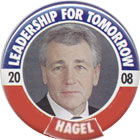 is under consideration for vice president by Barack Obama as well as, more predictably despite their differences over Iraq, John McCain.
If picked by Obama, Hagel would bring to the Democratic ticket the experience of a seasoned Washington insider (he has served on senate committees overseeing banking, foreign relations and intelligence) and the requisite record of service in Vietnam. As a bonus, his vigorous opposition to the Iraq war would reassure Democrats worried about how seriously Obama will pursue withdrawal. The very junior senator from Illinois plans to pack his cabinet with Republicans anyway, so why not start at the top?
McCain, on the other hand, who agrees with the conservative Cornhusker on virtually every other issue, can, by choosing a running mate anathematic to the White House, further distance himself from the most unpopular president in history without otherwise alienating his base.
While unorthodox, the best outcome might be for Hagel to be nominated for vice president by both parties simultaneously. Not only would McCain and Obama get to underscore their commitment to bringing a new era of comity to the nation's politics, but the rest of us would get to enjoy the spectacle of a debate between a U.S Senator and his sock puppet.
See, And Obama's Veep is...a Republican? by Mike Madden (Salon) and
Hagel would ‘consider’ joining Democratic ticket by Steve Benen (The Carpetbagge Report, 2008-06-21)
is under consideration for vice president by Barack Obama as well as, more predictably despite their differences over Iraq, John McCain.If picked by Obama, Hagel would bring to the Democratic ticket the experience of a seasoned Washington insider (he has served on senate committees overseeing banking, foreign relations and intelligence) and the requisite record of service in Vietnam. As a bonus, his vigorous opposition to the Iraq war would
reassure Democrats worried about how seriously Obama will pursue withdrawal. The very junior senator from Illinois plans to pack his cabinet with Republicans anyway, so why not start at the top?McCain, on the other hand, who agrees with the conservative Cornhusker on virtually every other issue, can, by choosing a running mate anathematic to the White House, further distance himself from the most unpopular president in history without otherwise alienating his base.
While unorthodox, the best outcome might be for Hagel to be nominated for vice president by both parties simultaneously. Not only would McCain and Obama get to underscore their commitment to bringing a new era of comity to the nation's politics, but the rest of us would get to enjoy the spectacle of a debate between a U.S Senator and his sock puppet.
See, And Obama's Veep is...a Republican? by Mike Madden (Salon) and
Hagel would ‘consider’ joining Democratic ticket by Steve Benen (The Carpetbagge Report, 2008-06-21)
Canards: Joe Lieberman is "a good Democrat"
It has been clear, at the least since his traitorous run for Senate in the 2006 general election against his party's nominee, that letting Joe Lieberman pass as an independent "Democrat" is deeply corrupting of the party's integrity and reputation. Just how far the senator's values deviate from his nominal consort can be seen in the chronicle of important votes taken since the Democrats took over Congress. It does progressivism no favor to have it tarred by a legislative record that is reflective not of a Democratic majority but of conservative dominance. If John McCain taps Jiltin' Joe for veep, the Democrats will have invited the GOP to present itself as the party of unity and comity. There's no hope of dumping the Connecticut conman now, but after November he will no longer be needed to reserve the bigger offices and inflated staffs for Harry Reid and company. If he's not the Republican vice president by then, Lieberman should be blocked from playacting the role of Democrat when the Congress begins a new run in January.
See also: Harry Reid Still Providing Cover for Joe Lieberman by Jane Hamsher (Firedoglake). In a recent interview, the Senate Majority Leader white-washes Joe Lieberman's voting record. The rest of the story.Things that don't exist in Harry Reid's world
by Glenn Greenwald (Salon, 2008-05-06)
Harry Reid was on The Daily Show last night (to promote his book, ironically entitled The Good Fight) and said that Joe Lieberman "supports us on virtually everything except the war." This is exactly what Reid has said repeatedly about Lieberman ("Joe Lieberman is my friend, and he is a good Democrat, votes with us on everything, except the war. So Joe Lieberman is easy to work with"). Two weeks ago, a NYT article on Lieberman quoted Reid praising him and then immediately added:A member of the Senate Democratic leadership, who insisted on not being identified, said: "The bloggers want us to get rid of him. It ain't happening." He added: "We need every vote. He's with us on everything but the war."Leave aside the insulting absurdity of talking about "the war" as though it's just one garden-variety political issue out of many. And also leave aside that Lieberman happens also not to be "voting with the Democrats" on the small matter of the presidential election. Beyond that, this claim that Lieberman votes with Democrats "on everything but the war" -- made repeatedly by Reid [and two weeks ago in the NYT by "a member of the Senate Democratic leadership" too scared to be quoted (if it's not Reid)] -- is a total falsehood, but nonetheless quite revealing about how the Senate Democratic leadership thinks.
Here are some non-war votes from Lieberman since the Democrats took over Congress in 2006:
Bill to ban the CIA from using waterboarding:
Democrats -- 45-1
Republicans - 5-46
Lieberman- NAY
Cloture vote on bill to restore habeas corpus (which Lieberman voted to abolish in 2006):
Democrats - 50-0
Republicans - 5-42
Lieberman - NAY
Vote to strip retroactive amnesty for telecoms out of the FISA bill (h/t Matt Browner-Hamlin):
Democrats -- 31-16
Republicans - 0-48
Lieberman - NAY
Vote to specify that FISA is the "exclusive means" by which the President can spy on telephone and email communications:
Democrats -- 49-1
Republicans - 9-40
Lieberman - NAY
Confirmation of Michael Mukasey as Attorney General:
Democrats -- 6-40
Republicans - 47-0
Lieberman - YEA
Cloture vote to proceed to consideration of No-Confidence Resolution for Alberto Gonzales as Attorney General:
Democrats -- 47-0
Republicans - 6-37
Lieberman - NAY
Obviously, Reid's repeated claim that Lieberman "votes with us on everything, except the war" is demonstrably false. But when he repeatedly makes that claim, I don't think Reid is consciously lying. It's just that, in Harry Reid's world (and in the world of the Democratic leadership generally), things like warrantless eavesdropping, the abolition of habeas corpus, telecom amnesty, the corrupt politicization of the Justice Department, chronic lying under oath, and the legalization of torture just don't exist. They don't matter. They're non-issues. And that is precisely why those radical, destructive measures are continuously permitted -- approved and endorsed -- by the Reid-led, Democratic-controlled Senate.
UPDATE: Several commenters and emailers, including Paul Dirks, argue that Reid views all of the above-listed issues as being part of "the war," broadly defined. Maybe. But if Reid and his comrades actually embrace the rhetorical deceit that things like the abolition of habeas corpus, warrantless eavesdropping, telecom amnesty, torture and Alberto Gonzales' behavior are all part of "the war" -- whatever that might mean -- then (a) that's even worse than the explanations I offered and (b) it makes the statement that Lieberman "votes with us on everything, except the war" all the more misleading and/or meaningless, since "the war" defined that way encompasses most matters of significance. -- Glenn Greenwald
Hang On, Hillary
The extended campaign isn't hurting the Democrats
It should come as no surprise that John Edwards is reluctant to make an endorsement in the presidential race. It must be difficult in the extreme for the populist Edwards to imagine either one of these business-as-usual pols in the White House at this troubled juncture in our history.
While he was still in the race, Edwards had to drag them kicking and screaming toward anything that vaguely resembled an original idea. Hillary Clinton is recycling DLC proposals going back to the Reagan era. Barack Obama's approach to making policy, apparently, is to position himself just to Clinton's right, no matter how off-center that may be. Edwards may be as disheartened as many of his followers are by the outcome this year, whichever way it finally turns out.
When Edwards bowed out just before Super Tuesday I, a lot of people assumed that he favored Obama. To me it appeared obvious that it was a tactical move specifically intended to stop Clinton. With Edwards out of the way, the anti-Clinton vote could coalesce around Obama enough to deny the New York senator the win conventional wisdom said she was headed for.
Unfortunately for Edwards, "Stop Hillary" succeeded beyond his wildest dreams. Any hope that he could come back into the race or that the party would turn to him as the un-Hillary-who-can-win evaporated when Obama surged into the lead.
When the endorsement of Obama didn't come after Super Tuesday I, a rumor floated around the blogosphere that Edwards was withholding because his feelings were hurt that the very junior senator from Illinois had continued to make fun of him -- gratuitously -- after he dropped out of the race. The story made both of them sound petty.
It made sense that Edwards, like Al Gore, would hang back until the convention to see how the primaries turned out. There is no point in having a convention -- or superdelegates -- unless it is to express the collective judgment of the party after the candidates have been heard, the rank and file have entered their opinions, and the delegates and superdelegates have had an opportunity to weigh all the factors that might affect the outcome in November.
For many Democrats, it will be important whom Gore and Edwards decide to support. Obviously Edwards is not held in the same degree of affection by Democrats as Gore (or Teddy Kennedy, for that matter), but he is widely respected, and he's more than that among those of us who thought 2008 could mark a turning back toward that moment when the United States stopped evolving into a social democracy.
(When was that moment, anyway? If I had to choose, I'd say April 12, 1945, the day FDR left us to fend for ourselves. In his 1944 State of the Union Address, Roosevelt laid out an "economic bill of rights" that all the current candidates, Edwards included, should read with shame. We've had our progressive moments since then -- Truman kept us from becoming South Africa, at least, and Johnson almost got us back on track -- would have, too, if the siren call of empire hadn't distracted him -- but, over all, our political life has been dominated for the last 60 years by a long, steady, rust-never-sleeps war of attrition against the New Deal.)
I continue to hope Edwards won't make an endorsement soon, at least not without getting concrete assurances that the issues that fired his supporters, especially a program that seriously addresses chronic poverty and a genuinely universal health care plan, will be given high priority early in any Democratic administration. I think it is telling that so many Edwards people have gravitated toward Clinton, because, whatever her limitations, she is clearly serious about matters of policy. The jury is still out on whether Obama has thought about anything beyond his carefully crafted public persona.
All this is by way of pointing you in the direction of an article in New York magazine (Who'll Stop the Pain by John Heilemann, New York 2008-03-28) speculating on whether anyone, including Gore and Edwards, has the clout to bring down the curtain on the Clinton-Obama show. It is the first couple of paragraphs that concern us here; to me, they have the ring of truth.
This campaign is keeping the opposition off balance. The Right is unsure whom to target, while the Democrats are free to pile on John McCain. Until there is a single Democratic contender, it is difficult for the corporate media to return single-mindedly to the horse race metaphor -- too many Democrats have the regrettable tendency to muddy the waters by bringing up issues and talking about ideas.
Plus, the longer it goes on, the more the candidates will feel pressure from policy-oriented primary and caucus voters and superdelegates to offer concrete proposals about ending the war and pursuing economic reforms. And, maybe, if it's allowed to go to its conclusion, the nominating process will result yet in a consensus satisfactory to most nominal Democrats.
Heilemann ends his entertaining piece with a depressing conclusion, an Obama-Clinton ticket that loses to John McCain in November, but I commend it to you anyway for his insight into the factors that might yet rescue the Democrats from their apparent division, even if he can't quite conjure up a happy ending.
Also: Don't Stop Campaigning (The Washington Post, 2008-03-29)
It should come as no surprise that John Edwards is reluctant to make an endorsement in the presidential race. It must be difficult in the extreme for the populist Edwards to imagine either one of these business-as-usual pols in the White House at this troubled juncture in our history.
While he was still in the race, Edwards had to drag them kicking and screaming toward anything that vaguely resembled an original idea. Hillary Clinton is recycling DLC proposals going back to the Reagan era. Barack Obama's approach to making policy, apparently, is to position himself just to Clinton's right, no matter how off-center that may be. Edwards may be as disheartened as many of his followers are by the outcome this year, whichever way it finally turns out.
When Edwards bowed out just before Super Tuesday I, a lot of people assumed that he favored Obama. To me it appeared obvious that it was a tactical move specifically intended to stop Clinton. With Edwards out of the way, the anti-Clinton vote could coalesce around Obama enough to deny the New York senator the win conventional wisdom said she was headed for.
Unfortunately for Edwards, "Stop Hillary" succeeded beyond his wildest dreams. Any hope that he could come back into the race or that the party would turn to him as the un-Hillary-who-can-win evaporated when Obama surged into the lead.
When the endorsement of Obama didn't come after Super Tuesday I, a rumor floated around the blogosphere that Edwards was withholding because his feelings were hurt that the very junior senator from Illinois had continued to make fun of him -- gratuitously -- after he dropped out of the race. The story made both of them sound petty.
It made sense that Edwards, like Al Gore, would hang back until the convention to see how the primaries turned out. There is no point in having a convention -- or superdelegates -- unless it is to express the collective judgment of the party after the candidates have been heard, the rank and file have entered their opinions, and the delegates and superdelegates have had an opportunity to weigh all the factors that might affect the outcome in November.
For many Democrats, it will be important whom Gore and Edwards decide to support. Obviously Edwards is not held in the same degree of affection by Democrats as Gore (or Teddy Kennedy, for that matter), but he is widely respected, and he's more than that among those of us who thought 2008 could mark a turning back toward that moment when the United States stopped evolving into a social democracy.
(When was that moment, anyway? If I had to choose, I'd say April 12, 1945, the day FDR left us to fend for ourselves. In his 1944 State of the Union Address, Roosevelt laid out an "economic bill of rights" that all the current candidates, Edwards included, should read with shame. We've had our progressive moments since then -- Truman kept us from becoming South Africa, at least, and Johnson almost got us back on track -- would have, too, if the siren call of empire hadn't distracted him -- but, over all, our political life has been dominated for the last 60 years by a long, steady, rust-never-sleeps war of attrition against the New Deal.)
I continue to hope Edwards won't make an endorsement soon, at least not without getting concrete assurances that the issues that fired his supporters, especially a program that seriously addresses chronic poverty and a genuinely universal health care plan, will be given high priority early in any Democratic administration. I think it is telling that so many Edwards people have gravitated toward Clinton, because, whatever her limitations, she is clearly serious about matters of policy. The jury is still out on whether Obama has thought about anything beyond his carefully crafted public persona.
All this is by way of pointing you in the direction of an article in New York magazine (Who'll Stop the Pain by John Heilemann, New York 2008-03-28) speculating on whether anyone, including Gore and Edwards, has the clout to bring down the curtain on the Clinton-Obama show. It is the first couple of paragraphs that concern us here; to me, they have the ring of truth.
In the days after John Edwards’s withdrawal from the Democratic race, the political world expected his endorsement of Barack Obama would be forthcoming tout de suite. The neo-populist and the hopemonger had spent months tag-teaming Hillary Clinton, pillorying her as a creature of the status quo, not a champion of the kind of "big change" they both deem essential. So appalled was Edwards at Clinton’s gaudy corporatism—her defense of the role of lobbyists, her suckling at the teats of the pharmaceutical and defense industries—that he’d essentially called her corrupt. And then, not least, there were the sentiments of his wife. "Elizabeth hasn’t always been crazy about Mrs. Clinton" is how an Edwards insider puts it; a less delicate member of HRC’s circle says, "Elizabeth hates her guts."This part, from general knowledge and personal contacts, I know to be true. Here's where it gets interesting:
But now two months have passed since Edwards dropped out—tempus fugit!—and still no endorsement. Why? According to a Democratic strategist unaligned with any campaign but with knowledge of the situation gleaned from all three camps, the answer is simple: Obama blew it. Speaking to Edwards on the day he exited the race, Obama came across as glib and aloof. His response to Edwards’s imprecations that he make poverty a central part of his agenda was shallow, perfunctory, pat. Clinton, by contrast, engaged Edwards in a lengthy policy discussion. Her affect was solicitous and respectful. When Clinton met Edwards face-to-face in North Carolina ten days later, her approach continued to impress; she even made headway with Elizabeth. Whereas in his Edwards sit-down, Obama dug himself in deeper, getting into a fight with Elizabeth about health care, insisting that his plan is universal (a position she considers [rightly - jg] a crock), high-handedly criticizing Clinton’s plan (and by extension Edwards’s) for its insurance mandate.The striking thing about this story is how perfectly in character everyone is. I've said before that, of all of Obama's achievements so far, one has impressed me most (because I thought it just shy of impossible): making Hillary Clinton look good. Here she is again, wonkish to be sure, but earnest, serious, prepared. And here is Obama as we've seen him before, too: glib, shallow and not serious enough about the game to make the big play when it's needed.
This campaign is keeping the opposition off balance. The Right is unsure whom to target, while the Democrats are free to pile on John McCain. Until there is a single Democratic contender, it is difficult for the corporate media to return single-mindedly to the horse race metaphor -- too many Democrats have the regrettable tendency to muddy the waters by bringing up issues and talking about ideas.
Plus, the longer it goes on, the more the candidates will feel pressure from policy-oriented primary and caucus voters and superdelegates to offer concrete proposals about ending the war and pursuing economic reforms. And, maybe, if it's allowed to go to its conclusion, the nominating process will result yet in a consensus satisfactory to most nominal Democrats.
Heilemann ends his entertaining piece with a depressing conclusion, an Obama-Clinton ticket that loses to John McCain in November, but I commend it to you anyway for his insight into the factors that might yet rescue the Democrats from their apparent division, even if he can't quite conjure up a happy ending.
Also: Don't Stop Campaigning (The Washington Post, 2008-03-29)
2008: Let the primary process play out
"Leahy says Clinton should withdraw" - AP Headline (2008-03-28).
Sen. Patrick Leahy, in an interview with Vermont Public Radio Thursday, urged Hillary Clinton to throw herself on her sword for the good of the party. Leahy, who just happens to favor Barack Obama for the nomination, said that, since the Obama team has decided there's no way that Clinton is going to win enough pledged delegates to get the nomination, she should quit.
Another Obama partisan, Sen. Chris Dodd, expressed a similar sentiment the same day.
Reacting to polls showing that some Obama and Clinton faithful say they will vote for John McCain if their own candidate is not the Democratic nominee, Obama supporters argue that animosity from the primary fight could hurt Democratic chances in November.
Obama got another boost Thursday when party chairman Howard Dean called on the superdelegates to commit to one candidate or the other by June 1, he said in the hope of avoiding a divisive fight on the convention floor.
“You do not want to demoralize the base of the Democratic Party by having the Democrats attack each other....Let the media and the Republicans and the talking heads on cable television attack and carry on, fulminate at the mouth. The supporters should keep their mouths shut about this stuff on both sides because that is harmful to the potential victory of a Democrat,” Dean told the AP.
But it seems to me that Dean and the Obamanians are whining about a situation that actually works in their favor. The longer the race is undecided, the longer it will be before the Republicans and the corporate media have a clear idea whom they're supposed to bring down. If John McCain has gotten a free ride from the media in this campaign, as some media critics maintain, it's not because the Democratic contenders' internecine combat has impeded their ability to take on the putative Republican nominee (both Clinton and Obama did so Thursday, for example, when they attacked the Arizona senator's economic proposals, and they've been doing so for months).
Meanwhile the party of Roosevelt is free to pile on McCain. If they don't want to leave it to the candidates, the DNC could designate Bill Clinton a one man hit team to follow McCain around taking potshots at him, which would have the added benefit of keeping the Billster too busy to make further mischief within his own party. If that seems too undignified a task for a former president, even Bill Clinton, they could field an actual team of clever rhetoricians (Barney Frank and Dennis Kucinich, come to mind) to do the job. Or Howard Dean's office could take a page from the GOP playbook and prepare a daily sheet of anti-McCain talking points to be distributed at the crack of dawn to every Democratic candidate, spokesperson, PAC and blogger in the universe.
In any case, McCain's free ride is likely to continue until the election is decided (David Brock has even written a book, Free Ride: John McCain and the Media, an expose of the press' coital relationship with the senator that every political junkie should read). It won't hurt McCain with the media that he is now the anointed candidate of the Right, but his greatest advantage is that reporters just like hanging out with the guy.
If the superdelegates settle it before the primaries are over, or if Hillary gives in to pressure to stand down, the effect will be to render the remaining tallies moot. You will recall that the party stripped Michigan and Florida of their convention delegates after those states tried to jump to the head of the line of voters in violation of party rules. Now they want to do the same thing to the Democrats who haven't voted yet.
So let me see if I have this straight. The voters in Florida and Michigan are being disenfranchised because their state parties didn't follow the rules. And now, if Dean and the Obama team have their ways, because the primaries in these states are coming later in the process, the voters in Pennsylvania, Indiana, North Carolina and so on are to be disenfranchised because their parties did follow the rules.
Seem fair to you?
Sen. Patrick Leahy, in an interview with Vermont Public Radio Thursday, urged Hillary Clinton to throw herself on her sword for the good of the party. Leahy, who just happens to favor Barack Obama for the nomination, said that, since the Obama team has decided there's no way that Clinton is going to win enough pledged delegates to get the nomination, she should quit.
Another Obama partisan, Sen. Chris Dodd, expressed a similar sentiment the same day.
Reacting to polls showing that some Obama and Clinton faithful say they will vote for John McCain if their own candidate is not the Democratic nominee, Obama supporters argue that animosity from the primary fight could hurt Democratic chances in November.
Obama got another boost Thursday when party chairman Howard Dean called on the superdelegates to commit to one candidate or the other by June 1, he said in the hope of avoiding a divisive fight on the convention floor.
“You do not want to demoralize the base of the Democratic Party by having the Democrats attack each other....Let the media and the Republicans and the talking heads on cable television attack and carry on, fulminate at the mouth. The supporters should keep their mouths shut about this stuff on both sides because that is harmful to the potential victory of a Democrat,” Dean told the AP.
But it seems to me that Dean and the Obamanians are whining about a situation that actually works in their favor. The longer the race is undecided, the longer it will be before the Republicans and the corporate media have a clear idea whom they're supposed to bring down. If John McCain has gotten a free ride from the media in this campaign, as some media critics maintain, it's not because the Democratic contenders' internecine combat has impeded their ability to take on the putative Republican nominee (both Clinton and Obama did so Thursday, for example, when they attacked the Arizona senator's economic proposals, and they've been doing so for months).
Meanwhile the party of Roosevelt is free to pile on McCain. If they don't want to leave it to the candidates, the DNC could designate Bill Clinton a one man hit team to follow McCain around taking potshots at him, which would have the added benefit of keeping the Billster too busy to make further mischief within his own party. If that seems too undignified a task for a former president, even Bill Clinton, they could field an actual team of clever rhetoricians (Barney Frank and Dennis Kucinich, come to mind) to do the job. Or Howard Dean's office could take a page from the GOP playbook and prepare a daily sheet of anti-McCain talking points to be distributed at the crack of dawn to every Democratic candidate, spokesperson, PAC and blogger in the universe.
In any case, McCain's free ride is likely to continue until the election is decided (David Brock has even written a book, Free Ride: John McCain and the Media, an expose of the press' coital relationship with the senator that every political junkie should read). It won't hurt McCain with the media that he is now the anointed candidate of the Right, but his greatest advantage is that reporters just like hanging out with the guy.
If the superdelegates settle it before the primaries are over, or if Hillary gives in to pressure to stand down, the effect will be to render the remaining tallies moot. You will recall that the party stripped Michigan and Florida of their convention delegates after those states tried to jump to the head of the line of voters in violation of party rules. Now they want to do the same thing to the Democrats who haven't voted yet.
So let me see if I have this straight. The voters in Florida and Michigan are being disenfranchised because their state parties didn't follow the rules. And now, if Dean and the Obama team have their ways, because the primaries in these states are coming later in the process, the voters in Pennsylvania, Indiana, North Carolina and so on are to be disenfranchised because their parties did follow the rules.
Seem fair to you?
Loyalty, as defined by Democrats
Jeff Norman writes: According to a new Gallup poll, 28% of Hillary Clinton supporters say they will vote for John McCain if Barack Obama is the nominee, and 19% of Obama supporters say they will vote for McCain if Clinton is the nominee. These people are, of course, DEMOCRATS whom one might reasonably EXPECT to show some allegiance to the DEMOCRATIC nominee. By contrast, Ralph Nader is NOT a Democrat, yet he was crucified for his "failure" to show allegiance to an OPPOSITION party, while no such public condemnation has been heaped on all these wayward Democrats. Why not? What about the importance of Supreme Court appointments and the whole "progressive" agenda, blah blah blah? Why is there no uproar about these REAL traitors? Could it be that Ralph was/is right, and Democrats and their enablers are a huge part of the problem? Nah, that couldn't be!
As the saying goes, read it and weep: <http://www.gallup.com/>
As the saying goes, read it and weep: <http://www.gallup.com/>
Election Year Actions for Peace
United for Peace and Justice's Carl Davidson has outlined an eight-point program for the peace movement in this election year (A Memo on UFPJ’s Antiwar Intervention in the 2008 Election Campaigns) that includes education and action components.
If our peace movement wants to make some far-reaching gains in the 2008 election cycle, it doesn’t have much time to waste. Texas and Ohio are over, Pennsylvania is on the horizon, the remaining campaigns will end in November, the war issue needs to be focused and linked to the economy, and critical events are moving at a rapid pace.You can read the document on the UFPG website.
Most important, ending the war in Iraq, inside and outside the electoral arena, needs to be a greater part of everyone’s political decisions in 2008 than it is now.
2008: Barack Obama's 'More perfect union'
Sen. Barack Obama's talk this morning in Philadelphia on race (transcript, YouTube) showed why he has gone from nowhere to become the frontrunner for the Democratic presidential nomination. It was the best address by any candidate so far in this campaign. If all there was to being president was speechifying, he would be unbeatable.
But to hold that Obama had to make this speech if his candidacy was to survive is not to give him credit for the brilliance and courage of his response to the biggest crisis of his campaign; whatever else you say about it, it's hard to imagine a better brief for the defense. This wasn't Mitt Romney trying to get around suspicions about his religion by denying that his faith means anything; Obama presents a nuanced outline of the bargainers case without pretending that the wages of race don't need to be paid. And of course he delivered it in at perfectly nuanced "quiet and thoughtful" pitch; to have used a "fiery tone" would have been like throwing on the house lights at a shadow play. It all may be calculated, but, unlike most political discourse to which we are subjected, at least it could never be called trivial.
Now can we get back to talking about the empire and the economy?
Charles Murray: Has any other major American politician ever made a speech on race that comes even close to this one? As far as I'm concerned, it is just plain flat out brilliant -- rhetorically, but also in capturing a lot of nuance about race in America. It is so far above the standard we're used to from our pols.The speech was especially interesting in the light of conservative polemicist Shelby Steele's analysis, published today before Obama's address, of the political advantages in being black. How do you turn race to your advantage?, Steele asks.
David Corn: ....a speech unlike any delivered by a major political figure in modern American history. While explaining--not excusing--Reverend Jeremiah Wright's remarks (which Obama had already criticized), he called on all Americans to recognize that even though the United States has experienced progress on the racial reconciliation front in recent decades (Exhibit A: Barack Obama), racial anger exists among both whites and blacks, and he said that this anger and its causes must be fully acknowledged before further progress can be achieved. Obama did this without displaying a trace of anger himself.
Peter S. Canellos: For perhaps the first time in the 2008 campaign, Obama presented a big problem as something to be confronted by average people -- the aggrieved white worker, the black person fuming about injustice -- who are part of his own political constituency. There was no corporation or lobbyist or rival politician in the picture.
James Fallows: It was a moment that Obama made great through the seriousness, intelligence, eloquence, and courage of what he said. I don't recall another speech about race with as little pandering or posturing or shying from awkward points, and as much honest attempt to explain and connect, as this one.
Andrew Sullivan: I have never felt more convinced that this man's candidacy - not this man, his candidacy - and what he can bring us to achieve - is an historic opportunity. This was a testing; and he did not merely pass it by uttering safe bromides. He addressed the intimate, painful love he has for an imperfect and sometimes embittered man. And how that love enables him to see that man's faults and pain as well as his promise. This is what my faith is about. It is what the Gospels are about. This is a candidate who does not merely speak as a Christian. He acts like a Christian.
First Read: His tone throughout was quiet and thoughtful. The same speech could have been delivered in a fiery tone. But Obama chose one that was quiet and thoughtful. It did little to lessen the impact and may have added to the weight of his words.
Hillary Clinton: I did not have a chance to see or to read yet Sen. Obama’s speech, but I’m very glad that he gave it. It’s an important topic. Issues of race and gender in America have been complicated throughout our history, and they have been complicated in this primary campaign. There have been detours and pitfalls along the way.
Marc Ambinder: How it plays will determine how it plays. If the media focuses more on the Wright defense-by-renouncements and then juxtaposes them with clips of Wright's comments, then I think the trouble remains. The seeds of doubt about who this guy really is may be nourished. I know that Obama believes that a discussion about race plays to his benefit, no matter what people think about white working class voters and their latent feelings. Perhaps this is the beginning of his opportunity to lift the veil and get everyone -- not just himself and the media -- to talk openly.
[And] I do think that Obama's speech was a marvel of contemporary political rhetoric. Politically, analytically and emotively, it hit many high notes. His acknowledgment of white working class resentments (busing) and about the perception that there's been no racial progress, his willingness to stick by his friends, his grasp of history, his sense that our views of race are cramped and caricatured... all of that is something that even those who disagree with the substance of his speech, can, I think, appreciate.
Oliver Willis: One of my personal maxims has been that politicians will disappoint you. The ones you like will have personal failings, while the ones you detest will fail time and time again. With Senator Obama, for the first time in my life, I have watched a political leader who I don’t worry if he’ll be up to the task. It’s like you had Michael Jordan in his prime or Joe Montana with 2 minutes to go. It’s that feeling where you say to yourself: Ok, breathe, he’s got it. Chill, Barack’s got it.
The answer is that one 'bargains.' Bargaining is a mask that blacks can wear in the American mainstream, one that enables them to put whites at their ease. This mask diffuses the anxiety that goes along with being white in a multiracial society. Bargainers make the subliminal promise to whites not to shame them with America's history of racism, on the condition that they will not hold the bargainer's race against him. And whites love this bargain -- and feel affection for the bargainer -- because it gives them racial innocence in a society where whites live under constant threat of being stigmatized as racist. So the bargainer presents himself as an opportunity for whites to experience racial innocence.With his unique personal history, Obama understands the political role he is playing better than his opponents, which is why his candidacy has blind-sided them. Steele thinks that bargainers have an Achilles heel that in Obama's case may bring him down. "And yet, in the end," he says,
This is how Mr. Obama has turned his blackness into his great political advantage, and also into a kind of personal charisma. Bargainers are conduits of white innocence, and they are as popular as the need for white innocence is strong. Mr. Obama's extraordinary dash to the forefront of American politics is less a measure of the man than of the hunger in white America for racial innocence.
His actual policy positions are little more than Democratic Party boilerplate and hardly a tick different from Hillary's positions. He espouses no galvanizing political idea. He is unable to say what he means by 'change' or 'hope' or 'the future.' And he has failed to say how he would actually be a 'unifier.' By the evidence of his slight political record (130 'present' votes in the Illinois state legislature, little achievement in the U.S. Senate) Barack Obama stacks up as something of a mediocrity. None of this matters much.
Race helps Mr. Obama in another way -- it lifts his political campaign to the level of allegory, making it the stuff of a far higher drama than budget deficits and education reform. His dark skin, with its powerful evocations of America's tortured racial past, frames the political contest as a morality play. Will his victory mean America's redemption from its racist past? Will his defeat show an America morally unevolved? Is his campaign a story of black overcoming, an echo of the civil rights movement? Or is it a passing-of-the-torch story, of one generation displacing another?
Barack Obama's candidacy is not qualitatively different from Al Sharpton's or Jesse Jackson's. Like these more irascible of his forbearers, Mr. Obama's run at the presidency is based more on the manipulation of white guilt than on substance. Messrs. Sharpton and Jackson were 'challengers,' not bargainers. They intimidated whites and demanded, in the name of historical justice, that they be brought forward. Mr. Obama flatters whites, grants them racial innocence, and hopes to ascend on the back of their gratitude. Two sides of the same coin.It is why the revelations of Rev. Wright are so dangerous to Obama, why this is the most important speech he will ever give. Wright is a challenger who goes far past Al Sharpton and Jesse Jackson in his anti-American outrage ("God damn America"); it would sink Obama's campaign if he came to be associated with Wright's views, however valid they might be, however unexceptional they may sound to members of the black community.
But bargainers... succeed as conduits of white innocence only as long as they are largely invisible as complex human beings. They hope to become icons that can be identified with rather than seen, and their individual complexity gets in the way of this. So bargainers are always laboring to stay invisible. (We don't know the real politics or convictions of Tiger Woods or Michael Jordan or Oprah Winfrey, bargainers all.) Mr. Obama has said of himself, 'I serve as a blank screen on which people of vastly different political stripes project their own views . . .' And so, human visibility is Mr. Obama's Achilles heel. If we see the real man, his contradictions and bents of character, he will be ruined as an icon, as a 'blank screen.'"
But to hold that Obama had to make this speech if his candidacy was to survive is not to give him credit for the brilliance and courage of his response to the biggest crisis of his campaign; whatever else you say about it, it's hard to imagine a better brief for the defense. This wasn't Mitt Romney trying to get around suspicions about his religion by denying that his faith means anything; Obama presents a nuanced outline of the bargainers case without pretending that the wages of race don't need to be paid. And of course he delivered it in at perfectly nuanced "quiet and thoughtful" pitch; to have used a "fiery tone" would have been like throwing on the house lights at a shadow play. It all may be calculated, but, unlike most political discourse to which we are subjected, at least it could never be called trivial.
Now can we get back to talking about the empire and the economy?
MoveOn continues to shill for Obama
So now MoveOn.Org wants you to "make a 30-second TV ad that tells the nation why Barack Obama should be our next President."
Not a spot that advances the cause of peace in the Middle East or takes on the military-industrial complex.
Not a circular setting out why we need single-payer, universal health care.
Not a plug for economic justice.
No.
You are invited to make a video that will "push Obama to victory," as if the triumph of the senator's DNC-lite politics is the best we can hope for from the once-in-a-lifetime opportunity provided by the failed presidency of George W. Bush.
You may see the need for profound, radical change if we are to recover from a half-century of failed leadership; what you are offered is a campaign whose ultimate success will do no more than validate the hypothesis that the only thing wrong with the John Kerry scenario was the casting.
With a deadline of April Fool's Day, MoveOn today launched an open call for online submissions to "Obama in 30 Seconds." The public will select a group of finalists from among the competing entries; a panel of "top artists, film professionals, and netroots heroes" will pick a winner from among the finalists.
Why celebrities -- the judges include Matt Damon, Ben Affleck, Naomi Wolf, Oliver Stone, John Legend, Donna Edwards, and Markos Moulitsas -- are better qualified than the organization's own members to choose among ads that are supposed to be "of the people, by the people, and for the people" is not explained.
MoveOn will sponsor airings of the winning commercial nationally, and the winner will receive a gift certificate for $20,000 in video equipment.
That members of the elite find Obama's pro-status quo campaign captivating should occasion no surprise. But on November 4, if he gets that far, middle- and working-class Democrats and independents will be invited to express their opinions about the senator's vaporous politicking.
And what they say then shouldn't come as a surprise, either.
Not a spot that advances the cause of peace in the Middle East or takes on the military-industrial complex.
Not a circular setting out why we need single-payer, universal health care.
Not a plug for economic justice.
No.
You are invited to make a video that will "push Obama to victory," as if the triumph of the senator's DNC-lite politics is the best we can hope for from the once-in-a-lifetime opportunity provided by the failed presidency of George W. Bush.
You may see the need for profound, radical change if we are to recover from a half-century of failed leadership; what you are offered is a campaign whose ultimate success will do no more than validate the hypothesis that the only thing wrong with the John Kerry scenario was the casting.
With a deadline of April Fool's Day, MoveOn today launched an open call for online submissions to "Obama in 30 Seconds." The public will select a group of finalists from among the competing entries; a panel of "top artists, film professionals, and netroots heroes" will pick a winner from among the finalists.
Why celebrities -- the judges include Matt Damon, Ben Affleck, Naomi Wolf, Oliver Stone, John Legend, Donna Edwards, and Markos Moulitsas -- are better qualified than the organization's own members to choose among ads that are supposed to be "of the people, by the people, and for the people" is not explained.
MoveOn will sponsor airings of the winning commercial nationally, and the winner will receive a gift certificate for $20,000 in video equipment.
That members of the elite find Obama's pro-status quo campaign captivating should occasion no surprise. But on November 4, if he gets that far, middle- and working-class Democrats and independents will be invited to express their opinions about the senator's vaporous politicking.
And what they say then shouldn't come as a surprise, either.
2008: What's a poor progressive to do?
For me, Barack Obama's singular achievement has been to make Hillary Clinton look good. Say what you will about Hillary, as a lifetime wonkette, at least she has some politics.
That said, I want to pass along these off-the-cuff notes to portside from D.C. Statehood Green Party activist David Schwartzman (he's responding to a pro-Obama brief that I won't burden you with), that make a couple of points in favor of voting for Obama, at least in states that might otherwise go to John McCain:
The peace movement has already given up whatever leverage it might have had over the very junior senator from Illinois by prematurely -- is that the word? -- embracing BHO in order to stop Clinton. What possible reason does he have to meet their expectations now? Far more important to address the needs and wishes of the conservative congressional majority and the DNC who will be in a much better position than the peace movement to make his life miserable for the next four years.
With this caveat: Schwartzman is thinking nationally and as a Green Party activist; but it's true that, although its commitment to economic justice is essentially untested, for now the Green Party is the only potentially viable national party of the Left. In California, however, it may also be worth casting a vote to keep the Peace and Freedom Party alive. And in some states the Socialist Party USA is on the ballot. So if the Dream Team is not your dream ticket and you decide to look elsewhere for someone to support, consider all the options.
That said, I want to pass along these off-the-cuff notes to portside from D.C. Statehood Green Party activist David Schwartzman (he's responding to a pro-Obama brief that I won't burden you with), that make a couple of points in favor of voting for Obama, at least in states that might otherwise go to John McCain:
Obama "progressive" ?!!! To argue that Obama is the best choice out of the three offered by the two war parties is well supported, but lets be clear why. It is not because he is "progressive," unless in some Bizzaro World being progressive includes support for expanding the military-industrial complex, the death penalty, the US/Israeli axis of human rights violation, voting for funding the war and the Patriot Act, opposing a universal single payer health plan, pretending clean energy includes nuclear power and corn ethanol, i.e., having a platform almost identical to Hillary Clinton's. Rather, Obama is preferable because:Actually, I disagree with this part of Schwartsman's argument: because, when he was their president, Bill Clinton was able to neuter Democratic progressives in Congress; there is no reason to believe this would not happen in a triangulating Obama administration actively pursuing a consensus with the GOP.
1) He is a Democrat, so with a Democratic President and Congress there will be no more excuses that it is all the Republicans' fault that the Iraq War/Occupation continues, urgent domestic needs are unmet, etc.
2) He is more likely to beat McCain, according to most polls.Not to be argumentative, but Obama has enjoyed a free ride up to now: there is no telling what his standing in the polls will be after the Right's slime machine is through with him.
3) Expectations are higher that he will end the Iraq war/occupation, hence a case can be made that the millions inspired by Obama's campaign will hold him accountable after his election with the help of the real progressives and thereby avoid more imperialist interventions.Okay. By now you're wondering why I'm sending you this piece at all. It's because I think Schwartzman does make the best case there is for supporting Obama. However:
The peace movement has already given up whatever leverage it might have had over the very junior senator from Illinois by prematurely -- is that the word? -- embracing BHO in order to stop Clinton. What possible reason does he have to meet their expectations now? Far more important to address the needs and wishes of the conservative congressional majority and the DNC who will be in a much better position than the peace movement to make his life miserable for the next four years.
4) And last but by far not least, the election of an African-American as US President will be an historic blow to racism despite his colorblind campaign.True enough, except the exact same argument can be made about Clinton and gender bias. But, and here's the real point,
preferring Obama should also mean voting strategically, so that the only really progressive party on the US scene, the Green Party, can grow and challenge the corporate duopoly. Hopefully many voters especially in safe states will make that choice by voting for the Cynthia McKinney for President, assuming she will be chosen by the Green Party Convention, and putting more Greens into local office.Hear, hear.
With this caveat: Schwartzman is thinking nationally and as a Green Party activist; but it's true that, although its commitment to economic justice is essentially untested, for now the Green Party is the only potentially viable national party of the Left. In California, however, it may also be worth casting a vote to keep the Peace and Freedom Party alive. And in some states the Socialist Party USA is on the ballot. So if the Dream Team is not your dream ticket and you decide to look elsewhere for someone to support, consider all the options.
Democrat Wins Hastert's District in Illinois
It's not worth more than any other seat in the House, but still, it was satisfying to watch Saturday as Illinois 14, the roost of former House speaker Denny_Hastert, fell to the Democrats. Despite gerrymandering in the 90s designed to protect the seat for the conservatives, wealthy Democratic scientist and businessman Bill Foster captured 53% of the vote to beat wealthy Republican businessman Jim Oberweis, a richer-than-smart perennial political wannabe who has previously lost two primaries for senator and one for governor.
According to the AP, "Republicans had been hoping to hold on to the district that President Bush easily carried in 2004 with 55 percent of the vote."
Although enjoyable, the victory could be short-lived. The special election was held now because Hastert abandoned the position early in order to avoid new lobbying regulations that would have limited his ability to cash in on his Service to the People. Both candidates are already back on the trail in what promises to be a hard-fought rematch in November.
Even if he wins, though, Foster won't threaten the conservative majority in Congress. In a repeat of 2006, Democratic kingmaker Rep. Rahm Emanuel is working overtime to assure that the Democrats who are added to the majority in the fall are reliable supporters of the status quo. For the GOP, on the other hand, Foster's win isn't good news. If they can't hold a "safe" district that has been receiving millions of dollars in pork and earmarks for decades from the longest serving Republican speaker in history, what can they hang on to?
Karl Rove was right that he and George Bush would leave behind a permanent political majority in Washington. He just got the party wrong.
According to the AP, "Republicans had been hoping to hold on to the district that President Bush easily carried in 2004 with 55 percent of the vote."
Although enjoyable, the victory could be short-lived. The special election was held now because Hastert abandoned the position early in order to avoid new lobbying regulations that would have limited his ability to cash in on his Service to the People. Both candidates are already back on the trail in what promises to be a hard-fought rematch in November.
Even if he wins, though, Foster won't threaten the conservative majority in Congress. In a repeat of 2006, Democratic kingmaker Rep. Rahm Emanuel is working overtime to assure that the Democrats who are added to the majority in the fall are reliable supporters of the status quo. For the GOP, on the other hand, Foster's win isn't good news. If they can't hold a "safe" district that has been receiving millions of dollars in pork and earmarks for decades from the longest serving Republican speaker in history, what can they hang on to?
Karl Rove was right that he and George Bush would leave behind a permanent political majority in Washington. He just got the party wrong.
The Best Man?
"If Clinton or Obama cannot find some miraculous way to lock down a nominating majority in the remaining primaries and caucuses, look for undecided super delegates to opt for the easiest way out and urge them to run together for the November election." - Craig CrawfordOn her victory lap around the talk show circuit this morning, a reborn Hillary Clinton allowed "the possibility of sharing the Democratic presidential ticket with Barack Obama, but says voters still have to decide the party nominee," according to reports by the New York Times and others.
"That may be where this is headed," Clinton said, "but of course we have to decide who is on the top of ticket," adding that the voters in Ohio, at least, have decided that it should be she.
It may be true that Clinton's comeback on Super Tuesday, The Sequel makes a joint ticket "the easiest way out," but here's a better idea. At the convention, after neither senator has achieved a majority on the first ballot, the candidate with the fewer votes, presumably Clinton, makes a dramatic move.
Howard Dean has taken the chair as the second ballot begins.
"Mr. Chairman, Alabama yields to New York."
Hillary Clinton steps up to the floor mic in the New York delegation, to ululations from all around Pepsi Center.
"Mr. Chairman," the senator begins. "This has been a long and hard-fought campaign. All of the candidates for this party's nomination have made us proud to be Democrats. It was an honor to stand with them -- Mike Gravel, Joe Biden, Dennis Kucinich, Chris Dodd, ..."
Swelling applause.
"...Bill Richardson, John Edwards, Barack Obama..."
The delegates rise to their feet, cheering.
"...All of them, myself included, are ready to take back the White House for the American people."
Wild cheering.
"And on November 4th, we will! We will win a secure majority of the Senate. We will win an even bigger majority of the House of Representatives. AND WE WILL ELECT THE NEXT PRESIDENT OF THE UNITED STATES."
Pandemonium.
After Dean finally restores order, Clinton continues:
"It has been a great campaign, but it is time to bring it to an end. It is time for us to pick a nominee who will unify the party, to choose the candidate who will lead us to victory. Mr.Chairman, the New York delegation proudly casts its 232 votes for the next president of the United States, JOHN EDWARDS."
As if out of nowhere, Edwards signs sprout all over the hall.
Chants of "John Edwards, John Edwards" shake the rafters of Denver's convention center.
Once again, Dean restores order and the count continues. The Edwards' tally increases as the Clinton delegates switch, until the chairman calls "Illinois."
Barack Obama is at the microphone.
"Mr. Chairman, America is at a turning point. We have made history in this campaign. We have shown that we are a people united. We have shown that it is not a person's gender that matters; we have shown that it is not a person's race that is important; we have shown that we Democrats judge a person only on the soundness of his or her ideas, on the quality of his or her character, on whether or not she or he is a leader who will bring about much-needed change. Hillary Clinton would make a great president..."
"Hillary Clinton, Hillary Clinton, Hillary Clinton..." chant the delegates.
"I would make a great president..."
"Yes we can, Yes we can, Yes we can..." the delegates yell.
"...But it is time to bring the debate to an end. It is time to come together as Democrats. It is time to bring the troops home. It is time to put an end the corruption and incompetence in the Oval Office. It is time to restore honor to the White House. It is time to send to Washington a great leader and a great American. Mr. Chairman, Illinois is proud to cast 153 votes for THE NEXT PRESIDENT OF THE UNITED STATES, JOHN EDWARDS."
After the delegates quiet down again, Indiana yields to North Carolina whose chair moves to make the nomination unanimous.
In November, John Edwards wins, bringing a, um, new deal to the White House. The Democrats retain the senate seats in New York and Illinois, thus protecting their control of the upper body. Hillary Clinton goes on to a long and distinguished career as a United States Senator. Barack Obama begins planning for 2016. We are spared John McCain.
I know, I know. But, hey, it could happen.
2008: MoveOn -- move back to issues
Instead of being an organization that advances a progressive agenda, MoveOn.Org has devolved into an arm of the Obama campaign. It wouldn't matter if MoveOn was backing Hilary Clinton or John Edwards, the effect would be the same: to reduce its members' influence on policy.
Candidates take seriously organizations whose support they have to court. What leverage is left to MoveOn in getting Obama to move to progressive positions on reducing military spending, on providing truly universal health care or on committing his administration to the fight for economic justice? None. Obama can now redirect his efforts to pleasing the DLC and the corporatists around Clinton. They're his natural constituency anyway, and they'll be the ones to reap the political benefits in the end.
"We are here to make clear," Barack Obama said in Virginia, "that this election is not between regions or religions or genders. It's not about rich versus poor; young versus old; and it is not about black versus white." As Gary Gordon reminds us, this sounds like a trope from one of comedian James Tripp's mock campaign speeches. It also brings to mind the scene in The Candidate when Robert Redford, sitting in the backseat of a car while running late to a TV appearance, does a "crack-up" monologue: "We cannot feed our feedless...."
The last thing we need is another run of The Candidate; we have had more than enough bloviation for one season from aspirants of both parties. If MoveOn was truly an issues organization rather than a tool of the Democratic Party, instead of advancing the interests of one centrist candidate over another, it would be trying to produce a revival of Gore Vidal's The Best Man, maybe with John Edwards in the title role.
Candidates take seriously organizations whose support they have to court. What leverage is left to MoveOn in getting Obama to move to progressive positions on reducing military spending, on providing truly universal health care or on committing his administration to the fight for economic justice? None. Obama can now redirect his efforts to pleasing the DLC and the corporatists around Clinton. They're his natural constituency anyway, and they'll be the ones to reap the political benefits in the end.
"We are here to make clear," Barack Obama said in Virginia, "that this election is not between regions or religions or genders. It's not about rich versus poor; young versus old; and it is not about black versus white." As Gary Gordon reminds us, this sounds like a trope from one of comedian James Tripp's mock campaign speeches. It also brings to mind the scene in The Candidate when Robert Redford, sitting in the backseat of a car while running late to a TV appearance, does a "crack-up" monologue: "We cannot feed our feedless...."
The last thing we need is another run of The Candidate; we have had more than enough bloviation for one season from aspirants of both parties. If MoveOn was truly an issues organization rather than a tool of the Democratic Party, instead of advancing the interests of one centrist candidate over another, it would be trying to produce a revival of Gore Vidal's The Best Man, maybe with John Edwards in the title role.
2008: Like hope, but different ("McCain" video on YouTube)
John.he.is
Here's an attempt to create an Obama-style video on behalf of John McCain:
And here, for your delectation, is another spoof of Will.i.am's Obama canonization, "Yes We Can," this one taking The.Prez to task for his statement that human beings and fish can co-exist peacefully:
Here's an attempt to create an Obama-style video on behalf of John McCain:
And here, for your delectation, is another spoof of Will.i.am's Obama canonization, "Yes We Can," this one taking The.Prez to task for his statement that human beings and fish can co-exist peacefully:
2008: Déjà vu all over again?
Unless there is a big change in the Obama campaign's approach to the issues that matter to me, I suspect that come November I will be voting for a third party or independent candidate. It is possible, I suppose, that, under the tutelage of Ted Kennedy, Obama can find his way to the left, but I doubt it. And so, once again, an independent candidacy is required.
Should it be a close election, and the Democrats lose to John McCain because the margin of victory has been ceded to an independent, perhaps, faint hope, I know, but perhaps the next time they will chose a progressive as their nominee instead of letting the media decide which dependable proponents of empire and economic oppression we can be allowed to consider.
Whom to vote for instead will depend mostly on who's on the ballot. There is a genuine possibility that the California Peace & Freedom Party will endorse Brian Moore, the nominee of the Socialist Party USA, making him much more of a national candidate. Should that happen, I plan to vote for him. In another scenario, Ralph Nader may be on the ballot in California as both a Green Party and a Peace and Freedom candidate, and a vote for him would also be acceptable.
In the meantime, I think the pressure should stay on the Democrats on the issues of empire and economic justice, including genuine health care reform. The American military budget now -- grotesquely, absurdly -- exceeds that of all the other nations of the world, combined. Neither Obama nor Clinton has indicated any objection to this state of affairs; on the contrary, each is a proponent of an aggressive, militarized foreign policy.
And so Brian Moore is submitted for your consideration. He certainly deserves at least a look.
Should it be a close election, and the Democrats lose to John McCain because the margin of victory has been ceded to an independent, perhaps, faint hope, I know, but perhaps the next time they will chose a progressive as their nominee instead of letting the media decide which dependable proponents of empire and economic oppression we can be allowed to consider.
Whom to vote for instead will depend mostly on who's on the ballot. There is a genuine possibility that the California Peace & Freedom Party will endorse Brian Moore, the nominee of the Socialist Party USA, making him much more of a national candidate. Should that happen, I plan to vote for him. In another scenario, Ralph Nader may be on the ballot in California as both a Green Party and a Peace and Freedom candidate, and a vote for him would also be acceptable.
In the meantime, I think the pressure should stay on the Democrats on the issues of empire and economic justice, including genuine health care reform. The American military budget now -- grotesquely, absurdly -- exceeds that of all the other nations of the world, combined. Neither Obama nor Clinton has indicated any objection to this state of affairs; on the contrary, each is a proponent of an aggressive, militarized foreign policy.
And so Brian Moore is submitted for your consideration. He certainly deserves at least a look.
Subscribe to:
Posts (Atom)


