


Showing posts with label history. Show all posts
Showing posts with label history. Show all posts
Can America Survive the Rule of a “Stupified Plutocracy”?
Lewis Lapham, who as editor of Harper's magazine made it essential reading, is without doubt our greatest living satirist, sardonic, erudite, righteous in the tradition of Twain, Mencken, Vidal and Hitchens. As the Times put it, "Lapham's portraits of his country are astute and his dry wit as sharp as a knife."
The occasion for this interview is the 30th anniversary reissue of his book of essays, Money and Class in America (with a new introduction by Thomas Frank), as essential a deconstruction of American political culture today as it was the moment it was first published in the decade that sent us spiraling down our current path.
Incidentally, Lapham Quarterly, the project of his "retirement," is out with a Special Issue: A History of Fake News.


Weekend reading:
Red Century: A series of essays published by the New York Times exploring the history and legacy of Communism, 100 years after the Russian Revolution.
Must read:
Who wins and who loses when we forget American history:
Ignorance of Things Past by Lewis H. Lapham (Harper's)
Resource: Mapping U.S. Social Movements Through the 20th Century
The links on this site lead to more than 80 visualizations and data tables, with more to come. Dozens of maps and charts show the activist geography of NAACP, United Farm Workers (UFW), Socialist Party, Industrial Workers of the World (IWW), Communist Party, Congress of Racial Equality (CORE), and League of United Latin American Citizens (LULAC). SNCC, Black Panther Party, the Chicana/o Movement, and underground newspapers from the 1965-75 are in the works. The National Woman's Party and NOW will follow.

Mapping U.S. Social Movements Through the 20th Century, directed by Professor James Gregory (University of Washington).
See, also: IWW History Project--The Industrial Workers of the World 1905-1935 and Upton Sinclair's End Poverty in California Campaign.

Mapping U.S. Social Movements Through the 20th Century, directed by Professor James Gregory (University of Washington).
See, also: IWW History Project--The Industrial Workers of the World 1905-1935 and Upton Sinclair's End Poverty in California Campaign.

Frank Little: The Hobo Agitator (PBS)
The summer of 1917: the war of the Copper Kings was winding down, a highly charged time for Butte, which had a socialist mayor and no unions. This extremely well done profile of Frank Little, the hobo agitator, brings that summer to life, when vigilantes roamed freely though the city and dominated the mines. Little was one of the major IWW leaders of the time; he was lynched at Butte on August 1 1917. The doc also provides background on Butte and copper, the emergence of militant unionism, and some of the radicalism of the times. Don't pass this up.
A little history never hurt anybody

[Striking families at Ludlow before the massacre, April 20, 1914]
Today marks the 100th anniversary of the Ludlow Massacre, described by Howard Zinn as “the culminating act of perhaps the most violent struggle between corporate power and laboring men in American history. This was the Colorado coal strike that began in September 1913 and culminated in the ‘Ludlow Massacre’ of April 1914.” Zinn first learned of the Ludlow Massacre from a song by Woody Guthrie. The song inspired Zinn to learn more about the massacre that “nobody had ever mentioned in any of my history courses [and] which no textbook of mine had ever mentioned.”
For the centennial of this major event in labor history, the Zinn Education Project is offering resources to teach outside the textbook about the Ludlow Massacre here.
Resource: The Zinn Education Project
#eternaltruths
Sack dresses seem to be enjoying a revival among teenagers here on the West Coast.
"Those who cannot remember the past are condemned to repeat it." - George Santayana
How Swedes and Norwegians Broke the Power of the '1 Percent'
by George Lakey (Waging Nonviolence 2012-01-25)
While many of us are working to ensure that the Occupy movement will have a lasting impact, it’s worthwhile to consider other countries where masses of people succeeded in nonviolently bringing about a high degree of democracy and economic justice.
Sweden and Norway, for example, both experienced a major power shift in the 1930s after prolonged nonviolent struggle. They “fired” the top 1 percent of people who set the direction for society and created the basis for something different.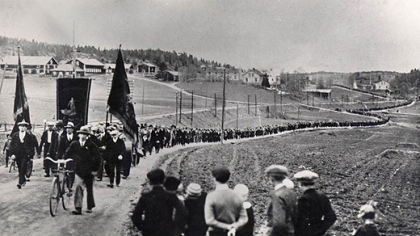
(A march in Ådalen, Sweden, in 1931.)
Both countries had a history of horrendous poverty. When the 1 percent was in charge, hundreds of thousands of people emigrated to avoid starvation. Under the leadership of the working class, however, both countries built robust and successful economies that nearly eliminated poverty, expanded free university education, abolished slums, provided excellent health care available to all as a matter of right and created a system of full employment. Unlike the Norwegians, the Swedes didn’t find oil, but that didn’t stop them from building what the latest CIA World Factbook calls “an enviable standard of living.”
Neither country is a utopia, as readers of the crime novels by Stieg Larsson, Henning Mankell and Jo Nesbro will know. Critical left-wing authors such as these try to push Sweden and Norway to continue on the path toward more fully just societies. However, as an American activist who first encountered Norway as a student in 1959 and learned some of its language and culture, the achievements I found amazed me. I remember, for example, bicycling for hours through a small industrial city, looking in vain for substandard housing. Sometimes resisting the evidence of my eyes, I made up stories that “accounted for” the differences I saw: “small country,” “homogeneous,” “a value consensus.” I finally gave up imposing my frameworks on these countries and learned the real reason: their own histories.
Then I began to learn that the Swedes and Norwegians paid a price for their standards of living through nonviolent struggle. There was a time when Scandinavian workers didn’t expect that the electoral arena could deliver the change they believed in. They realized that, with the 1 percent in charge, electoral “democracy” was stacked against them, so nonviolent direct action was needed to exert the power for change.
In both countries, the troops were called out to defend the 1 percent; people died. Award-winning Swedish filmmaker Bo Widerberg told the Swedish story vividly in Ådalen 31, which depicts the strikers killed in 1931 and the sparking of a nationwide general strike. (You can read more about this case in an entry by Max Rennebohm in the Global Nonviolent Action Database.)
The Norwegians had a harder time organizing a cohesive people’s movement because Norway’s small population—about three million—was spread out over a territory the size of Britain. People were divided by mountains and fjords, and they spoke regional dialects in isolated valleys. In the nineteenth century, Norway was ruled by Denmark and then by Sweden; in the context of Europe Norwegians were the “country rubes,” of little consequence. Not until 1905 did Norway finally become independent.
When workers formed unions in the early 1900s, they generally turned to Marxism, organizing for revolution as well as immediate gains. They were overjoyed by the overthrow of the czar in Russia, and the Norwegian Labor Party joined the Communist International organized by Lenin. Labor didn’t stay long, however. One way in which most Norwegians parted ways with Leninist strategy was on the role of violence: Norwegians wanted to win their revolution through collective nonviolent struggle, along with establishing co-ops and using the electoral arena.
In the 1920s strikes increased in intensity. The town of Hammerfest formed a commune in 1921, led by workers councils; the army intervened to crush it. The workers’ response verged toward a national general strike. The employers, backed by the state, beat back that strike, but workers erupted again in the ironworkers’ strike of 1923–24.
The Norwegian 1 percent decided not to rely simply on the army; in 1926 they formed a social movement called the Patriotic League, recruiting mainly from the middle class. By the 1930s, the League included as many as 100,000 people for armed protection of strike breakers—this in a country of only 3 million!
The Labor Party, in the meantime, opened its membership to anyone, whether or not in a unionized workplace. Middle-class Marxists and some reformers joined the party. Many rural farm workers joined the Labor Party, as well as some small landholders. Labor leadership understood that in a protracted struggle, constant outreach and organizing was needed to a nonviolent campaign. In the midst of the growing polarization, Norway’s workers launched another wave of strikes and boycotts in 1928.
The Depression hit bottom in 1931. More people were jobless there than in any other Nordic country. Unlike in the U.S., the Norwegian union movement kept the people thrown out of work as members, even though they couldn’t pay dues. This decision paid off in mass mobilizations. When the employers’ federation locked employees out of the factories to try to force a reduction of wages, the workers fought back with massive demonstrations.
Many people then found that their mortgages were in jeopardy. (Sound familiar?) The Depression continued, and farmers were unable to keep up payment on their debts. As turbulence hit the rural sector, crowds gathered nonviolently to prevent the eviction of families from their farms. The Agrarian Party, which included larger farmers and had previously been allied with the Conservative Party, began to distance itself from the 1 percent; some could see that the ability of the few to rule the many was in doubt.
By 1935, Norway was on the brink. The Conservative-led government was losing legitimacy daily; the 1 percent became increasingly desperate as militancy grew among workers and farmers. A complete overthrow might be just a couple years away, radical workers thought. However, the misery of the poor became more urgent daily, and the Labor Party felt increasing pressure from its members to alleviate their suffering, which it could do only if it took charge of the government in a compromise agreement with the other side.
This it did. In a compromise that allowed owners to retain the right to own and manage their firms, Labor in 1935 took the reins of government in coalition with the Agrarian Party. They expanded the economy and started public works projects to head toward a policy of full employment that became the keystone of Norwegian economic policy. Labor’s success and the continued militancy of workers enabled steady inroads against the privileges of the 1 percent, to the point that majority ownership of all large firms was taken by the public interest. (There is an entry on this case as well at the Global Nonviolent Action Database.)
The 1 percent thereby lost its historic power to dominate the economy and society. Not until three decades later could the Conservatives return to a governing coalition, having by then accepted the new rules of the game, including a high degree of public ownership of the means of production, extremely progressive taxation, strong business regulation for the public good and the virtual abolition of poverty. When Conservatives eventually tried a fling with neoliberal policies, the economy generated a bubble and headed for disaster. (Sound familiar?)
Labor stepped in, seized the three largest banks, fired the top management, left the stockholders without a dime and refused to bail out any of the smaller banks. The well-purged Norwegian financial sector was not one of those countries that lurched into crisis in 2008; carefully regulated and much of it publicly owned, the sector was solid.
Although Norwegians may not tell you about this the first time you meet them, the fact remains that their society’s high level of freedom and broadly-shared prosperity began when workers and farmers, along with middle class allies, waged a nonviolent struggle that empowered the people to govern for the common good.
This work is licensed under a Creative Commons Attribution-Share Alike 3.0 United States License

While many of us are working to ensure that the Occupy movement will have a lasting impact, it’s worthwhile to consider other countries where masses of people succeeded in nonviolently bringing about a high degree of democracy and economic justice.
Sweden and Norway, for example, both experienced a major power shift in the 1930s after prolonged nonviolent struggle. They “fired” the top 1 percent of people who set the direction for society and created the basis for something different.
(A march in Ådalen, Sweden, in 1931.)
Both countries had a history of horrendous poverty. When the 1 percent was in charge, hundreds of thousands of people emigrated to avoid starvation. Under the leadership of the working class, however, both countries built robust and successful economies that nearly eliminated poverty, expanded free university education, abolished slums, provided excellent health care available to all as a matter of right and created a system of full employment. Unlike the Norwegians, the Swedes didn’t find oil, but that didn’t stop them from building what the latest CIA World Factbook calls “an enviable standard of living.”
Neither country is a utopia, as readers of the crime novels by Stieg Larsson, Henning Mankell and Jo Nesbro will know. Critical left-wing authors such as these try to push Sweden and Norway to continue on the path toward more fully just societies. However, as an American activist who first encountered Norway as a student in 1959 and learned some of its language and culture, the achievements I found amazed me. I remember, for example, bicycling for hours through a small industrial city, looking in vain for substandard housing. Sometimes resisting the evidence of my eyes, I made up stories that “accounted for” the differences I saw: “small country,” “homogeneous,” “a value consensus.” I finally gave up imposing my frameworks on these countries and learned the real reason: their own histories.
Then I began to learn that the Swedes and Norwegians paid a price for their standards of living through nonviolent struggle. There was a time when Scandinavian workers didn’t expect that the electoral arena could deliver the change they believed in. They realized that, with the 1 percent in charge, electoral “democracy” was stacked against them, so nonviolent direct action was needed to exert the power for change.
In both countries, the troops were called out to defend the 1 percent; people died. Award-winning Swedish filmmaker Bo Widerberg told the Swedish story vividly in Ådalen 31, which depicts the strikers killed in 1931 and the sparking of a nationwide general strike. (You can read more about this case in an entry by Max Rennebohm in the Global Nonviolent Action Database.)
The Norwegians had a harder time organizing a cohesive people’s movement because Norway’s small population—about three million—was spread out over a territory the size of Britain. People were divided by mountains and fjords, and they spoke regional dialects in isolated valleys. In the nineteenth century, Norway was ruled by Denmark and then by Sweden; in the context of Europe Norwegians were the “country rubes,” of little consequence. Not until 1905 did Norway finally become independent.
When workers formed unions in the early 1900s, they generally turned to Marxism, organizing for revolution as well as immediate gains. They were overjoyed by the overthrow of the czar in Russia, and the Norwegian Labor Party joined the Communist International organized by Lenin. Labor didn’t stay long, however. One way in which most Norwegians parted ways with Leninist strategy was on the role of violence: Norwegians wanted to win their revolution through collective nonviolent struggle, along with establishing co-ops and using the electoral arena.
In the 1920s strikes increased in intensity. The town of Hammerfest formed a commune in 1921, led by workers councils; the army intervened to crush it. The workers’ response verged toward a national general strike. The employers, backed by the state, beat back that strike, but workers erupted again in the ironworkers’ strike of 1923–24.
The Norwegian 1 percent decided not to rely simply on the army; in 1926 they formed a social movement called the Patriotic League, recruiting mainly from the middle class. By the 1930s, the League included as many as 100,000 people for armed protection of strike breakers—this in a country of only 3 million!
The Labor Party, in the meantime, opened its membership to anyone, whether or not in a unionized workplace. Middle-class Marxists and some reformers joined the party. Many rural farm workers joined the Labor Party, as well as some small landholders. Labor leadership understood that in a protracted struggle, constant outreach and organizing was needed to a nonviolent campaign. In the midst of the growing polarization, Norway’s workers launched another wave of strikes and boycotts in 1928.
The Depression hit bottom in 1931. More people were jobless there than in any other Nordic country. Unlike in the U.S., the Norwegian union movement kept the people thrown out of work as members, even though they couldn’t pay dues. This decision paid off in mass mobilizations. When the employers’ federation locked employees out of the factories to try to force a reduction of wages, the workers fought back with massive demonstrations.
Many people then found that their mortgages were in jeopardy. (Sound familiar?) The Depression continued, and farmers were unable to keep up payment on their debts. As turbulence hit the rural sector, crowds gathered nonviolently to prevent the eviction of families from their farms. The Agrarian Party, which included larger farmers and had previously been allied with the Conservative Party, began to distance itself from the 1 percent; some could see that the ability of the few to rule the many was in doubt.
By 1935, Norway was on the brink. The Conservative-led government was losing legitimacy daily; the 1 percent became increasingly desperate as militancy grew among workers and farmers. A complete overthrow might be just a couple years away, radical workers thought. However, the misery of the poor became more urgent daily, and the Labor Party felt increasing pressure from its members to alleviate their suffering, which it could do only if it took charge of the government in a compromise agreement with the other side.
This it did. In a compromise that allowed owners to retain the right to own and manage their firms, Labor in 1935 took the reins of government in coalition with the Agrarian Party. They expanded the economy and started public works projects to head toward a policy of full employment that became the keystone of Norwegian economic policy. Labor’s success and the continued militancy of workers enabled steady inroads against the privileges of the 1 percent, to the point that majority ownership of all large firms was taken by the public interest. (There is an entry on this case as well at the Global Nonviolent Action Database.)
The 1 percent thereby lost its historic power to dominate the economy and society. Not until three decades later could the Conservatives return to a governing coalition, having by then accepted the new rules of the game, including a high degree of public ownership of the means of production, extremely progressive taxation, strong business regulation for the public good and the virtual abolition of poverty. When Conservatives eventually tried a fling with neoliberal policies, the economy generated a bubble and headed for disaster. (Sound familiar?)
Labor stepped in, seized the three largest banks, fired the top management, left the stockholders without a dime and refused to bail out any of the smaller banks. The well-purged Norwegian financial sector was not one of those countries that lurched into crisis in 2008; carefully regulated and much of it publicly owned, the sector was solid.
Although Norwegians may not tell you about this the first time you meet them, the fact remains that their society’s high level of freedom and broadly-shared prosperity began when workers and farmers, along with middle class allies, waged a nonviolent struggle that empowered the people to govern for the common good.
This work is licensed under a Creative Commons Attribution-Share Alike 3.0 United States License
Resource: Digitized Newspapers from the turn of the last century
The Library of Congress' Chronicling America provides free access to more than a million pages of historic newspapers from 11 states, published between 1880 and 1922.
Propaganda: Don't let Texas rewrite your kids' history books
Led by far-right ideologues, the Texas State Board of Education recently gave preliminary approval to a plan that would radically change what children across the country learn in history class.
The ultra-conservative majority on the board - none of whom are experts in any academic discipline and many of whom are explicitly anti-science - took the curricula proposed by teachers and made over a hundred changes to "correct" the perceived left-wing bias.
But it gets worse. Since Texas is one of the largest textbook markets in the country, material written to cater to the Texas curricula will find its way into textbooks across the country unless textbook publishers take a stand.
Children who use textbooks conforming to the new standards will not learn anything about the political philosophy of Thomas Jefferson or his thoughts on the separation of church and state. When they learn about the Civil War, they'll have to study Jefferson Davis' inaugural address alongside Abraham Lincoln's. And when they study the civil rights movement they'll have to learn about the "unintended consequences" of Great Society programs, affirmative action and Title IX.
It's outrageous. Education will fail if we can't teach our children history. We can't let these far-right ideologues co-opt our educational system.
Sign the petition to tell the textbook publishers: Don't let Texas rewrite history. -- from the CREDO Action website
Action: Sign the petition
Background: How Christian Were the Founders? and Texas Conservatives Win Curriculum Change (both New York Times)
The ultra-conservative majority on the board - none of whom are experts in any academic discipline and many of whom are explicitly anti-science - took the curricula proposed by teachers and made over a hundred changes to "correct" the perceived left-wing bias.
But it gets worse. Since Texas is one of the largest textbook markets in the country, material written to cater to the Texas curricula will find its way into textbooks across the country unless textbook publishers take a stand.
Children who use textbooks conforming to the new standards will not learn anything about the political philosophy of Thomas Jefferson or his thoughts on the separation of church and state. When they learn about the Civil War, they'll have to study Jefferson Davis' inaugural address alongside Abraham Lincoln's. And when they study the civil rights movement they'll have to learn about the "unintended consequences" of Great Society programs, affirmative action and Title IX.
It's outrageous. Education will fail if we can't teach our children history. We can't let these far-right ideologues co-opt our educational system.
Sign the petition to tell the textbook publishers: Don't let Texas rewrite history. -- from the CREDO Action website
Action: Sign the petition
Background: How Christian Were the Founders? and Texas Conservatives Win Curriculum Change (both New York Times)
Ambience Chasers: The Lower East Side
Until you make it to the Lower East Side Tenement Museum, at 108 Orchard St. (below Delancey), console yourself with the museum's new CD, Folk Songs for the Five Points, a collection of experimental music capturing the sounds, and the spirit, of one of New York's oldest and most culturally diverse neighborhoods. The album was created from audio fragments caught on location in the Lower East Side and remixed by cross-disciplinary artist David Gunn. Featuring new compositions by Angolan composer and instrument-builder, Victor Gama, the CD combines oral histories, local music, and Alan Lomax-style ambient field recordings -- from the street cries of market sellers in Chinatown to the screech of the subway, from church sermons to buskers on Spring Street -- to create a unique document of my old stomping grounds. Gunn has reinterpreted and transformed these sounds, creating surprising and evocative pieces like a queasy re-imagining of ice cream van music and a deconstructed performance by celebrated Nuyorican poet Tato Laviera.
The CD has its roots in a Digital Artist in Residence Project commissioned by the museum and part of an ongoing series of works by The Folk Songs Project. For The Tenement, as it likes to be called, Gunn and his collaborators in the Folk Songs Project, Alastair Dant and Tom Davis, created an interactive site where users could remix various noises and music to create their own "folk songs." Gunn recorded a wide variety of sounds, based on the suggestions of local residents and chance events as he walked the streets of the Lower East Side. Gama was invited to New York to create a series of compositions inspired by the neighborhood. The results, performed on the "toha" (an instrument conceived and built by the artist), were recorded in one take on a hot evening in an unrestored apartment in the museum's historic tenement building. The album was conceived as a collection of "folk songs" -- field recordings is more like it -- not finished compositions, but snapshots of moments in time. With this in mind, Gunn avoided the rigid aesthetics of modern electronic music, using simple editing and effects processes to retain a sense of immediacy and the unpredictable aspects of the source recordings -- tape glitches, wind noise, and radio interference. The result is a powerful, compelling portrait of a living, breathing community of sounds: not for everybody, but fascinating if you like this sort of thing, and time-capsule ready, should the need arise.
The CD has its roots in a Digital Artist in Residence Project commissioned by the museum and part of an ongoing series of works by The Folk Songs Project. For The Tenement, as it likes to be called, Gunn and his collaborators in the Folk Songs Project, Alastair Dant and Tom Davis, created an interactive site where users could remix various noises and music to create their own "folk songs." Gunn recorded a wide variety of sounds, based on the suggestions of local residents and chance events as he walked the streets of the Lower East Side. Gama was invited to New York to create a series of compositions inspired by the neighborhood. The results, performed on the "toha" (an instrument conceived and built by the artist), were recorded in one take on a hot evening in an unrestored apartment in the museum's historic tenement building. The album was conceived as a collection of "folk songs" -- field recordings is more like it -- not finished compositions, but snapshots of moments in time. With this in mind, Gunn avoided the rigid aesthetics of modern electronic music, using simple editing and effects processes to retain a sense of immediacy and the unpredictable aspects of the source recordings -- tape glitches, wind noise, and radio interference. The result is a powerful, compelling portrait of a living, breathing community of sounds: not for everybody, but fascinating if you like this sort of thing, and time-capsule ready, should the need arise.
Subscribe to:
Posts (Atom)


