


Bush the Younger abused executive power and overstepped constitutional boundaries.Democrats test limits of oversight powers on Trump by Jacqueline Thomsen and Morgan Chalfant (The Hill)
Congress did nothing.
Obama abused executive power and overstepped constitutional boundaries.
Congress did nothing.
Then came Trump.
Congress?
Showing posts with label U.S. Constitution. Show all posts
Showing posts with label U.S. Constitution. Show all posts
End Game?

quote unquote: James Madison

James Madison: The Structure of the Government Must Furnish the Proper Checks and Balances Between the Different Departments [The Federalist No. 51], Independent Journal, New York, Wednesday, February 6, 1788.
quote unquote: Thomas Jefferson
I am certainly not an advocate for frequent and untried changes in laws and constitutions. I think moderate imperfections had better be borne with; because, when once known, we accommodate ourselves to them,
and find practical means of correcting their ill effects. But I know also, that laws and institutions must go hand in hand with the progress of the human mind. As that becomes more developed, more enlightened, as new discoveries are made, new truths disclosed, and manners and opinions change with the change of circumstances, institutions must advance also, and keep pace with the times. We might as well require a man to wear still the coat which fitted him when a boy, as civilized society to remain ever under the regimen of their barbarous ancestors." -- Thomas Jefferson, writing to H. Tompkinson (aka Samuel Kercheval), July 12, 1816

Rule of Law
Ex-CIA chief Mike Pompeo says the president has authority launch missile strikes without congressional action: "I don't think that has been disputed by Republicans or Democrats throughout an extended period of time."
Sen. Rand Paul: "Actually, it's disputed mostly by our Founding Fathers."
Sen. Rand Paul: "Actually, it's disputed mostly by our Founding Fathers."
A dozen here, a dozen there, pretty soon it adds up to mass murder.
The Second Amendment is not a paragraph in a suicide pact.
"The current FBI definition of mass murder, commonly accepted by the media as a proxy for 'mass gun violence', is three or more people murdered in one event. We believe this does not capture the whole

Using this definition, there have been 41 mass shootings in the United States since January 1, 2018.
How about an ambassador for liberty and justice for all?
“Democrats plan to force Senate Majority Leader Mitch McConnell to take extra procedural steps on” Gov. Sam Brownback’s confirmation “as ambassador for religious liberty because of his record on gay rights” (Kansas City Star), begging the question why a secular nation with a constitutional barrier between church and state has an ambassador for religious liberty.
It's not just Obama.
It's going to be important in 2014 -- in terms of manpower; donations; Green, Peace & Freedom and independent challenges; etc. -- to remember who is responsible for what.
Apparently, House Democratic minority leader Nancy Pelosi influenced Democratic members of whom we can usually expect better, such as Debbie Wasserman Schultz (FL), Sheila Jackson Lee (TX), Luis Gutierrez (IL), Jan Schakowsky (IL), Marcy Kaptur (OH), Chris Van Hollen (MD), Steve Israel (NY), Ami Bera (CA), Joaquin Castro (TX), Joe Kennedy (MA), Annie Kuster (NH), Nita Lowey (NY) and Louise Slaughter (NY), to vote to protect NSA's power. If only 12 of them had opposed the program, some spying would have been stopped.
That the vote was close is good news, however: it offers hope that opponents will be encouraged to keep fighting.
How Nancy Pelosi Saved the NSA Surveillance Program: "The obituary of Rep. Justin Amash's amendment to claw back the sweeping powers of the National Security Agency has largely been written as a victory for the White House and NSA chief Keith Alexander, who lobbied the Hill aggressively in the days and hours ahead of Wednesday's shockingly close vote. But Hill sources say most of the credit for the amendment's defeat goes to someone else: House Minority Leader Nancy Pelosi. It's an odd turn, considering that Pelosi has been, on many occasions, a vocal surveillance critic...."
The rest of the story: http://thecable.foreignpolicy.com/posts/2013/07/25/how_nancy_pelosi_saved_the_nsa_surveillance_program
More on possible congressional resistance to domestic spying: Six Ways Congress May Reform NSA Snooping
Apparently, House Democratic minority leader Nancy Pelosi influenced Democratic members of whom we can usually expect better, such as Debbie Wasserman Schultz (FL), Sheila Jackson Lee (TX), Luis Gutierrez (IL), Jan Schakowsky (IL), Marcy Kaptur (OH), Chris Van Hollen (MD), Steve Israel (NY), Ami Bera (CA), Joaquin Castro (TX), Joe Kennedy (MA), Annie Kuster (NH), Nita Lowey (NY) and Louise Slaughter (NY), to vote to protect NSA's power. If only 12 of them had opposed the program, some spying would have been stopped.
That the vote was close is good news, however: it offers hope that opponents will be encouraged to keep fighting.
How Nancy Pelosi Saved the NSA Surveillance Program: "The obituary of Rep. Justin Amash's amendment to claw back the sweeping powers of the National Security Agency has largely been written as a victory for the White House and NSA chief Keith Alexander, who lobbied the Hill aggressively in the days and hours ahead of Wednesday's shockingly close vote. But Hill sources say most of the credit for the amendment's defeat goes to someone else: House Minority Leader Nancy Pelosi. It's an odd turn, considering that Pelosi has been, on many occasions, a vocal surveillance critic...."
The rest of the story: http://thecable.foreignpolicy.com/posts/2013/07/25/how_nancy_pelosi_saved_the_nsa_surveillance_program
More on possible congressional resistance to domestic spying: Six Ways Congress May Reform NSA Snooping
1) Raise the standard for what records are considered “relevant.”
2) Require NSA analysts to obtain court approval before searching metadata.
3) Declassify Foreign Intelligence Surveillance Court opinions.
4) Change the way Foreign Intelligence Surveillance Court judges are appointed.
5) Appoint a public advocate to argue before the Foreign Intelligence Surveillance Court.
6) End phone metadata collection on constitutional grounds.
Democracy: Bulk up the House. Dump the Senate.
A number of initiatives and referenda have been cleared for circulation by the California Secretary of State, including,
Democracy is badly in need of reform. What was practicable in the days of horses and buggies may be appropriate no longer. If the Founders were inventing the United States now, Paine would be tweeting, Hamilton, Madison and Jay would have a blog, and Jefferson and Adams would be arguing over at Constitution.Org. The system they would devise today would look nothing like the Rube Goldberg contraption they arrived at by compromise more than two centuries ago. For sure, they'd consider the current constitutional release as beta.
See, also:
The Big House by Sean Wilentz and Micheal Merrill (The New Republic 1992-11-16).
How Can the U.S. House Be Made More Representative? by J.F. Zimmerman and W. Rule (Political Science and Politics Volume 31, Number 1; 1998).
House of Representatives: Setting the Size at 435 by David C. Huckabee (pdf) (CRS Report for Congress 1995-07-11).
Beyond Administrative Apportionment: Rediscovering the Calculus of Representative Government by John A. Kromkowski (pdf) (Polity, Vol. XXIV, No. 3 Spring 1992).
A House of Our Own or A House We’ve Outgrown? An Argument for Increasing the Size of the House of Representatives by Christopher St. John Yates Columbia Journal of Law and Social Problems 1992).
How to build a better House: Why Not Have 1000 Congressmen? by Jeff Jacoby (Boston Globe 2009-11-08).
Political monopoly power by Walter Williams (Creators Syndicate 2008-10-15).
Why not have 1000 Congressman? by George Will (Townhall 2001-01-14).
Want to be more efficient? Increase number of politicians by Jonah Goldberg (Jewish World Review 2001-01-04).
Increasing the size of Congress could limit campaign spending by Andrew W. Cohen (CNN.com Law Center 200-06-30).
Growth in U.S. Population Calls for Larger House of Representatives by Margo Anderson (Population Today 2000-04).
Full Text 0f Legislature Expansion. Legislative Process. Initiative Constitutional Amendment.
Complete list of California Initiatives and Referenda Cleared for Circulation.
1540. (11-0067) Legislature Expansion. Legislative Process. Initiative Constitutional AmendmentI've proposed elsewhere that the federal legislature be reduced to one house and that the resultant unicameral congress be reconstituted with 30,000 members. Research has shown that beyond about 10,000 voters, districts are too big for citizens effectively to know their representatives. Given the reach of digital technology, participants in a 30K-member body would be able to remain in their district most of the time, meeting with other representatives virtually and conducting the people's business within the grasp of their constituents.
Increases size of Legislature almost 100-fold by dividing current Assembly and Senate districts into neighborhood districts such that each Assemblymember represents about 5,000 persons and each Senator represents about 10,000 persons. Provides for neighborhood district representatives to elect working committees the size of the current Assembly and Senate, 80 Assemblymembers and 40 Senators. Gives working committees the legislative power generally, and sole power to amend bills, but requires approval by appropriate vote of the full membership in each house for passage of any non-urgency bill. Reduces legislators' pay and expenditures. Summary of estimate by Legislative Analyst and Director of Finance of fiscal impact on state and local government: Decreased state spending on the Legislature of over $180 million annually. Increased county election costs, potentially in the range of tens of millions of dollars initially and lower amounts annually thereafter.
Democracy is badly in need of reform. What was practicable in the days of horses and buggies may be appropriate no longer. If the Founders were inventing the United States now, Paine would be tweeting, Hamilton, Madison and Jay would have a blog, and Jefferson and Adams would be arguing over at Constitution.Org. The system they would devise today would look nothing like the Rube Goldberg contraption they arrived at by compromise more than two centuries ago. For sure, they'd consider the current constitutional release as beta.
See, also:
The Big House by Sean Wilentz and Micheal Merrill (The New Republic 1992-11-16).
How Can the U.S. House Be Made More Representative? by J.F. Zimmerman and W. Rule (Political Science and Politics Volume 31, Number 1; 1998).
House of Representatives: Setting the Size at 435 by David C. Huckabee (pdf) (CRS Report for Congress 1995-07-11).
Beyond Administrative Apportionment: Rediscovering the Calculus of Representative Government by John A. Kromkowski (pdf) (Polity, Vol. XXIV, No. 3 Spring 1992).
A House of Our Own or A House We’ve Outgrown? An Argument for Increasing the Size of the House of Representatives by Christopher St. John Yates Columbia Journal of Law and Social Problems 1992).
How to build a better House: Why Not Have 1000 Congressmen? by Jeff Jacoby (Boston Globe 2009-11-08).
Political monopoly power by Walter Williams (Creators Syndicate 2008-10-15).
Why not have 1000 Congressman? by George Will (Townhall 2001-01-14).
Want to be more efficient? Increase number of politicians by Jonah Goldberg (Jewish World Review 2001-01-04).
Increasing the size of Congress could limit campaign spending by Andrew W. Cohen (CNN.com Law Center 200-06-30).
Growth in U.S. Population Calls for Larger House of Representatives by Margo Anderson (Population Today 2000-04).
Full Text 0f Legislature Expansion. Legislative Process. Initiative Constitutional Amendment.
Complete list of California Initiatives and Referenda Cleared for Circulation.
Must Read: How the US Government Strikes Fear in Its Own Citizens and People Around the World
In a recent speech, Glenn Greenwald discussed how the government and media treatment of WikiLeaks is symptomatic of a total lack of respect for the law and government transparency by the secret consortium of government and corporate power that runs the United States.
[Editor's note: The following is an excerpt from the transcript of a speech delivered by Constitutional lawyer and Salon blogger Glenn Greenwald at the Lannan Foundation on March 8. The speech was transcribed by the blog Contumacious. Please visit AlterNet to read the entire speech.]
by Glenn Greenwald
...[P]olitical controversies and political issues never take place in isolation. They're always part of some broader framework, that drives political outcomes, and that determines how political power is exercised. And so it doesn't really matter which specific topic, or which specific controversy of the day you want to discuss, the reality is, you can't really meaningfully discuss any of them without examining all the forces that shape political culture, and that shape how political outcomes are determined. So, in order to talk about any issue, you end up speaking about these same, broad themes, that are shaping, and I think plaguing, the political discourse in the United States.
This is something that I first realized when I started writing about politics in late 2005. One of the very first topics on which I focused was the scandal about the Bush administration eavesdropping on American citizens without the warrants required by law. This was first exposed by the NYT in December of 2005, so it happened around six weeks after I began writing about politics. I had this very naïve idea that this was going to be very straightforward and simple political controversy. The reason I thought that in my naiveté, was because what the Bush administration got caught doing [eavesdropping on Americans without warrants from the FISA court] is as clear as could possibly be a felony under American law. You can actually look at the criminal law that existed since 1978, when FISA was enacted. It says that doing exactly what the Bush administration got caught doing, is a felony in the U.S., just like robbing a bank, or extortion or murder, and that it's punishable by a prison term of five years or a $10,000 fine for each offense.
The report that the NYT published was that there were at least hundreds and probably thousands of instances where American citizens were eavesdropped on illegally and in violation of the law. So, I thought that this was going to be a fairly straightforward controversy, because I had this idea that if you get caught committing a felony, and the NYT writes and reports on that and everybody's talking about that, that that's actually going to be a really bad thing for the person who got caught doing that. I know it was really naïve. I'm actually embarrassed to admit that I thought that, but that really is was I thought at the time. I also thought that basically everybody would be in agreement that that was a really bad thing to do....that thing that the law said for 30 years was a felony and punishable by a prison term and a large fine. And, as it turned out (and I realized this fairly quickly) none of that actually happened. It wasn't a really bad thing for the people who got caught committing that felony.
And, not only did everyone not agree that that was a bad thing, very few people actually agreed that that was a very bad thing. So, what I thought I was going to be able to do was to take this issue and write very legalistically about it, and demonstrate that what the Bush administration had done was a crime, that it was a felony under the statute and that the legal defenses for it that they had raised were frivolous and baseless and that would be the end of the story. Crime committed, investigation commenced, punishment ensues. So what immediately happened, when I realized that none of that was really going on, of course then the question became why. Why was my expectation about what would happen so radically different than what in fact happened?
So, then I needed to delve into that dynamic, that I began by referencing that determines political outcomes. I had to examine the fact that we have a political faction inside the U.S. [the American Right] that is drowning in concepts of nationalism, and exceptionalism, in tribalism that leads them to believe that whatever they and their leaders do is justifiable inherently because they do it, and in a complete lack of principle...this is the same faction that impeached a democratically elected president not more than 10 years earlier on the grounds that the rule of law is paramount and we can't allow our presidents to break the law. And, yet, here they were defending it.
Please read the entire address at How the US Government Strikes Fear in Its Own Citizens and People Around the World by Glenn Greenwald (AlterNet 2011-03-21).
Glenn Greenwald is a constitutional law attorney and chief blogger at Unclaimed Territory. His forthcoming book, How Would a Patriot Act: Defending American Values from a President Run Amok will be released by Working Assets Publishing next month.
[Editor's note: The following is an excerpt from the transcript of a speech delivered by Constitutional lawyer and Salon blogger Glenn Greenwald at the Lannan Foundation on March 8. The speech was transcribed by the blog Contumacious. Please visit AlterNet to read the entire speech.]
by Glenn Greenwald
...[P]olitical controversies and political issues never take place in isolation. They're always part of some broader framework, that drives political outcomes, and that determines how political power is exercised. And so it doesn't really matter which specific topic, or which specific controversy of the day you want to discuss, the reality is, you can't really meaningfully discuss any of them without examining all the forces that shape political culture, and that shape how political outcomes are determined. So, in order to talk about any issue, you end up speaking about these same, broad themes, that are shaping, and I think plaguing, the political discourse in the United States.
This is something that I first realized when I started writing about politics in late 2005. One of the very first topics on which I focused was the scandal about the Bush administration eavesdropping on American citizens without the warrants required by law. This was first exposed by the NYT in December of 2005, so it happened around six weeks after I began writing about politics. I had this very naïve idea that this was going to be very straightforward and simple political controversy. The reason I thought that in my naiveté, was because what the Bush administration got caught doing [eavesdropping on Americans without warrants from the FISA court] is as clear as could possibly be a felony under American law. You can actually look at the criminal law that existed since 1978, when FISA was enacted. It says that doing exactly what the Bush administration got caught doing, is a felony in the U.S., just like robbing a bank, or extortion or murder, and that it's punishable by a prison term of five years or a $10,000 fine for each offense.
The report that the NYT published was that there were at least hundreds and probably thousands of instances where American citizens were eavesdropped on illegally and in violation of the law. So, I thought that this was going to be a fairly straightforward controversy, because I had this idea that if you get caught committing a felony, and the NYT writes and reports on that and everybody's talking about that, that that's actually going to be a really bad thing for the person who got caught doing that. I know it was really naïve. I'm actually embarrassed to admit that I thought that, but that really is was I thought at the time. I also thought that basically everybody would be in agreement that that was a really bad thing to do....that thing that the law said for 30 years was a felony and punishable by a prison term and a large fine. And, as it turned out (and I realized this fairly quickly) none of that actually happened. It wasn't a really bad thing for the people who got caught committing that felony.
And, not only did everyone not agree that that was a bad thing, very few people actually agreed that that was a very bad thing. So, what I thought I was going to be able to do was to take this issue and write very legalistically about it, and demonstrate that what the Bush administration had done was a crime, that it was a felony under the statute and that the legal defenses for it that they had raised were frivolous and baseless and that would be the end of the story. Crime committed, investigation commenced, punishment ensues. So what immediately happened, when I realized that none of that was really going on, of course then the question became why. Why was my expectation about what would happen so radically different than what in fact happened?
So, then I needed to delve into that dynamic, that I began by referencing that determines political outcomes. I had to examine the fact that we have a political faction inside the U.S. [the American Right] that is drowning in concepts of nationalism, and exceptionalism, in tribalism that leads them to believe that whatever they and their leaders do is justifiable inherently because they do it, and in a complete lack of principle...this is the same faction that impeached a democratically elected president not more than 10 years earlier on the grounds that the rule of law is paramount and we can't allow our presidents to break the law. And, yet, here they were defending it.
Please read the entire address at How the US Government Strikes Fear in Its Own Citizens and People Around the World by Glenn Greenwald (AlterNet 2011-03-21).
Glenn Greenwald is a constitutional law attorney and chief blogger at Unclaimed Territory. His forthcoming book, How Would a Patriot Act: Defending American Values from a President Run Amok will be released by Working Assets Publishing next month.
Saturday Catchup 2010-05-15
Mad Crowd Disease: "A new strain of populism is metastasizing before our eyes, nourished by the same libertarian impulses that have unsettled American society for half a century now. Anarchistic like the Sixties, selfish like the Eighties, contradicting neither, it is estranged, aimless, and as juvenile as our new century. It appeals to petulant individuals convinced that they can do everything themselves if they are only left alone, and that others are conspiring to keep them from doing just that. This is the one threat that will bring Americans into the streets. Welcome to the politics of the libertarian mob." -- The Tea Party Jacobins by Mark Lilla (New York Review of Books 2010-05-09).
Alone Together (Naturally): A call for more freedom is really a demand for power, "our power to make real choices, about not only our personal lives but about the forces determining the quality of life in our communities." So many of the factors that affect our opportunity, our freedom to thrive -- general access to quality education and to health care, say, or to public transport and libraries and parks, or to clean air and potable water, to say nothing of police and fire protection -- all require a fair and functioning society. We can’t even achieve the state of being “left alone,” alone. -- Why Freedom Should Be the #1 Issue for Progressives by Frances Moore Lappé (AlterNet 2010-05-13).
The (Tea) Party is over: When trouble comes, those who complain the loudest about big government are the first ones with their hands out for federal help. "Until tea partiers are willing to tear up their Social Security cards and Medicare cards, and reject all help from the FBI, Coast Guard, EPA, FEMA, or any other federal agency, they're nothing but a bunch of phonies." -- The Death of the Tea Party Movement by Bill Press (Baraboo News Republic 2010-06-09).
I'd say Что делать?, but that'd kinda be like raising a red flag: Here's a video from a grass roots campaign that is working to "wrest control of our economy from the big banks, crony capitalists and financial elites:"
( Watch on YouTube.) Action: Go to ForOurEconomy.org, download their 12-point primer on how to seize a measure of control over our economic lives; join; donate; protest.
Change Watch: "There is nothing inherently good about compromise. The ability to form a good compromise, when it is necessary, is an important skill. But you should compromise only when you can’t completely achieve what you want without it. If you have sufficient votes or support for your position and think it is the best choice of action, then you should pursue it. Compromising in that instance is stupid. The problem with Washington is the fake 'compromise fetish' (which is similar to the 'bipartisan fetish') that turned compromise into the desired goal–without regard to policy value or whether there is a need to compromise in the first place. What is the source of this fetish? Compromise destroys accountability. Politicians hate being held accountable and so they have a vested interest to support this fetish and those who share it." -- Compromise Fetishists: How Secret Deals Obscure Accountability, Subvert Democracy by Jon Walker (FireDogLake 2010-05-08).
Or to put it another way, summer's (almost) here and the time is right for fighting in the streets:
Or watch it on YouTube.
Don't want what they're smokin': "Just days after the White House released their inherently flawed 2010 National Drug Control Strategy (Read NORML’s refutation of it on The Huffington Post here and here), and mere hours after Drug Czar Gil Kerlikowske told reporters at the National Press Club, 'I have read thoroughly the ballot proposition in California; I think I once got an e-mail that told me I won the Irish sweepstakes and that actually had more truth in it than the ballot proposition,' the Associated Press takes the entire U.S. drug war strategy and rakes it over the coals. It’s about damn time!" -- After 40 Years, $1 Trillion, US Drug War “Has Failed to Meet Any of Its Goals” by Paul Armentano (AlterNet 2010-05-13).
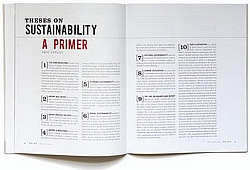 Recycling Rhetoric: "The term has so widely used that it is in danger of meaning nothing. It has been applied to all manner of activities in an effort to give those activities the gloss of moral imperative, the cachet of environmental enlightenment. 'Sustainable' has been used variously to mean 'politically feasible,' 'economically feasible,' 'not part of a pyramid or bubble,' 'socially enlightened,' 'consistent with neoconservative small-government dogma,' 'consistent with liberal principles of justice and fairness,' 'morally desirable,' and, at its most diffuse, 'sensibly far-sighted'.” -- Theses on Sustainability: A Primer by Eric Zencey (Orion magazine 2010-5/6).
Following up on Jon Stewart's brilliant impersonation of Glenn Beck a couple of months back, Lewis Black brings on a diagnosis of Beck's Nazi Tourette's Syndrome:
Or go to The Daily Show.
Budget whoas: Underpinning Defense Secretary Robert Gates’s speech last week on Pentagon spending is an understanding of what Spencer Ackerman calls the "mutually distorting relationship between unsustainable defense budgets and political courage" (Gates Claims Eisenhower’s Mantle, Challenging Pentagon Overspending -- Attackerman 2010-06-08).
Someday, won't we just run out of places to invade?: The House is about to vote on a $33 billion bill "war funding," a euphemism for legislation that will pay for the Obama administration's escalation of the war against Afghanistan that must have George Orwell spinning in his grave. The White House is asking the House to treat the expanded war as a fait accompli. In an excellent account of how we got here, David Swanson asks "how much money are we talking about exactly? Well not enough, evidently, for the teabagging enemies of reckless government spending to take notice. Clearly not enough for the labor movement or any other advocates of spending on jobs or healthcare or education or green energy to disturb their slumbers. God forbid! Yet it's still a sizeable number by a certain reckoning. After all, 33 billion miles could take you to the sun 226 times. And $33 billion could radically alter any non-military program in existence. There's a bill in the senate, for instance, that would prevent schools from laying off teachers in all 50 states for a mere $23 billion. Another $9.6 billion would quadruple the Department of Energy's budget for renewable energy. Now, what to do with that extra $0.4 billion?" Victory at all costs in Afghanistan by David Swanson (Asia Times 2010-05-13).
With friends like these...: "The British government has estimated that 70 percent of the terror plots it has uncovered in the past decade can be traced back to Pakistan. Pakistan remains a terrorist hothouse even as jihadism is losing favor elsewhere in the Muslim world. From Egypt to Jordan to Malaysia to Indonesia, radical Islamic groups have been weakened militarily and have lost much of the support they had politically. Why not in Pakistan? The answer is simple: from its founding, the Pakistani government has supported and encouraged jihadi groups, creating an atmosphere that has allowed them to flourish. It appears to have partially reversed course in recent years, but the rot is deep." -- Terrorism’s Supermarket: Why Pakistan keeps exporting jihad by Fareed Zakaria (Newsweek 2010-05-07).
You think?: "The notion that the government can, in effect, execute one of its own citizens far from a combat zone, with no judicial process and based on secret intelligence, makes some legal authorities deeply uneasy." -- U.S. Approval of Killing of Cleric Causes Unease by Scott Shane (New York Times 2010-05-13).
Be prepared: "In the raw aftermath of a successful attack, it will be very hard for an American president to shift the debate in a more productive and honest direction. Imagine if, after a fatal attack, President Obama responded by proposing greater outreach to Muslim communities domestically and around the world, in an effort to undercut radicalization. That is precisely what we and other nations should be doing, but it would undoubtedly be decried as a weak, starry-eyed reaction by our commander in chief, especially after an attack that revealed deficiencies in our counterterrorism system. But right now, after a near-miss, there is a better opportunity to adjust than in an emotionally charged period when the nation is mourning. Though a good dose of political courage would still be required, it would constitute a major improvement to our debate if leaders could come together now and agree on a few key points about our efforts to battle terrorism." -- The Times Square bomb failed. What will we do when the next bomb works? by Richard A. Clarke (The Washington Post 2010-05-09).
First it was our boys in Afghanistan doing a cover of Lady Gaga. Now, from Iraq, “Watch: Straight Soldiers Show Their Support for Gays in the Military by Dancing to Ke$ha”:
The future's last half century: "Fifty years ago this Sunday, Theodore Maiman and his fellow scientists at Hughes Research Laboratory shined a high-power flash lamp on a ruby rod, triggering a beam of coherent light: the first laser. It wasn’t long before the Pentagon started dreaming up military applications, and futurists were predicting that our soldiers would all get ray guns. Well, not quite. But lasers have revolutionized the U.S. military — changing the way it targets bombs, scares off insurgents, and, yes, blows stuff to bits." Wired's Danger Room remembers some of the greatest hits (and biggest misses) from the first half-century of military lasers. -- 50 Years of Real-Life Ray Guns by Noah Shachtman (Danger Room 2010-05-14).
Not on our airwaves leased from the American people you won't: Faux News refused this ad from the progressive veterans organization Vote Vets:
(also available on YouTube). What's doubly odd is that only a few weeks ago they were running an even stronger spot by same outfit.
Present Shock: A new report from Brookings reveals that our nation now faces five “new realities” that are redefining who we are, where and with whom we live, and how we provide for our own welfare, as well as that of our families and communities. In each of these five areas -- growth and outward expansion, population diversification, aging of the population, uneven higher educational attainment, and income polarization -- the nation reached critical milestones in the 2000s that make those underlying realities too large to ignore any longer. And large metropolitan areas -- the collections of cities, suburbs, and rural areas that house two-thirds of America’s population -- lay squarely at the forefront of these trends. -- State of Metropolitan America: On the Front Lines of Demographic Transformation (pdf) (The Brookings Institution Metropolitan Policy Program 2010).
Burke's Without Peerage: Sometime toward the end of the last millennium, Jerry Wexler and I, spending a happy couple of hours sharing music we liked, discovered that both of thought that, if there was such a thing as the greatest soul singer of all time, it was probably Solomon Burke. Still is.
Or go to YouTube.
Alone Together (Naturally): A call for more freedom is really a demand for power, "our power to make real choices, about not only our personal lives but about the forces determining the quality of life in our communities." So many of the factors that affect our opportunity, our freedom to thrive -- general access to quality education and to health care, say, or to public transport and libraries and parks, or to clean air and potable water, to say nothing of police and fire protection -- all require a fair and functioning society. We can’t even achieve the state of being “left alone,” alone. -- Why Freedom Should Be the #1 Issue for Progressives by Frances Moore Lappé (AlterNet 2010-05-13).
The (Tea) Party is over: When trouble comes, those who complain the loudest about big government are the first ones with their hands out for federal help. "Until tea partiers are willing to tear up their Social Security cards and Medicare cards, and reject all help from the FBI, Coast Guard, EPA, FEMA, or any other federal agency, they're nothing but a bunch of phonies." -- The Death of the Tea Party Movement by Bill Press (Baraboo News Republic 2010-06-09).
I'd say Что делать?, but that'd kinda be like raising a red flag: Here's a video from a grass roots campaign that is working to "wrest control of our economy from the big banks, crony capitalists and financial elites:"
( Watch on YouTube.) Action: Go to ForOurEconomy.org, download their 12-point primer on how to seize a measure of control over our economic lives; join; donate; protest.
Change Watch: "There is nothing inherently good about compromise. The ability to form a good compromise, when it is necessary, is an important skill. But you should compromise only when you can’t completely achieve what you want without it. If you have sufficient votes or support for your position and think it is the best choice of action, then you should pursue it. Compromising in that instance is stupid. The problem with Washington is the fake 'compromise fetish' (which is similar to the 'bipartisan fetish') that turned compromise into the desired goal–without regard to policy value or whether there is a need to compromise in the first place. What is the source of this fetish? Compromise destroys accountability. Politicians hate being held accountable and so they have a vested interest to support this fetish and those who share it." -- Compromise Fetishists: How Secret Deals Obscure Accountability, Subvert Democracy by Jon Walker (FireDogLake 2010-05-08).
Or to put it another way, summer's (almost) here and the time is right for fighting in the streets:
Or watch it on YouTube.
Don't want what they're smokin': "Just days after the White House released their inherently flawed 2010 National Drug Control Strategy (Read NORML’s refutation of it on The Huffington Post here and here), and mere hours after Drug Czar Gil Kerlikowske told reporters at the National Press Club, 'I have read thoroughly the ballot proposition in California; I think I once got an e-mail that told me I won the Irish sweepstakes and that actually had more truth in it than the ballot proposition,' the Associated Press takes the entire U.S. drug war strategy and rakes it over the coals. It’s about damn time!" -- After 40 Years, $1 Trillion, US Drug War “Has Failed to Meet Any of Its Goals” by Paul Armentano (AlterNet 2010-05-13).
Recycling Rhetoric: "The term has so widely used that it is in danger of meaning nothing. It has been applied to all manner of activities in an effort to give those activities the gloss of moral imperative, the cachet of environmental enlightenment. 'Sustainable' has been used variously to mean 'politically feasible,' 'economically feasible,' 'not part of a pyramid or bubble,' 'socially enlightened,' 'consistent with neoconservative small-government dogma,' 'consistent with liberal principles of justice and fairness,' 'morally desirable,' and, at its most diffuse, 'sensibly far-sighted'.” -- Theses on Sustainability: A Primer by Eric Zencey (Orion magazine 2010-5/6).Following up on Jon Stewart's brilliant impersonation of Glenn Beck a couple of months back, Lewis Black brings on a diagnosis of Beck's Nazi Tourette's Syndrome:
Or go to The Daily Show.
Budget whoas: Underpinning Defense Secretary Robert Gates’s speech last week on Pentagon spending is an understanding of what Spencer Ackerman calls the "mutually distorting relationship between unsustainable defense budgets and political courage" (Gates Claims Eisenhower’s Mantle, Challenging Pentagon Overspending -- Attackerman 2010-06-08).
Someday, won't we just run out of places to invade?: The House is about to vote on a $33 billion bill "war funding," a euphemism for legislation that will pay for the Obama administration's escalation of the war against Afghanistan that must have George Orwell spinning in his grave. The White House is asking the House to treat the expanded war as a fait accompli. In an excellent account of how we got here, David Swanson asks "how much money are we talking about exactly? Well not enough, evidently, for the teabagging enemies of reckless government spending to take notice. Clearly not enough for the labor movement or any other advocates of spending on jobs or healthcare or education or green energy to disturb their slumbers. God forbid! Yet it's still a sizeable number by a certain reckoning. After all, 33 billion miles could take you to the sun 226 times. And $33 billion could radically alter any non-military program in existence. There's a bill in the senate, for instance, that would prevent schools from laying off teachers in all 50 states for a mere $23 billion. Another $9.6 billion would quadruple the Department of Energy's budget for renewable energy. Now, what to do with that extra $0.4 billion?" Victory at all costs in Afghanistan by David Swanson (Asia Times 2010-05-13).
With friends like these...: "The British government has estimated that 70 percent of the terror plots it has uncovered in the past decade can be traced back to Pakistan. Pakistan remains a terrorist hothouse even as jihadism is losing favor elsewhere in the Muslim world. From Egypt to Jordan to Malaysia to Indonesia, radical Islamic groups have been weakened militarily and have lost much of the support they had politically. Why not in Pakistan? The answer is simple: from its founding, the Pakistani government has supported and encouraged jihadi groups, creating an atmosphere that has allowed them to flourish. It appears to have partially reversed course in recent years, but the rot is deep." -- Terrorism’s Supermarket: Why Pakistan keeps exporting jihad by Fareed Zakaria (Newsweek 2010-05-07).
You think?: "The notion that the government can, in effect, execute one of its own citizens far from a combat zone, with no judicial process and based on secret intelligence, makes some legal authorities deeply uneasy." -- U.S. Approval of Killing of Cleric Causes Unease by Scott Shane (New York Times 2010-05-13).
Be prepared: "In the raw aftermath of a successful attack, it will be very hard for an American president to shift the debate in a more productive and honest direction. Imagine if, after a fatal attack, President Obama responded by proposing greater outreach to Muslim communities domestically and around the world, in an effort to undercut radicalization. That is precisely what we and other nations should be doing, but it would undoubtedly be decried as a weak, starry-eyed reaction by our commander in chief, especially after an attack that revealed deficiencies in our counterterrorism system. But right now, after a near-miss, there is a better opportunity to adjust than in an emotionally charged period when the nation is mourning. Though a good dose of political courage would still be required, it would constitute a major improvement to our debate if leaders could come together now and agree on a few key points about our efforts to battle terrorism." -- The Times Square bomb failed. What will we do when the next bomb works? by Richard A. Clarke (The Washington Post 2010-05-09).
First it was our boys in Afghanistan doing a cover of Lady Gaga. Now, from Iraq, “Watch: Straight Soldiers Show Their Support for Gays in the Military by Dancing to Ke$ha”:
The future's last half century: "Fifty years ago this Sunday, Theodore Maiman and his fellow scientists at Hughes Research Laboratory shined a high-power flash lamp on a ruby rod, triggering a beam of coherent light: the first laser.
It wasn’t long before the Pentagon started dreaming up military applications, and futurists were predicting that our soldiers would all get ray guns. Well, not quite. But lasers have revolutionized the U.S. military — changing the way it targets bombs, scares off insurgents, and, yes, blows stuff to bits." Wired's Danger Room remembers some of the greatest hits (and biggest misses) from the first half-century of military lasers. -- 50 Years of Real-Life Ray Guns by Noah Shachtman (Danger Room 2010-05-14).Not on our airwaves leased from the American people you won't: Faux News refused this ad from the progressive veterans organization Vote Vets:
(also available on YouTube). What's doubly odd is that only a few weeks ago they were running an even stronger spot by same outfit.
Present Shock: A new report from Brookings reveals that our nation now faces five “new realities” that are redefining who we are, where and with whom we live, and how we provide for our own welfare, as well as that of our families and communities. In each of these five areas -- growth and outward expansion, population diversification, aging of the population, uneven higher educational attainment, and income polarization -- the nation reached critical milestones in the 2000s that make those underlying realities too large to ignore any longer. And large metropolitan areas -- the collections of cities, suburbs, and rural areas that house two-thirds of America’s population -- lay squarely at the forefront of these trends. -- State of Metropolitan America: On the Front Lines of Demographic Transformation (pdf) (The Brookings Institution Metropolitan Policy Program 2010).
Burke's Without Peerage: Sometime toward the end of the last millennium, Jerry Wexler and I, spending a happy couple of hours sharing music we liked, discovered that both of thought that, if there was such a thing as the greatest soul singer of all time, it was probably Solomon Burke. Still is.
Or go to YouTube.
Time for a U.S. Revolution? Fifteen Reasons Why
Writing today on the progressive organizing website Common Dreams, Bill Quigley, who is legal director of the Center for Constitutional Rights and a law professor at Loyola University New Orleans, argues that the time is right for a revolution. "Government does not work for regular people. It appears to work quite well for big corporations, banks, insurance companies, military contractors, lobbyists, and for the rich and powerful. But it does not work for people.
"Look at what our current system has brought us," Quigley continues, "and ask if it is time for a revolution?
It's past time. But a lot of questions need to be answered before it can happen.
The 1776 Declaration of Independence stated that when a long train of abuses by those in power evidence a design to reduce the rights of people to life, liberty and the pursuit of happiness, it is the peoples right, in fact their duty to engage in a revolution.In fact, in the years since the assassinations of King and Sen. Robert Kennedy, there has been a revolution in this country. Since the early 70s, there has been a glacial but enduring shift in power from the people to the multinational corporations and the mechanisms of the security state. During those years the collective goal of a humane community has been replaced by an ideology that makes selfish ambitions primary in nearly every area of American life.
Martin Luther King, Jr., said forty three years ago next month that it was time for a radical revolution of values in the United States. He preached “a true revolution of values will soon cause us to question the fairness and justice of many of our past and present policies.” It is clearer than ever that now is the time for radical change.
"Look at what our current system has brought us," Quigley continues, "and ask if it is time for a revolution?
Over 2.8 million people lost their homes in 2009 to foreclosure or bank repossessions – nearly 8000 each day – higher numbers than the last two years when millions of others also lost their homes.Although Quigley outlines clearly some of the reasons why radical change is necessary, he does does less well with identifying revolutionary forces capable of challenging corporatist and militarist power.
At the same time, the government bailed out Bank of America, Citigroup, AIG, Bear Stearns, Fannie Mae, Freddie Mac, the auto industry and enacted the troubled asset (TARP) program with $1.7 trillion of our money.
Wall Street then awarded itself over $20 billion in bonuses in 2009 alone, an average bonus on top of pay of $123,000.
At the same time, over 17 million people are jobless right now. Millions more are working part-time when they want and need to be working full-time.
Yet the current system allows one single U.S. Senator to stop unemployment and Medicare benefits being paid to millions.
There are now 35 registered lobbyists in Washington DC for every single member of the Senate and House of Representatives, at last count 13,739 in 2009. There are eight lobbyists for every member of Congress working on the health care fiasco alone.
At the same time, the U.S. Supreme Court decided that corporations now have a constitutional right to interfere with elections by pouring money into races.
The Department of Justice gave a get out of jail free card to its own lawyers who authorized illegal torture.
At the same time another department of government, the Pentagon, is prosecuting Navy SEALS for punching an Iraqi suspect.
The US is not only involved in senseless wars in Iraq, Afghanistan and Pakistan, the U.S. now maintains 700 military bases world-wide and another 6000 in the US and our territories. Young men and women join the military to protect the U.S. and to get college tuition and healthcare coverage and killed and maimed in elective wars and being the world’s police. Wonder whose assets they are protecting and serving?
In fact, the U.S. spends $700 billion directly on military per year, half the military spending of the entire world – much more than Europe, China, Russia, Iran, Pakistan, North Korea, and Venezuela - combined.
The government and private companies have dramatically increased surveillance of people through cameras on public streets and private places, airport searches, phone intercepts, access to personal computers, and compilation of records from credit card purchases, computer views of sites, and travel.
The number of people in jails and prisons in the U.S. has risen sevenfold since 1970 to over 2.3 million. The US puts a higher percentage of our people in jail than any other country in the world.
The tea party people are mad at the Republicans, who they accuse of selling them out to big businesses.Well, okay, some people are mad as hell and are saying they're not going to take it any more. A few members of the mostly inchoate tea party movement are asking the right questions, but so far the teabaggers have been easily manipulated by corporatist shills and political hustlers like Dick Armey, Sarah Palin and Glenn Beck. As far as liberals in the Democratic Party go, we see the New York left being browbeaten to support blue dog Kirsten Gillibrand against one of their own, Jonathan Tasini, to protect a Senate majority the Democrats have been disinclined to use; nearly the entire party leadership seems intent on delivering a Senate seat to GOP-reject Arlen Specter over Democratic Congressman Joe Sestak; in California witness the pathetic sight of supposed progressives Reps. Henry Waxman and Lynn Woolsey endorsing the ultimate agent of the security state, Rep. Jane Harman against a challenger from the left, Marcy Winograd, in a pattern that repeats itself across the country. Only a handful of Democrats, such as Reps. Dennis Kucinich, Alan Grayson, Anthony Weiner, Marcy Kaptur and Barbara Lee appear to be willing to take on the conservative majority that controls both parties.
Democrats are working their way past depression to anger because their party, despite majorities in the House and Senate, has not made significant advances for immigrants, or women, or unions, or African Americans, or environmentalists, or gays and lesbians, or civil libertarians, or people dedicated to health care, or human rights, or jobs or housing or economic justice. Democrats also think their party is selling out to big business.
Forty three years ago next month, Rev. Martin Luther King, Jr. preached in Riverside Church in New York City that “a time comes when silence is betrayal.” He went on to condemn the Vietnam War and the system which created it and the other injustices clearly apparent. “We as a nation must undergo a radical revolution of values. We must rapidly begin the shift from a “thing oriented” society to a “person oriented” society. When machines and computers, profit motives and property rights are considered more important than people, the giant triplets of racism, materialism and militarism are incapable of being conquered.”
It is time.
It's past time. But a lot of questions need to be answered before it can happen.
Must See TV: Abolish the Senate
AfterDowningStreet's David Swanson makes the case for ditching a dysfunctional and anti-democratic anachronism:
The Filibuster
The Subpoena
Q&A
Q&A (cont.)
The Filibuster
The Subpoena
Q&A
Q&A (cont.)
Change Watch: ...plus c'est le même chose
Who made the following statement in response to criticism of U.S. counter-terrorism policies?:
“Politically motivated criticism and unfounded fear-mongering only serve the goals of al-Qaeda.”
Admit it. You're not surprised. With Bush-era policies that undermine civil rights and civil liberties continuing unchallenged and unabated by the administration of Barack Obama, it is hardly surprising to hear the president's minions repeating the same tired rationalizations employed by their discredited predecessors.
In an op-ed in USA Today today, 'We need no lectures': Administration disrupts terrorists’ plots, takes fight to them abroad, Brennan -- sounding like he's channeling Dick Cheney -- writes that politics "should never get in the way of national security. But too many in Washington are now misrepresenting the facts to score political points, instead of coming together to keep us safe." This is the security state at its most transparent. No debate. No consideration by the citizenry of tactics, strategies, morality, common sense. Just shut up and do what we say. We need no lectures, indeed.
More: Obama's embrace of Bush terrorism policies is celebrated as "Centrism" by Glenn Greenwald (Salon 2009-05-15)
“Politically motivated criticism and unfounded fear-mongering only serve the goals of al-Qaeda.”
a. John Yoo, assistant attorney general in the Department of Justice's Office of Legal Counsel during the George W. Bush AdministrationAnswer: c.
b. Alberto Gonzales, Attorney General of the United States under George W. Bush
c. John Brennan, Barack Obama's Assistant to the President and Deputy National Security Advisor for Homeland Security and Counterterrorism
Admit it. You're not surprised. With Bush-era policies that undermine civil rights and civil liberties continuing unchallenged and unabated by the administration of Barack Obama, it is hardly surprising to hear the president's minions repeating the same tired rationalizations employed by their discredited predecessors.
In an op-ed in USA Today today, 'We need no lectures': Administration disrupts terrorists’ plots, takes fight to them abroad, Brennan -- sounding like he's channeling Dick Cheney -- writes that politics "should never get in the way of national security. But too many in Washington are now misrepresenting the facts to score political points, instead of coming together to keep us safe." This is the security state at its most transparent. No debate. No consideration by the citizenry of tactics, strategies, morality, common sense. Just shut up and do what we say. We need no lectures, indeed.
More: Obama's embrace of Bush terrorism policies is celebrated as "Centrism" by Glenn Greenwald (Salon 2009-05-15)
Change Watch: Obama disappoints on media shield law
In another policy flip-flop by Barack Obama, the White House is fighting legislation that could keep journalists out of jail if they decline to violate the trust of sources in cases the government says involve national security. Revisions sent by the administration to Congress would significantly weaken provisions of the Free Flow of Information act that protect reporters from being strong-armed into testifying against confidential sources without judicial review. In an editorial in today's edition, The Miami Herald writes that
The act currently under consideration may be another case where no law would be better than a bad law. The U.S. Constitution lays out the parameters unequivocally: "Congress shall make no law ... abridging the freedom of speech, or of the press." If the courts and the executive need reminders and guidelines to assure that this simple requirement is met, then the legislature is duty-bound to supply them. But the legislature is not required to give the executive cover for end runs around constitutional protections. Without legislative "clarifications," no law would mean no law; the Constitution is so straightforward, federal courts can't stray far from upholding the First Amendment without resorting to sophistry. Rather than bow to authoritarian impulses of the executive, the legislature should just leave the Obama White House to live with the Constitution.
The rest of the story: Obama disappoints on media shield law (editorial, The Miami Herald 2009-10-06)
See, also: A Change That’s Hard to Believe In - Obama calls backsies on shield law by Clint Hendler (Columbia Journalism Review 2009-10-02)
White House Proposes Changes in Bill Protecting Reporters’ Confidentiality by Charlie Savage (New York Times 2009-09-30)
[t]he Obama administration's efforts to impede Senate approval of a law designed to protect reporters from punishment if they refuse to divulge confidential sources are both surprising and utterly disappointing.Disappointing? For sure. Surprising? Hardly. It was always clear that the military and intelligence communities had no reason to fear candidate Obama. The choice of Joe Biden for veep, the promise to expand the war in Afghansitan, the belligerence toward Iran and Parkistan, all were intended to reassure the security state that it would be safe in the hands of President Obama.
As a candidate, Sen. Obama endorsed the "media shield" that allows courts to decide whether a confidential source deserves protection. (So did Sen. John McCain, the Republican contender.) As a senator, Mr. Obama co-sponsored an earlier version of the bill that the Senate Judiciary Committee is considering.
Now that he's the decider, Mr. Obama has developed cold feet. Last week, he let lawmakers know that he wanted the bill changed in a way that would cripple key provisions on when and how to invoke protections for reporters and their sources. This would gut the essential provisions of the proposed law.
No one disputes that there are instances when the government should have the right to compel information to safeguard the public. That is why all versions of the bill offer a qualified, rather than absolute privilege, with courts providing meaningful judicial review to determine when the "media shield" should come into play.
It also requires prosecutors to make reporters the last stop, not the first stop, for finding the source of information. More important, it offers a balancing test that weighs the needs of the government for information against "the public interest in gathering news and maintaining the free flow of information."
The act currently under consideration may be another case where no law would be better than a bad law. The U.S. Constitution lays out the parameters unequivocally: "Congress shall make no law ... abridging the freedom of speech, or of the press."
If the courts and the executive need reminders and guidelines to assure that this simple requirement is met, then the legislature is duty-bound to supply them. But the legislature is not required to give the executive cover for end runs around constitutional protections. Without legislative "clarifications," no law would mean no law; the Constitution is so straightforward, federal courts can't stray far from upholding the First Amendment without resorting to sophistry. Rather than bow to authoritarian impulses of the executive, the legislature should just leave the Obama White House to live with the Constitution.The rest of the story: Obama disappoints on media shield law (editorial, The Miami Herald 2009-10-06)
See, also: A Change That’s Hard to Believe In - Obama calls backsies on shield law by Clint Hendler (Columbia Journalism Review 2009-10-02)
White House Proposes Changes in Bill Protecting Reporters’ Confidentiality by Charlie Savage (New York Times 2009-09-30)
The Senate Caves In Again to Bush on FISA
But the House shows a little moxie
The FISA Amendments Act of 2007 (S. 2248), an "updating" of the 30-year-old law that authorized a secret court to oversee intelligence operations by federal agencies, sailed through the "Democratically-controlled" Senate on Feb 12.
Intended to "modernize and streamline" provisions of the Foreign Intelligence Surveillance Act of 1978, "and for other purposes" (italics added), the act includes a section authorizing warrantless wiretaps of foreign-to-foreign communications and retroactive immunity for telecommunications companies that helped the administration to spy on Americans. The bill also states that the government will not need a warrant for foreign-to-American communications, with no privacy protections on the American end, and will allow the government to install monitoring stations in telephone and internet facilities inside the U.S., also without judicial review.
In effect, the statute provides retroactive immunity to government officials as completely as to the telecoms.
You could be forgiven for thinking that the Democrat's narrow majority was diminished by the defections of a few conservatives like Lieberman and Salazar, but you'd be wrong. The vote wasn't even close.
Sixty-eight senators voted for the bill; only 29 said nay. To put it another way, 19 Democrats -- 40% of the Democratic delegation -- joined Lieberman and the Republicans in voting to gut the Constitution.
Three senators couldn't be bothered to vote at all. One was Lindsey Graham. No loss there. But the others were the two liberal champions who seek to be the leader of their party: Hillary Clinton and Barack Obama.
It's no wonder that millions of American feel disenfranchised by the current system. In the absence of party discipline, there is no downside to lying about who you are or what you'll do once you're in office. Voters pull the lever for a Democrat and wind up with a senator or a representative allied with the GOP and supporting a corrupt, incompetent and fascistic president. Why wouldn't they vote for Ralph Nader the next time, or just stay home? It shouldn't be a shock that more people vote for American Idol than for president; at least you can count on the likes of Kelly Clarkson, Ruben Studdard, Fantasia Barrino, Carrie Underwood and Taylor Hicks to deliver as promised.
The problem with Washington is not that it is narrowly divided between Democrats and Republicans. Nor is Federalism the problem. The problem is that the government -- all branches -- is firmly and utterly in the hands of conservatives. Nothing is changed by dispatching someone to the District for no more compelling reason than that s/he labels self a Democrat. We have to start choosing people who actually will take on the military-industrial complex, engage in the fight against poverty, expand democratic government, protect the environment, and rebuild the country's tattered infrastructure, regardless of party. We have to stop letting conservatives use the Democratic Party to camouflage their dominance of policy. There are no liberals in the Republican congressional delegation; why should conservatives be allowed to hide out among the Democrats? Party labels are just another way of keeping us from figuring out what's really going on.
Instead of sucking up to right wingers in order to cop the choice corner suites in the Senate office buildings, the Democrats should toss traitors like Joe Lieberman out on their Dumbo-sized ears. What has been gained by taking "control" of the Senate, beyond winning for the Democrats a share of the responsibility for the failures of George W. Bush and of the conservative majority that truly controls the legislative agenda? We would have a far more responsive, effective and democratic government if our elected officials were organized along ideological instead of partisan political lines.
With the White House already lost to the center-right, liberals, progressives, peace advocates, environmentalists, labor activists and such can more effectively deploy their time, talent and legal tender to reorienting the Congress than worrying over who's going to be president. Not that there aren't reasons to choose among them, but McCain, Clinton and Obama are more alike than they are different: none of them is going to tackle the radical adjustment in priorities needed if this is to become a just and democratic country. There should be no rush to choose one over another without getting concrete policy commitments in return.
In the matter at hand, for example, here is the list of nominal Democrats who voted with the Republicans to give the president the added power he craves: Baucus (MT), Bayh (IN), Carper (DE), Casey (PA), Conrad (ND), Inouye (HI), Johnson (SD), Kohl (WI), Landrieu (LA), Lincoln (AR), McCaskill (MO), Mikulski (MD), Nelson (FL), Nelson (NE), Rockefeller (WV) -- the bill's sponsor, Salazar (CO), Pryor (AR), Webb (VA) and Whitehouse (D-RI). I'm not saying protecting your rights as citizens should be the only thing on your mind when you vote, but at least it ought to be a consideration.
Besides, many of these names -- Baucus, Casey, Conrad, Johnson, Kohl, Landrieu, the Nelson boys, Lincoln, Pryor, Rockefeller, Salazar -- come up over and over again as stalwart defenders of corporate interests and opponents of economic reform. Put a hand on your wallet and look around for a progressive alternative the next time they come conning for support in your precinct.
The list should give us pause in other ways. It turns out that a candidate's opposition to the war du jour may be an insufficient reason to endorse him if his objection to the conflict is that it has been mismanaged, the position of many corporatist Democrats, Jim Webb apparently among them. By the same token, it is hard to see what was gained by replacing the last liberal Republican, Lincoln Chafee, with the conservative Democrat Sheldon Whitehouse (another possible warning flag to keep in mind this particular election season: the Rhode Island Democrat's campaign slogan was "Change the Senate").
In 2006, the Democratic Senate and House election committees systematically supported conservatives against candidates who ran on such issues as peace and economic justice. With many more progressives in primary races this time than last, activists need to be on the alert for a reappearance of similar tactics in upcoming contests.
The news isn't all bad.
Although the president was at his fearmongering worst last week, in a rare demonstration of backbone, the leadership in the House, balking at shielding phone carriers from privacy lawsuits and at warrantless and unwarranted surveillance of American citizens by their government -- took a two-week Presidents' Day vacation without reauthorizing last summer's temporary domestic wiretapping law.
"By blocking this piece of legislation, our country is more in danger of an attack," Bush said of the House's presumption. "By not giving the professionals the tools they need, it's going to be a lot harder to do the job we need to be able to defend America."
The temporary provisions are set to expire at midnight tonight, but Democrats argued that the basic law will remain in effect and that the president wittingly manufactured the confrontation by threatening to veto a short-term extension that was intended to permit the Senate and House time to deliberate responsibly on revising FISA permanently. "He knows that the underlying 'intelligence' law and the power given to him in the Protect America Act give him sufficient authority to do all of the surveillance and collecting that he needs to do in order to protect the American people," House Speaker Nancy Pelosi told The New York Times on Thursday.
In response to Bush's accusation that Democrats are imperiling the nation's security, House Majority Leader Steny Hoyer accused the president of "fear mongering."
"After refusing to extend current law, the president repeated today his untenable and irresponsible claim that our national security will be jeopardized unless the House immediately rubber-stamps a Senate bill," Hoyer said. "In fact, a wide range of national security experts has made clear that the president and the intelligence community have all the tools they need to protect our nation."
"This is not about protecting Americans," added Illinois Rep. Rahm Emanuel, head of the House Democratic Caucus, on Friday. "The president just wants to protect American telephone companies."
If the bill is so vital, some Democrats wondered, why not sign the measure without the telecoms' "Get Out of Jail Free" card and let the phone companies off the hook with separate legislation?
Whether the rare display of gumption by House leaders is evidence that the Democrats are ready at last to take on the worst excesses of the president remains to be seen. But so low are our expectations by now that it was gratifying to see them display even the faintest profile of courage, notwithstanding that to do it they had to get out of town.
Countdown Special Comment on FISA: President Bush Is A Liar And A Fascist by Keith Olberman (CrooksAndLiars.com, 2008-02-14)
Putting the president above the law (International Herald Tribune, 2008-02-10)
Bush Says Congress Putting US in Danger (AP/NYTimes, 2008-02-15)
Update: House Democrats reject telecom amnesty, warrantless surveillance
The House approved a new FISA bill that denies retroactive immunity to lawbreaking telecoms and which refuses to grant most of the new powers for the President to spy on Americans without warrants. It passed comfortably, by a 213-197 margin. (Salon.com, 2008-03-14)
The FISA Amendments Act of 2007 (S. 2248), an "updating" of the 30-year-old law that authorized a secret court to oversee intelligence operations by federal agencies, sailed through the "Democratically-controlled" Senate on Feb 12.
Intended to "modernize and streamline" provisions of the Foreign Intelligence Surveillance Act of 1978, "and for other purposes" (italics added), the act includes a section authorizing warrantless wiretaps of foreign-to-foreign communications and retroactive immunity for telecommunications companies that helped the administration to spy on Americans. The bill also states that the government will not need a warrant for foreign-to-American communications, with no privacy protections on the American end, and will allow the government to install monitoring stations in telephone and internet facilities inside the U.S., also without judicial review.
In effect, the statute provides retroactive immunity to government officials as completely as to the telecoms.
You could be forgiven for thinking that the Democrat's narrow majority was diminished by the defections of a few conservatives like Lieberman and Salazar, but you'd be wrong. The vote wasn't even close.
Sixty-eight senators voted for the bill; only 29 said nay. To put it another way, 19 Democrats -- 40% of the Democratic delegation -- joined Lieberman and the Republicans in voting to gut the Constitution.
Three senators couldn't be bothered to vote at all. One was Lindsey Graham. No loss there. But the others were the two liberal champions who seek to be the leader of their party: Hillary Clinton and Barack Obama.
It's no wonder that millions of American feel disenfranchised by the current system. In the absence of party discipline, there is no downside to lying about who you are or what you'll do once you're in office. Voters pull the lever for a Democrat and wind up with a senator or a representative allied with the GOP and supporting a corrupt, incompetent and fascistic president. Why wouldn't they vote for Ralph Nader the next time, or just stay home? It shouldn't be a shock that more people vote for American Idol than for president; at least you can count on the likes of Kelly Clarkson, Ruben Studdard, Fantasia Barrino, Carrie Underwood and Taylor Hicks to deliver as promised.
The problem with Washington is not that it is narrowly divided between Democrats and Republicans. Nor is Federalism the problem. The problem is that the government -- all branches -- is firmly and utterly in the hands of conservatives. Nothing is changed by dispatching someone to the District for no more compelling reason than that s/he labels self a Democrat. We have to start choosing people who actually will take on the military-industrial complex, engage in the fight against poverty, expand democratic government, protect the environment, and rebuild the country's tattered infrastructure, regardless of party. We have to stop letting conservatives use the Democratic Party to camouflage their dominance of policy. There are no liberals in the Republican congressional delegation; why should conservatives be allowed to hide out among the Democrats? Party labels are just another way of keeping us from figuring out what's really going on.
Instead of sucking up to right wingers in order to cop the choice corner suites in the Senate office buildings, the Democrats should toss traitors like Joe Lieberman out on their Dumbo-sized ears. What has been gained by taking "control" of the Senate, beyond winning for the Democrats a share of the responsibility for the failures of George W. Bush and of the conservative majority that truly controls the legislative agenda? We would have a far more responsive, effective and democratic government if our elected officials were organized along ideological instead of partisan political lines.
With the White House already lost to the center-right, liberals, progressives, peace advocates, environmentalists, labor activists and such can more effectively deploy their time, talent and legal tender to reorienting the Congress than worrying over who's going to be president. Not that there aren't reasons to choose among them, but McCain, Clinton and Obama are more alike than they are different: none of them is going to tackle the radical adjustment in priorities needed if this is to become a just and democratic country. There should be no rush to choose one over another without getting concrete policy commitments in return.
In the matter at hand, for example, here is the list of nominal Democrats who voted with the Republicans to give the president the added power he craves: Baucus (MT), Bayh (IN), Carper (DE), Casey (PA), Conrad (ND), Inouye (HI), Johnson (SD), Kohl (WI), Landrieu (LA), Lincoln (AR), McCaskill (MO), Mikulski (MD), Nelson (FL), Nelson (NE), Rockefeller (WV) -- the bill's sponsor, Salazar (CO), Pryor (AR), Webb (VA) and Whitehouse (D-RI). I'm not saying protecting your rights as citizens should be the only thing on your mind when you vote, but at least it ought to be a consideration.
Besides, many of these names -- Baucus, Casey, Conrad, Johnson, Kohl, Landrieu, the Nelson boys, Lincoln, Pryor, Rockefeller, Salazar -- come up over and over again as stalwart defenders of corporate interests and opponents of economic reform. Put a hand on your wallet and look around for a progressive alternative the next time they come conning for support in your precinct.
The list should give us pause in other ways. It turns out that a candidate's opposition to the war du jour may be an insufficient reason to endorse him if his objection to the conflict is that it has been mismanaged, the position of many corporatist Democrats, Jim Webb apparently among them. By the same token, it is hard to see what was gained by replacing the last liberal Republican, Lincoln Chafee, with the conservative Democrat Sheldon Whitehouse (another possible warning flag to keep in mind this particular election season: the Rhode Island Democrat's campaign slogan was "Change the Senate").
In 2006, the Democratic Senate and House election committees systematically supported conservatives against candidates who ran on such issues as peace and economic justice. With many more progressives in primary races this time than last, activists need to be on the alert for a reappearance of similar tactics in upcoming contests.
The news isn't all bad.
Although the president was at his fearmongering worst last week, in a rare demonstration of backbone, the leadership in the House, balking at shielding phone carriers from privacy lawsuits and at warrantless and unwarranted surveillance of American citizens by their government -- took a two-week Presidents' Day vacation without reauthorizing last summer's temporary domestic wiretapping law.
"By blocking this piece of legislation, our country is more in danger of an attack," Bush said of the House's presumption. "By not giving the professionals the tools they need, it's going to be a lot harder to do the job we need to be able to defend America."
The temporary provisions are set to expire at midnight tonight, but Democrats argued that the basic law will remain in effect and that the president wittingly manufactured the confrontation by threatening to veto a short-term extension that was intended to permit the Senate and House time to deliberate responsibly on revising FISA permanently. "He knows that the underlying 'intelligence' law and the power given to him in the Protect America Act give him sufficient authority to do all of the surveillance and collecting that he needs to do in order to protect the American people," House Speaker Nancy Pelosi told The New York Times on Thursday.
In response to Bush's accusation that Democrats are imperiling the nation's security, House Majority Leader Steny Hoyer accused the president of "fear mongering."
"After refusing to extend current law, the president repeated today his untenable and irresponsible claim that our national security will be jeopardized unless the House immediately rubber-stamps a Senate bill," Hoyer said. "In fact, a wide range of national security experts has made clear that the president and the intelligence community have all the tools they need to protect our nation."
"This is not about protecting Americans," added Illinois Rep. Rahm Emanuel, head of the House Democratic Caucus, on Friday. "The president just wants to protect American telephone companies."
If the bill is so vital, some Democrats wondered, why not sign the measure without the telecoms' "Get Out of Jail Free" card and let the phone companies off the hook with separate legislation?
Whether the rare display of gumption by House leaders is evidence that the Democrats are ready at last to take on the worst excesses of the president remains to be seen. But so low are our expectations by now that it was gratifying to see them display even the faintest profile of courage, notwithstanding that to do it they had to get out of town.
Countdown Special Comment on FISA: President Bush Is A Liar And A Fascist by Keith Olberman (CrooksAndLiars.com, 2008-02-14)
Putting the president above the law (International Herald Tribune, 2008-02-10)
Bush Says Congress Putting US in Danger (AP/NYTimes, 2008-02-15)
Update: House Democrats reject telecom amnesty, warrantless surveillance
The House approved a new FISA bill that denies retroactive immunity to lawbreaking telecoms and which refuses to grant most of the new powers for the President to spy on Americans without warrants. It passed comfortably, by a 213-197 margin. (Salon.com, 2008-03-14)
Our Battered Constitution: FBI Prepares Vast Database of Biometrics
One billion dollar project to include images of irises and faces.
by Ellen Nakashima (The Washington Post, 2007-12-22)The rest of the story: The Washington Post.
Clarksburg, West Virginia - The FBI is embarking on a $1 billion effort to build the world's largest computer database of peoples' physical characteristics, a project that would give the government unprecedented abilities to identify individuals in the United States and abroad.
Déjà Vu: The return of HUAC
A little over a half century ago, the Feds held hearings around the country in an effort to uncover, expose and punish "disloyal" Americans. The most irresponsible of these vigilantes were the members and staff of the House Un-American Activities Committee. If the current, Democratically controlled House has its way, a similar operation will be at work in 2008.
by Peter ErlinderThe rest of the story: CommonDreams.Org
...Under media radar, the Democrat-sponsored "Prevention of Violent Radicalism and Homegrown Terrorism" bill (H.R. 1955) passed the House at the end of October by a vote of 404 to 6. The bill was tagged as noncontroversial by the House leadership and is pending before the Senate. For those senators and citizens who remember history, the bill should be controversial, indeed.
Promoted as a relatively innocuous public safety measure, the bill directs money to the Department of Homeland Security for research on homegrown terrorist-Americans in our midst. While this may seem to make sense, the way the bill describes the "hidden enemy," and the powers inherent in the 10-member investigative commission it establishes, should raise concerns among Americans who remember history, no matter what their political leanings.
According to the bill, "homegrown terrorists" can be anyone who " intimidate(s) or coerce(s) the United States government, the civilian population or any segment thereof, in furtherance of political or social belief," a definition broad enough to include Americans who organize mass marches on Washington to "coerce" changes in government policy."
A challenge to Bush's grab for power
A group of conservatives is confronting abuses of power by the Bush administration. Under the banner of the American Freedom Agenda, they have proposed a series of statutes designed to rein in the executive branch. They hope to make restoration of liberties mandated and protected by the Constitution central to the 2008 campaign for president and to the deliberations of Congress in the coming months. This is from the organization's website (I've added some bolding for emphasis):
These are matters crucial to our ability to conduct ourselves as a democracy. It is encouraging to see conservatives joining the fight to save the Constitution. And, although it's good to have them on board and all, it is a little discouraging to this progressive that even with a Democratic majority in Congress it should be necessary to look to the likes of Bruce Fein, Bob Barr, David Keene and Richard Viguerie for defense of our freedoms.
American Freedom Agenda:
<http://www.americanfreedomagenda.org/>
The American Freedom Agenda’s (AFA) mission is twofold: the enactment of a cluster of statutes that would restore the Constitution’s checks and balances as enshrined by the Founding Fathers; and, making the subject a staple of political campaigns and of foremost concern to Members of Congress and to voters and educators. Especially since 9/11, the executive branch has chronically usurped legislative or judicial power, and has repeatedly claimed that the President is the law. The constitutional grievances against the White House are chilling, reminiscent of the kingly abuses that provoked the Declaration of Independence.To advance this agenda during the 2008 campaign, the AFA has proposed a 10-point "Freedom Pledge" it hopes the candidates will agree to:
The 10-point American Freedom Agenda would work to restore the roles of Congress and the federal judiciary to prevent such abuses of power and protect against injustices that are the signature of civilized nations. In particular, the American Freedom Agenda would:* Prohibit military commissions whose verdicts are suspect except in places of active hostilities where a battlefield tribunal is necessary to obtain fresh testimony or to prevent anarchy;The mission of the AFA is explained further here
* Prohibit the use of secret evidence or evidence obtained by torture or coercion in military or civilian tribunals;
* Prohibit the detention of American citizens as unlawful enemy combatants without proof of criminal activity on the President’s say-so;
* Restore habeas corpus for alleged alien enemy combatants, i.e., non-citizens who have allegedly participated in active hostilities against the United States, to protect the innocent;
* Prohibit the National Security Agency from intercepting phone conversations or emails or breaking and entering homes on the President’s say-so in violation of federal law;
* Empower the House of Representatives and the Senate collectively to challenge in the Supreme Court the constitutionality of signing statements that declare the intent of the President to disregard duly enacted provisions of bills he has signed into law because he maintains they are unconstitutional;
* Prohibit the executive from invoking the state secrets privilege to deny justice to victims of constitutional violations perpetrated by government officers or agents; and, establish legislative-executive committees in the House and Senate to adjudicate the withholding of information from Congress based on executive privilege that obstructs oversight and government in the sunshine;
* Prohibit the President from kidnapping, detaining, and torturing persons abroad in collaboration with foreign governments;
* Amend the Espionage Act to permit journalists to report on classified national security matters without fear of prosecution; and;
* Prohibit the listing of individuals or organizations with a presence in the United States as global terrorists or global terrorist organizations based on secret evidence.
I, (candidate), hereby pledge that if elected President of the United States I will undertake the following to restore the Constitution’s checks and balances, to honor fundamental protections against injustice, and to eschew usurpations of legislative or judicial power.These are keystones of national security and individual freedom:______________ (signed: Hillary Clinton? John Edwards? Barack Obama? Bill Richardson? Al Gore? Mitt Romney? Rudy Giuliani? Sam Brownback? Fred Thompson? Newt Gingrich?)
1. No Military Commissions Except on the Battlefield. I will not employ military commissions to prosecute offenses against the laws of war except in places where active hostilities are ongoing and a battlefield tribunal is necessary to obtain fresh testimony and to prevent local anarchy or chaos.
2. No Evidence Extracted by Torture or Coercion. I will not permit the use of evidence obtained by torture or coercion to be admissible in a military commission or other tribunal.
3. No Detaining Citizens as Unlawful Enemy Combatants. I will not detain any American citizen as an unlawful enemy combatant. Citizens accused of terrorism-linked crimes will be prosecuted in federal civilian courts.
4. Restoring Habeas Corpus for Suspected Alien Enemy Combatants. I will detain non-citizens as enemy combatants only if they have actively participated in actual hostilities against the United States. I will urge Congress to amend the Military Commissions Act of 2006 to permit any individual detained under the custody or control of the United States government to file a petition for a writ of habeas corpus in federal courts.
5. Prohibiting Warrantless Spying by the National Security Agency in Violation of Law. I will prohibit the National Security Agency from gathering foreign intelligence except in conformity with the Foreign Intelligence Surveillance Act of 1978, and end the NSA’s domestic surveillance program that targets American citizens on American soil for warrantless electronic surveillance.
6. Renouncing Presidential Signing Statements. I will not issue presidential signing statements declaring the intent to disregard provisions of a bill that I have signed into law because I believe they are unconstitutional. Instead, I will veto any bill that I believe contains an unconstitutional provision and ask Congress to delete it and re-pass the legislation.
7. Ending Secret Government by Invoking State Secrets Privilege. I will not invoke the state secrets privilege to deny remedies to individuals victimized by constitutional violations perpetrated by government officials or agents. I will not assert executive privilege to deny Congress information relevant to oversight or legislation unless supreme state secrets are involved. In that case, I will submit the privilege claim to a legislative-executive committee for definitive resolution.
8. Stopping Extraordinary Renditions. I will order the cessation of extraordinary renditions except where the purpose of the capture and transportation of the suspected criminal is for prosecution according to internationally accepted standards of fairness and due process.
9. Stopping Threats to Prosecuting Journalists under the Espionage Act. I will urge Congress to amend the Espionage Act to create a journalistic exception for reporting on matters relating to the national defense. As a matter of prosecutorial discretion, until such an amendment is enacted I will not prosecute journalists for alleged Espionage Act violations except for the intentional disclosure of information that threatens immediate physical harm to American troops or citizens at home or abroad.
10. Ending the Listing of Individuals or Organizations as Terrorists Based on Secret Evidence. I will not list individuals or organizations as foreign terrorists or foreign terrorist organizations for purposes of United States or international law based on secret evidence.
I will issue a public report annually elaborating on how the actions enumerated in paragraphs 1-10 have strengthened the ability of the United States to defeat international terrorism, secure fundamental freedoms, and preserve the nation’s democratic dispensation.
These are matters crucial to our ability to conduct ourselves as a democracy. It is encouraging to see conservatives joining the fight to save the Constitution. And, although it's good to have them on board and all, it is a little discouraging to this progressive that even with a Democratic majority in Congress it should be necessary to look to the likes of Bruce Fein, Bob Barr, David Keene and Richard Viguerie for defense of our freedoms.
American Freedom Agenda:
<http://www.americanfreedomagenda.org/>
Subscribe to:
Posts (Atom)


