|
| (photo: John Gabree) |
Showing posts with label economy. Show all posts
Showing posts with label economy. Show all posts

quote unquote
Man: "Well, baby, now we're poor again."
Woman: "No, we're BROKE again. We were already poor."
-- Overheard at Santa Fe Savers check-out.
From the Windfall Profits Desk:
"The $65 billion gain is...real-rest assured of that. But only $36 billion came from [our] operations. The [other] $29 billion was delivered to us in Dec when Congress rewrote the U.S. Tax Code." -- Warren Buffett, Annual Letter, Berkshire Hathaway
On Us
The problems we face as a nation are much bigger than, as most Democrats see it, "this horrible Republican President and Congress."
Distorted spending decisions, selective application of free market economic policies and militarized foreign policy pursued by both parties over the last 30+ years are what fueled the anger that permitted "this horrible Republican President" to ascend, but it is the permanent conservative majority in Congress, made up of both Republicans and Democrats, that has sent this country into its long, slow decline.
The one positive of the Donald Trump presidency is that it has ripped the happy face off the deadly fiction of American exceptionalism.
Electing in 2020 another personable and integrous but unimpassioned abettor of the best and the brightest, such as Barack Obama, won't be nearly up to the job of bringing about the fundamental changes needed (we mustn't allow ourselves to forget that the number of poor and the number of wars increased under the last president). It will require a radicalized congress and an aggressively pro-change executive to fix what ails us, to get us back on the difficult path toward economic and social justice. We must either accomplish a radical course correction or resign ourselves to further decline.
“Well, Doctor," Ben Franklin was asked outside Independence Hall on the final day of deliberations, "what have we got -- a Republic or a Monarchy?”
“A Republic," he replied, "if you can keep it.”
It's on us to keep it.
Extra credit:
>>Thirty years ago, the old deal that held US society together started to unwind, with social cohesion sacrificed to greed. Was it an inevitable process – or was it engineered by self-interested elites?: Decline and fall: how American society unravelled by George Packer (The Guardian)
>>Domestic and global trends suggest that in 2025, now just 8 years from now, the American century could all be over except for the shouting: The Decline and Fall of the American Empire by Alfred W. McCoy (Tom Dispatch)
>>Austerity is riskier than stimulus. The Big Question on the Economy: Is This Really Full Employment? by J.W. Mason (Roosevelt Institute)
>>What went wrong and what comes next?: Capitalism in Crisis by Mark Blyth (Foreign Affairs) >>Putting community needs at the center of society rather than those of the individual: An Economic Alternative to Exploitative Free Market Capitalism by Thomas Hedges (Truthdig)
Distorted spending decisions, selective application of free market economic policies and militarized foreign policy pursued by both parties over the last 30+ years are what fueled the anger that permitted "this horrible Republican President" to ascend, but it is the permanent conservative majority in Congress, made up of both Republicans and Democrats, that has sent this country into its long, slow decline.
The one positive of the Donald Trump presidency is that it has ripped the happy face off the deadly fiction of American exceptionalism.
Electing in 2020 another personable and integrous but unimpassioned abettor of the best and the brightest, such as Barack Obama, won't be nearly up to the job of bringing about the fundamental changes needed (we mustn't allow ourselves to forget that the number of poor and the number of wars increased under the last president). It will require a radicalized congress and an aggressively pro-change executive to fix what ails us, to get us back on the difficult path toward economic and social justice. We must either accomplish a radical course correction or resign ourselves to further decline.
“Well, Doctor," Ben Franklin was asked outside Independence Hall on the final day of deliberations, "what have we got -- a Republic or a Monarchy?”
“A Republic," he replied, "if you can keep it.”
It's on us to keep it.
Extra credit:
>>Thirty years ago, the old deal that held US society together started to unwind, with social cohesion sacrificed to greed. Was it an inevitable process – or was it engineered by self-interested elites?: Decline and fall: how American society unravelled by George Packer (The Guardian)
>>Domestic and global trends suggest that in 2025, now just 8 years from now, the American century could all be over except for the shouting: The Decline and Fall of the American Empire by Alfred W. McCoy (Tom Dispatch)
>>Austerity is riskier than stimulus. The Big Question on the Economy: Is This Really Full Employment? by J.W. Mason (Roosevelt Institute)
>>What went wrong and what comes next?: Capitalism in Crisis by Mark Blyth (Foreign Affairs) >>Putting community needs at the center of society rather than those of the individual: An Economic Alternative to Exploitative Free Market Capitalism by Thomas Hedges (Truthdig)
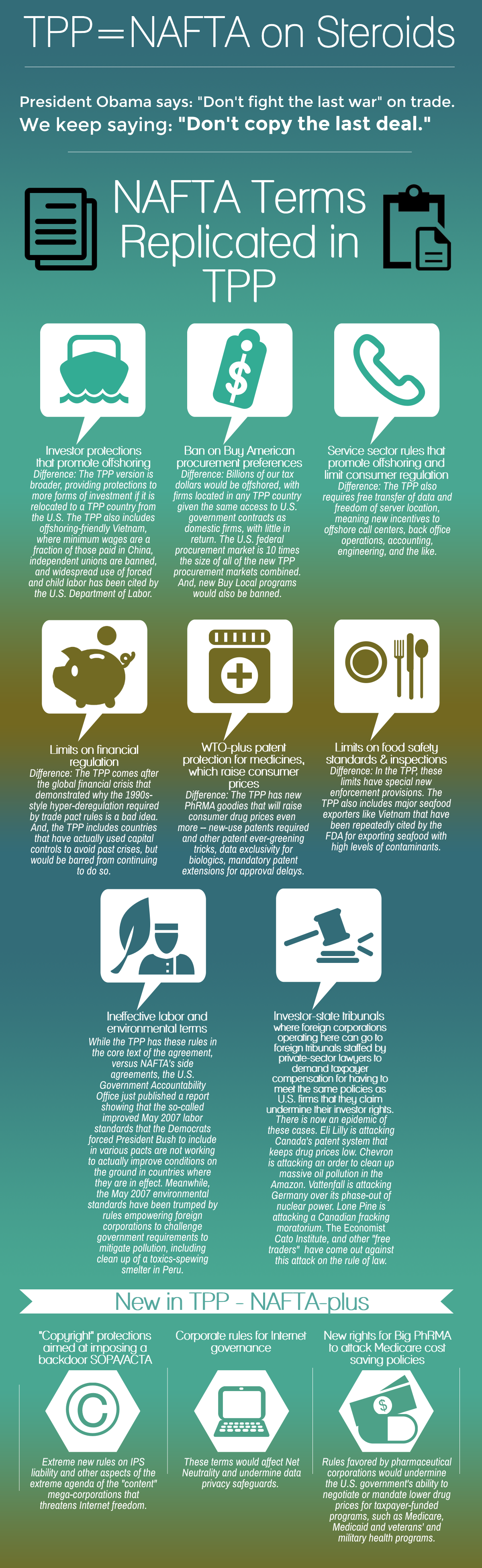
A Picture Is Worth A Thousand Words Dept.:

-> make it easier for big corporations to ship our jobs overseas, pushing down our wages and increasing income inequalityReading List:
-> flood our country with unsafe imported food
-> jack up the cost of medicines by giving big pharmaceutical corporations new monopoly rights to keep lower cost generic drugs off the market
-> empower corporations to attack our environmental and health safeguards
-> ban Buy American policies needed to create green jobs
-> roll back Wall Street reforms
-> sneak in SOPA-like threats to Internet freedom and
-> undermine human rights.
The Government of Canada is committed to being transparent, open and consultative with Canadians on the Trans-Pacific Partnership (TPP).
"TPP raises significant concerns about citizens’ freedom of expression, due process, innovation, the future of the Internet’s global infrastructure, and the right of sovereign nations to develop policies and laws that best meet their domestic priorities. In sum, the TPP puts at risk some of the most fundamental rights that enable access to knowledge for the world’s citizens:" What is TPP? (Electronic Frontier Foundation).
Provisions that allow foreign investors to bypass the federal courts could undermine U.S. legal protections: Is the Trans-Pacific Partnership Unconstitutional? by Alan Morrison (The Atlantic).
The “Investor-State Dispute Settlement,” or ISDS, may sound mild, but don’t be fooled. Agreeing to ISDS in this enormous new treaty would tilt the playing field in the United States further in favor of big multinational corporations. Worse, it would undermine U.S. sovereignty: The Trans-Pacific Partnership clause everyone should oppose by Sen. Elizabeth Warren (Washington Post).
Just curious #67,233
If Bernie Sanders' understanding of economics is so inconsiderable, why have the Democrats made him the ranking minority member on the Senate Budget Committee? Just curious.
At the flicks
"The movie shows why Bernie Sanders’s plan to break up the biggest banks and reinstate the Glass-Steagall Act (separating investment from commercial banking) is necessary – and why Hillary Clinton’s more modest plan is inadequate." — Robert Reich
The rest of the story:
'The Big Short' and Bernie Sanders' Plan to Bust Up Wall Street by Robert Reich (TruthDig)
The rest of the story:
'The Big Short' and Bernie Sanders' Plan to Bust Up Wall Street by Robert Reich (TruthDig)
Living big at $7.25 an hour
The Times spent a few column inches yesterday mulling over the mystery of why the poverty rate hasn't budged in 30 years. Gosh. I don't know. I'm sure it can't have anything to do with the systematic decimation of organized labor and the shipping of American jobs to China and Mexico. Can't see how starving the free universal education system could have anything to do with it. It can't be because of all that expenditure of public wealth on the liberal project of empire-building instead of on the building roads and bridges and harbors and airports and hospitals and schools and housing here at home. Can't be that. You can't blame the war on drugs, or the creation of a vast army of former inmates without jobs, or the expenditure of hundreds of millions of dollars on incarceration instead of education, on building prisons instead of schools. I'm sure it has nothing to do with Bill Clinton's welfare reforms. Surely it wasn't because the minimum wage wasn't linked to inflation or to worker productivity so that as the decades rolled by low end jobs were worth less and less. Couldn't be that. Certainly it had nothing to do with the mortgage crisis. Or allowing the banks to bleed us dry. Or slashing services for the poor and middle class so that taxes for the very wealthiest could be slashed, too. I can't think what the reason might be. Can you?
The real state of the union:
From Business Insider:
1. New income generated since 2009 that has gone to the top 1 percent: 95 percent
2. Financial wealth controlled by the bottom 60 percent of all Americans: 2.3 percent
3. Record combined wealth of the top 400 richest Americans: $2,000,000,000,000
4. Real decline in median middle-class incomes since 1999: $5,000
5. Percentage of Hispanic and African-American children living in poverty, respectively: 33.8 percent; 36.7 percent
6. Amount that food stamps will be cut in 2014: $5 billion
7. Federal minimum wage: $7.25
8. What the minimum wage would be if it had kept pace with gains in worker productivity since 1968: $21.72
9. Number of U.S. workers laboring at or below minimum wage: 3.6 million – the near equivalent of the population of Los Angeles.
10.Stealth taxpayer subsidy to the fast-food industry, paid out as safety-net benefits to McWorkers earning poverty wages: $7 billion
11. Global carbon dioxide levels measured in parts per million: 397
12. Maximum concentration of the greenhouse gas that scientists deem sustainable: 350
13. Years since the turn of this century that have ranked among the warmest 15 on record: All 13
14. Rank of 2013 on that list of the warmest years on record: Number Four
15. U.S. defense spending as of 2012: $682 billion
16. Dollar amount by which that surpassed our nearest plausible military rival, China: $516 billion
17. Federal deficit last year: $680 billion
18. Number of Americans disenfranchised from voting for felony convictions: 5.9 million
19. Share of those disenfranchised voters who are African-American: 37 percent
20. Number of Americans arrested annually for marijuana possession: 658,000
21. Total incarcerated U.S. population: 2.3 million
22. Total population on probation/parole: 4.8 million
23. States that could be entirely filled by all of the Americans under correctional supervision: Nevada and Kentucky
24. Official unemployment rate: 6.7 percent
25. Alternate rate including Americans who've given up looking for work, or have only been able to secure part-time employment: 13.1 percent
26. Number of jobs the United States is still down from 2008 employment peak: 1.69 million
27. Number of Americans who were cut off from long-term unemployment benefits at the turn of the year: 1.3 million
1. New income generated since 2009 that has gone to the top 1 percent: 95 percent
2. Financial wealth controlled by the bottom 60 percent of all Americans: 2.3 percent
3. Record combined wealth of the top 400 richest Americans: $2,000,000,000,000
4. Real decline in median middle-class incomes since 1999: $5,000
5. Percentage of Hispanic and African-American children living in poverty, respectively: 33.8 percent; 36.7 percent
6. Amount that food stamps will be cut in 2014: $5 billion
7. Federal minimum wage: $7.25
8. What the minimum wage would be if it had kept pace with gains in worker productivity since 1968: $21.72
9. Number of U.S. workers laboring at or below minimum wage: 3.6 million – the near equivalent of the population of Los Angeles.
10.Stealth taxpayer subsidy to the fast-food industry, paid out as safety-net benefits to McWorkers earning poverty wages: $7 billion
11. Global carbon dioxide levels measured in parts per million: 397
12. Maximum concentration of the greenhouse gas that scientists deem sustainable: 350
13. Years since the turn of this century that have ranked among the warmest 15 on record: All 13
14. Rank of 2013 on that list of the warmest years on record: Number Four
15. U.S. defense spending as of 2012: $682 billion
16. Dollar amount by which that surpassed our nearest plausible military rival, China: $516 billion
17. Federal deficit last year: $680 billion
18. Number of Americans disenfranchised from voting for felony convictions: 5.9 million
19. Share of those disenfranchised voters who are African-American: 37 percent
20. Number of Americans arrested annually for marijuana possession: 658,000
21. Total incarcerated U.S. population: 2.3 million
22. Total population on probation/parole: 4.8 million
23. States that could be entirely filled by all of the Americans under correctional supervision: Nevada and Kentucky
24. Official unemployment rate: 6.7 percent
25. Alternate rate including Americans who've given up looking for work, or have only been able to secure part-time employment: 13.1 percent
26. Number of jobs the United States is still down from 2008 employment peak: 1.69 million
27. Number of Americans who were cut off from long-term unemployment benefits at the turn of the year: 1.3 million
The Times doesn't like Larry Summers any more than you do
"Mr. Summers has also shown an indifference to the effects of economic decisions on ordinary people — the opposite of what is needed in a Fed leader at a time of high unemployment. He advised the president to support a stimulus that other economists correctly warned was too small. He resisted bankruptcy relief for underwater homeowners that would have forced banks into mortgage modifications — even as the administration spared no expense to bail out the banks. Senators who have endorsed Ms. Yellen would do well to let Mr. Obama know, either publicly or through back channels, that their endorsement translates into a no vote for Mr. Summers."
The rest of the story:
The Federal Reserve Nomination by the New York Times Editorial Board (New York Times).
Punditry
Here's a handy list of blogs edited by The Economist:
- Analects | China
- Americas view | The Americas
- Babbage | Science and technology
- Bagehot's notebook | British politics
- Banyan | Asia
- Baobab | Africa
- Blighty | Britain
- Buttonwood's notebook | Financial markets
- Charlemagne's notebook | European politics
- Clausewitz | Defence, security and diplomacy
- Democracy in America | American politics
- Eastern approaches | Ex-communist Europe
- Feast and famine | Demography and development
- Free exchange | Economics
- Game theory | Sports
- Graphic detail | Charts, maps and infographics
- Gulliver | Business travel
- Johnson | Language
- Leviathan | Public policy
- Lexington's notebook | American politics
- Newsbook | News analysis
- Prospero | Books, arts and culture
- Schumpeter | Business and management
The Fed: 11 Charts Prove The Economy Has Gone Ice Cold
"With the June Fed meeting just around the corner," writes Robert Kienst, "the market is waiting with bated breath for the decision on Quantitative Easing 3. It is like a bad movie where they keep making sequels nobody wants to watch, but are forced to endure."
The state of the economy will dictate the central bank's actions, if any, this month. With that reality in mind, Kienst presents some charts that suggest where we stand.
The most interesting fact to me is that retail sales reports are up sharply and so, apparently, is consumer confidence (although not according to the Conference Board), at the same time that durable goods purchases are down, real estate is down, and customers haven't returned to the retail stock market. So if people are spending more money, it's on essentials like bread and milk, and -- not learning from recent experience -- they're doing so with credit cards. With jobs still not in the offing (in fact, more public sector layoffs are coming in most states), that's a danger signal for the economy not a sign of recovery. Without proper savings, investment suffers and so does growth.
The rest of the story: These 11 Charts Prove The Economy Has Gone Ice Cold by Robert Kienst (Seeking Alpha 2012-06-14)
The state of the economy will dictate the central bank's actions, if any, this month. With that reality in mind, Kienst presents some charts that suggest where we stand.
The most interesting fact to me is that retail sales reports are up sharply and so, apparently, is consumer confidence (although not according to the Conference Board), at the same time that durable goods purchases are down, real estate is down, and customers haven't returned to the retail stock market. So if people are spending more money, it's on essentials like bread and milk, and -- not learning from recent experience -- they're doing so with credit cards. With jobs still not in the offing (in fact, more public sector layoffs are coming in most states), that's a danger signal for the economy not a sign of recovery. Without proper savings, investment suffers and so does growth.
The rest of the story: These 11 Charts Prove The Economy Has Gone Ice Cold by Robert Kienst (Seeking Alpha 2012-06-14)
Bubble, bubble, toil and trouble
Sayeth George Soros:
I contend that the European Union itself is like a bubble. In the boom phase the EU was what the psychoanalyst David Tuckett calls a “fantastic object” – unreal but immensely attractive. The EU was the embodiment of an open society – an association of nations founded on the principles of democracy, human rights, and rule of law in which no nation or nationality would have a dominant position.
The process of integration was spearheaded by a small group of far sighted statesmen who practiced what Karl Popper called piecemeal social engineering. They recognized that perfection is unattainable; so they set limited objectives and firm timelines and then mobilized the political will for a small step forward, knowing full well that when they achieved it, its inadequacy would become apparent and require a further step. The process fed on its own success, very much like a financial bubble. That is how the Coal and Steel Community was gradually transformed into the European Union, step by step.
Germany used to be in the forefront of the effort. When the Soviet empire started to disintegrate, Germany’s leaders realized that reunification was possible only in the context of a more united Europe and they were willing to make considerable sacrifices to achieve it. When it came to bargaining they were willing to contribute a little more and take a little less than the others, thereby facilitating agreement. At that time, German statesmen used to assert that Germany has no independent foreign policy, only a European one.
The process culminated with the Maastricht Treaty and the introduction of the euro. It was followed by a period of stagnation which, after the crash of 2008, turned into a process of disintegration. The first step was taken by Germany when, after the bankruptcy of Lehman Brothers, Angela Merkel declared that the virtual guarantee extended to other financial institutions should come from each country acting separately, not by Europe acting jointly. It took financial markets more than a year to realize the implication of that declaration, showing that they are not perfect.
Keep Out
The wealth of top six family members who own Wal-Mart is equal to the wealth of 30% of the American people.
This has been accomplished by destroying thousands of local businesses and jobs and by denying adequate pay and benefits to its employees.
It's Henry Ford turned on his head. Ford provided good jobs to create customers for his cars; Wal-Mart destroys good jobs so people will have no choice but become customers of its stores.
It should not be allowed destroy businesses and jobs in Los Angeles County.
On June 30, join 10,000 to March Against Wal-Mart in Los Angeles.
The economy: Professor Robert Reich Explains It All for You
Got a couple of minutes? Want to understand what's up with the economy? Here you go:
Labor: The attack on unions is an attack on the middle class
Unionized workers earn more and get more generous benefits. In 2010, wages of workers in unionized manufacturing  companies in Indiana were 16 percent higher than in nonunion plants. One study concluded that the decline in unionization since the 1970s is responsible for one-fifth to one-third of the growth in inequality in this country. Voters, unionized or not, should recognize the new "right to work" push for what it is: bad economics and cynical politics. -- New York Times editorial (2012-01-07).
See, also: Working hard to make Indiana look bad: The tortured, uphill case for ‘right-to-work’ by Gordon Lafer (Economic Policy Institute 2012-01-03).
Unions, Norms, and the Rise in American Wage Inequality by Bruce Western and Jake Rosenfeld (Department of Sociology, Harvard University 2011-03).
Update:
See, also: Republicans Douse ‘Light of Democracy’ and Ram Through RTW Bill by Mike Hall (AFL-CIO Now Blog News 2012-01-10).
companies in Indiana were 16 percent higher than in nonunion plants. One study concluded that the decline in unionization since the 1970s is responsible for one-fifth to one-third of the growth in inequality in this country. Voters, unionized or not, should recognize the new "right to work" push for what it is: bad economics and cynical politics. -- New York Times editorial (2012-01-07).See, also: Working hard to make Indiana look bad: The tortured, uphill case for ‘right-to-work’ by Gordon Lafer (Economic Policy Institute 2012-01-03).
Unions, Norms, and the Rise in American Wage Inequality by Bruce Western and Jake Rosenfeld (Department of Sociology, Harvard University 2011-03).
Update:
Collective bargaining…has played a major role in America’s economic miracle. Unions represent some of the freest institutions in this land. There are few finer examples of participatory democracy to be found anywhere. Too often, discussion about the labor movement concentrates on disputes, corruption and strikes. But while these things are headlines, there are thousands of good agreements reached and put into practice every year without a hitch. -- Ronald Reagan (New York Times 1981-09-04)quoted in It's Scott Walker's Party: How anti-union zealotry defines GOP race by John Nichols (Nation of Change 2012-01-09).
See, also: Republicans Douse ‘Light of Democracy’ and Ram Through RTW Bill by Mike Hall (AFL-CIO Now Blog News 2012-01-10).
Resource: Teaching about Employee Ownership
The Aspen Institute hosts the largest online academic repository of
 teaching and background materials on employee ownership. The Institute's Curriculum Library on Employee Ownership (CLEO) includes books, articles, case studies and teaching materials. The Aspen Institute’s Center for Business Education hosts CLEO with support from the Foundation for Enterprise Development and the Employee Ownership Foundation.
teaching and background materials on employee ownership. The Institute's Curriculum Library on Employee Ownership (CLEO) includes books, articles, case studies and teaching materials. The Aspen Institute’s Center for Business Education hosts CLEO with support from the Foundation for Enterprise Development and the Employee Ownership Foundation.
Resource: Workers' Cooperatives
Cooperatives: A Tool for Community Economic Development, a manual produced by The University of Wisconsin Center for Cooperatives, is designed to provide a comprehensive overview of cooperatives: what they are, how they work, and how to start one. It includes numerous examples of co-ops in Wisconsin and other states that are successfully meeting the needs of their members and their communities.
Resources:
The University of Wisconsin Center for Cooperatives
Other academic centers that focus on cooperatives include The Ohio Employee Ownership Center at Kent State and Southern New Hampshire University's Community Economic Development Department
American Worker Cooperative: an inventory of people, organizations, writings, media, and tools
U.S. Federation of Worker Cooperatives
Regional federations and support organizations in the Bay Area, Madison, the Pioneer Valley, Austin, and New York City
The Canadian Worker Cooperative Federation
The Workers' Paradise blog
Arizmendi Association of Cooperatives' worker cooperative resources
CooperationWorks!, a national organization of cooperative development centers and practitioners
Resources:
The University of Wisconsin Center for Cooperatives
Other academic centers that focus on cooperatives include The Ohio Employee Ownership Center at Kent State and Southern New Hampshire University's Community Economic Development Department
American Worker Cooperative: an inventory of people, organizations, writings, media, and tools
U.S. Federation of Worker Cooperatives
Regional federations and support organizations in the Bay Area, Madison, the Pioneer Valley, Austin, and New York City
The Canadian Worker Cooperative Federation
The Workers' Paradise blog
Arizmendi Association of Cooperatives' worker cooperative resources
CooperationWorks!, a national organization of cooperative development centers and practitioners
Economy: Vast inequalities of wealth undermine society
Why is it important that, finally, a movement has arisen to resist the slo-mo counter-revolution that since the 1970s has seized political and economic control of the United States?
Since before the Revolutionary War, economic inequality has been a fact of American economic life, and indeed the Founders went out of their way to institutionalize the advantages of wealth, but in recent decades the gap between rich and poor has widened to a pathological degree. Today, more than 40% of total income is going to the wealthiest 10%, and the oligarchs have purchased control of government at every level to cement in place the status quo.
By every measure -- infant mortality, longevity, health, productivity, democratic governance, crime -- the social and political repercussions on society of economic inequality are devastating. Like a cancer, economic injustice eats away at civil society, weakening democracy and destroying the quality of life for most citizens.
The evidence shows that it is not possible to have a functioning civil society and a vibrant economy when a tiny oligarchy absconds with nearly all the benefits. In this TED talk from Richard Wilkinson, who with Kate Pickett wrote The Spirit Level: Why Greater Equality Makes Societies Stronger, demonstrates graphically how inequality damages societies.
Until now, the majority of Americans has acquiesced in the corporate raid on America. We sat quietly for decades while the progressive tax was flattened; the labor unions were defanged; public education deteriorated; the infrastructure rotted away; public services were rolled back or privatized; the prison system metastasized. We watched as the public weal was stolen, tuning in while plane loads of cash -- sometimes literally -- vanished. We watched as democracy was transformed into kleptocracy.
Until now.
Occupy Wall Street is the middle class' way of shouting "I'm mad as hell and I'm not going to take it any more." Americans are articulating, even as the oligarchs are too befuddled by greed to comprehend, the simple fact that the current system is unsustainable.
Welcome to the Golden Age of Signage
Although the media has done its best to obscure the message of the Occupy movement, anyone interested in finding out what the demonstrations are about has only to look at the astonishingly articulate signs in the "what do they want" videos and newsphotos. Or you can download the following video of Michael Moore being interviewed on lower Broadway by CNBC's Carl Quintanilla (to the network's credit, for a full eight minutes).
Moore isn't confused by the protests, as the pundits pretend to be. Don’t the American people deserve some answers and some justice?, he asks. Where did their money go? Who stole it? Everybody down at Occupy Wall Street wants the wealthy to be taxed more. They want Glass-Steagall reinstated. They want the money out of politics. They want to know where the jobs went. They want to know if the jobs coming back.
“I’m not even sure equality of opportunity is there anymore," he says.
It's the Inequality, Stupid: Eleven charts that explain what's wrong with America by Dave Gilson and Carolyn Perot (Mother Jones March/April 2011)
Inequality.Org
Since before the Revolutionary War, economic inequality has been a fact of American economic life, and indeed the Founders went out of their way to institutionalize the advantages of wealth, but in recent decades the gap between rich and poor has widened to a pathological degree. Today, more than 40% of total income is going to the wealthiest 10%, and the oligarchs have purchased control of government at every level to cement in place the status quo.
By every measure -- infant mortality, longevity, health, productivity, democratic governance, crime -- the social and political repercussions on society of economic inequality are devastating. Like a cancer, economic injustice eats away at civil society, weakening democracy and destroying the quality of life for most citizens.
The evidence shows that it is not possible to have a functioning civil society and a vibrant economy when a tiny oligarchy absconds with nearly all the benefits. In this TED talk from Richard Wilkinson, who with Kate Pickett wrote The Spirit Level: Why Greater Equality Makes Societies Stronger, demonstrates graphically how inequality damages societies.
Until now, the majority of Americans has acquiesced in the corporate raid on America. We sat quietly for decades while the progressive tax was flattened; the labor unions were defanged; public education deteriorated; the infrastructure rotted away; public services were rolled back or privatized; the prison system metastasized. We watched as the public weal was stolen, tuning in while plane loads of cash -- sometimes literally -- vanished. We watched as democracy was transformed into kleptocracy.
Until now.
Occupy Wall Street is the middle class' way of shouting "I'm mad as hell and I'm not going to take it any more." Americans are articulating, even as the oligarchs are too befuddled by greed to comprehend, the simple fact that the current system is unsustainable.
Welcome to the Golden Age of Signage
Although the media has done its best to obscure the message of the Occupy movement, anyone interested in finding out what the demonstrations are about has only to look at the astonishingly articulate signs in the "what do they want" videos and newsphotos. Or you can download the following video of Michael Moore being interviewed on lower Broadway by CNBC's Carl Quintanilla (to the network's credit, for a full eight minutes).
Moore isn't confused by the protests, as the pundits pretend to be. Don’t the American people deserve some answers and some justice?, he asks. Where did their money go? Who stole it? Everybody down at Occupy Wall Street wants the wealthy to be taxed more. They want Glass-Steagall reinstated. They want the money out of politics. They want to know where the jobs went. They want to know if the jobs coming back.
“I’m not even sure equality of opportunity is there anymore," he says.
It's the Inequality, Stupid: Eleven charts that explain what's wrong with America by Dave Gilson and Carolyn Perot (Mother Jones March/April 2011)
Inequality.Org
Subscribe to:
Posts (Atom)