


I am certainly not an advocate for frequent and untried changes in laws and constitutions. I think moderate imperfections had better be borne with; because, when once known, we accommodate ourselves to them,
and find practical means of correcting their ill effects. But I know also, that laws and institutions must go hand in hand with the progress of the human mind. As that becomes more developed, more enlightened, as new discoveries are made, new truths disclosed, and manners and opinions change with the change of circumstances, institutions must advance also, and keep pace with the times. We might as well require a man to wear still the coat which fitted him when a boy, as civilized society to remain ever under the regimen of their barbarous ancestors." -- Thomas Jefferson, writing to H. Tompkinson (aka Samuel Kercheval), July 12, 1816
Showing posts with label change. Show all posts
Showing posts with label change. Show all posts
quote unquote: Thomas Jefferson


Would Norman Thomas or Eugene Debs been more effective...
...if they'd run as Democrats?
Many of us who support him against Hillary Clinton now, warned before he declared that, by running as a Democrat instead of an independent, Bernie Sanders risks legitimizing the candidate from Goldman Sachs. Come September 2016, when most voters will be just starting to pay attention to the campaign, he will be either silenced or in the uncomfortable position of supporting a candidate for president he knows will pursue policies against which he has stood for his entire career. As Chris Hedges argues,
Many of us who support him against Hillary Clinton now, warned before he declared that, by running as a Democrat instead of an independent, Bernie Sanders risks legitimizing the candidate from Goldman Sachs. Come September 2016, when most voters will be just starting to pay attention to the campaign, he will be either silenced or in the uncomfortable position of supporting a candidate for president he knows will pursue policies against which he has stood for his entire career. As Chris Hedges argues,
If you want change you can believe in, destroy the system. And changing the system does not mean collaborating with it as Bernie Sanders is doing by playing by the cooked rules of the Democratic Party. Profound social and political transformation is acknowledged in legislatures and courts but never initiated there. Radical change always comes from below. As long as our gaze is turned upward to the powerful, as long as we invest hope in reforming the system of corporate power, we will remain enslaved. There may be good people within the system -- Sanders and Elizabeth Warren are examples -- but that is not the point. It is the system that is rotten. It must be replaced.The rest of the story: Make the Rich Panic by Chris Hedges (TruthDig).
Won't be fooled again?
According to Gallup, 60% of Americans want a third party candidate for 2016. Even so, in the fall of 2016, we will be warned once again (by The Nation, Daily Kos and their ilk) that -- once again -- we must must must vote for the Lesser-of-Two-Evils -- a Wall Street-militarist-security state Democrat -- or face Catastrophe -- a Wall Street-militarist-security state Republican.
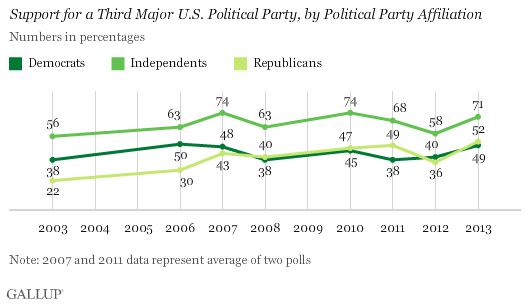
Doing the same thing over and over again and expecting a different result isn't really the definition of insanity. But it is the definition of stupidity.
See, In U.S., Perceived Need for Third Party Reaches New High: Twenty-six percent believe Democratic and Republican parties do adequate job (Gallup).
Class Unconsciousness
President Obama has gotten a lot of free advice since Nov 6 from progressives who think he should refocus his attentions on their priorities. But why should he? Since, when it appeared he needed them, they volunteered their support for his reelection without demanding anything in return, why should he now feel obligated to take their wishes seriously?
When he was first running for president, then Sen. Obama repeated the famous story about a delegation of progressives, led by the great labor organizer A. Philip Randolph of the railroad porters' union, meeting with another newly elected president, Franklin Delano Roosevelt. The delegation described the things they believed FDR needed to do to help fix the economy and improve the situation of ordinary citizens. As the story is told, FDR listened intently, then replied: 'I agree with everything you have said. Now, make me do it.'
Making Obama "do it" is going to take a lot more than op-ed pieces, open letters and online petitions. To move this administration in a more progressive direction, to overcome its leader's native caution and to beat back the relentless pressure it is under from the corporate class and the military-security state apparatus will require an equal or greater pressure from a national movement demanding economic justice and a restoration of the middle class. Such a movement can only be built if the identification that currently exists between the 99% and their oppressors can be broken. In other words, until Americans become class conscious there will never be a reason for Obama, or any politician, to do anything other than carry on with business as usual.
Building class consciousness won't happen -- can't happen -- by recruiting people to join the Peace and Freedom Party or the Greens (although third party mechanisms will be necessary in the future as the country continues its decline under the Democratic-Republican duopoly, so it's to be hoped that Jill Stein's paltry 396,684 tally is enough to keep the Green Party on state ballots). But class consciousness can be built by engaging in practical political work in our communities.
There are a number of local issues that are looming (or that are chronic, is more like it) -- repairing the public schools; providing universal access to public institutions of higher learning; keeping hospital emergency rooms and clinics open and accessible; raising local minimum wages to livable levels; restraining public transportation costs and assuring availability; resisting hand-outs to developers; opposing the crushing of local businesses by big-box stores and malls; increasing infrastructure spending; making state and local taxes more progressive; supporting labor actions by janitors, hotel workers, grocery clerks, teachers, factory workers -- that offer opportunities for common-sense, real-world discussions about capitalism and economic and social justice.
Also, reforms that would make our political system more democratic and thus more responsive to the majority -- weekend voting; instant run-offs; proportional representation; public financing of elections -- will only gain traction if they are tested and proven effective on the local level. And that won't happen, either, unless that majority begins to understand whose interests are served by the creaky, calcified, undemocratic political mechanism we use now.
This is not to say that we should give up attempting to affect national issues -- the security state; the war machine; our murderous and counter-productive foreign policy; the immoral drone campaign; climate change; free trade; protecting and expanding Medicare, Medicaid, and Social Security; the private health care insurance gravy train; control of the government by oligarchs; the kleptocracy -- but these are matters for discussion and op-ed pages; organizing around them will only make sense when people active locally begin to connect the dots between community concerns and macro issues, and local organizations join together to demand change on these national issues.
The Democratic Party as a whole has moved steadily to the right for four decades. But many people within the party who share our goals are potential allies in local fights; these engaged people also need and deserve support when they resist the pro-business, anti-labor forces that dominate the party. After the "change" election in 2008, many on the left suffered buyer's remorse when Obama adopted a business-as-usual attitude toward governing (and doubled-down on many of Bush's worst security-state policies); yet four-years later they found themselves with seemingly no choice but to push once again for the lesser-of-two-evils option. If we're going to use our limited personal energies in electoral politics going forward, it should be in local races and political institutions where we can build trust with our communities and demonstrate concrete results. If this country is going to begin down a new road, the journey will start at Neighborhood Watch and the PTA, in community organizations, planning commissions and city councils. Not only is it possible to make concrete changes in our lives at the micro-political level, but local successes will demonstrate the practical worth of our ideas.
When he was first running for president, then Sen. Obama repeated the famous story about a delegation of progressives, led by the great labor organizer A. Philip Randolph of the railroad porters' union, meeting with another newly elected president, Franklin Delano Roosevelt. The delegation described the things they believed FDR needed to do to help fix the economy and improve the situation of ordinary citizens. As the story is told, FDR listened intently, then replied: 'I agree with everything you have said. Now, make me do it.'
Making Obama "do it" is going to take a lot more than op-ed pieces, open letters and online petitions. To move this administration in a more progressive direction, to overcome its leader's native caution and to beat back the relentless pressure it is under from the corporate class and the military-security state apparatus will require an equal or greater pressure from a national movement demanding economic justice and a restoration of the middle class. Such a movement can only be built if the identification that currently exists between the 99% and their oppressors can be broken. In other words, until Americans become class conscious there will never be a reason for Obama, or any politician, to do anything other than carry on with business as usual.
Building class consciousness won't happen -- can't happen -- by recruiting people to join the Peace and Freedom Party or the Greens (although third party mechanisms will be necessary in the future as the country continues its decline under the Democratic-Republican duopoly, so it's to be hoped that Jill Stein's paltry 396,684 tally is enough to keep the Green Party on state ballots). But class consciousness can be built by engaging in practical political work in our communities.
There are a number of local issues that are looming (or that are chronic, is more like it) -- repairing the public schools; providing universal access to public institutions of higher learning; keeping hospital emergency rooms and clinics open and accessible; raising local minimum wages to livable levels; restraining public transportation costs and assuring availability; resisting hand-outs to developers; opposing the crushing of local businesses by big-box stores and malls; increasing infrastructure spending; making state and local taxes more progressive; supporting labor actions by janitors, hotel workers, grocery clerks, teachers, factory workers -- that offer opportunities for common-sense, real-world discussions about capitalism and economic and social justice.
Also, reforms that would make our political system more democratic and thus more responsive to the majority -- weekend voting; instant run-offs; proportional representation; public financing of elections -- will only gain traction if they are tested and proven effective on the local level. And that won't happen, either, unless that majority begins to understand whose interests are served by the creaky, calcified, undemocratic political mechanism we use now.
This is not to say that we should give up attempting to affect national issues -- the security state; the war machine; our murderous and counter-productive foreign policy; the immoral drone campaign; climate change; free trade; protecting and expanding Medicare, Medicaid, and Social Security; the private health care insurance gravy train; control of the government by oligarchs; the kleptocracy -- but these are matters for discussion and op-ed pages; organizing around them will only make sense when people active locally begin to connect the dots between community concerns and macro issues, and local organizations join together to demand change on these national issues.
The Democratic Party as a whole has moved steadily to the right for four decades. But many people within the party who share our goals are potential allies in local fights; these engaged people also need and deserve support when they resist the pro-business, anti-labor forces that dominate the party. After the "change" election in 2008, many on the left suffered buyer's remorse when Obama adopted a business-as-usual attitude toward governing (and doubled-down on many of Bush's worst security-state policies); yet four-years later they found themselves with seemingly no choice but to push once again for the lesser-of-two-evils option. If we're going to use our limited personal energies in electoral politics going forward, it should be in local races and political institutions where we can build trust with our communities and demonstrate concrete results. If this country is going to begin down a new road, the journey will start at Neighborhood Watch and the PTA, in community organizations, planning commissions and city councils. Not only is it possible to make concrete changes in our lives at the micro-political level, but local successes will demonstrate the practical worth of our ideas.
Lesser of two evils? Really?
Like Bill Clinton as president (you remember: banking "reform," telecom "reform," welfare "reform," WTO, NAFTA -- that Bill Clinton), President Obama has tried to deflect criticism by adopting the policies of his opponents, in effect, as used to be said, being more Catholic than the Pope. In domestic affairs, this has led to passivity and inaction, allowing the Right to stake out the parameters of the political debate: the pursuit of austerity; the advancement of tax cuts (more of a muddle now that candidate Obama is a born-again populist); the promotion of the health of the insurance industry ahead of the health of the people; the setting "on the table" of cuts in Social Security and Medicare.
But, as troubling as the administration's domestic agenda has been, it is in the area of foreign policy that its behavior is most distressing. Not wishing to allow criticism from conservatives, Obama has not just continued George W. Bush's Long War, but has enlarged it both in scope and in ferocity. The legal and physical framework established during Bush's reign, from the P.A.T.R.I.O.T. Act thru Gitmo to drones, not only remains in place, but has been extended to include contract killings and a list of conflict points that looks like the departure board of an international airline.
So where does that leave the Left in November 2012? True to form, the presidential wing of the Democratic Party is campaigning on the shop-worn "lesser-of-two-evils" platform, even though it has become so threadbare the only part not in tatters is the fear-mongering about appointments to the Supreme Court. (And, by the way, how different is jazzing up the Democratic base over Roe V. Wade from the GOP's cynical use of "social issues" to get its base hyperventilating? Here's something you can put money on: whether Obama or Romney is president, the next appointee to the Supreme Court will be a reliable defender of corporate interests and the status quo.) Even if you're appalled, as you should be, by the idea of Mitt Romney in the White House (and Paul Ryan a heartbeat away), how can you vote for Obama without endorsing his policy choices?
The answer, of course, is that you can't. In 2008, it was possible to convince yourself that the Democratic candidate's general blandness ("hope," "change," "yes we can") and specific conservatism (missile attacks on Iran, more war in Afghanistan and Pakistan, advocacy of the death penalty, deliberate blurring of the clear language of the 2nd amendment, bipartisanship as a policy goal) was a disguise intended to slip him past voters on election day, a "whites of their eyes" strategy as it is (now wistfully) described to get hold of the reins of power before turning the carriage of state down the road to peace and economic justice. In 2012, deluding yourself that Obama is the candidate of change is no longer possible. No wonder the campaign is spending its millions demonizing the hapless Romney (Obama has been supremely lucky in his opponents, but never more so than this season); what else is there to talk about?
If you're not a supporter of fiscal austerity except when it comes to funding endless war, what do you do? In some states, third party candidates will be on the ballot (in California, no joke, Roseanne Barr was nominated for president last week by the Peace and Freedom Party, which also has in Marsha Feinland a first rate candidate for U.S. Senate against that pillar of the status quo, Sen. Diane Feinstein; Barr is also working hard to get on the ballot in other states; and the Green Party has a worthy candidate in Dr. Jill Stein). In most of the places where where liberal disappointment in the president is greatest -- New York, Illinois, California, New England and the Pacific Northwest, the distortions of the electoral college have rendered votes in the Obama-Romney contest so meaningless that even progressives persuaded by lesser-of-two-evils argument can cast a third party protest vote without worrying. There also are numerous opportunities to affect the much more important matter of who gets to serve in the national legislature: in addition to such obvious choices as Sen. Sherrod Brown, Elizabeth Warren, and Alan Grayson, scores of federal and local progressive candidates need your support: you'll find most (or all) of them at the fundraising site ActBlue. And you can work to build a third party more in tune with the your politics than the duopoly; get involved in local politics; join the struggle to create alternative power bases, for example in labor or community organizations; pursue change in specific policy areas (such as militarization or the environment); assist civil rights and civil liberties defenders like the Southern Poverty Law Center or the American Civil Liberties Union.
Or you can take to the streets.
What you can't do, it seems to me, is sit passively in the audience of our political theater; what you can't do is agree to business as usual; what you can't do is once again accept without resistance the lesser of two evils.
But, as troubling as the administration's domestic agenda has been, it is in the area of foreign policy that its behavior is most distressing. Not wishing to allow criticism from conservatives, Obama has not just continued George W. Bush's Long War, but has enlarged it both in scope and in ferocity. The legal and physical framework established during Bush's reign, from the P.A.T.R.I.O.T. Act thru Gitmo to drones, not only remains in place, but has been extended to include contract killings and a list of conflict points that looks like the departure board of an international airline.
So where does that leave the Left in November 2012? True to form, the presidential wing of the Democratic Party is campaigning on the shop-worn "lesser-of-two-evils" platform, even though it has become so threadbare the only part not in tatters is the fear-mongering about appointments to the Supreme Court. (And, by the way, how different is jazzing up the Democratic base over Roe V. Wade from the GOP's cynical use of "social issues" to get its base hyperventilating? Here's something you can put money on: whether Obama or Romney is president, the next appointee to the Supreme Court will be a reliable defender of corporate interests and the status quo.) Even if you're appalled, as you should be, by the idea of Mitt Romney in the White House (and Paul Ryan a heartbeat away), how can you vote for Obama without endorsing his policy choices?
The answer, of course, is that you can't. In 2008, it was possible to convince yourself that the Democratic candidate's general blandness ("hope," "change," "yes we can") and specific conservatism (missile attacks on Iran, more war in Afghanistan and Pakistan, advocacy of the death penalty, deliberate blurring of the clear language of the 2nd amendment, bipartisanship as a policy goal) was a disguise intended to slip him past voters on election day, a "whites of their eyes" strategy as it is (now wistfully) described to get hold of the reins of power before turning the carriage of state down the road to peace and economic justice. In 2012, deluding yourself that Obama is the candidate of change is no longer possible. No wonder the campaign is spending its millions demonizing the hapless Romney (Obama has been supremely lucky in his opponents, but never more so than this season); what else is there to talk about?
If you're not a supporter of fiscal austerity except when it comes to funding endless war, what do you do? In some states, third party candidates will be on the ballot (in California, no joke, Roseanne Barr was nominated for president last week by the Peace and Freedom Party, which also has in Marsha Feinland a first rate candidate for U.S. Senate against that pillar of the status quo, Sen. Diane Feinstein; Barr is also working hard to get on the ballot in other states; and the Green Party has a worthy candidate in Dr. Jill Stein). In most of the places where where liberal disappointment in the president is greatest -- New York, Illinois, California, New England and the Pacific Northwest, the distortions of the electoral college have rendered votes in the Obama-Romney contest so meaningless that even progressives persuaded by lesser-of-two-evils argument can cast a third party protest vote without worrying. There also are numerous opportunities to affect the much more important matter of who gets to serve in the national legislature: in addition to such obvious choices as Sen. Sherrod Brown, Elizabeth Warren, and Alan Grayson, scores of federal and local progressive candidates need your support: you'll find most (or all) of them at the fundraising site ActBlue. And you can work to build a third party more in tune with the your politics than the duopoly; get involved in local politics; join the struggle to create alternative power bases, for example in labor or community organizations; pursue change in specific policy areas (such as militarization or the environment); assist civil rights and civil liberties defenders like the Southern Poverty Law Center or the American Civil Liberties Union.
Or you can take to the streets.
What you can't do, it seems to me, is sit passively in the audience of our political theater; what you can't do is agree to business as usual; what you can't do is once again accept without resistance the lesser of two evils.
2012: talk is cheap
The Democrats are circling Zucotti Park like cold-eyed vultures hungry to feed on the flesh of its idealism and passion. Already, bits and pieces of the heartfelt conversation inside the Occupy Movement about purposes and principles are being cut-and-pasted into the stump speeches of Democratic pols from Barack to Barney. But we are long past talking about hope of change.
"The country needs," Franklin Roosevelt said in May 1932,
"The country needs," Franklin Roosevelt said in May 1932,
and, unless I mistake its temper, the country demands, bold, persistent experimentation. It is common sense to take a method and try it: if it fails, admit it frankly and try another. But above all, try something. The millions who are in want will not stand by silently forever while the things to satisfy their needs are within easy reach.Roosevelt in 1932 was no more a radical than was Obama in 2008. But FDR demanded solutions. He made plenty of mistakes in his fight for a new deal for the American people, but unlike Obama he was hamstrung neither by lack of imagination nor an obsession with process. It's still a long time until the 2012 election. Are we in for another 12 months of homilies about the need for change? Or will Barack Obama flex the powers of his office and "try something?"
2012: Apparently, we can't
Okay. Let's get this out of our system now. Because in just a few months we're going to be invited again to ignore our lying eyes and vote to extend for four more years what historians will one day call the Bush-Obama Era. And it would be nice, wouldn't it, if we didn't fall for the same bullshit twice.
Activism: A Field Manual for Nonviolent Revolution
Massachusetts political scientist Gene Sharp's "practical writings on nonviolent revolution — most notably From Dictatorship to Democracy (pdf), a 93-page guide to toppling autocrats, available for download in 24 languages — have inspired dissidents around the world, including in Burma, Bosnia, Estonia and Zimbabwe, and now Tunisia and Egypt."
The rest of the story: Shy U.S. Intellectual Created Playbook Used in a Revolution by Sheryl Gay Stolberg (New York Times 2011-02-16).
The rest of the story: Shy U.S. Intellectual Created Playbook Used in a Revolution by Sheryl Gay Stolberg (New York Times 2011-02-16).
2010: Triangulation -- third way, bipartisanship -- was a mistake.
How different this election season would have been if two years ago the Obama administration and the Democratic leadership had come out with guns blazing.  Affordable, universal health care -- Medicare for all. Meaningful financial regulation. A stimulus program built around job creation, infrastructure spending, and protection of state and local governments. These are the specifics of "hope" and "change."
Affordable, universal health care -- Medicare for all. Meaningful financial regulation. A stimulus program built around job creation, infrastructure spending, and protection of state and local governments. These are the specifics of "hope" and "change."What I hear on the ground is, people didn't say you went too far on health care. They say "You didn't do enough. You should have had a public option. You should have had this; you should have had that. You didn't go too far on job creation, you should have created more jobs." No one has said to me, "You know, Rich, you guys went too far in regulating Wall Street." Most people want to tar and feather them for what they have done. -- AFL-CIO President Richard TrumkaThe rest of the story: Trumka: Primarying Lincoln Was 'Priceless', Dems Will Realize Their Timidity by Sam Stein (Huffinton Post 2010-10-05).
Accountability: To avoid a repeat of the current disaster, it is important apportion responsibility accurately
Here's the inside story of how the administration of Barack Obama failed to crack down on the corruption of the Bush years – and let the world's most dangerous oil company get away with murder: "It's tempting to believe that the Gulf spill, like so many disasters inherited by Obama, was the fault of the Texas oilman who preceded him in office. But, though George W. Bush paved the way for the catastrophe, it was Obama who gave BP the green light to drill. 'Bush owns eight years of the mess,' says Rep. Darrell Issa, a Republican from California. 'But after more than a year on the job, [Interior Secretary Ken] Salazar owns it too.'" -- The Spill, The Scandal and the President by Tim Dickinson (Rolling Stone 2010-05-08).
Change Watch: Obama is craking down on whistleblowers
The Obama administration's tough investigative stance on unauthorized press leaks goes against the president's campaign promises to bring back openness and transparency. Is the government under Obama mounting an attack on press freedom?
Saturday Catchup 2010-05-22
Nicole Belle on CrooksAndLiars.com: Many people "...didn't think things could get worse than jingoism and dishonesty of the Bush/Cheney years....that more than a year into the Obama presidency that things like the 1964 Civil Rights Act and 1968 Fair Housing Act would be considered less than settled matters....that thinking that the world's superpower should be able to offer health care to its citizens would make one a Maoist/Stalinist/Communist, despite the fact that most Americans want it too...Or that suddenly the existence of undocumented workers has become so intolerable that we must address them with huge fences, detention camps, moats and all other matter of law enforcement, despite the fact that there have always been an underclass of undocumented workers and not one person has proposed focusing energy on reducing demand by going after the employers of said workers. What I came away with from all these conversations is that the dialogue in this country is fundamentally dishonest, just as these members of the People's Front of Judea are. I mean, honestly, apart from the sanitation, medicine, education, wine, public order, irrigation, roads, the fresh water system and public health, what have the Romans ever done for us? Change PFJ to 'Tea Party' and change Romans to 'government' and you've got an idea of the intellectual dishonesty rampant:
An OA meeting. The setting is a dingy meeting room in a church basement. Seated in a circle on rickety folding chairs are LP Record, VHS Tape, 8-Track, Cassette Tape, Compact Disc, Video Rental Store, SLR Camera, Instant Camera, TV Antenna, Dot Matrix Printer, Copy Machine, Fold-Out Map, Typewriter, others.
Moderator: Welcome to Obsoletes Anonymous! I've gathered you all here to welcome our latest member, the Print Industry.
Print Industry: Hello, everyone. But there's been a mistake. I don't belong here.
(chuckles all around)
Print Industry (continues): I'm serious. I'm not obsolete. I'm relevant. Print books have been around for hundreds of years. They're never going to be replaced.
VHS Tape: Yeah, we all thought like that once.
LP Record: It's called denial. It's tough to deal with at first. -- Is Print Dead? by J.A. Konrath (Huffington Post 2010-05-21).
R.I.P.: Martin Gardner, 1914-2010 (Discover 2010/05/22)
The Nature of Things / Martin Gardner from Wagner Brenner on Vimeo.
All of the survivors feel hatred toward the United States. It is a real problem,this rising hatred: "People who have seen an air strike live on a monitor described it as both awe-inspiring and horrifying. 'You could see these little figures scurrying, and the explosion going off, and when the smoke cleared there was just rubble and charred stuff,' a former CIA officer who was based in Afghanistan after September 11th says of one attack....Human beings running for cover are such a common sight that they have inspired a slang term: 'squirters.'" -- Drones and Democracy by Kathy Kelly and Joshua Brollier (truthout 2010-05-20).
WalMart isn't the only American organization to have brought something home from China: With rendition, suspension of habeas corpus, and other Bush-era human rights violations continuing and worsening under Obama, the report by Think Progress, Why Bush’s ‘Enhanced Interrogation’ Program Failed, has taken on new relevance and urgency.
Oops!: Arizona seems about to say it's sorry.
Watch on YouTube.
We have a dream, too, and it's nothing like Dr. King's: "To understand Rand Paul's agonized contortions over America's civil rights consensus, let's review the tainted pedigree of the movement that reared him. Specifically, both the Kentucky Republican Senate nominee and his father, Ron Paul, have been closely associated over the past two decades with a faction that described itself as 'paleolibertarian,' led by former Ron Paul aide Lew Rockwell and the late writer Murray Rothbard. They eagerly forged an alliance with the 'paleoconservatives' behind Patrick Buchanan, the columnist and former presidential candidate whose trademarks are nativism, racism and anti-Semitism." -- The roots of Rand Paul's civil rights resentment by Joe Conason (Salon 2010-05-21). Or as Bill Maher put it the other night: "The shit doesn't fall far from the bat."
Change Watch: "Over the past couple years, I've written numerous times about the serious left-right coalition that had emerged in Britain -- between the Tories and Liberal Democrats -- in opposition to the Labour Government's civil liberties abuses, many (thought not all) of which were justified by Terrorism. In June of 2008, David Davis, a leading Tory MP, resigned from Parliament in protest of the Government's efforts to expand its power of preventive detention to 42 days (and was then overwhelmingly re-elected on a general platform of opposing growing surveillance and detention authorities). Numerous leading figures from both the Right and Left defied their party's establishment to speak out in support of Davis and against the Government's growing powers. Back then, the Liberal Democrats' Leader, Nick Clegg, notably praised the right-wing Davis' resignation, and to show his support for Davis' positions, Clegg even refused to run a LibDem candidate for that seat because, as he put it, "some issues 'go beyond party politics'." Now that this left-right, Tory/Lib-Dem alliance has removed the Labour Party from power and is governing Britain, these commitments to restoring core liberties -- Actual Change -- show no sign of retreating. Rather than cynically tossing these promises of restrained government power onto the trash pile of insincere campaign rhetoric, they are implementing them into actual policy. Clegg, now the Deputy Prime Minister, gave an extraordinary speech last week in which he vowed "the biggest shake-up of our democracy since 1832." -- The Tory/Lib-Dem Government endorses actual change by Glenn Greenwald (Salon 2010-05-21).
Time saver: Eclectic Method remixes all of Phish’s list of "99 Albums":
Eclectic Method Goes Phish :: 99 Albums in 4:20 from Eclectic Method on Vimeo.
"It's alive!" As a non-believer educated by Jesuits and likeminded cultivators of inquiring minds, I've never understood the objection to "playing god." Why would a higher being be irked by his creatures' clumsy efforts to figure out what he had in mind? So I don't see it as a moral or ethical dilemma that researchers at the J. Craig Venter Institute have created a new organism by injecting man-made genetic material into the empty body of a cell. Artificial organisms almost certainly will provide solutions to many serious health and environmental difficulties, from cancer to oil spills. The only real question, just as it is with other scientific developments such as nuclear power and genetically modified food and life-prolonging drugs and technology, is whether "synthetic life" is worth the risks as a matter of public safety.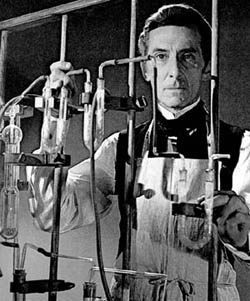 Constructing artificial creatures "has unimaginable potential risks," naysays Oxford ethics professor Julian Savulescu, since by "engineering organisms that could never naturally exist," we expose ourselves to possible calamities — from bio-weapon terrorism to environmental catastrophes — so destructive they could wipe out life as we know it. Such an outcome is certainly undesired, but, counters Ken MacLeod in the Guardian, worries about blowback from playing god are entirely "misguided:" our "biosphere comes up with natural resistance to entirely new organisms every day;" and while the threat of bio-terrorism "may be great," it's "not in principle greater than those posed by natural organisms" that already exist; besides, the potential upsides are so phenomenal, practical benefits ought to trump whatever squeamishness anyone may have over theoretical disasters. One can more easily imagine a bacterium that sucks carbon from the air than one that leeches poison into our water supply. I'm with David Ropeik, author of How Risky Is It, Really?: Why Our Fears Don't Always Match the Facts, that the "almost unimaginable promise" of being able to create life "to our specifications" shouldn't be sacrificed just because we've seen too many movies about Dr. Frankenstein, although his caution is well taken that "far less of that promise will be realized if the people doing this work" treat it, as Venter seems to, simply as a race to fame and fortune, and "fail to recognize and address [the public's concerns] about what they are doing."
Editorial: The debt that the public owes to police officers for taking the risks that they take can never be repaid. -- Growing risk for the police -- Extreme views behind the West Memphis tragedy: Two officers are dead after a shootout with a delusional conspiracy theorist (The Commercial Appeal, Memphis TN 2010-05-22).
Resource: The earliest gangs of New York were not criminal groups. Many street gang members were employed, mostly as common laborers. Some were bouncers in saloons and dance halls, as well as longshoremen. A few were apprentice butchers, carpenters, sailmakers, and shipbuilders. “They engaged in violence, but violence was a normal part of their always-contested environment; turf warfare was a condition of the neighborhood." Gangs formed the “basic unit of social life among the young males in New York in the nineteenth century.” More dangerous street gangs than previously seen emerged around 1820 from the persistent disorder that gripped the city slums, tenements, saloons, and dance halls. The Forty Thieves gang was characterized as “the first important and decisively dangerous gang of the quarter century.” It and other new groups of gangs that emerged in this period were centered in criminal enterprises as much as in territorial disputes. “It is axiomatic that the more sophisticated the gangs became, the more violent they grew as well.” -- History of Street Gangs in the United States (pdf) by James C. Howell and John P. Moore (National Gang Center Bulletin 2010-04).
Cartoon Beatles do the Dead Kennedys' California über alles:
The truth is out there: The only way to debunk an enshrined falsehood is with maximum reportorial firepower. Toting big guns and an itchy trigger-finger is American University professor W. Joseph Campbell, whose new book, Getting It Wrong: Ten of the Greatest Misreported Stories in American Journalism, flattens established myths that you were brought up to believe were true: that Orson Welles sparked a national panic with his 1938 War of the Worlds broadcast; that the New York Times suppressed news of the Bay of Pigs invasion of Cuba at the request of the White House; that Edward R. Murrow destroyed Sen. Joseph McCarthy; that publishing magnate William Randolph Hearst told an illustrator, "You furnish the pictures, I'll furnish the war," before the Spanish-American war started; and more. -- The Master of Debunk: W. Joseph Campbell corrects the record on 10 important misreported stories by Jack Shafer (Slate 2010-05-21).
Here comes the sun: One year ago this Friday, U.S. chief information officer Vivek Kundra launched an ambitious website called Data.gov to make the government’s vast stores of data available to the public. The thinking behind the site then, as now, was to give app developers access to these rich, comprehensive datasets on all sorts of topics — health care, education, energy, the environment and so on — in the hope that they would create useful tools for analyzing a range of information, from air quality by county to crime statistics by neighborhood and foreign aid by nation. To make good on incoming president Barack Obama's promise of transparency and open government, Data.gov launched with 47 datasets. By its first anniversary on Friday, Data.gov had ballooned to more than 250,000 datasets and racked up 97.6 million hits — not bad for a website whose main attractions are massive databases and wonky graphs. However, the sailing has not been entirely smooth. Federal Computer Week complained that Data.gov was a demonstration of “how not to do open government” because it didn’t pass “the ‘mom test.’” By that, FCW meant it was too hard for the average person to figure out what to do on the site and where everything was. Kundra’s team redesigned the entire Data.gov with that sort of feedback in mind, and the new homepage is markedly more intuitive and user-friendly. -- Sneak Peek: Obama Administration’s Redesigned Data.gov by Eliot Van Buskirk (Epicenter 2010-05-19).
This is about all you need to know about Lost:
An OA meeting. The setting is a dingy meeting room in a church basement. Seated in a circle on rickety folding chairs are LP Record, VHS Tape, 8-Track, Cassette Tape, Compact Disc, Video Rental Store, SLR Camera, Instant Camera, TV Antenna, Dot Matrix Printer, Copy Machine, Fold-Out Map, Typewriter, others.
Moderator: Welcome to Obsoletes Anonymous! I've gathered you all here to welcome our latest member, the Print Industry.
Print Industry: Hello, everyone. But there's been a mistake. I don't belong here.
(chuckles all around)
Print Industry (continues): I'm serious. I'm not obsolete. I'm relevant. Print books have been around for hundreds of years. They're never going to be replaced.
VHS Tape: Yeah, we all thought like that once.
LP Record: It's called denial. It's tough to deal with at first. -- Is Print Dead? by J.A. Konrath (Huffington Post 2010-05-21).
R.I.P.: Martin Gardner, 1914-2010 (Discover 2010/05/22)
The Nature of Things / Martin Gardner from Wagner Brenner on Vimeo.
All of the survivors feel hatred toward the United States. It is a real problem,this rising hatred: "People who have seen an air strike live on a monitor described it as both awe-inspiring and horrifying. 'You could see these little figures scurrying, and the explosion going off, and when the smoke cleared there was just rubble and charred stuff,' a former CIA officer who was based in Afghanistan after September 11th says of one attack....Human beings running for cover are such a common sight that they have inspired a slang term: 'squirters.'" -- Drones and Democracy by Kathy Kelly and Joshua Brollier (truthout 2010-05-20).
WalMart isn't the only American organization to have brought something home from China: With rendition, suspension of habeas corpus, and other Bush-era human rights violations continuing and worsening under Obama, the report by Think Progress, Why Bush’s ‘Enhanced Interrogation’ Program Failed, has taken on new relevance and urgency.
Oops!: Arizona seems about to say it's sorry.
Watch on YouTube.
We have a dream, too, and it's nothing like Dr. King's: "To understand Rand Paul's agonized contortions over America's civil rights consensus, let's review the tainted pedigree of the movement that reared him. Specifically, both the Kentucky Republican Senate nominee and his father, Ron Paul, have been closely associated over the past two decades with a faction that described itself as 'paleolibertarian,' led by former Ron Paul aide Lew Rockwell and the late writer Murray Rothbard. They eagerly forged an alliance with the 'paleoconservatives' behind Patrick Buchanan, the columnist and former presidential candidate whose trademarks are nativism, racism and anti-Semitism." -- The roots of Rand Paul's civil rights resentment by Joe Conason (Salon 2010-05-21). Or as Bill Maher put it the other night: "The shit doesn't fall far from the bat."
Change Watch: "Over the past couple years, I've written numerous times about the serious left-right coalition that had emerged in Britain -- between the Tories and Liberal Democrats -- in opposition to the Labour Government's civil liberties abuses, many (thought not all) of which were justified by Terrorism. In June of 2008, David Davis, a leading Tory MP, resigned from Parliament in protest of the Government's efforts to expand its power of preventive detention to 42 days (and was then overwhelmingly re-elected on a general platform of opposing growing surveillance and detention authorities). Numerous leading figures from both the Right and Left defied their party's establishment to speak out in support of Davis and against the Government's growing powers. Back then, the Liberal Democrats' Leader, Nick Clegg, notably praised the right-wing Davis' resignation, and to show his support for Davis' positions, Clegg even refused to run a LibDem candidate for that seat because, as he put it, "some issues 'go beyond party politics'." Now that this left-right, Tory/Lib-Dem alliance has removed the Labour Party from power and is governing Britain, these commitments to restoring core liberties -- Actual Change -- show no sign of retreating. Rather than cynically tossing these promises of restrained government power onto the trash pile of insincere campaign rhetoric, they are implementing them into actual policy. Clegg, now the Deputy Prime Minister, gave an extraordinary speech last week in which he vowed "the biggest shake-up of our democracy since 1832." -- The Tory/Lib-Dem Government endorses actual change by Glenn Greenwald (Salon 2010-05-21).
Time saver: Eclectic Method remixes all of Phish’s list of "99 Albums":
Eclectic Method Goes Phish :: 99 Albums in 4:20 from Eclectic Method on Vimeo.
"It's alive!" As a non-believer educated by Jesuits and likeminded cultivators of inquiring minds, I've never understood the objection to "playing god." Why would a higher being be irked by his creatures' clumsy efforts to figure out what he had in mind? So I don't see it as a moral or ethical dilemma that researchers at the J. Craig Venter Institute have created a new organism by injecting man-made genetic material into the empty body of a cell. Artificial organisms almost certainly will provide solutions to many serious health and environmental difficulties, from cancer to oil spills. The only real question, just as it is with other scientific developments such as nuclear power and genetically modified food and life-prolonging drugs and technology, is whether "synthetic life" is worth the risks as a matter of public safety.
Constructing artificial creatures "has unimaginable potential risks," naysays Oxford ethics professor Julian Savulescu, since by "engineering organisms that could never naturally exist," we expose ourselves to possible calamities — from bio-weapon terrorism to environmental catastrophes — so destructive they could wipe out life as we know it. Such an outcome is certainly undesired, but, counters Ken MacLeod in the Guardian, worries about blowback from playing god are entirely "misguided:" our "biosphere comes up with natural resistance to entirely new organisms every day;" and while the threat of bio-terrorism "may be great," it's "not in principle greater than those posed by natural organisms" that already exist; besides, the potential upsides are so phenomenal, practical benefits ought to trump whatever squeamishness anyone may have over theoretical disasters. One can more easily imagine a bacterium that sucks carbon from the air than one that leeches poison into our water supply. I'm with David Ropeik, author of How Risky Is It, Really?: Why Our Fears Don't Always Match the Facts, that the "almost unimaginable promise" of being able to create life "to our specifications" shouldn't be sacrificed just because we've seen too many movies about Dr. Frankenstein, although his caution is well taken that "far less of that promise will be realized if the people doing this work" treat it, as Venter seems to, simply as a race to fame and fortune, and "fail to recognize and address [the public's concerns] about what they are doing." Editorial: The debt that the public owes to police officers for taking the risks that they take can never be repaid. -- Growing risk for the police -- Extreme views behind the West Memphis tragedy: Two officers are dead after a shootout with a delusional conspiracy theorist (The Commercial Appeal, Memphis TN 2010-05-22).
Resource: The earliest gangs of New York were not criminal groups. Many street gang members were employed, mostly as common laborers. Some were bouncers in saloons and dance halls, as well as longshoremen. A few were apprentice butchers, carpenters, sailmakers, and shipbuilders. “They engaged in violence, but violence was a normal part of their always-contested environment; turf warfare was a condition of the neighborhood." Gangs formed the “basic unit of social life among the young males in New York in the nineteenth century.” More dangerous street gangs than previously seen emerged around 1820 from the persistent disorder that gripped the city slums, tenements, saloons, and dance halls. The Forty Thieves gang was characterized as “the first important and decisively dangerous gang of the quarter century.” It and other new groups of gangs that emerged in this period were centered in criminal enterprises as much as in territorial disputes. “It is axiomatic that the more sophisticated the gangs became, the more violent they grew as well.” -- History of Street Gangs in the United States (pdf) by James C. Howell and John P. Moore (National Gang Center Bulletin 2010-04).
Cartoon Beatles do the Dead Kennedys' California über alles:
The truth is out there: The only way to debunk an enshrined falsehood is with maximum reportorial firepower. Toting big guns and an itchy trigger-finger is American University professor W. Joseph Campbell, whose new book, Getting It Wrong: Ten of the Greatest Misreported Stories in American Journalism, flattens established myths that you were brought up to believe were true: that Orson Welles sparked a national panic with his 1938 War of the Worlds broadcast; that the New York Times suppressed news of the Bay of Pigs invasion of Cuba at the request of the White House; that Edward R. Murrow destroyed Sen. Joseph McCarthy; that publishing magnate William Randolph Hearst told an illustrator, "You furnish the pictures, I'll furnish the war," before the Spanish-American war started; and more. -- The Master of Debunk: W. Joseph Campbell corrects the record on 10 important misreported stories by Jack Shafer (Slate 2010-05-21).
Here comes the sun: One year ago this Friday, U.S. chief information officer Vivek Kundra launched an ambitious website called Data.gov to make the government’s vast stores of data available to the public. The thinking behind the site then, as now, was to give app developers access to these rich, comprehensive datasets on all sorts of topics — health care, education, energy, the environment and so on — in the hope that they would create useful tools for analyzing a range of information, from air quality by county to crime statistics by neighborhood and foreign aid by nation. To make good on incoming president Barack Obama's promise of transparency and open government, Data.gov launched with 47 datasets. By its first anniversary on Friday, Data.gov had ballooned to more than 250,000 datasets and racked up 97.6 million hits — not bad for a website whose main attractions are massive databases and wonky graphs. However, the sailing has not been entirely smooth. Federal Computer Week complained that Data.gov was a demonstration of “how not to do open government” because it didn’t pass “the ‘mom test.’” By that, FCW meant it was too hard for the average person to figure out what to do on the site and where everything was. Kundra’s team redesigned the entire Data.gov with that sort of feedback in mind, and the new homepage is markedly more intuitive and user-friendly. -- Sneak Peek: Obama Administration’s Redesigned Data.gov by Eliot Van Buskirk (Epicenter 2010-05-19).
This is about all you need to know about Lost:
Saturday Catchup 2010-05-08
Perceptions: Let’s start with a game. It's called 'Imagine.' Playing is simple: Take recent happenings in the news, scenes where white people are the main actors and imagine they were black folks or other people of color instead. The object of the game is to predict the public reaction to events or incidents in the news if the persons who are driving the action were of color rather than white. Whoever gains the most insight into the workings of race in America wins. -- Imagine if the Tea Party Was Black by Tim Wise (Ephphatha Poetry 2010-04-22). An effective antidote to the mainstream media's habitual, mindless racism.
Give Arizona back to Mexico: "When conservatives...think of racial profiling, they seem to think of a straw man. The image is something like an evil officer out of the Jim Crow South, full of 'prejudice' (itself a fairly silly and inaccurate way to describe racism), enacting his hatred by stopping black people or Latinos arbitrarily. Although it is arbitrary and unfair in terms of who gets targeted, racial profiling also fits into a set of structures guiding police behavior. If cops want to stop someone, they'll be able to cite some legitimate-sounding suspicion, whether it is actually legitimate or not. Profiling doesn't need to feel like profiling to the police, and they don't need to be secret Klansmen to enforce racial discrimination. It shows up way before you get to that point, among ordinary officers who probably just think they're doing their duty." -- E-mail reveals Arizona law was designed to maximize harassment by Gabriel Winant (Salon 2010-05-03).
Can you say putz?: "Joe Lieberman's latest exercise in demagoguery -- his plan to strip citizenship rights from Americans allegedly involved in terrorism -- has been quickly and incisively condemned (as "madness" by Andrew Sullivan, among others). But like Arizona's dangerous, unconstitutional immigration law, it seems likely to garner support from a majority or substantial minority of Americans who will assume that they won't be victimized by it -- that it will only target other people, namely presumptively guilty terrorists. In fact, Lieberman's proposal, combined with an obscure network of federal laws enabling the executive branch to designate individuals and groups as terrorists, with no due process, would put millions of innocent Americans at risk of arbitrarily losing their citizenship." -- Joe Lieberman Means You by Wendy Kaminer (The Atlantic 2010-05-05).
Coffee break:
Or go to YouTube.
What, me worry?: "The roots of mass apathy are found in the profound divide between liberals, who are mostly white and well educated, and our disenfranchised working class, whose sons and daughters, because they cannot get decent jobs with benefits, have few options besides the military. Liberals, whose children are more often to be found in elite colleges than the Marine Corps, did not fight the North American Free Trade Agreement in 1994 and the dismantling of our manufacturing base. They did nothing when the Democrats gutted welfare two years later and stood by as our banks were turned over to Wall Street speculators. They signed on, by supporting the Clinton and Obama Democrats, for the corporate rape carried out in the name of globalization and endless war, and they ignored the plight of the poor. And for this reason the poor have little interest in the moral protestations of liberals. We have lost all credibility. We are justly hated for our tacit complicity in the corporate assault on workers and their families. Our passivity has resulted, however, in much more than imperial adventurism and a permanent underclass. A slow-motion coup by a corporate state has cemented into place a neofeudalism in which there are only masters and serfs. And the process is one that cannot be reversed through the traditional mechanisms of electoral politics." -- No One Cares by Chris Hedges (truthdig 2010-06-03).
Our fragile polity: The decline in Congressional oversight stems from a complete break from the historical perception within Congress itself that first and foremost it is a separate branch of government. Once upon a time, very powerful Democratic chairmen would have no trouble going after Democratic or Republican administration wrongdoing. And, at least as importantly, they were aggressive at preserving their power in the Congress to access information from the Executive branch. But now they've become so deferential -- both Democrats and Republicans -- to the executive branch, especially when it comes to national security, that it's appalling. The fundamental problem is that Congress doesn't have the same sense of itself that it used to -- certainly not when brash leaders like Lyndon Baines Johnson were in charge. They took their power really seriously and they were not afraid to use it. -- Congressional Oversight Crippled By Institutional Anemia, Reformer Says by Dan Froomkin (Huffington Post 2010-05-05).
What Jed Bartlet would do: How Hollywood Presidents Would Solve America’s Problems by Peter Baker (New York Times 2010-04-30).
"Britain needs change" was the refrain of the hotly contested election in the U.K. this week. But did that mean changing the name of the Isle of Man to "the Isle of Men, Women, Children and Some Animals?" That is just one of the questions posed by the Official Monster Raving Loony Party, a lampoon of the British political scene that has been running for nearly three decades. While the big parties cross swords over deficits and immigration, Loony proposals include knighthood for Ozzy Osbourne, adding the Loch Ness Monster to the endangered-species list and creating a 99-pence coin (to end the nuisance of carrying pennies). -- In the Longest-Running Joke In Politics, Life Imitates Farce -- Britain's Loony Party Feuds Over Bookies And Term Limits; Glue and Chocolate by Paul Sonne and Alistair MacDonald (Wall Street Journal 2010-05-06).
And speaking of jokes, lets hope Paul Campos is right that, if she is nominated to be one of the Supremes, Elena Kagan will be laughed out of town: The Next Harriet Miers? by Paul Campos (DailyBeast 2010-05-01).
Freedom of the press has declined for the eighth year in a row, according to Freedom House’s annual report. And while the media has focused on the lack of media freedoms in such suspect locales as China and Venezuela, they’ve virtually ignored the U.S. position – No. 24 (PDF).
Foxhole humor: Here is a swell video by some U.S. soldiers in Afghanistan doing an affectionate send-up of Lady Gaga:
Or watch it on YouTube.
Time to pack in AfPak: The pilots waging America’s undeclared drone war in Pakistan could be liable to criminal prosecution for “war crimes,” a prominent law professor told a Congressional panel Wednesday. Well, no wonder. The CIA has been allowed to use drones to attack a broader range of targets, according to the L.A.Times. Previously, drones were only able to fire on enemies on an approved list a few dozen times a year, but now they are able to attack several times a week. Danger Room reminds us that once upon a time, the CIA had to know a militant’s name before putting him up for a robotic targeted killing. Now, if the guy acts like a guerrilla, it’s enough to call in a drone strike; it’s another sign of that a once-limited, once-covert program to off senior terrorist leaders has morphed into a full-scale -- if undeclared -- war in Pakistan. And finally, less well known, but perhaps equally dubious, is the State Department’s counter-narcotics air force, staffed by mercenaries.-- Drone Pilots Could Be Tried for ‘War Crimes,’ Law Prof Says by Nathan Hodge (Danger Room 2010-04-28)
At least "Pakistan is not an ungovernable Somalia. The numbers tell the story. At least 55% of Pakistan's 170 million-strong population are Punjabis. There's no evidence they are about to embrace Talibanistan; they are essentially Shi'ites, Sufis or a mix of both. Around 50 million are Sindhis - faithful followers of the late Benazir Bhutto and her husband, now President Asif Ali Zardari's centrist and overwhelmingly secular Pakistan People's Party. Talibanistan fanatics in these two provinces -- amounting to 85% of Pakistan's population, with a heavy concentration of the urban middle class -- are an infinitesimal minority. The Pakistan-based Taliban -- subdivided in roughly three major groups, amounting to less than 10,000 fighters with no air force, no Predator drones, no tanks and no heavily weaponized vehicles -- are concentrated in the Pashtun tribal areas, in some districts of North-West Frontier Province (NWFP), and some very localized, small parts of Punjab." Although, wait until we're done with it. -- The myth of Talibanistan by Pepe Escobar (Asia Times 2010-05-01).
Activism: The New York Times reported on a lesser-known Big Apple tradition –- one that has nothing to do with hot dogs, Broadway or spitting obscenities at strangers. For the last 330 Wednesdays, a group of elderly women (and a couple of elderly men) have met on 5th Avenue to protest the American presence in Iraq and Afghanistan. The demonstrations began Jan. 14, 2004 and are still going strong. -- Badass Anti-War Grannies Still At It, After 330 Straight Weeks by Byard Duncan (AlterNet 2010-05-07).
This has been around a while, but despite the poor quality of the picture it's still fun to watch Marty Robbins' reaction to Merle Haggard's impersonation of him:
Or go to YouTube.
Serpico Redux: Two years ago, a police officer in a Brooklyn precinct became gravely concerned about how the public was being served. To document his concerns, he began carrying around a digital sound recorder, secretly recording his colleagues and superiors. He recorded precinct roll calls; his precinct commander and other supervisors; street encounters; small talk and stationhouse banter; in all, he surreptitiously recorded hundreds of hours of cops talking about their jobs. Made without the knowledge or approval of the NYPD, the tapes provide an unprecedented portrait of what it's like to work as a cop in New York City. They reveal that precinct bosses threaten street cops if they don't make their quotas of arrests and stop-and-frisks, but also tell them not to take certain robbery reports in order to manipulate crime statistics. The tapes also refer to command officers calling crime victims directly to intimidate them about their complaints. -- The NYPD Tapes: Inside Bed-Stuy's 81st Precinct by Graham Rayman (Village Voice 2010-05-04)
It's reassuring that even in the noughts a mainstream band could still upset the fuzz. Rock and roll!:
Or go to YouTube.
Give Arizona back to Mexico: "When conservatives...think of racial profiling, they seem to think of a straw man. The image is something like an evil officer out of the Jim Crow South, full of 'prejudice' (itself a fairly silly and inaccurate way to describe racism), enacting his hatred by stopping black people or Latinos arbitrarily. Although it is arbitrary and unfair in terms of who gets targeted, racial profiling also fits into a set of structures guiding police behavior. If cops want to stop someone, they'll be able to cite some legitimate-sounding suspicion, whether it is actually legitimate or not. Profiling doesn't need to feel like profiling to the police, and they don't need to be secret Klansmen to enforce racial discrimination. It shows up way before you get to that point, among ordinary officers who probably just think they're doing their duty." -- E-mail reveals Arizona law was designed to maximize harassment by Gabriel Winant (Salon 2010-05-03).
Can you say putz?: "Joe Lieberman's latest exercise in demagoguery -- his plan to strip citizenship rights from Americans allegedly involved in terrorism -- has been quickly and incisively condemned (as "madness" by Andrew Sullivan, among others). But like Arizona's dangerous, unconstitutional immigration law, it seems likely to garner support from a majority or substantial minority of Americans who will assume that they won't be victimized by it -- that it will only target other people, namely presumptively guilty terrorists. In fact, Lieberman's proposal, combined with an obscure network of federal laws enabling the executive branch to designate individuals and groups as terrorists, with no due process, would put millions of innocent Americans at risk of arbitrarily losing their citizenship." -- Joe Lieberman Means You by Wendy Kaminer (The Atlantic 2010-05-05).
Coffee break:
Or go to YouTube.
What, me worry?: "The roots of mass apathy are found in the profound divide between liberals, who are mostly white and well educated, and our disenfranchised working class, whose sons and daughters, because they cannot get decent jobs with benefits, have few options besides the military. Liberals, whose children are more often to be found in elite colleges than the Marine Corps, did not fight the North American Free Trade Agreement in 1994 and the dismantling of our manufacturing base. They did nothing when the Democrats gutted welfare two years later and stood by as our banks were turned over to Wall Street speculators. They signed on, by supporting the Clinton and Obama Democrats, for the corporate rape carried out in the name of globalization and endless war, and they ignored the plight of the poor. And for this reason the poor have little interest in the moral protestations of liberals. We have lost all credibility. We are justly hated for our tacit complicity in the corporate assault on workers and their families. Our passivity has resulted, however, in much more than imperial adventurism and a permanent underclass. A slow-motion coup by a corporate state has cemented into place a neofeudalism in which there are only masters and serfs. And the process is one that cannot be reversed through the traditional mechanisms of electoral politics." -- No One Cares by Chris Hedges (truthdig 2010-06-03).
Our fragile polity: The decline in Congressional oversight stems from a complete break from the historical perception within Congress itself that first and foremost it is a separate branch of government. Once upon a time, very powerful Democratic chairmen would have no trouble going after Democratic or Republican administration wrongdoing. And, at least as importantly, they were aggressive at preserving their power in the Congress to access information from the Executive branch. But now they've become so deferential -- both Democrats and Republicans -- to the executive branch, especially when it comes to national security, that it's appalling. The fundamental problem is that Congress doesn't have the same sense of itself that it used to -- certainly not when brash leaders like Lyndon Baines Johnson were in charge. They took their power really seriously and they were not afraid to use it. -- Congressional Oversight Crippled By Institutional Anemia, Reformer Says by Dan Froomkin (Huffington Post 2010-05-05).
What Jed Bartlet would do: How Hollywood Presidents Would Solve America’s Problems by Peter Baker (New York Times 2010-04-30).
"Britain needs change" was the refrain of the hotly contested election in the U.K. this week. But did that mean changing the name of the Isle of Man to "the Isle of Men, Women, Children and Some Animals?" That is just one of the questions posed by the Official Monster Raving Loony Party, a lampoon of the British political scene that has been running for nearly three decades. While the big parties cross swords over deficits and immigration, Loony proposals include knighthood for Ozzy Osbourne, adding the Loch Ness Monster to the endangered-species list and creating a 99-pence coin (to end the nuisance of carrying pennies). -- In the Longest-Running Joke In Politics, Life Imitates Farce -- Britain's Loony Party Feuds Over Bookies And Term Limits; Glue and Chocolate by Paul Sonne and Alistair MacDonald (Wall Street Journal 2010-05-06).
And speaking of jokes, lets hope Paul Campos is right that, if she is nominated to be one of the Supremes, Elena Kagan will be laughed out of town: The Next Harriet Miers? by Paul Campos (DailyBeast 2010-05-01).
Freedom of the press has declined for the eighth year in a row, according to Freedom House’s annual report. And while the media has focused on the lack of media freedoms in such suspect locales as China and Venezuela, they’ve virtually ignored the U.S. position – No. 24 (PDF).
Foxhole humor: Here is a swell video by some U.S. soldiers in Afghanistan doing an affectionate send-up of Lady Gaga:
Or watch it on YouTube.
Time to pack in AfPak: The pilots waging America’s undeclared drone war in Pakistan could be liable to criminal prosecution for “war crimes,” a prominent law professor told a Congressional panel Wednesday. Well, no wonder. The CIA has been allowed to use drones to attack a broader range of targets, according to the L.A.Times. Previously, drones were only able to fire on enemies on an approved list a few dozen times a year, but now they are able to attack several times a week. Danger Room reminds us that once upon a time, the CIA had to know a militant’s name before putting him up for a robotic targeted killing. Now, if the guy acts like a guerrilla, it’s enough to call in a drone strike; it’s another sign of that a once-limited, once-covert program to off senior terrorist leaders has morphed into a full-scale -- if undeclared -- war in Pakistan. And finally, less well known, but perhaps equally dubious, is the State Department’s counter-narcotics air force, staffed by mercenaries.-- Drone Pilots Could Be Tried for ‘War Crimes,’ Law Prof Says by Nathan Hodge (Danger Room 2010-04-28)
At least "Pakistan is not an ungovernable Somalia. The numbers tell the story. At least 55% of Pakistan's 170 million-strong population are Punjabis. There's no evidence they are about to embrace Talibanistan; they are essentially Shi'ites, Sufis or a mix of both. Around 50 million are Sindhis - faithful followers of the late Benazir Bhutto and her husband, now President Asif Ali Zardari's centrist and overwhelmingly secular Pakistan People's Party. Talibanistan fanatics in these two provinces -- amounting to 85% of Pakistan's population, with a heavy concentration of the urban middle class -- are an infinitesimal minority. The Pakistan-based Taliban -- subdivided in roughly three major groups, amounting to less than 10,000 fighters with no air force, no Predator drones, no tanks and no heavily weaponized vehicles -- are concentrated in the Pashtun tribal areas, in some districts of North-West Frontier Province (NWFP), and some very localized, small parts of Punjab." Although, wait until we're done with it. -- The myth of Talibanistan by Pepe Escobar (Asia Times 2010-05-01).
Activism: The New York Times reported on a lesser-known Big Apple tradition –- one that has nothing to do with hot dogs, Broadway or spitting obscenities at strangers. For the last 330 Wednesdays, a group of elderly women (and a couple of elderly men) have met on 5th Avenue to protest the American presence in Iraq and Afghanistan. The demonstrations began Jan. 14, 2004 and are still going strong. -- Badass Anti-War Grannies Still At It, After 330 Straight Weeks by Byard Duncan (AlterNet 2010-05-07).
This has been around a while, but despite the poor quality of the picture it's still fun to watch Marty Robbins' reaction to Merle Haggard's impersonation of him:
Or go to YouTube.
Serpico Redux: Two years ago, a police officer in a Brooklyn precinct became gravely concerned about how the public was being served. To document his concerns, he began carrying around a digital sound recorder, secretly recording his colleagues and superiors. He recorded precinct roll calls; his precinct commander and other supervisors; street encounters; small talk and stationhouse banter; in all, he surreptitiously recorded hundreds of hours of cops talking about their jobs. Made without the knowledge or approval of the NYPD, the tapes provide an unprecedented portrait of what it's like to work as a cop in New York City. They reveal that precinct bosses threaten street cops if they don't make their quotas of arrests and stop-and-frisks, but also tell them not to take certain robbery reports in order to manipulate crime statistics. The tapes also refer to command officers calling crime victims directly to intimidate them about their complaints. -- The NYPD Tapes: Inside Bed-Stuy's 81st Precinct by Graham Rayman (Village Voice 2010-05-04)
It's reassuring that even in the noughts a mainstream band could still upset the fuzz. Rock and roll!:
Or go to YouTube.
Time for a U.S. Revolution? Fifteen Reasons Why
Writing today on the progressive organizing website Common Dreams, Bill Quigley, who is legal director of the Center for Constitutional Rights and a law professor at Loyola University New Orleans, argues that the time is right for a revolution. "Government does not work for regular people. It appears to work quite well for big corporations, banks, insurance companies, military contractors, lobbyists, and for the rich and powerful. But it does not work for people.
"Look at what our current system has brought us," Quigley continues, "and ask if it is time for a revolution?
It's past time. But a lot of questions need to be answered before it can happen.
The 1776 Declaration of Independence stated that when a long train of abuses by those in power evidence a design to reduce the rights of people to life, liberty and the pursuit of happiness, it is the peoples right, in fact their duty to engage in a revolution.In fact, in the years since the assassinations of King and Sen. Robert Kennedy, there has been a revolution in this country. Since the early 70s, there has been a glacial but enduring shift in power from the people to the multinational corporations and the mechanisms of the security state. During those years the collective goal of a humane community has been replaced by an ideology that makes selfish ambitions primary in nearly every area of American life.
Martin Luther King, Jr., said forty three years ago next month that it was time for a radical revolution of values in the United States. He preached “a true revolution of values will soon cause us to question the fairness and justice of many of our past and present policies.” It is clearer than ever that now is the time for radical change.
"Look at what our current system has brought us," Quigley continues, "and ask if it is time for a revolution?
Over 2.8 million people lost their homes in 2009 to foreclosure or bank repossessions – nearly 8000 each day – higher numbers than the last two years when millions of others also lost their homes.Although Quigley outlines clearly some of the reasons why radical change is necessary, he does does less well with identifying revolutionary forces capable of challenging corporatist and militarist power.
At the same time, the government bailed out Bank of America, Citigroup, AIG, Bear Stearns, Fannie Mae, Freddie Mac, the auto industry and enacted the troubled asset (TARP) program with $1.7 trillion of our money.
Wall Street then awarded itself over $20 billion in bonuses in 2009 alone, an average bonus on top of pay of $123,000.
At the same time, over 17 million people are jobless right now. Millions more are working part-time when they want and need to be working full-time.
Yet the current system allows one single U.S. Senator to stop unemployment and Medicare benefits being paid to millions.
There are now 35 registered lobbyists in Washington DC for every single member of the Senate and House of Representatives, at last count 13,739 in 2009. There are eight lobbyists for every member of Congress working on the health care fiasco alone.
At the same time, the U.S. Supreme Court decided that corporations now have a constitutional right to interfere with elections by pouring money into races.
The Department of Justice gave a get out of jail free card to its own lawyers who authorized illegal torture.
At the same time another department of government, the Pentagon, is prosecuting Navy SEALS for punching an Iraqi suspect.
The US is not only involved in senseless wars in Iraq, Afghanistan and Pakistan, the U.S. now maintains 700 military bases world-wide and another 6000 in the US and our territories. Young men and women join the military to protect the U.S. and to get college tuition and healthcare coverage and killed and maimed in elective wars and being the world’s police. Wonder whose assets they are protecting and serving?
In fact, the U.S. spends $700 billion directly on military per year, half the military spending of the entire world – much more than Europe, China, Russia, Iran, Pakistan, North Korea, and Venezuela - combined.
The government and private companies have dramatically increased surveillance of people through cameras on public streets and private places, airport searches, phone intercepts, access to personal computers, and compilation of records from credit card purchases, computer views of sites, and travel.
The number of people in jails and prisons in the U.S. has risen sevenfold since 1970 to over 2.3 million. The US puts a higher percentage of our people in jail than any other country in the world.
The tea party people are mad at the Republicans, who they accuse of selling them out to big businesses.Well, okay, some people are mad as hell and are saying they're not going to take it any more. A few members of the mostly inchoate tea party movement are asking the right questions, but so far the teabaggers have been easily manipulated by corporatist shills and political hustlers like Dick Armey, Sarah Palin and Glenn Beck. As far as liberals in the Democratic Party go, we see the New York left being browbeaten to support blue dog Kirsten Gillibrand against one of their own, Jonathan Tasini, to protect a Senate majority the Democrats have been disinclined to use; nearly the entire party leadership seems intent on delivering a Senate seat to GOP-reject Arlen Specter over Democratic Congressman Joe Sestak; in California witness the pathetic sight of supposed progressives Reps. Henry Waxman and Lynn Woolsey endorsing the ultimate agent of the security state, Rep. Jane Harman against a challenger from the left, Marcy Winograd, in a pattern that repeats itself across the country. Only a handful of Democrats, such as Reps. Dennis Kucinich, Alan Grayson, Anthony Weiner, Marcy Kaptur and Barbara Lee appear to be willing to take on the conservative majority that controls both parties.
Democrats are working their way past depression to anger because their party, despite majorities in the House and Senate, has not made significant advances for immigrants, or women, or unions, or African Americans, or environmentalists, or gays and lesbians, or civil libertarians, or people dedicated to health care, or human rights, or jobs or housing or economic justice. Democrats also think their party is selling out to big business.
Forty three years ago next month, Rev. Martin Luther King, Jr. preached in Riverside Church in New York City that “a time comes when silence is betrayal.” He went on to condemn the Vietnam War and the system which created it and the other injustices clearly apparent. “We as a nation must undergo a radical revolution of values. We must rapidly begin the shift from a “thing oriented” society to a “person oriented” society. When machines and computers, profit motives and property rights are considered more important than people, the giant triplets of racism, materialism and militarism are incapable of being conquered.”
It is time.
It's past time. But a lot of questions need to be answered before it can happen.
Change Watch: Gates Invokes New Authority to Block Release of Detainee Abuse Photos
"Secretary of Defense Robert Gates has blocked the release of photographs depicting US soldiers abusing detainees in Iraq and Afghanistan, invoking new powers just granted to him by Congress that allows him to circumvent the Freedom of Information Act (FOIA) and keep the images under wraps on national security grounds."
The rest of the story: Gates Invokes New Authority to Block Release of Detainee Abuse Photos by Jason Leopold (truthout 2009-11-14)
Follow up: Why Isn't Gates Blocks Torture Photos Bigger News? by RFK Lives (Daily Kos 2009-11-15)
The rest of the story: Gates Invokes New Authority to Block Release of Detainee Abuse Photos by Jason Leopold (truthout 2009-11-14)
Follow up: Why Isn't Gates Blocks Torture Photos Bigger News? by RFK Lives (Daily Kos 2009-11-15)
Change Watch: Whaddaya Mean Obama Hasn't Done Anything?
As one quick to point to the gap between Barack Obama's rhetoric and his actions as chief executive (insert the words "Change Watch" in the search box at left for examples), I read with interest John H. Richardson's defense of the president in the November issue of Esquire. The current conventional wisdom about President Obama, he thinks, was captured by a headline on the recent one-year-anniversary cover of Newsweek: YES HE CAN (BUT HE SURE HASN'T YET). ** Or, as Saturday Night Live  had it a few weeks ago, Obama's two biggest accomplishments thus far are "Jack and Squat."
Richardson argues that the prevailing sentiment that Obama hasn't accomplished anything may be the only example of real bipartisanship in America, ignoring that the right is convinced he has spent the last nine months installing an authoritarian communist regime rapidly stripping us of all we hold dear as a free people and the left is afraid he is bent on transferring national wealth and political power to the corporate elite. If the opinion that Obama has done nothing is bipartisan it is so only inside the Beltway and in the corporate media. With varying degrees of accuracy, voters on the right and left are afraid he's done too much.
Richardson's summation of the conventional rap against Obama could have appeared on Impractical Proposals: Obama hasn't exited Iraq, hasn't closed Guantánamo, is getting mired in Afghanistan, hasn't passed health-care reform, hasn't put people back to work. His obsession with bipartisanship is a sick joke.
"What a failure! What a splash of cold water in the face of all our bold hopes!"
(If it were really on IP, though, the bill of complaints would probably include references to the bailout, Timothy Geithner, too big too fail, executive compensation and bonuses, foxes managing chicken coops, the PATRIOT Act, renditions, habeas corpus, warrentless wiretaps, grotesquely large military appropriations, Pakistan, executive orders, signing statements, the media shield law ... but okay, fair enough).
Richardson thinks the conventional wisdom is wrong -- the word he actually uses is "insane." He asks that we "consider the record":
Similarly, if you believe that many of our political problems stem from the unconstitutional transfer of power from the legislature to the executive, even unarguably good outcomes, such as the changes to stem cell research and family planning policies, can be seen as doing further harm to democratic practice if they are secured by executive fiat.
And a "withdrawal" from Iraq that leaves "enduring" military bases, tens of thousands of military trainers and advisers, and an army of private contractors is no withdrawal at all.
Richardson continues with tips of the hat to "Sonia Sotomeyer, the Lilly Ledbetter Fair Pay Act, the order to release the torture memos" -- what about the photos?, "...charter schools, his $288 billion tax cut, and the end of Bush's war on medical marijuana. Or the minor fact that he seems" -- I'm trying to stay out of Richardson's way here -- "to have — with Bush's help, it must be said — stopped the financial collapse, revived the credit markets, and nudged the economy toward 3.5 percent growth in the last quarter."
Richardson feels safe in predicting that President Obama is now a month or two from accomplishing "the awesome and seemingly impossible task of passing health-care reform." It remains to be seen, of course, whether the package that finally emerges from negotiations between the House and Senate is anything that can be described fairly as affordable and universal.
And, as they like to say in late-night commercials, that's not all. Richardson also awards Obama points for
"What's worse," Richardson says, "both sides are so angry and righteous that they can't even begin to give credit where it is due." I think he's right when he says that conservatives could be more appreciative about that $288 billion tax cut. And you would think the president would be getting a few more kudos from the right for McChrystal and Gates, to say nothing of AfPac and the drones. But to ask "how many liberals choose to be understanding about the practical difficulties of shutting down Guantánamo, achieving equal rights for gays, or tapping Al Qaeda's phones?" is to admit that the left has valid reasons to be unhappy with the Agent of Change. And to wonder "where, on either side, can you find a scrap of humility about the staggeringly complex challenge of Afghanistan and Pakistan? Or a scrap of gratitude at having escaped global financial doom?" is to beg more questions than Alex Trebek.
Our worries about how much Obama has accomplished in the year since we elected him are legitimate, especially considering the magnitude of the problems we face as a nation, and we are not only permitted to express our concerns but, as engaged citizens, we are obligated to express them.
** Richardson points out you "can find other versions of this perspective from Matt Lauer and David Gregory on NBC, from thousands of obnoxious bloggers, even from the hapless governor of New York."
had it a few weeks ago, Obama's two biggest accomplishments thus far are "Jack and Squat." Richardson argues that the prevailing sentiment that Obama hasn't accomplished anything may be the only example of real bipartisanship in America, ignoring that the right is convinced he has spent the last nine months installing an authoritarian communist regime rapidly stripping us of all we hold dear as a free people and the left is afraid he is bent on transferring national wealth and political power to the corporate elite. If the opinion that Obama has done nothing is bipartisan it is so only inside the Beltway and in the corporate media. With varying degrees of accuracy, voters on the right and left are afraid he's done too much.
Richardson's summation of the conventional rap against Obama could have appeared on Impractical Proposals: Obama hasn't exited Iraq, hasn't closed Guantánamo, is getting mired in Afghanistan, hasn't passed health-care reform, hasn't put people back to work. His obsession with bipartisanship is a sick joke.
"What a failure! What a splash of cold water in the face of all our bold hopes!"
(If it were really on IP, though, the bill of complaints would probably include references to the bailout, Timothy Geithner, too big too fail, executive compensation and bonuses, foxes managing chicken coops, the PATRIOT Act, renditions, habeas corpus, warrentless wiretaps, grotesquely large military appropriations, Pakistan, executive orders, signing statements, the media shield law ... but okay, fair enough).
Richardson thinks the conventional wisdom is wrong -- the word he actually uses is "insane." He asks that we "consider the record":
A week before he was sworn in, Obama jammed part two of the bank bailout down the throat of his own party — a $350 billion accomplishment.I'm not going to contest each of these assertions, except to say that they are a pretty mixed bag. If you think that the economic meltdown was about foreclosures and jobs not banks and Wall Street, then you may not see the bailouts as achievements, especially in the light of plus 10% unemployment and thousands of foreclosures and business failures. Even if you accept that the bailouts were necessary, you may be irked that the loot could have been handed over in brown paper bags, for all the strings that were attached.
Two days after he was sworn in, Obama banned the use of "harsh interrogation" and ordered the closing of Guantánamo.
A day later, Obama reversed George W. Bush's funding cutoff to overseas family planning organizations — saving millions of lives with the stroke of a pen.
Three days after that, Obama gave a green light to the California car-emissions standards that Bush had been blocking for six years — an important step on the road to cleaner air and a cooler planet.
Two weeks after that, Obama signed the stimulus bill — a $787 billion accomplishment.
Ten days after that, Obama formally announced America's withdrawal from Iraq.
A week later — we're in early March now — Obama erased Bush's decision to restrict federal funding for stem-cell research.
In April and June, Obama forced Chrysler and GM into bankruptcy.
In June, Obama reset the tone of our relations with the entire Arab world with a single speech...
Also in June, Obama unveiled the "Cash for Clunkers" program, a "socialist" giveaway that reanimated the corpse of our car industry — leading, for example, to the billion-dollar profit that Ford announced on Monday.
Similarly, if you believe that many of our political problems stem from the unconstitutional transfer of power from the legislature to the executive, even unarguably good outcomes, such as the changes to stem cell research and family planning policies, can be seen as doing further harm to democratic practice if they are secured by executive fiat.
And a "withdrawal" from Iraq that leaves "enduring" military bases, tens of thousands of military trainers and advisers, and an army of private contractors is no withdrawal at all.
Richardson continues with tips of the hat to "Sonia Sotomeyer, the Lilly Ledbetter Fair Pay Act, the order to release the torture memos" -- what about the photos?, "...charter schools, his $288 billion tax cut, and the end of Bush's war on medical marijuana. Or the minor fact that he seems" -- I'm trying to stay out of Richardson's way here -- "to have — with Bush's help, it must be said — stopped the financial collapse, revived the credit markets, and nudged the economy toward 3.5 percent growth in the last quarter."
Richardson feels safe in predicting that President Obama is now a month or two from accomplishing "the awesome and seemingly impossible task of passing health-care reform." It remains to be seen, of course, whether the package that finally emerges from negotiations between the House and Senate is anything that can be described fairly as affordable and universal.
And, as they like to say in late-night commercials, that's not all. Richardson also awards Obama points for
Appointing a conservative Bush holdover like Robert Gates as Secretary of Defense.Richardson concludes by setting up a straw man -- the Vital Center -- and then kicking the stuffing out of it. You see, Obama is governing from the middle, so "[b]lame it on the Internet, on partisan politics, on the economic crash, on the legacy of war or Fox News or Michael Moore, but our vital center is getting stiff — and it is starting to stink." Somehow transferring trillions of dollars to the corporate class is a liberal project, or at least so he can seem to be bashing both sides equally Richardson pretends to think so, and expanding the empire is central to the conservative agenda, so both sides are just being churlish when they profess to be disappointed with the way policies that they find important are being addressed.
Appointing an establishment centrist like Leon Panetta at CIA [silencing in the process one of the strongest voices in the Democratic Party calling for CIA accountability for torture].
Appointing a hard-ass like Stanley McChrystal to head up our military forces in Afghanistan, despite McChrystal's dubious involvement in torture and the cover-up of Pat Tillman's death.
Increasing the number of drone attacks on Al Qaeda — more in the last year than all the Bush years combined.
Reinstating, with tweaks, Bush's military tribunal system for Guantánamo prisoners.
Fighting, in another unexpected defense of a controversial Bush policy, lawsuits against the "warrantless wiretapping" program — as recently as this weekend with a decision that a leading civil liberties group called "extremely disappointing."
Sending, way back in February, seventeen thousand more soldiers to Afghanistan. As Fareed Zakaira recently pointed out, this was just three thousand fewer soldiers than Bush sent to Iraq for his famous "surge."
"What's worse," Richardson says, "both sides are so angry and righteous that they can't even begin to give credit where it is due." I think he's right when he says that conservatives could be more appreciative about that $288 billion tax cut. And you would think the president would be getting a few more kudos from the right for McChrystal and Gates, to say nothing of AfPac and the drones. But to ask "how many liberals choose to be understanding about the practical difficulties of shutting down Guantánamo, achieving equal rights for gays, or tapping Al Qaeda's phones?" is to admit that the left has valid reasons to be unhappy with the Agent of Change. And to wonder "where, on either side, can you find a scrap of humility about the staggeringly complex challenge of Afghanistan and Pakistan? Or a scrap of gratitude at having escaped global financial doom?" is to beg more questions than Alex Trebek.
Our worries about how much Obama has accomplished in the year since we elected him are legitimate, especially considering the magnitude of the problems we face as a nation, and we are not only permitted to express our concerns but, as engaged citizens, we are obligated to express them.
** Richardson points out you "can find other versions of this perspective from Matt Lauer and David Gregory on NBC, from thousands of obnoxious bloggers, even from the hapless governor of New York."
Change Watch: White House's secret deal with Big Pharma
Until this week, the most tellingly cynical moment in Washington's two millennium struggle to deny Americans access to adequate health care came in 2003 when the Medicare Prescription Drug, Improvement, and Modernization Act was adopted with a provision that prohibited the government from negotiating on behalf of seniors for lower drug prices (the final bill passed the upper body with 76 votes, so you can stop blaming the Republicans).
That was then. This week came the news that the Obama White House worked out a deal -- in secret -- that accepts at face value the pharmaceutical industry’s celebrated pledge not to charge us for $80 billion worth of drugs over the next 10 years and promises not to bother the drug companies with any further threats to profits.
“Eighty billion is the max — no more or less,” said Billy Tauzin, the chief lobbyist for the drug makers," writes Gail Collins in the Times.
The usual reaction to an episode like this is to assume that the offending pol is talking down, that he thinks the people he represents are idiots who need to be treated like third graders. That Grassley is one of the Senate's leaders makes it harder (and scarier) to accept what is more likely the truth: that he's an idiot.
Update: Internal Memo Confirms Big Giveaways In White House Deal With Big Pharma (Ryan Grim; Huffington Post 2009-08-13)are
That was then. This week came the news that the Obama White House worked out a deal -- in secret -- that accepts at face value the pharmaceutical industry’s celebrated pledge not to charge us for $80 billion worth of drugs over the next 10 years and promises not to bother the drug companies with any further threats to profits.
“Eighty billion is the max — no more or less,” said Billy Tauzin, the chief lobbyist for the drug makers," writes Gail Collins in the Times.
In a past incarnation, he was the congressman who shepherded the Bush plan for Medicare coverage of prescription drugs through the House, in a form that was very, very kind to his future employers. He was also — is this a world of coincidences or what? — a co-founder of the Blue Dog Democrats.Part of our problem, yours and mine, is that we are far too generous in our assessment of our leaders. Senators, representatives, justices, cabinet members, presidents -- after all we've been through since Nixon was driven from office, we still imagine we are led by other than political hacks and petty thieves. And third rate crooks and hacks, at that. If you think I'm overstating, take a look at this performance on the floor of the U.S. Senate by the aforementioned distinguished senator from Iowa, the Honorable Charles Grassley:
The drug deal, although blessed by the White House, actually emerged from the black hole which is otherwise known as the Senate Finance Committee. The chairman is Max Baucus of Montana, whose powers and responsibilities on health care are so great that they require the political genius and moral fiber of a Rocky Mountain Lincoln. Unfortunately, nobody has ever once described Baucus in anything remotely close to those terms.
Baucus has set up a special bipartisan negotiating committee on health care with his pal Chuck Grassley, the Iowa Republican. He is hoping that if Grassley signs off on a bill, other members of his party will follow. Grassley has said he will not sign off on anything unless a whole lot of other Republicans accept it first.
You will notice that these two plans are not really the same.
The senators on this special committee hail from Montana, North Dakota, New Mexico, Iowa, Maine and Wyoming. This was quite a coup on Baucus’s part, since you have to work really hard to put together six states that represent only 2.77 percent of the population.
| The Daily Show With Jon Stewart | Mon - Thurs 11p / 10c | |||
| Chuck Grassley's Debt and Deficit Dragon | ||||
| ||||
Update: Internal Memo Confirms Big Giveaways In White House Deal With Big Pharma (Ryan Grim; Huffington Post 2009-08-13)are
Is A Change Gonna Come?: Obama is taking a big risk with 'business as usual' politics
"'Populist anger' is a condescending label pundits use to suggest an irrational, unruly temperament. But what's really going on is deeper and potentially more forceful. It will not be contained with good rhetoric or symbolic gestures.
"Populism was the highly creative, self-made movement formed by desperate farmers in the late 19th century. It is disparaged in elite circles, but it generated vital ideas that ultimately reshaped government and democracy. We are not there yet, not even close. But the impulse for small-d democracy could be very healthy -- if the political system learns to listen and respond." -- "Obama Told Us To Speak Out, But Is He Listening?" by William Greider
Go. Read: The Washington Post, 2009-03-22).
"Populism was the highly creative, self-made movement formed by desperate farmers in the late 19th century. It is disparaged in elite circles, but it generated vital ideas that ultimately reshaped government and democracy. We are not there yet, not even close. But the impulse for small-d democracy could be very healthy -- if the political system learns to listen and respond." -- "Obama Told Us To Speak Out, But Is He Listening?" by William Greider
Go. Read: The Washington Post, 2009-03-22).
I'm just sayin': Change we can believe in
"[I]f we are all complicit in the damage, then we all share responsibility in the solutions; that is, we are united, or can be united, in taking a stand, in revolt." -- John Gibler in Mexico Unconquered: Chronicles of Power and Revolt, his thorough and readable history of our troubled southern neighbor.
God must love the Clintonites...
...he made so many of them.
From the apparent intention to drag every Clinton administration veteran back to Washington from the lobbying company, law firm, brokerage house, or outpost of the academic gulag where eight years of exile were endured, to the perplexing consideration of Hillary Clinton and John Kerry as secretary of state, President Change has become President StatusQuo more swiftly than you can say, Yes we can.
The absence of a strong set of political beliefs was part of candidate Obama's appeal. It allowed every supporter to project his own ambitions for the country on the blank face of "change." But now, that same absence of political agenda is enabling the center-right coalition that has run this country for its own benefit since Reagan to seize control of the next administration. Call it Clintonism with a new face.
The incoming White House chief of staff is Rahm Emmanuel, who was a staff assistant to President Clinton (and, not incidentally, as head of the last several Democratic House election efforts, the hatchet man who systematically undermined the candidacies of progressives in the Democratic primaries). Former Clinton chief of staff John Podesta is in overall charge of the transition team. Overseeing the selection of the foreign policy corps is former Clinton secretary of state Warren Christopher. And staffing defense is up to former senator Sam Nunn, not a Clinton intimate, exactly, but as head of the Senate armed services committee in the Clinton years intimately involved in crafting the militarized foreign policy of that era. The first important picks after Biden and Emmanuel: Clinton's impeachment attorney Gregory Craig as White House counsel and Ronald Klain, a former lobbyist who was a lawyer on Al Gore's vice presidential staff, as the new veep's legal adviser.
Bowles, Ian; Mathews Burwell, Sylvia; Campbell, Kurt; Cunningham, Nelson; Danzig, Richard; Downey, Mortimer; Garvey, Jane; Gensler, Gary; Hochberg, Fred; Johnson, James; Lake, Anthony; McGinty, Kathleen; Ness, Susan; Rice, Susan; Sperling, Gene; Steinberg, James; Talbot, Strobe; Thompson, Mozelle; Witt, James Lee; Zoellick, Robert...the nice thing about this return of the politically undead is that lobbyists won't be compelled to waste a lot of energy updating their speed dialers. If he didn't throw out his old business cards, Lawrence Summers is really set; treasury under secretary Clinton, and partly responsible for our current economic mess, he is likely to get the same job from Obama.
Then there are short-list names one prays are no more than the latest examples of the Obama crew's mastery of political symbolism. John Kerry or Hillary Clinton at the state department (and what happened to Bill Richardson, anyway?). Al Gore as secretary of interior. Bill freaking Clinton at the UN. Excuse me, but wasn't getting rid of the Clintons the whole point of the rush to endorse Obama on SuperTuesday?
It's not that many of these people are not admirable in their own right, it's just that in their massed numbers, and in conjunction with other appointment rumors -- retaining defense secretary Robert "The Surge Is Working" Gates; bringing back former Federal Reserve chairman Paul Volcker as treasury secretary; putting GOP stalwarts Chuck Hagel and Richard Lugar in charge, respectively, of defense and state (no, really, what did happen to Bill Richardson?); sending Jane Harman, the scary Democratic representative from Venice CA, to homeland security; giving education to Colin "Mea Culpa" Powell, as if he doesn't have enough to apologize for already -- they make it seem increasingly likely that the only change we're going to see is the kind that is confusingly difficult to distinguish from la même chose.
We thought we were throwing the bums out. Silly us.
From the apparent intention to drag every Clinton administration veteran back to Washington from the lobbying company, law firm, brokerage house, or outpost of the academic gulag where eight years of exile were endured, to the perplexing consideration of Hillary Clinton and John Kerry as secretary of state, President Change has become President StatusQuo more swiftly than you can say, Yes we can.
The absence of a strong set of political beliefs was part of candidate Obama's appeal. It allowed every supporter to project his own ambitions for the country on the blank face of "change." But now, that same absence of political agenda is enabling the center-right coalition that has run this country for its own benefit since Reagan to seize control of the next administration. Call it Clintonism with a new face.
The incoming White House chief of staff is Rahm Emmanuel, who was a staff assistant to President Clinton (and, not incidentally, as head of the last several Democratic House election efforts, the hatchet man who systematically undermined the candidacies of progressives in the Democratic primaries). Former Clinton chief of staff John Podesta is in overall charge of the transition team. Overseeing the selection of the foreign policy corps is former Clinton secretary of state Warren Christopher. And staffing defense is up to former senator Sam Nunn, not a Clinton intimate, exactly, but as head of the Senate armed services committee in the Clinton years intimately involved in crafting the militarized foreign policy of that era. The first important picks after Biden and Emmanuel: Clinton's impeachment attorney Gregory Craig as White House counsel and Ronald Klain, a former lobbyist who was a lawyer on Al Gore's vice presidential staff, as the new veep's legal adviser.
Bowles, Ian; Mathews Burwell, Sylvia; Campbell, Kurt; Cunningham, Nelson; Danzig, Richard; Downey, Mortimer;
Garvey, Jane; Gensler, Gary; Hochberg, Fred; Johnson, James; Lake, Anthony; McGinty, Kathleen; Ness, Susan; Rice, Susan; Sperling, Gene; Steinberg, James; Talbot, Strobe; Thompson, Mozelle; Witt, James Lee; Zoellick, Robert...the nice thing about this return of the politically undead is that lobbyists won't be compelled to waste a lot of energy updating their speed dialers. If he didn't throw out his old business cards, Lawrence Summers is really set; treasury under secretary Clinton, and partly responsible for our current economic mess, he is likely to get the same job from Obama.Then there are short-list names one prays are no more than the latest examples of the Obama crew's mastery of political symbolism. John Kerry or Hillary Clinton at the state department (and what happened to Bill Richardson, anyway?). Al Gore as secretary of interior. Bill freaking Clinton at the UN. Excuse me, but wasn't getting rid of the Clintons the whole point of the rush to endorse Obama on SuperTuesday?
It's not that many of these people are not admirable in their own right, it's just that in their massed numbers, and in conjunction
with other appointment rumors -- retaining defense secretary Robert "The Surge Is Working" Gates; bringing back former Federal Reserve chairman Paul Volcker as treasury secretary; putting GOP stalwarts Chuck Hagel and Richard Lugar in charge, respectively, of defense and state (no, really, what did happen to Bill Richardson?); sending Jane Harman, the scary Democratic representative from Venice CA, to homeland security; giving education to Colin "Mea Culpa" Powell, as if he doesn't have enough to apologize for already -- they make it seem increasingly likely that the only change we're going to see is the kind that is confusingly difficult to distinguish from la même chose.We thought we were throwing the bums out. Silly us.
Subscribe to:
Posts (Atom)


