


“The world is a dangerous place to live; not because of the people who are evil, but because of the people who don’t do anything about it.” ~ Albert Einstein
Showing posts with label political journalism. Show all posts
Showing posts with label political journalism. Show all posts
Lucy Aharish: Humanity Made Irrelevant

Media: Top 10 Works of Journalism of the Last Decade
The faculty of New York University's Arthur L. Carter Journalism Institute and a group of distinguished outside judges has selected "The Top Ten Works of Journalism of the Decade in the United States." We began with a list of eighty nominees. Our purpose was to call attention to and honor work of exceptional importance and quality - journalism that brilliantly met the challenges of this difficult decade.
Ten years ago New York University, using some of the same judges, selected "The Top 100 Works of Journalism of the Twentieth Century in the United States."
The official press release is here.
The staff of The New York Times: "A Nation Challenged" 2001
Ten years ago New York University, using some of the same judges, selected "The Top 100 Works of Journalism of the Twentieth Century in the United States."
The official press release is here.
The staff of The New York Times: "A Nation Challenged" 2001
Adrian Nicole LeBlanc: Random Family: Love, Drugs, Trouble, and Coming of Age in the Bronx 2003
Lawrence Wright: The Looming Tower: Al-Qaeda and the Road to 9/11 2006
Alex Blumberg and Adam Davidson: This American Life & NPR: "The Giant Pool of Money" 2008
C.J. Chivers (reporter), Dexter Filkins (reporter) and Tyler Hicks (photographer): The New York Times ongoing reporting from the front lines in Iraq and Afghanistan. More2003-2009
Barbara Ehrenreich: Nickel and Dimed: On (Not) Getting By in America 2001
The Times-Picayune staff, New Orleans, La.: Coverage of Hurricane Katrina, August-December 2005
Anne Hull, Dana Priest (reporters) and Michel du Cille (photographer) - The Washington Post: "Soldiers Face Neglect, Frustration at Army's Top Medical Facility" 2007
Walter Robinson, Michael Rezendes, Sacha Pfeiffer, Matt Carroll, Stephen Kurkjian, Tom Farragher, Michael Paulson, Kevin Cullen, Ben Bradlee Jr., Mark Morrow - The Boston Globe: Abuse in the Catholic Church" 2002
Resource: Digitized Newspapers from the turn of the last century
The Library of Congress' Chronicling America provides free access to more than a million pages of historic newspapers from 11 states, published between 1880 and 1922.
Some Journalism Deserves Respect
Writing in the New Yorker, George Packer reminds us that, every year, the Committee to Protect Journalists holds a fund-raising gala at the Waldorf-Astoria in midtown Manhattan to raise the budget it needs to "continue for another year doing its job of defending journalists around the world — calling attention to murders, threats, attacks, and imprisonments, lobbying for journalists’ safety and release, supporting endangered journalists and their families and survivors."
Murders, threats, attacks and imprisonments. This litany of intimidation goes on, in part, because in most places where journalists suffer such mistreatment either no government exists or the government itself is violent, corrupt and autocratic. The CPJ dinner is a reminder that behind many stories it honors are "brave, humorous, quietly defiant men and women, rarities and eccentrics who nonetheless seem to exist in every country, upholding high journalistic standards in the world’s most dangerous places, with no powerful backers, and almost no one paying attention except government thugs or anonymous gunmen."
The rest of the story: Annual Reminder: Some Journalism Deserves Respect! by George Packer (The New Yorker 2009-11-30).
In thinking about the situation of these brave writers, editors, researchers, photographers and videographers, it occurred to me that digital technology might enable a mechanism that would provide more support and protection. Many of these abuses are possible, inevitable even, because they take place in the metaphorical dark. What if there existed an organization pledged to carry on the work of a journalist who is intimidated, imprisoned or killed even after the original reporter has been eliminated? That an act of violence or intimidation intended to silence a reporter would only assure that an even brighter light would shine on his or her investigation?
It might work like this: a secure website is established where journalists can store copies of notes, phone books, appointment calendars, documentary evidence, audio, video and image files, drafts, manuscripts, and so on. These reporters let it be known to their contacts, subjects, bosses, etc., that this cache of information exists, and that it will be followed up on if anything untoward happens. Professional journalists in safer parts of the world, volunteering to pair up with the at-risk reporters, commit either to continuing the work themselves or making sure that the research is handed over to reporters in the field who can finish the job. With communication around the planet now virtually instantaneous, this website will also provide a trail of cookie crumbs behind reporters when their work carries them into dangerous situations. To take an example from within our own shores, isn't it likely that the goons from the Black Muslim Bakery might have had second thoughts about gunning down Chauncey Bailey if they'd known that the Oakland Post editor's notes and other materials would be instantly in the hands of other investigators at the Chronicle, the Bee or the Times dedicated to carrying on with the story? In addition, wouldn't it provide a small measure of security if a reporter going into a dangerous situation -- a meeting with an informant in a remote location, say -- could leave a real-time record of who, when & where so that immediate action could be taken if he or she didn't check in at a designated time?
Such a website would not be terribly difficult or expensive to create and could be operated with a very small staff. An operating budget would have to be found, but in that respect it would be no different than any other non-profit. The greatest difficulty would be in finding journalists with the wherewithal to genuinely provide the back up, although it wouldn't be a surprise if aggressive media operations like the BBC, Reuters, CNN, McClatchy, the Washington Post and the New York Times would find it in their interest to provide institutional support to employees inclined to participate.
Murders, threats, attacks and imprisonments. This litany of intimidation goes on, in part, because in most places where journalists suffer such mistreatment either no government exists or the government itself is violent, corrupt and autocratic. The CPJ dinner is a reminder that behind many stories it honors are "brave, humorous, quietly defiant men and women, rarities and eccentrics who nonetheless seem to exist in every country, upholding high journalistic standards in the world’s most dangerous places, with no powerful backers, and almost no one paying attention except government thugs or anonymous gunmen."
Since 1992, almost eight hundred journalists have been killed for doing their job, and the graph of the annual total rises steadily upward over time. Many thousands more have been imprisoned, including — just to put one name on the statistic — Thet Zin, an editor of the Myanmar Nation weekly in Rangoon, who was arrested shortly before I was to meet him on a trip to Burma last year, and who is serving a seven-year sentence for possessing a report issued by the United Nations special envoy to Burma for human rights. The one organization that can be counted on to keep alive the names and fates of these easily forgotten men and women is the Committee to Protect Journalists.As Packer writes, the CPJ carries on its crucial work on the shoestring budget it manages to scrape together at its annual dinner: here's a link to information on how to help the CPJ to help at-risk journalists.
The rest of the story: Annual Reminder: Some Journalism Deserves Respect! by George Packer (The New Yorker 2009-11-30).
In thinking about the situation of these brave writers, editors, researchers, photographers and videographers, it occurred to me that digital technology might enable a mechanism that would provide more support and protection. Many of these abuses are possible, inevitable even, because they take place in the metaphorical dark. What if there existed an organization pledged to carry on the work of a journalist who is intimidated, imprisoned or killed even after the original reporter has been eliminated? That an act of violence or intimidation intended to silence a reporter would only assure that an even brighter light would shine on his or her investigation?
It might work like this: a secure website is established where journalists can store copies of notes, phone books, appointment calendars, documentary evidence, audio, video and image files, drafts, manuscripts, and so on. These reporters let it be known to their contacts, subjects, bosses, etc., that this cache of information exists, and that it will be followed up on if anything untoward happens. Professional journalists in safer parts of the world, volunteering to pair up with the at-risk reporters, commit either to continuing the work themselves or making sure that the research is handed over to reporters in the field who can finish the job. With communication around the planet now virtually instantaneous, this website will also provide a trail of cookie crumbs behind reporters when their work carries them into dangerous situations. To take an example from within our own shores, isn't it likely that the goons from the Black Muslim Bakery might have had second thoughts about gunning down Chauncey Bailey if they'd known that the Oakland Post editor's notes and other materials would be instantly in the hands of other investigators at the Chronicle, the Bee or the Times dedicated to carrying on with the story? In addition, wouldn't it provide a small measure of security if a reporter going into a dangerous situation -- a meeting with an informant in a remote location, say -- could leave a real-time record of who, when & where so that immediate action could be taken if he or she didn't check in at a designated time?
Such a website would not be terribly difficult or expensive to create and could be operated with a very small staff. An operating budget would have to be found, but in that respect it would be no different than any other non-profit. The greatest difficulty would be in finding journalists with the wherewithal to genuinely provide the back up, although it wouldn't be a surprise if aggressive media operations like the BBC, Reuters, CNN, McClatchy, the Washington Post and the New York Times would find it in their interest to provide institutional support to employees inclined to participate.
The Media: Amy Goodman
by Bill Moyers (truthout 2009-10-27)
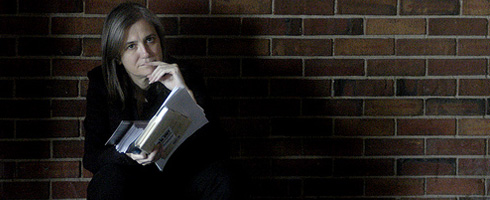
This is Bill Moyers's introduction to Amy Goodman's latest book, "Breaking the Sound Barrier," published by Haymarket Books.
You can learn more of the truth about Washington and the world from one week of Amy Goodman's "Democracy Now!" than from a month of Sunday morning talk shows.
Make that a year of Sunday morning talk shows.
That's because Amy, as you will discover on every page of her new book, "Breaking the Sound Barrier", knows the critical question for journalists is how close they are to the truth, not how close they are to power. Like I. F. Stone, she values the facts on the ground; unlike the Sunday beltway anchors, she refuses to take the official version of reality as the definition of news, or to engage in Washington's "wink-wink" game, by which both parties to an interview tacitly understand that the questions and answers will be framed to appear adversarial when in fact their purpose is to avoid revealing how power really works. Quick: recall the last time you heard a celebrity journalist on any of the Sunday talk shows grill a politician on what campaign contributors get for their generosity. Try again: name any of those elite interrogators who skewered any politician for saying that "single-payer" wasn't on the table in the debate over health care reform because "there's no support for it." OK, one last chance: recall how often you have heard any of the network stars insist that Newt Gingrich reveal just who is funding his base as the omnipresent expert on everything.
See?
Now read "Breaking the Sound Barrier" for a reality check. And tune in to "Democracy Now!" to hear and see the difference an independent journalist can make in providing citizens what they need to know to make democracy work.
It takes the nerves, stamina and willpower of an Olympic triathlete to do what Amy Goodman does. That's just who she is, this quiet-spoken tornado of muckraking journalism: Edward R. Murrow with a twist of Emma Goldman, a Washington Post reporter once noted - willing to take on the powers that be to get at truth and justice, then spreading the word of those two indispensable gospels to the republic and the world beyond. Amy Goodman goes where angels fear to tread. Beaten by Indonesian troops while she and a colleague - also beaten - were covering East Timor's fight for independence. Hiking dangerous African deltas to get to the bottom of Chevron Oil's collusion with the Nigerian military. Or closer to home, in New Orleans or Appalachia or facing down the police when her colleagues were arrested in Minneapolis during the 2008 Republican National Convention (they threw her in the slammer, too).
Through her reporting, we hear from people who scarcely exist in news covered by the corporate-owned press. We learn about issues of war and peace and social wrong. She is impervious to government subterfuge or spin. "Goodman is the journalist as uninvited guest," that Washington Post reporter wrote. "You might think of the impolitic question; she asks it." And once it's been asked, she refuses to take "no comment" for an answer. She returns to a story time and again, continually digging, refusing to let her audience or investigative target forget how important it is to nail down just who's responsible and what needs to be done.
On top of everything else, she finds time to take her message out to a broad public with speeches and books and a weekly newspaper column, from which her collection of essays, "Breaking the Sound Barrier," has been selected. I'd be envious if it didn't appear unseemly. Let's just say I'm in awe. Read this collection and revel in the truth-telling. Be outraged by what you learn from it and renew your oath as a citizen. "We stand with journalists around the world who deeply believe that the mission of a journalist is to go where the silence is," Amy Goodman said in December 2008 when she accepted the Right Livelihood Award for personal courage and transformation. "The responsibility of a journalist is to give a voice to those who have been forgotten, forsaken, beaten down by the powerful." And, at a time when the future of journalism is in question, this ringing rationale for our embattled but essential craft: "It's the best reason I know for us to carry our pens, our microphones, and our cameras, both into our own communities and out to the wider world."
Right on.
"As an organization, truthout works to broaden and diversify the political discussion by introducing independent voices and focusing on undercovered issues and unconventional thinking."
This is Bill Moyers's introduction to Amy Goodman's latest book, "Breaking the Sound Barrier," published by Haymarket Books.
You can learn more of the truth about Washington and the world from one week of Amy Goodman's "Democracy Now!" than from a month of Sunday morning talk shows.
Make that a year of Sunday morning talk shows.
That's because Amy, as you will discover on every page of her new book, "Breaking the Sound Barrier", knows the critical question for journalists is how close they are to the truth, not how close they are to power. Like I. F. Stone, she values the facts on the ground; unlike the Sunday beltway anchors, she refuses to take the official version of reality as the definition of news, or to engage in Washington's "wink-wink" game, by which both parties to an interview tacitly understand that the questions and answers will be framed to appear adversarial when in fact their purpose is to avoid revealing how power really works. Quick: recall the last time you heard a celebrity journalist on any of the Sunday talk shows grill a politician on what campaign contributors get for their generosity. Try again: name any of those elite interrogators who skewered any politician for saying that "single-payer" wasn't on the table in the debate over health care reform because "there's no support for it." OK, one last chance: recall how often you have heard any of the network stars insist that Newt Gingrich reveal just who is funding his base as the omnipresent expert on everything.
See?
Now read "Breaking the Sound Barrier" for a reality check. And tune in to "Democracy Now!" to hear and see the difference an independent journalist can make in providing citizens what they need to know to make democracy work.
It takes the nerves, stamina and willpower of an Olympic triathlete to do what Amy Goodman does. That's just who she is, this quiet-spoken tornado of muckraking journalism: Edward R. Murrow with a twist of Emma Goldman, a Washington Post reporter once noted - willing to take on the powers that be to get at truth and justice, then spreading the word of those two indispensable gospels to the republic and the world beyond. Amy Goodman goes where angels fear to tread. Beaten by Indonesian troops while she and a colleague - also beaten - were covering East Timor's fight for independence. Hiking dangerous African deltas to get to the bottom of Chevron Oil's collusion with the Nigerian military. Or closer to home, in New Orleans or Appalachia or facing down the police when her colleagues were arrested in Minneapolis during the 2008 Republican National Convention (they threw her in the slammer, too).
Through her reporting, we hear from people who scarcely exist in news covered by the corporate-owned press. We learn about issues of war and peace and social wrong. She is impervious to government subterfuge or spin. "Goodman is the journalist as uninvited guest," that Washington Post reporter wrote. "You might think of the impolitic question; she asks it." And once it's been asked, she refuses to take "no comment" for an answer. She returns to a story time and again, continually digging, refusing to let her audience or investigative target forget how important it is to nail down just who's responsible and what needs to be done.
On top of everything else, she finds time to take her message out to a broad public with speeches and books and a weekly newspaper column, from which her collection of essays, "Breaking the Sound Barrier," has been selected. I'd be envious if it didn't appear unseemly. Let's just say I'm in awe. Read this collection and revel in the truth-telling. Be outraged by what you learn from it and renew your oath as a citizen. "We stand with journalists around the world who deeply believe that the mission of a journalist is to go where the silence is," Amy Goodman said in December 2008 when she accepted the Right Livelihood Award for personal courage and transformation. "The responsibility of a journalist is to give a voice to those who have been forgotten, forsaken, beaten down by the powerful." And, at a time when the future of journalism is in question, this ringing rationale for our embattled but essential craft: "It's the best reason I know for us to carry our pens, our microphones, and our cameras, both into our own communities and out to the wider world."
Right on.
"As an organization, truthout works to broaden and diversify the political discussion by introducing independent voices and focusing on undercovered issues and unconventional thinking."
Must Read: The Nation
The Nation has been restored over the past couple of years to a deserved place as essential reading on the Left. Here, for example, are titles from The Most Popular and Most Read lists today on the weekly's website:
» The Nightmare of Christianity
» Obama's Presidency Isn't Too Big to Fail
» Slide Show: Race in the Obama Era
» The Right's Fringe Festival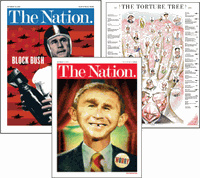
» Stewart Slams Beck, Tea Party Protesters
» Double Standard for Serena Williams
» Stop the Sex Scare in Sports
» Why Is Obama Still Using Blackwater?
» Slide Show: The Palin Saga
» Operation Rollback
» The Unauthorized 9/12 Teabagger Tour
» Right On
» The Crusade Against Sex Trafficking
» A Method to Their Madness
» The Death of Adam Hermanson
» Three R's and a Why
» Sexual Healing
» The Tel Aviv Party Stops Here
» Aracataca and Sucre
Go. Read. The Nation.
» The Nightmare of Christianity
» Obama's Presidency Isn't Too Big to Fail
» Slide Show: Race in the Obama Era
» The Right's Fringe Festival
» Stewart Slams Beck, Tea Party Protesters
» Double Standard for Serena Williams
» Stop the Sex Scare in Sports
» Why Is Obama Still Using Blackwater?
» Slide Show: The Palin Saga
» Operation Rollback
» The Unauthorized 9/12 Teabagger Tour
» Right On
» The Crusade Against Sex Trafficking
» A Method to Their Madness
» The Death of Adam Hermanson
» Three R's and a Why
» Sexual Healing
» The Tel Aviv Party Stops Here
» Aracataca and Sucre
Go. Read. The Nation.
Block That Metaphor: Jerry Brown Superstar
This is not to knock Jerry Brown. His is a long and honorable public career. But even by the diminished standards of contemporary California political journalism, 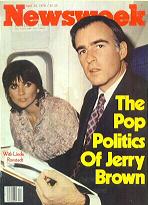 the profile of the past and future governor by Scott Sabatini on Examiner.com is silly:
the profile of the past and future governor by Scott Sabatini on Examiner.com is silly:Despite his 71 years, California Attorney General Jerry Brown has never been caught behind the times. Over a political career that has out-survived even Morris the Cat, Brown has become the Rolling Stones of California politics, played on both the classic rock station, the oldies and Top 40 playlists alike.From The Contenders: Brown's classic rock back in fashion in 2010 by Scott Sabatini (Examiner.com).
His is one act -- no matter how many times folks have said it has grown stale -- that continues to pack the house come election day.
Subscribe to:
Posts (Atom)


