


Worth your time and attention:
Showing posts with label federal budget. Show all posts
Showing posts with label federal budget. Show all posts

Budget deficit. So what.
Liberals and progressives need to think twice about making an issue of deficits. The federal debt, per se, is not a problem. If the government uses deficit spending to invest in the nation's future prosperity, as it must and should, we would not have a complaint. What needs to be attacked is our retrogressive tax system, corporate welfare, and military waste and adventurism. Deficit funding -- of efficient and economically competitive infrastructure; health care; lifetime education (not just pre-K to college and technical school, but skill-maintenance and retraining to avoid obsolescence); housing; and guaranteed basic income -- would be a bargain in the long run. Fetishizing the federal deficit runs the risk of making needed spending too expensive politically.
The Long War
A new 'Costs of War' report published by Brown University's Watson Institute shows the actual costs incurred by the U.S. as part of its global 'war on terror' that widely contradicts the cost of war figures put together by the Pentagon in its report.

Some of the Costs of War Project’s main findings include:
370,000 people have died due to direct war violence, including armed forces on all sides of the conflicts, contractors, civilians, journalists, and humanitarian workers.
It is likely that many times more than 370,000 people have died indirectly in these wars, due to malnutrition, damaged infrastructure, and environmental degradation.
200,000 civilians have been killed in direct violence by all parties to these conflicts.
Over 6,800 US soldiers have died in the wars.
We do not know the full extent of how many US service members returning from these wars became injured or ill while deployed.
Many deaths and injuries among US contractors have not been reported as required by law, but it is likely that at least 6,900 have been killed.
10.1 million million Afghan, Iraqi, and Pakistani people are living as war refugees and internally displaced persons, in grossly inadequate conditions.*
The US has made an estimated 76 drone strikes in Yemen, making the US arguably at war in that country.
The wars have been accompanied by erosions in civil liberties and human rights at home and abroad.
The human and economic costs of these wars will continue for decades with some costs, such as the financial costs of US veterans’ care, not peaking until mid-century.
US government funding of reconstruction efforts in Iraq and Afghanistan has totaled over $170 billion. Most of those funds have gone towards arming security forces in both countries. Much of the money allocated to humanitarian relief and rebuilding civil society has been lost to fraud, waste, and abuse.
The cost for the Iraq and Afghanistan/Pakistan wars totals about $4.8 trillion. This does not include future interest costs on borrowing for the wars, which will add an estimated $8 trillion through 2054.
The ripple effects on the US economy have also been significant, including job loss and interest rate increases.
Both Iraq and Afghanistan continue to rank extremely low in global studies of political freedom.
Women in Iraq and Afghanistan are excluded from political power and experience high rates of unemployment and war widowhood.
Compelling alternatives to war were scarcely considered in the aftermath of 9/11 or in the discussion about war against Iraq. Some of those alternatives are still available to the US.
* Source: The UN Refugee Agency (UNHCR) (2015).

Some of the Costs of War Project’s main findings include:
370,000 people have died due to direct war violence, including armed forces on all sides of the conflicts, contractors, civilians, journalists, and humanitarian workers.
It is likely that many times more than 370,000 people have died indirectly in these wars, due to malnutrition, damaged infrastructure, and environmental degradation.
200,000 civilians have been killed in direct violence by all parties to these conflicts.
Over 6,800 US soldiers have died in the wars.
We do not know the full extent of how many US service members returning from these wars became injured or ill while deployed.
Many deaths and injuries among US contractors have not been reported as required by law, but it is likely that at least 6,900 have been killed.
10.1 million million Afghan, Iraqi, and Pakistani people are living as war refugees and internally displaced persons, in grossly inadequate conditions.*
The US has made an estimated 76 drone strikes in Yemen, making the US arguably at war in that country.
The wars have been accompanied by erosions in civil liberties and human rights at home and abroad.
The human and economic costs of these wars will continue for decades with some costs, such as the financial costs of US veterans’ care, not peaking until mid-century.
US government funding of reconstruction efforts in Iraq and Afghanistan has totaled over $170 billion. Most of those funds have gone towards arming security forces in both countries. Much of the money allocated to humanitarian relief and rebuilding civil society has been lost to fraud, waste, and abuse.
The cost for the Iraq and Afghanistan/Pakistan wars totals about $4.8 trillion. This does not include future interest costs on borrowing for the wars, which will add an estimated $8 trillion through 2054.
The ripple effects on the US economy have also been significant, including job loss and interest rate increases.
Both Iraq and Afghanistan continue to rank extremely low in global studies of political freedom.
Women in Iraq and Afghanistan are excluded from political power and experience high rates of unemployment and war widowhood.
Compelling alternatives to war were scarcely considered in the aftermath of 9/11 or in the discussion about war against Iraq. Some of those alternatives are still available to the US.
* Source: The UN Refugee Agency (UNHCR) (2015).
Diary
21 Democrats plus Sen. Sanders (and 18 Republicans) tried to stop the giveback to the banksters and other bad stuff in the budget bill. Here they are:
Blumenthal (D-CT)You will note that Feinstein and Schumer are not among them.
Booker (D-NJ)
Boxer (D-CA)
Brown (D-OH)
Cantwell (D-WA)
Franken (D-MN)
Gillibrand (D-NY)
Harkin (D-IA)
Hirono (D-HI)
Klobuchar (D-MN)
Levin (D-MI)
Manchin (D-WV)
Markey (D-MA)
McCaskill (D-MO)
Menendez (D-NJ)
Merkley (D-OR)
Reed (D-RI)
Sanders (I-VT)
Tester (D-MT)
Warren (D-MA)
Whitehouse (D-RI)
Wyden (D-OR)

Tax Fraud
The primary justification for the negotiations b/t the WH and the GOP was the need to reduce the federal budget. However, the CBO estimates the budgetary impact of the fiscal-cliff deal will be that the debt will be nearly $4 trillion higher over the next ten years as compared with current policy.
The Hill: “The extension of lower tax rates for a bulk of the nation’s taxpayers and the addition of a permanent patch to the alternative minimum tax would add roughly $3.6 trillion to the deficit over the next decade… Other individual, business, and energy tax extenders would add another $76 billion.
“The extension of unemployment benefits would cost roughly $30 billion, and the so-called ‘doc fix’ would tally another $25 billion through fiscal 2022… the budget agreement will lead to an overall increase in spending of about $330 billion.”
The Hill: “The extension of lower tax rates for a bulk of the nation’s taxpayers and the addition of a permanent patch to the alternative minimum tax would add roughly $3.6 trillion to the deficit over the next decade… Other individual, business, and energy tax extenders would add another $76 billion.
“The extension of unemployment benefits would cost roughly $30 billion, and the so-called ‘doc fix’ would tally another $25 billion through fiscal 2022… the budget agreement will lead to an overall increase in spending of about $330 billion.”
Maybe we should stop electing Democrats to the White House and start electing democrats.
It looks like the new deal (an expression I am using ironically) will define -- absurdly -- "middle class" as any family making up to $450,000/yr or individual bringing in $400,000. The median household income is about $50,000/yr. Four out of five U.S. families make less than $100,000/yr. Fewer than 1% earn more than $450,000/yr. We've got to stop electing Democrats to the White House and start electing democrats.

Discuss:
"Neither spending more nor taxing less will help the country pay its bills. What it can and must do is radically simplify its tax, health-care, retirement and financial systems, each of which is a complete mess. But this is the good news. It means they can each be redesigned to achieve their legitimate purposes at much lower cost and, in the process, revitalize the economy."
U.S. Is Bankrupt and We Don’t Even Know It by Laurence Kotlikoff (Bloomberg)
Federal Budget: "I would rather have no deal than a bad deal"
Wolf Blitzer appears never to have met a principled liberal before.
They're rare enough. Maybe he never has.
They're rare enough. Maybe he never has.
Change Watch: The lame-duck session is about as good as it's going to get
With all appreciation due for the passage of START (thanks Sen. Kerry and Sen. Lugar), the end of the cruel and ridiculous DADT policy (you, too, Sen. Reid and Sen. Lieberman), improved food safety, and watered-down health care for 9/11 responders, the extension of the Bush tax cuts makes clear that Congress is not ready to make the really tough decisions that would get the country moving again. As Kevin Drum wrote last month in Mother Jones (Willful Self Destruction 2010-11-30), "We need:
A big stimulus now aimed at infrastructure development. A credible plan to close the long-term deficit that acknowledges the need for tax increases to be part of the solution. A serious and sustained effort at reining in healthcare costs and broadening access. A collective decision to cut out the culture war nonsense and figure out how to improve our educational system with no more than modest spending increases. Real financial reform, not the weak tea of Dodd-Frank. Less spending on empire building and much, much more spending on real sustainable energy development and engineering.Little to none of this will happen -- we'll be lucky to emerge from the next congress with Social Security and Medicare intact -- unless there is a revolutionary change in the way we conduct our political business. With Nancy Pelosi reduced to minority leader and the White House and the Senate dominated by conservatives and bogus pragmatists standing in the way of change, there is little hope of reversing our long, slow economic decline.
Economy: In the middle of the worst economic decline in over 80 years, we need fiscal stimuli, not fiscal austerity
In the political current climate, mainstream Keynesianism, as espoused by economists such as Paul Krugman and Joseph Stiglitz, has come to seem almost left-wing. Is the Keynesian critique of austerity correct, and is a return to Keynesianism what we need?
Must read: Freezing Out Hope by Paul Krugman -- After the pummeling in the midterm elections, has President Obama suffered a moral collapse?
Keynesianism only seems left-wing because the center has caved rightward. First, even a Nobel Prize does not protect one from ostracism by the mainstream of the economics profession today if you persist in dispensing Keynesian wisdom and challenge the assumption that unfettered markets always know best. As hard as this may be for non-economists to believe, Stiglitiz and Krugman are now persona non grata within the economics profession. Second, in the 1950s and 60s even Tories and Republicans had to begrudgingly accede to the wisdom of financial regulation and Keynesian fiscal and monetary policies. But that day is long past. Now even Labour and Democrats buy into the myth that markets, including financial markets, can be relied on to self-regulate, and governments must engage in fiscal austerity when recessions create temporary budget deficits. When the center caves right, center left appears to be left.The rest of the story: Digging In A Hole -- Robin Hahnel, economics professor at American University and author of Economic Justice and Democracy: From Competition to Cooperation and, with Michael Albert, of The Political Economy of Participatory Economics, discusses the continuing mismanagement of the economic crisis in the UK, Ireland and the US with Alex Doherty of New Left Project.
There are two important lessons to be drawn. (1) While socialists should not have to lead the charge for Keynesian policies to ameliorate capitalist crises, unfortunately that is the position we find ourselves in. Right now we must not only do our own work – explaining why all versions of capitalism are far less desirable than participatory, democratic socialism – but do the work of Keynesian reformers as well who have lost influence in all major political parties. (2) There is no point in trying to explain to Tories and Republicans why their policies are flawed. They have chosen to embrace ill-advised, discredited, nineteenth century economic policies because these policies serve their most important purpose – further pressing the class war they have been winning for more than three decades. Their first instinct when a crisis hits is not to search for policies that would actually solve the crisis. Instead they search their “wish list” for ways to take advantage of the crisis to press for changes that serve their class interests – further cuts in social spending, further concessions regarding wages, benefits, and working conditions, more tax cuts for corporations and the wealthy, and of course more corporate welfare like the bailouts doled out to the financial industry. The fact that every one of these policies will only deepen the current crisis is of no concern to them.
When capitalism proves completely incapable of putting our productive potential to good use what is called for is replacing capitalism with socialism. A return to Keynesianism would be to settle for only part of a loaf, and leave us vulnerable to another counter revolutionary roll back of hard won gains, like the one we have been living through. However, unless I am pleasantly surprised, and leftists can win the loyalty and support of a majority of the population for replacing capitalism with socialism much sooner than I foresee, there is no road to participatory, democratic socialism that does not run through many successful reform campaigns to bring Keynesian policies back in vogue.
Must read: Freezing Out Hope by Paul Krugman -- After the pummeling in the midterm elections, has President Obama suffered a moral collapse?
Press Release: Public Transit Projects Create More Jobs than Highways
(Washington DC 2010-09-02) New data released today by the Transportation Equity Network reveals that investment in public transit can create hundreds of thousands more jobs than highway projects.
More Transit Equals More Jobs examines official project lists from 20 federally authorized Metropolitan Planning Organizations (MPOs) and concludes that “if [they] shifted 50 percent of their highway funds to transit, they would generate an additional 184,801 jobs over a five-year period without spending any more money.”
“This report reveals just how much more bang we can get for our buck if we invest in transit,” said Dan Smith, a transportation associate for U.S. Public Interest Research Group (U.S. PIRG). “Transit provides important benefits to communities and, with unemployment so high, this is data that should not be ignored.”
Previous studies, including examinations of federal Recovery Act spending, have consistently found that public transportation creates more jobs than highways. Investment in public transit tends to be more labor-intensive than highway projects because the work is generally more complex, involves the purchase and maintenance of vehicles, and requires much less spending on land acquisition.
More Transit Equals More Jobs makes a broad case for larger investments in our public transit systems. More money for transit not only means more jobs but would additionally lead to less traffic congestion, hazardous pollution, and global warming emissions. # # #
U.S. PIRG, the federation of state Public Interest Research Groups, is a non-profit, non-partisan public interest advocacy organization. For more information visit http://www.uspirg.org.
More Transit Equals More Jobs examines official project lists from 20 federally authorized Metropolitan Planning Organizations (MPOs) and concludes that
“if [they] shifted 50 percent of their highway funds to transit, they would generate an additional 184,801 jobs over a five-year period without spending any more money.” “This report reveals just how much more bang we can get for our buck if we invest in transit,” said Dan Smith, a transportation associate for U.S. Public Interest Research Group (U.S. PIRG). “Transit provides important benefits to communities and, with unemployment so high, this is data that should not be ignored.”
Previous studies, including examinations of federal Recovery Act spending, have consistently found that public transportation creates more jobs than highways. Investment in public transit tends to be more labor-intensive than highway projects because the work is generally more complex, involves the purchase and maintenance of vehicles, and requires much less spending on land acquisition.
More Transit Equals More Jobs makes a broad case for larger investments in our public transit systems. More money for transit not only means more jobs but would additionally lead to less traffic congestion, hazardous pollution, and global warming emissions. # # #
U.S. PIRG, the federation of state Public Interest Research Groups, is a non-profit, non-partisan public interest advocacy organization. For more information visit http://www.uspirg.org.
The Long War: Losing in Afghanistan
Barack Obama is following the footsteps of a predecessor, but they are not Theodore Roosevelt's, as he imagines, but Lyndon Johnson's
by Marjorie Cohn (truthout 2010-07-07)
Last week, the House of Representatives voted 215-210 for $33 billion to fund Barack Obama's troop increase in Afghanistan. But there was considerable opposition to giving the president a blank check. One hundred sixty-two House members supported an amendment that would have tied the funding to a withdrawal timetable. One hundred members voted for another amendment that would have rejected the $33 billion for the 30,000 new troops already on their way to Afghanistan; that amendment would have required that the money be spent to redeploy our troops out of Afghanistan. Democrats voting for the second amendment included House Speaker Nancy Pelosi and nine Republicans. Both amendments failed to pass.
The new appropriation is in addition to the $130 billion Congress has already approved for Iraq and Afghanistan this year. And the 2010 Pentagon budget is $693 billion, more than all other discretionary spending programs combined.
Our economic crisis is directly tied to the cost of the war. We are in desperate need of money for education and health care. The $1 million per year it costs to maintain a single soldier in Afghanistan could pay for 20 green jobs.
Not only is the war bankrupting us, it has come at a tragic cost in lives. June was the deadliest month for US troops in Afghanistan. In addition to the 1,149 American soldiers killed in Afghanistan, untold numbers of Afghan civilians have died from the war - untold because the Defense Department refuses to maintain statistics of anyone except US personnel. After all, Donald Rumsfeld quipped in 2005, "death has a tendency to encourage a depressing view of war."
There are other "depressing" aspects of this war as well. As Gen. Stanley McChrystal reported just days before he got the ax, there is a "resilient and growing insurgency" with high levels of violence and corruption within the Karzai government. McChrystal's remarks were considered "off message" by the White House, which was also irked by the general's criticisms of Obama officials in a Rolling Stone article. McChrystal believes that you can't kill your way out of Afghanistan. "The Russians killed 1 million Afghans and that didn't work."
He and his successor, Gen. David Petraeus, likely disagree on the need to prevent civilian casualties (known as "Civ Cas"). McChrystal instituted some of the most stringent rules of engagement the US military has had in a war zone: "Patrol only in areas that you are reasonably certain that you will not have to defend yourselves with lethal force." Commanders cannot fire on buildings or other places if they have reason to believe civilians might be present unless their own forces are in imminent danger of being overrun. And they must end engagements and withdraw rather than risk harming noncombatants. McChrystal knows that for every innocent person you kill, you create new enemies; he calls it "insurgent math." According to The Los Angeles Times, McChrystal "was credited with bringing about a substantial drop in the proportion of civilian casualties suffered at the hands of NATO's International Security Assistance Force and its Afghan allies."
While testifying in Congress before he was confirmed to take McChrystal's place, Petraeus told senators that some US soldiers had complained about the former's rules of engagement aimed at preventing civilian casualties.
According to the Rolling Stone article, Obama capitulated to McChrystal's insistence that more troops were needed in Afghanistan. In his December 1 speech at West Point, the article says, "the president laid out all the reasons why fighting the war in Afghanistan is a bad idea: It's expensive; we're in an economic crisis; a decade-long commitment would sap American power; Al Qaeda has shifted its base of operations to Pakistan. Then," the article continued, "without ever using the words 'victory' or 'win,' Obama announced that he would send an additional 30,000 troops to Afghanistan, almost as many as McChrystal had requested."
Both Obama and Petraeus no longer speak of "victory" over the Taliban; they both hold open the possibility of settlement with the Taliban. Indeed, Maj. Gen. Bill Mayville, chief of operations for McChrystal, told Rolling Stone, "It's not going to look like a win, smell like a win or taste like a win."
The majority of Americans now oppose the war in Afghanistan. Fareed Zakaria had some harsh words for the war on his CNN show, saying, "the whole enterprise in Afghanistan feels disproportionate, a very expensive solution to what is turning out to be a small but real problem." Noting that CIA Director Leon Panetta admitted that the number of al-Qaeda left in Afghanistan may be 50 to 100, Zakaria asked, "why are we fighting a major war" there? "Last month alone there were more than 100 NATO troops killed in Afghanistan," he said. "That's more than one allied death for each living Al Qaeda member in the country in just one month." Citing estimates that the war will cost more than $100 billion in 2010 alone, Zakaria observed, "That's a billion dollars for every member of Al Qaeda thought to be living in Afghanistan in one year." He queried, "Why are we investing so much time, energy, and effort when Al Qaeda is so weak?" And Zakaria responded to the argument that we should continue fighting the Taliban because they are allied with al-Qaeda by saying, "this would be like fighting Italy in World War II after Hitler's regime had collapsed and Berlin was in flames just because Italy had been allied with Germany."
There is also division in the Republican ranks over the war. Republican National Committee Chairman Michael Steele made some gutsy comments about the war in Afghanistan, saying it is not winnable and calling it a "war of Obama's choosing." (Even though George W. Bush first invaded Afghanistan, Obama made the escalation of US involvement a centerpiece of his campaign.) Steele said that if Obama is "such a student of history, has he not understood that, you know, that's the one thing you don't do, is engage in a land war in Afghanistan? Everyone who has tried, over 1,000 years of history, has failed." Interestingly, Republicans Lindsey Graham and John McCain slammed Steele and jumped to Obama's defense. Rep. Ron Paul, however, agreed with Steele, saying, "Michael Steele has it right, and Republicans should stick by him."
Obama will likely persist with his failed war. He appears to be stumbling along the same path that Lyndon Johnson followed. Johnson lost his vision for a "Great Society" when he became convinced that his legacy depended on winning the Vietnam War. It appears that Obama has similarly lost his way.
This work by Truthout is licensed under a Creative Commons Attribution-Noncommercial 3.0 United States License.
by Marjorie Cohn (truthout 2010-07-07)
Last week, the House of Representatives voted 215-210 for $33 billion to fund Barack Obama's troop increase in Afghanistan. But there was considerable opposition to giving the president a blank check. One hundred sixty-two House members supported an amendment that would have tied the funding to a withdrawal timetable. One hundred members voted for another amendment that would have rejected the $33 billion for the 30,000 new troops already on their way to Afghanistan; that amendment would have required that the money be spent to redeploy our troops out of Afghanistan. Democrats voting for the second amendment included House Speaker Nancy Pelosi and nine Republicans. Both amendments failed to pass.
The new appropriation is in addition to the $130 billion Congress has already approved for Iraq and Afghanistan this year. And the 2010 Pentagon budget is $693 billion, more than all other discretionary spending programs combined.
Our economic crisis is directly tied to the cost of the war. We are in desperate need of money for education and health care. The $1 million per year it costs to maintain a single soldier in Afghanistan could pay for 20 green jobs.
Not only is the war bankrupting us, it has come at a tragic cost in lives. June was the deadliest month for US troops in Afghanistan. In addition to the 1,149 American soldiers killed in Afghanistan, untold numbers of Afghan civilians have died from the war - untold because the Defense Department refuses to maintain statistics of anyone except US personnel. After all, Donald Rumsfeld quipped in 2005, "death has a tendency to encourage a depressing view of war."
There are other "depressing" aspects of this war as well. As Gen. Stanley McChrystal reported just days before he got the ax, there is a "resilient and growing insurgency" with high levels of violence and corruption within the Karzai government. McChrystal's remarks were considered "off message" by the White House, which was also irked by the general's criticisms of Obama officials in a Rolling Stone article. McChrystal believes that you can't kill your way out of Afghanistan. "The Russians killed 1 million Afghans and that didn't work."
He and his successor, Gen. David Petraeus, likely disagree on the need to prevent civilian casualties (known as "Civ Cas"). McChrystal instituted some of the most stringent rules of engagement the US military has had in a war zone: "Patrol only in areas that you are reasonably certain that you will not have to defend yourselves with lethal force." Commanders cannot fire on buildings or other places if they have reason to believe civilians might be present unless their own forces are in imminent danger of being overrun. And they must end engagements and withdraw rather than risk harming noncombatants. McChrystal knows that for every innocent person you kill, you create new enemies; he calls it "insurgent math." According to The Los Angeles Times, McChrystal "was credited with bringing about a substantial drop in the proportion of civilian casualties suffered at the hands of NATO's International Security Assistance Force and its Afghan allies."
While testifying in Congress before he was confirmed to take McChrystal's place, Petraeus told senators that some US soldiers had complained about the former's rules of engagement aimed at preventing civilian casualties.
According to the Rolling Stone article, Obama capitulated to McChrystal's insistence that more troops were needed in Afghanistan. In his December 1 speech at West Point, the article says, "the president laid out all the reasons why fighting the war in Afghanistan is a bad idea: It's expensive; we're in an economic crisis; a decade-long commitment would sap American power; Al Qaeda has shifted its base of operations to Pakistan. Then," the article continued, "without ever using the words 'victory' or 'win,' Obama announced that he would send an additional 30,000 troops to Afghanistan, almost as many as McChrystal had requested."
Both Obama and Petraeus no longer speak of "victory" over the Taliban; they both hold open the possibility of settlement with the Taliban. Indeed, Maj. Gen. Bill Mayville, chief of operations for McChrystal, told Rolling Stone, "It's not going to look like a win, smell like a win or taste like a win."
The majority of Americans now oppose the war in Afghanistan. Fareed Zakaria had some harsh words for the war on his CNN show, saying, "the whole enterprise in Afghanistan feels disproportionate, a very expensive solution to what is turning out to be a small but real problem." Noting that CIA Director Leon Panetta admitted that the number of al-Qaeda left in Afghanistan may be 50 to 100, Zakaria asked, "why are we fighting a major war" there? "Last month alone there were more than 100 NATO troops killed in Afghanistan," he said. "That's more than one allied death for each living Al Qaeda member in the country in just one month." Citing estimates that the war will cost more than $100 billion in 2010 alone, Zakaria observed, "That's a billion dollars for every member of Al Qaeda thought to be living in Afghanistan in one year." He queried, "Why are we investing so much time, energy, and effort when Al Qaeda is so weak?" And Zakaria responded to the argument that we should continue fighting the Taliban because they are allied with al-Qaeda by saying, "this would be like fighting Italy in World War II after Hitler's regime had collapsed and Berlin was in flames just because Italy had been allied with Germany."
There is also division in the Republican ranks over the war. Republican National Committee Chairman Michael Steele made some gutsy comments about the war in Afghanistan, saying it is not winnable and calling it a "war of Obama's choosing." (Even though George W. Bush first invaded Afghanistan, Obama made the escalation of US involvement a centerpiece of his campaign.) Steele said that if Obama is "such a student of history, has he not understood that, you know, that's the one thing you don't do, is engage in a land war in Afghanistan? Everyone who has tried, over 1,000 years of history, has failed." Interestingly, Republicans Lindsey Graham and John McCain slammed Steele and jumped to Obama's defense. Rep. Ron Paul, however, agreed with Steele, saying, "Michael Steele has it right, and Republicans should stick by him."
Obama will likely persist with his failed war. He appears to be stumbling along the same path that Lyndon Johnson followed. Johnson lost his vision for a "Great Society" when he became convinced that his legacy depended on winning the Vietnam War. It appears that Obama has similarly lost his way.
This work by Truthout is licensed under a Creative Commons Attribution-Noncommercial 3.0 United States License.
The Federal Deficit: First, do no harm
Here are "Eight Keys To Addressing The Deficit" offered to the White House National Commission on Fiscal Responsibility and Reform, a presidential advisory body that has the Obama administration has stacked with Wall Street apologists, by AFL-CIO president Richard Trumka,
First, stabilizing the national debt is a means to an end, not an end in itself. "...stabilizing the debt is simply a means to achieve our goal of sustainable, broadly shared prosperity, and we should reject approaches to debt stabilization that take us away from that goal."
Second, we should be honest about will cause deficits over the next ten years: The tax cuts enacted under President George W. Bush, the wars in Afghanistan and Iraq, and the economic downturn (and not a crisis of entitlement spending generally, caused by the retirement of the Baby Boomers).
Third, premature withdrawal of economic stimulus threatens to throw the global economy into a double-dip recession, or worse. "By withdrawing economic stimulus, we run the risk not only of prolonging the jobs crisis for several more years, but also of bringing about a “double-dip” recession—or even what Nobel Laureate Paul Krugman calls 'a third Depression.'”
Fourth, stronger economic growth, job growth, and wage growth are needed to stabilize the debt. "...[W]e must have a job-centered approach to stabilizing the national debt, which would bring us closer to our goal of sustainable, broadly shared prosperity."
Fifth, Wall Street should pay to build a 21st century infrastructure that will lead to long-term economic growth by investing heavily in public infrastructure that has been badly neglected over the past 30 years, not only to roads and bridges but also to airports and air traffic control systems, urban transit, high-speed rail, schools and university facilities, national laboratories, national parks, ‘smart’ electric grids, broadband networks, green generating plants, and health information networks.
Seventh, we must reduce health care costs even further—without cutting benefits or compromising the quality of care. "Reducing excess cost growth can and should be accomplished without cutting benefits. Approaches that should be considered include (1) Medicare drug price negotiation; (2) easing restrictions on imports of prescription drugs; (3) expanding proven Medicare payment and delivery reforms; and (4) offering the choice of a public health insurance plan option that would offer premiums 10% below private insurance and would reportedly reduce the federal deficit by $110 billion over 10 years."
Eighth, Social Security benefits are not the problem and must not be cut. "In fact, Social Security should be strengthened to compensate for the decline of traditional pensions and for the stock market losses of retirement savings plans. Social Security benefits are about one third lower than the average of 30 OECD countries.
See, also, commission testimony Dr. Margaret Flowers for Physicians for a National Health Program: "The alternative scenario of a national improved Medicare for All will save lives and save money. National improved Medicare for All will place our nation on the path of becoming one of the best health systems in the world - something of which we can all be proud. This commission has the ability to recommend creating a financially sustainable universal health system. I urge the members of this commission to recommend addressing the deficit through adopting this most popular approach: national improved Medicare for All. Don't cut Medicare. Protect it, improve it and expand it to cover everyone." -- Improve and strengthen Medicare by expanding it to all (PNHP 2010-02-01).
First, stabilizing the national debt is a means to an end, not an end in itself. "...stabilizing the debt is simply a means to achieve our goal of sustainable, broadly shared prosperity, and we should reject approaches to debt stabilization that take us away from that goal."
Second, we should be honest about will cause deficits over the next ten years: The tax cuts enacted under President George W. Bush, the wars in Afghanistan and Iraq, and the economic downturn (and not a crisis of entitlement spending generally, caused by the retirement of the Baby Boomers).
Third, premature withdrawal of economic stimulus threatens to throw the global economy into a double-dip recession, or worse. "By withdrawing economic stimulus, we run the risk not only of prolonging the jobs crisis for several more years, but also of bringing about a “double-dip” recession—or even what Nobel Laureate Paul Krugman calls 'a third Depression.'”
Fourth, stronger economic growth, job growth, and wage growth are needed to stabilize the debt. "...[W]e must have a job-centered approach to stabilizing the national debt, which would bring us closer to our goal of sustainable, broadly shared prosperity."
Fifth, Wall Street should pay to build a 21st century infrastructure that will lead to long-term economic growth by investing heavily in public infrastructure that has been badly neglected over the past 30 years, not only to roads and bridges but also to airports and air traffic control systems, urban transit, high-speed rail, schools and university facilities, national laboratories, national parks, ‘smart’ electric grids, broadband networks, green generating plants, and health information networks.
We believe it is only fitting to ask Wall Street to pay to rebuild the economy it helped destroy. One way to do that would be through a Financial Speculation Tax (FST) — a tiny 0.05% tax on transactions of stocks, options, futures, credit default swaps, and other derivative instruments. The $100 to $300 billion in additional tax revenue per year that this tax would generate could be used to fund higher levels of public investment, and the tax itself would curb unproductive speculation that is harmful to the economy.Sixth, efforts to stabilize the national debt should not include approaches that increase income inequality, such as prolonged unemployment, which would permanently cripple the earnings potential of millions of workers, exert downward pressure on workers’ wages, and condemn millions of children to poverty unnecessarily; cuts to Social Security benefits; and cuts to Medicare benefits.
It would also be fitting to ask the wealthiest Americans who benefited most from the failed economic policies of the past 30 years to pay their fair share for rebuilding the 21st century economy and stabilizing the national debt. For example, a surtax of 1%-5.4% on earnings over $350,000 would raise close to $600 billion over 10 years.
Seventh, we must reduce health care costs even further—without cutting benefits or compromising the quality of care. "Reducing excess cost growth can and should be accomplished without cutting benefits. Approaches that should be considered include (1) Medicare drug price negotiation; (2) easing restrictions on imports of prescription drugs; (3) expanding proven Medicare payment and delivery reforms; and (4) offering the choice of a public health insurance plan option that would offer premiums 10% below private insurance and would reportedly reduce the federal deficit by $110 billion over 10 years."
Eighth, Social Security benefits are not the problem and must not be cut. "In fact, Social Security should be strengthened to compensate for the decline of traditional pensions and for the stock market losses of retirement savings plans. Social Security benefits are about one third lower than the average of 30 OECD countries.
In the short term, we have a jobs crisis—not a debt crisis. The best way to improve our fiscal situation is through stronger job growth. However, given the massive shortfall of aggregate demand, additional deficit spending is necessary in the short term to bring down unemployment and avert a double dip recession, which would only make deficits worse.Drawn from Eight Keys To Addressing The Deficit by Richard Trumka (Campaign for America's Future 2010-06-30).
After the jobs crisis is behind us, we will need more tax revenues to pay for the higher levels of public investment in 21st century infrastructure that are necessary to create good jobs, ensure long-term economic growth, and improve our global competitiveness. Additional health reforms will also be necessary to further reduce excess health care cost growth.
Stabilizing the national debt over the long term can be a means of achieving sustainable, broadly shared prosperity. But exaggerated fears of deficits and the debt should not be used as a pretext to increase inequality and thereby repeat the mistakes of the past that brought us to the precipice of global depression.
See, also, commission testimony Dr. Margaret Flowers for Physicians for a National Health Program: "The alternative scenario of a national improved Medicare for All will save lives and save money. National improved Medicare for All will place our nation on the path of becoming one of the best health systems in the world - something of which we can all be proud. This commission has the ability to recommend creating a financially sustainable universal health system. I urge the members of this commission to recommend addressing the deficit through adopting this most popular approach: national improved Medicare for All. Don't cut Medicare. Protect it, improve it and expand it to cover everyone." -- Improve and strengthen Medicare by expanding it to all (PNHP 2010-02-01).
The Long War: The "War Is Making You Poor" Act
The Republicans are very good at repackaging horseshit as fertilizer. Want to permit power plants to pollute?: Promote the "Clear Skies Initiative." Want to mow down trees?: Pass "Healthy Forests." Think defunding public education is nifty?: Trot out "No Child Left Behind." Planning on eviscerating the Bill of Rights?: Call it "Uniting and Strengthening America by Providing Appropriate Tools Required to Intercept and Obstruct Terrorism," i.e., the "U.S.A. P.A.T.R.I.O.T. Act."
Democrats tend to be more forthcoming, if less imaginative. When they're running things we get bills like the “Restoring American Financial Stability Act” and the "Patient Protection and Affordable Care Act." However, at least one Democratic Congressman understands that good ideas are made better by proper marketing:
Today, Rep. Alan Grayson (D-FL) introduced bipartisan legislation called the “War Is Making You Poor Act,” which aims to call attention to a) how much money is being spent to fight the wars in Iraq and Afghanistan, and b) how budget gimmicks are used to pay for them. Grayson’s legislation would slash the $159 billion request for supplemental war funding and use that money to deliver a tax break for all Americans. Grayson demands the Pentagon use its currently existing $549 billion defense budget to fight the wars. Speaking on the House floor today, Grayson underscored that the point of his legislation is to highlight the costs of the wars:
Grayson’s bill, which is currently being co-sponsored by Reps. Ron Paul (R-TX), Walter Jones (R-NC), Dennis Kucinich (D-OH), Barbara Lee (D-CA), John Conyers (D-MI) and Lynn Woolsey (D-CA), would also cut the federal deficit by $15.9 billion. “There is no longer any need to go beyond the exorbitant base defense budget,” Grayson said. “It is not necessary. Enough is enough.”
(From Think Progress)
Democrats tend to be more forthcoming, if less imaginative. When they're running things we get bills like the “Restoring American Financial Stability Act” and the "Patient Protection and Affordable Care Act." However, at least one Democratic Congressman understands that good ideas are made better by proper marketing:
Today, Rep. Alan Grayson (D-FL) introduced bipartisan legislation called the “War Is Making You Poor Act,” which aims to call attention to a) how much money is being spent to fight the wars in Iraq and Afghanistan, and b) how budget gimmicks are used to pay for them. Grayson’s legislation would slash the $159 billion request for supplemental war funding and use that money to deliver a tax break for all Americans. Grayson demands the Pentagon use its currently existing $549 billion defense budget to fight the wars. Speaking on the House floor today, Grayson underscored that the point of his legislation is to highlight the costs of the wars:
GRAYSON: So I believe that the thing we need to do is to take that $159 billion that the President has set aside – we’re not saying he has to stop the war, we’re not giving a cut-off date for the war – we’re simply saying you need to fund that out of the base budget of $549 billion. And we take 90 percent of that and give it back to the American people.Watch it:
And I think most people would be surprised to learn that that is so much money that we’ve been spending on the war in Afghanistan and the war in Iraq that every single taxpayer in America will be get his first or her first $35,000 of income completely tax free.
Grayson’s bill, which is currently being co-sponsored by Reps. Ron Paul (R-TX), Walter Jones (R-NC), Dennis Kucinich (D-OH), Barbara Lee (D-CA), John Conyers (D-MI) and Lynn Woolsey (D-CA), would also cut the federal deficit by $15.9 billion. “There is no longer any need to go beyond the exorbitant base defense budget,” Grayson said. “It is not necessary. Enough is enough.”
(From Think Progress)
Lies, damned lies & statistics: Reconciling reconciliation
The Republicans will say anything, no matter how unencumbered by fact, if they think it will hurt their opponents and return the GOP to power. Currently, they are shocked --shocked -- that to pass health care reform the Democratic majority plans to use "reconciliation," a wonky term for a legislative process that allows a bill to be adopted by a simple majority, as if the Republicans had never employed the mechanism themselves when they controlled Congress.
"Consider three bills -- two of them passed under budget reconciliation, the third heading for budget reconciliation. Each had an effect on the fiscal health of the nation, calculated by the Congressional Budget Office. The first two, the tax cuts pushed by President George W. Bush, blew a hole in the budget.
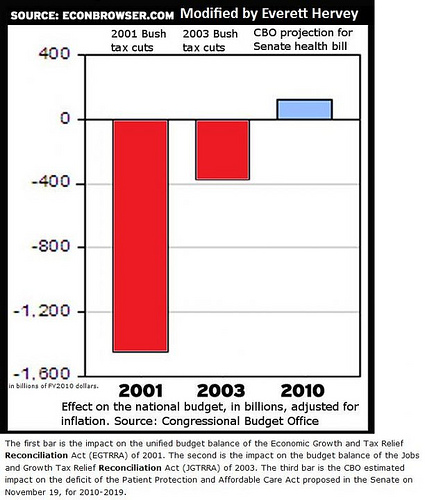
The third, the Senate's health reform bill? As you can see from the CBO projection, that's a different story." -- from The Rachel Maddow Show blog, based on a graph originally prepared by Econbrowser.
"Consider three bills -- two of them passed under budget reconciliation, the third heading for budget reconciliation. Each had an effect on the fiscal health of the nation, calculated by the Congressional Budget Office. The first two, the tax cuts pushed by President George W. Bush, blew a hole in the budget.
The third, the Senate's health reform bill? As you can see from the CBO projection, that's a different story." -- from The Rachel Maddow Show blog, based on a graph originally prepared by Econbrowser.
Resource: Guide to Current War Dept. Expenditures
Trillions to Burn?
Commonwealth Institute's Project on Defense Alternatives has made available A Quick Guide to the Surge in Pentagon Spending, a series of charts and graphs that make it easier to understand the unconscionable expansion of the military budget under George W. Bush and Barack Obama.
The rest of the story: For more detailed analysis, see An Undisciplined Defense – Understanding the $2 Trillion Surge in US Defense Spending and The President’s Dilemma: Deficits, Debt, and Defense Spending (both Project on Defense Alternatives 2010-01-18).
See, also: Pentagon’s Black Budget Tops $56 Billion by Noah Shachtman (Wired 2010-02-01)
Commonwealth Institute's Project on Defense Alternatives has made available A Quick Guide to the Surge in Pentagon Spending, a series of charts and graphs that make it easier to understand the unconscionable expansion of the military budget under George W. Bush and Barack Obama.
With his decision to further boost defense spending, President Obama is continuing the process of re-inflating the Pentagon that began in late 1998 – fully three years before the 9/11 attacks on America.You'd think that it would hardly need repeating that none of America's domestic problems -- decrepit infrastructure, declining schools, chronic unemployment, the crisis in health care, and so on -- can be addressed so long as the Pentagon is gobbling up resources.The FY 2011 budget marks a milestone, however: the inflation-adjusted rise in spending since 1998 will probably exceed 100% in real terms by the end of the fiscal year.
Taking the 2011 budget into account, the Defense Department has been given about $7.2 trillion since 1998, when the post-Cold War decline in defense spending ended. Approximately $2.5 trillion of this total is due to spending above the annual level set in 1998. This added amount constitutes the post-1998 spending surge.
The rest of the story: For more detailed analysis, see An Undisciplined Defense – Understanding the $2 Trillion Surge in US Defense Spending and The President’s Dilemma: Deficits, Debt, and Defense Spending (both Project on Defense Alternatives 2010-01-18).
See, also: Pentagon’s Black Budget Tops $56 Billion by Noah Shachtman (Wired 2010-02-01)
Resource: DoD strategic defense policy summaries
The Department of Defense has undertaken four distinct but related major defense reviews, each of which focuses on a dimension of our national security spending: Quadrennial Defense Review, Ballistic Missile Defense Review, Nuclear Posture Review, and Space Posture Review. The legislatively-mandated Quadrennial Defense Review outlines the Pentagon's view of the long-term threats and challenges faced by the nation and sets out the strategies, capabilities, and forces the military believes will address today's conflicts and tomorrow's threats.
More: Interview (mp3) with Robert Hale, Under Secretary of Defense (Comptroller) and Chief Financial Officer for the DOD about the proposed military budget for fiscal year 2011. He discusses budgetary support for programs and initiatives within the department and make comparisons to budgets from previous fiscal years.
Gates seeks to change 'out of date' vision of military challenges by Mike Mount (CNN 2010-02-01)
More: Interview (mp3) with Robert Hale, Under Secretary of Defense (Comptroller) and Chief Financial Officer for the DOD about the proposed military budget for fiscal year 2011. He discusses budgetary support for programs and initiatives within the department and make comparisons to budgets from previous fiscal years.
Gates seeks to change 'out of date' vision of military challenges by Mike Mount (CNN 2010-02-01)
State of the Union: The debate over priorities
Here's some background to consider as you evaluate the president's state of the union address. On this clip from her show, Rachel Maddow is arguing with Joe Biden's economic adviser Jared Bernstein, a progressive economist who has been placed in the absurd position of defending corporatist federal budget priorities. Maddow finds it "completely, completely insane” to restrain spending at a time when the nation is still undergoing an economic recovery. “You haven’t convinced me at all,” Maddow concludes. Me, neither,
Be sure to listen to the president tomorrow evening and conclude for yourself.
Be sure to listen to the president tomorrow evening and conclude for yourself.
Subscribe to:
Posts (Atom)


