


 |
| How many people are locked up in the United States? |
Showing posts with label war on drugs. Show all posts
Showing posts with label war on drugs. Show all posts

High note
New Hampshire license plates instruct you to "Live Free or Die."
You aren't allowed to do both things at once, however: It's illegal in the Granite State to inhale bus fumes with the intent to induce euphoria.
You aren't allowed to do both things at once, however: It's illegal in the Granite State to inhale bus fumes with the intent to induce euphoria.
Damaged Collateral
U.S. banks are getting out of the business of international remittances -- cash transfers -- because law enforcement requirements to prevent and monitor terror funding and drug money laundering are becoming too irksome. Guess who will be hurt by this. Drug smugglers? Nope. Terrorists? Uhn-unh. Mexicans and to a lesser extent Central Americans? Yep. Because cash transfers to Latin America make up by far the largest share of remittances. And ordinary people are far less apt to have the resources to negotiate around petty bureaucratic obstructions.
Saturday Catchup 2010-05-15
Mad Crowd Disease: "A new strain of populism is metastasizing before our eyes, nourished by the same libertarian impulses that have unsettled American society for half a century now. Anarchistic like the Sixties, selfish like the Eighties, contradicting neither, it is estranged, aimless, and as juvenile as our new century. It appeals to petulant individuals convinced that they can do everything themselves if they are only left alone, and that others are conspiring to keep them from doing just that. This is the one threat that will bring Americans into the streets. Welcome to the politics of the libertarian mob." -- The Tea Party Jacobins by Mark Lilla (New York Review of Books 2010-05-09).
Alone Together (Naturally): A call for more freedom is really a demand for power, "our power to make real choices, about not only our personal lives but about the forces determining the quality of life in our communities." So many of the factors that affect our opportunity, our freedom to thrive -- general access to quality education and to health care, say, or to public transport and libraries and parks, or to clean air and potable water, to say nothing of police and fire protection -- all require a fair and functioning society. We can’t even achieve the state of being “left alone,” alone. -- Why Freedom Should Be the #1 Issue for Progressives by Frances Moore Lappé (AlterNet 2010-05-13).
The (Tea) Party is over: When trouble comes, those who complain the loudest about big government are the first ones with their hands out for federal help. "Until tea partiers are willing to tear up their Social Security cards and Medicare cards, and reject all help from the FBI, Coast Guard, EPA, FEMA, or any other federal agency, they're nothing but a bunch of phonies." -- The Death of the Tea Party Movement by Bill Press (Baraboo News Republic 2010-06-09).
I'd say Что делать?, but that'd kinda be like raising a red flag: Here's a video from a grass roots campaign that is working to "wrest control of our economy from the big banks, crony capitalists and financial elites:"
( Watch on YouTube.) Action: Go to ForOurEconomy.org, download their 12-point primer on how to seize a measure of control over our economic lives; join; donate; protest.
Change Watch: "There is nothing inherently good about compromise. The ability to form a good compromise, when it is necessary, is an important skill. But you should compromise only when you can’t completely achieve what you want without it. If you have sufficient votes or support for your position and think it is the best choice of action, then you should pursue it. Compromising in that instance is stupid. The problem with Washington is the fake 'compromise fetish' (which is similar to the 'bipartisan fetish') that turned compromise into the desired goal–without regard to policy value or whether there is a need to compromise in the first place. What is the source of this fetish? Compromise destroys accountability. Politicians hate being held accountable and so they have a vested interest to support this fetish and those who share it." -- Compromise Fetishists: How Secret Deals Obscure Accountability, Subvert Democracy by Jon Walker (FireDogLake 2010-05-08).
Or to put it another way, summer's (almost) here and the time is right for fighting in the streets:
Or watch it on YouTube.
Don't want what they're smokin': "Just days after the White House released their inherently flawed 2010 National Drug Control Strategy (Read NORML’s refutation of it on The Huffington Post here and here), and mere hours after Drug Czar Gil Kerlikowske told reporters at the National Press Club, 'I have read thoroughly the ballot proposition in California; I think I once got an e-mail that told me I won the Irish sweepstakes and that actually had more truth in it than the ballot proposition,' the Associated Press takes the entire U.S. drug war strategy and rakes it over the coals. It’s about damn time!" -- After 40 Years, $1 Trillion, US Drug War “Has Failed to Meet Any of Its Goals” by Paul Armentano (AlterNet 2010-05-13).
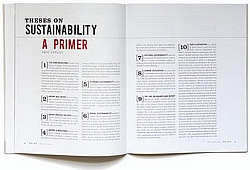 Recycling Rhetoric: "The term has so widely used that it is in danger of meaning nothing. It has been applied to all manner of activities in an effort to give those activities the gloss of moral imperative, the cachet of environmental enlightenment. 'Sustainable' has been used variously to mean 'politically feasible,' 'economically feasible,' 'not part of a pyramid or bubble,' 'socially enlightened,' 'consistent with neoconservative small-government dogma,' 'consistent with liberal principles of justice and fairness,' 'morally desirable,' and, at its most diffuse, 'sensibly far-sighted'.” -- Theses on Sustainability: A Primer by Eric Zencey (Orion magazine 2010-5/6).
Following up on Jon Stewart's brilliant impersonation of Glenn Beck a couple of months back, Lewis Black brings on a diagnosis of Beck's Nazi Tourette's Syndrome:
Or go to The Daily Show.
Budget whoas: Underpinning Defense Secretary Robert Gates’s speech last week on Pentagon spending is an understanding of what Spencer Ackerman calls the "mutually distorting relationship between unsustainable defense budgets and political courage" (Gates Claims Eisenhower’s Mantle, Challenging Pentagon Overspending -- Attackerman 2010-06-08).
Someday, won't we just run out of places to invade?: The House is about to vote on a $33 billion bill "war funding," a euphemism for legislation that will pay for the Obama administration's escalation of the war against Afghanistan that must have George Orwell spinning in his grave. The White House is asking the House to treat the expanded war as a fait accompli. In an excellent account of how we got here, David Swanson asks "how much money are we talking about exactly? Well not enough, evidently, for the teabagging enemies of reckless government spending to take notice. Clearly not enough for the labor movement or any other advocates of spending on jobs or healthcare or education or green energy to disturb their slumbers. God forbid! Yet it's still a sizeable number by a certain reckoning. After all, 33 billion miles could take you to the sun 226 times. And $33 billion could radically alter any non-military program in existence. There's a bill in the senate, for instance, that would prevent schools from laying off teachers in all 50 states for a mere $23 billion. Another $9.6 billion would quadruple the Department of Energy's budget for renewable energy. Now, what to do with that extra $0.4 billion?" Victory at all costs in Afghanistan by David Swanson (Asia Times 2010-05-13).
With friends like these...: "The British government has estimated that 70 percent of the terror plots it has uncovered in the past decade can be traced back to Pakistan. Pakistan remains a terrorist hothouse even as jihadism is losing favor elsewhere in the Muslim world. From Egypt to Jordan to Malaysia to Indonesia, radical Islamic groups have been weakened militarily and have lost much of the support they had politically. Why not in Pakistan? The answer is simple: from its founding, the Pakistani government has supported and encouraged jihadi groups, creating an atmosphere that has allowed them to flourish. It appears to have partially reversed course in recent years, but the rot is deep." -- Terrorism’s Supermarket: Why Pakistan keeps exporting jihad by Fareed Zakaria (Newsweek 2010-05-07).
You think?: "The notion that the government can, in effect, execute one of its own citizens far from a combat zone, with no judicial process and based on secret intelligence, makes some legal authorities deeply uneasy." -- U.S. Approval of Killing of Cleric Causes Unease by Scott Shane (New York Times 2010-05-13).
Be prepared: "In the raw aftermath of a successful attack, it will be very hard for an American president to shift the debate in a more productive and honest direction. Imagine if, after a fatal attack, President Obama responded by proposing greater outreach to Muslim communities domestically and around the world, in an effort to undercut radicalization. That is precisely what we and other nations should be doing, but it would undoubtedly be decried as a weak, starry-eyed reaction by our commander in chief, especially after an attack that revealed deficiencies in our counterterrorism system. But right now, after a near-miss, there is a better opportunity to adjust than in an emotionally charged period when the nation is mourning. Though a good dose of political courage would still be required, it would constitute a major improvement to our debate if leaders could come together now and agree on a few key points about our efforts to battle terrorism." -- The Times Square bomb failed. What will we do when the next bomb works? by Richard A. Clarke (The Washington Post 2010-05-09).
First it was our boys in Afghanistan doing a cover of Lady Gaga. Now, from Iraq, “Watch: Straight Soldiers Show Their Support for Gays in the Military by Dancing to Ke$ha”:
The future's last half century: "Fifty years ago this Sunday, Theodore Maiman and his fellow scientists at Hughes Research Laboratory shined a high-power flash lamp on a ruby rod, triggering a beam of coherent light: the first laser. It wasn’t long before the Pentagon started dreaming up military applications, and futurists were predicting that our soldiers would all get ray guns. Well, not quite. But lasers have revolutionized the U.S. military — changing the way it targets bombs, scares off insurgents, and, yes, blows stuff to bits." Wired's Danger Room remembers some of the greatest hits (and biggest misses) from the first half-century of military lasers. -- 50 Years of Real-Life Ray Guns by Noah Shachtman (Danger Room 2010-05-14).
Not on our airwaves leased from the American people you won't: Faux News refused this ad from the progressive veterans organization Vote Vets:
(also available on YouTube). What's doubly odd is that only a few weeks ago they were running an even stronger spot by same outfit.
Present Shock: A new report from Brookings reveals that our nation now faces five “new realities” that are redefining who we are, where and with whom we live, and how we provide for our own welfare, as well as that of our families and communities. In each of these five areas -- growth and outward expansion, population diversification, aging of the population, uneven higher educational attainment, and income polarization -- the nation reached critical milestones in the 2000s that make those underlying realities too large to ignore any longer. And large metropolitan areas -- the collections of cities, suburbs, and rural areas that house two-thirds of America’s population -- lay squarely at the forefront of these trends. -- State of Metropolitan America: On the Front Lines of Demographic Transformation (pdf) (The Brookings Institution Metropolitan Policy Program 2010).
Burke's Without Peerage: Sometime toward the end of the last millennium, Jerry Wexler and I, spending a happy couple of hours sharing music we liked, discovered that both of thought that, if there was such a thing as the greatest soul singer of all time, it was probably Solomon Burke. Still is.
Or go to YouTube.
Alone Together (Naturally): A call for more freedom is really a demand for power, "our power to make real choices, about not only our personal lives but about the forces determining the quality of life in our communities." So many of the factors that affect our opportunity, our freedom to thrive -- general access to quality education and to health care, say, or to public transport and libraries and parks, or to clean air and potable water, to say nothing of police and fire protection -- all require a fair and functioning society. We can’t even achieve the state of being “left alone,” alone. -- Why Freedom Should Be the #1 Issue for Progressives by Frances Moore Lappé (AlterNet 2010-05-13).
The (Tea) Party is over: When trouble comes, those who complain the loudest about big government are the first ones with their hands out for federal help. "Until tea partiers are willing to tear up their Social Security cards and Medicare cards, and reject all help from the FBI, Coast Guard, EPA, FEMA, or any other federal agency, they're nothing but a bunch of phonies." -- The Death of the Tea Party Movement by Bill Press (Baraboo News Republic 2010-06-09).
I'd say Что делать?, but that'd kinda be like raising a red flag: Here's a video from a grass roots campaign that is working to "wrest control of our economy from the big banks, crony capitalists and financial elites:"
( Watch on YouTube.) Action: Go to ForOurEconomy.org, download their 12-point primer on how to seize a measure of control over our economic lives; join; donate; protest.
Change Watch: "There is nothing inherently good about compromise. The ability to form a good compromise, when it is necessary, is an important skill. But you should compromise only when you can’t completely achieve what you want without it. If you have sufficient votes or support for your position and think it is the best choice of action, then you should pursue it. Compromising in that instance is stupid. The problem with Washington is the fake 'compromise fetish' (which is similar to the 'bipartisan fetish') that turned compromise into the desired goal–without regard to policy value or whether there is a need to compromise in the first place. What is the source of this fetish? Compromise destroys accountability. Politicians hate being held accountable and so they have a vested interest to support this fetish and those who share it." -- Compromise Fetishists: How Secret Deals Obscure Accountability, Subvert Democracy by Jon Walker (FireDogLake 2010-05-08).
Or to put it another way, summer's (almost) here and the time is right for fighting in the streets:
Or watch it on YouTube.
Don't want what they're smokin': "Just days after the White House released their inherently flawed 2010 National Drug Control Strategy (Read NORML’s refutation of it on The Huffington Post here and here), and mere hours after Drug Czar Gil Kerlikowske told reporters at the National Press Club, 'I have read thoroughly the ballot proposition in California; I think I once got an e-mail that told me I won the Irish sweepstakes and that actually had more truth in it than the ballot proposition,' the Associated Press takes the entire U.S. drug war strategy and rakes it over the coals. It’s about damn time!" -- After 40 Years, $1 Trillion, US Drug War “Has Failed to Meet Any of Its Goals” by Paul Armentano (AlterNet 2010-05-13).
Recycling Rhetoric: "The term has so widely used that it is in danger of meaning nothing. It has been applied to all manner of activities in an effort to give those activities the gloss of moral imperative, the cachet of environmental enlightenment. 'Sustainable' has been used variously to mean 'politically feasible,' 'economically feasible,' 'not part of a pyramid or bubble,' 'socially enlightened,' 'consistent with neoconservative small-government dogma,' 'consistent with liberal principles of justice and fairness,' 'morally desirable,' and, at its most diffuse, 'sensibly far-sighted'.” -- Theses on Sustainability: A Primer by Eric Zencey (Orion magazine 2010-5/6).Following up on Jon Stewart's brilliant impersonation of Glenn Beck a couple of months back, Lewis Black brings on a diagnosis of Beck's Nazi Tourette's Syndrome:
Or go to The Daily Show.
Budget whoas: Underpinning Defense Secretary Robert Gates’s speech last week on Pentagon spending is an understanding of what Spencer Ackerman calls the "mutually distorting relationship between unsustainable defense budgets and political courage" (Gates Claims Eisenhower’s Mantle, Challenging Pentagon Overspending -- Attackerman 2010-06-08).
Someday, won't we just run out of places to invade?: The House is about to vote on a $33 billion bill "war funding," a euphemism for legislation that will pay for the Obama administration's escalation of the war against Afghanistan that must have George Orwell spinning in his grave. The White House is asking the House to treat the expanded war as a fait accompli. In an excellent account of how we got here, David Swanson asks "how much money are we talking about exactly? Well not enough, evidently, for the teabagging enemies of reckless government spending to take notice. Clearly not enough for the labor movement or any other advocates of spending on jobs or healthcare or education or green energy to disturb their slumbers. God forbid! Yet it's still a sizeable number by a certain reckoning. After all, 33 billion miles could take you to the sun 226 times. And $33 billion could radically alter any non-military program in existence. There's a bill in the senate, for instance, that would prevent schools from laying off teachers in all 50 states for a mere $23 billion. Another $9.6 billion would quadruple the Department of Energy's budget for renewable energy. Now, what to do with that extra $0.4 billion?" Victory at all costs in Afghanistan by David Swanson (Asia Times 2010-05-13).
With friends like these...: "The British government has estimated that 70 percent of the terror plots it has uncovered in the past decade can be traced back to Pakistan. Pakistan remains a terrorist hothouse even as jihadism is losing favor elsewhere in the Muslim world. From Egypt to Jordan to Malaysia to Indonesia, radical Islamic groups have been weakened militarily and have lost much of the support they had politically. Why not in Pakistan? The answer is simple: from its founding, the Pakistani government has supported and encouraged jihadi groups, creating an atmosphere that has allowed them to flourish. It appears to have partially reversed course in recent years, but the rot is deep." -- Terrorism’s Supermarket: Why Pakistan keeps exporting jihad by Fareed Zakaria (Newsweek 2010-05-07).
You think?: "The notion that the government can, in effect, execute one of its own citizens far from a combat zone, with no judicial process and based on secret intelligence, makes some legal authorities deeply uneasy." -- U.S. Approval of Killing of Cleric Causes Unease by Scott Shane (New York Times 2010-05-13).
Be prepared: "In the raw aftermath of a successful attack, it will be very hard for an American president to shift the debate in a more productive and honest direction. Imagine if, after a fatal attack, President Obama responded by proposing greater outreach to Muslim communities domestically and around the world, in an effort to undercut radicalization. That is precisely what we and other nations should be doing, but it would undoubtedly be decried as a weak, starry-eyed reaction by our commander in chief, especially after an attack that revealed deficiencies in our counterterrorism system. But right now, after a near-miss, there is a better opportunity to adjust than in an emotionally charged period when the nation is mourning. Though a good dose of political courage would still be required, it would constitute a major improvement to our debate if leaders could come together now and agree on a few key points about our efforts to battle terrorism." -- The Times Square bomb failed. What will we do when the next bomb works? by Richard A. Clarke (The Washington Post 2010-05-09).
First it was our boys in Afghanistan doing a cover of Lady Gaga. Now, from Iraq, “Watch: Straight Soldiers Show Their Support for Gays in the Military by Dancing to Ke$ha”:
The future's last half century: "Fifty years ago this Sunday, Theodore Maiman and his fellow scientists at Hughes Research Laboratory shined a high-power flash lamp on a ruby rod, triggering a beam of coherent light: the first laser.
It wasn’t long before the Pentagon started dreaming up military applications, and futurists were predicting that our soldiers would all get ray guns. Well, not quite. But lasers have revolutionized the U.S. military — changing the way it targets bombs, scares off insurgents, and, yes, blows stuff to bits." Wired's Danger Room remembers some of the greatest hits (and biggest misses) from the first half-century of military lasers. -- 50 Years of Real-Life Ray Guns by Noah Shachtman (Danger Room 2010-05-14).Not on our airwaves leased from the American people you won't: Faux News refused this ad from the progressive veterans organization Vote Vets:
(also available on YouTube). What's doubly odd is that only a few weeks ago they were running an even stronger spot by same outfit.
Present Shock: A new report from Brookings reveals that our nation now faces five “new realities” that are redefining who we are, where and with whom we live, and how we provide for our own welfare, as well as that of our families and communities. In each of these five areas -- growth and outward expansion, population diversification, aging of the population, uneven higher educational attainment, and income polarization -- the nation reached critical milestones in the 2000s that make those underlying realities too large to ignore any longer. And large metropolitan areas -- the collections of cities, suburbs, and rural areas that house two-thirds of America’s population -- lay squarely at the forefront of these trends. -- State of Metropolitan America: On the Front Lines of Demographic Transformation (pdf) (The Brookings Institution Metropolitan Policy Program 2010).
Burke's Without Peerage: Sometime toward the end of the last millennium, Jerry Wexler and I, spending a happy couple of hours sharing music we liked, discovered that both of thought that, if there was such a thing as the greatest soul singer of all time, it was probably Solomon Burke. Still is.
Or go to YouTube.
Public Policy: How the War on Drugs gave birth to a permanent American undercaste
The War on Drugs would be a laughable waste of dollars and public resources, if not for the horrible toll it has taken in lives lost and destroyed. Ostensibly a prohibition campaign, it has resulted in the militarization, economic colonization and literal poisoning of vast swatches of other countries, especially in the Americas, and has been used to justify military campaigns against leftist political movements and insurgencies in various parts of the world. Here at home, it has resulted in the destruction of the lives of millions of Americans, especially young black males, as this article by Michelle Alexander explains.
On the other hand, although the Obama administration doesn't plan to significantly alter drug enforcement policy, according to Gil Kerlikowske, the current director of the Office of National Drug Control Policy, it's counted as progress that it won't use the term "War on Drugs" because it's counter-productive. Still, the next national drug control budget proposed by the Obama Administration will increase spending on prevention and treatment of drug abuse.
Undoing the damage caused by hapless drug policy will not be cheap or easy. But it must be done. The growing support for legalization in the states and in other countries offers a way out. Although proponents of legalization have won the moral and intellectual debate, political leadership is unlikely to come from the White House or Congress, as irrational and dysfunctional here as in so many other policy areas. But with drug use being decriminalized (or legalized de facto) from Concord to Sacramento and from Berne to Mexico City, the end of the War on Drugs may be in sight.
Michelle Alexander's essay was originally published on TomDispatch.com
To track the $ billions that have been burned in the drug war, visit the Drug War Clock, at DrugSense.Org, supported by Media Awareness Project and Drug Policy Central
Further reading:
Brief History of The War on Drugs by Claire Suddath (Time 2009-03-25)
Drug faqs from the Schaffer Library of Drug Policy, sponsored by a company that promotes the commercialization medical marijuana
What's Wrong With the Drug War? by the Drug Policy Alliance Network
The War on Drugs Is a Failure by Fernando Henrique Cardoso, César Gaviria And Ernesto Zedillo (Wall Street Journal 2009-02-23)
War on drugs is insane by Jack Cafferty (CNN 2009-03-31)
Ending the 'War on Drugs' by Misha Glenny (New York Times 2009-09-18)
Ever since Barack Obama lifted his right hand and took his oath of office, pledging to serve the United States as its 44th president, ordinary people and their leaders around the globe have been celebrating our nation’s “triumph over race.” Obama’s election has been touted as the final nail in the coffin of Jim Crow, the bookend placed on the history of racial caste in America.There is a small chance that some of this damage can be repaired. New York has rolled back the Draconian drugs laws imposed when then Gov. Nelson Rockefeller sought to appear tough on crime in GOP presidential primaries. Cash-strapped California can no longer afford it's huge prison system; the natural way to reduce it is to release nonviolent drug offenders. Colorado is aggressively pushing medical pot production and California voters are likely to legalize -- and tax -- cannabis. Even in New Hampshire this week, the state assembly overwhelmingly decriminalized possession of small quantities of marijuana.
Obama’s mere presence in the Oval Office is offered as proof that “the land of the free” has finally made good on its promise of equality. There’s an implicit yet undeniable message embedded in his appearance on the world stage: this is what freedom looks like; this is what democracy can do for you. If you are poor, marginalized, or relegated to an inferior caste, there is hope for you. Trust us. Trust our rules, laws, customs, and wars. You, too, can get to the promised land.
Perhaps greater lies have been told in the past century, but they can be counted on one hand. Racial caste is alive and well in America.
Most people don’t like it when I say this. It makes them angry. In the “era of colorblindness” there’s a nearly fanatical desire to cling to the myth that we as a nation have “moved beyond” race. Here are a few facts that run counter to that triumphant racial narrative:
Excuses for the Lockdown
- There are more African Americans under correctional control today — in prison or jail, on probation or parole — than were enslaved in 1850, a decade before the Civil War began.
- As of 2004, more African American men were disenfranchised (due to felon disenfranchisement laws) than in 1870, the year the Fifteenth Amendment was ratified, prohibiting laws that explicitly deny the right to vote on the basis of race.
- A black child born today is less likely to be raised by both parents than a black child born during slavery. The recent disintegration of the African American family is due in large part to the mass imprisonment of black fathers.
- If you take into account prisoners, a large majority of African American men in some urban areas have been labeled felons for life. (In the Chicago area, the figure is nearly 80%.) These men are part of a growing undercaste — not class, caste — permanently relegated, by law, to a second-class status. They can be denied the right to vote, automatically excluded from juries, and legally discriminated against in employment, housing, access to education, and public benefits, much as their grandparents and great-grandparents were during the Jim Crow era.
There is, of course, a colorblind explanation for all this: crime rates. Our prison population has exploded from about 300,000 to more than 2 million in a few short decades, it is said, because of rampant crime. We’re told that the reason so many black and brown men find themselves behind bars and ushered into a permanent, second-class status is because they happen to be the bad guys.
The uncomfortable truth, however, is that crime rates do not explain the sudden and dramatic mass incarceration of African Americans during the past 30 years.Crime rates have fluctuated over the last few decades — they are currently at historical lows — but imprisonment rates have consistently soared. Quintupled, in fact. And the vast majority of that increase is due to the War on Drugs. Drug offenses alone account for about two-thirds of the increase in the federal inmate population, and more than half of the increase in the state prison population.
The drug war has been brutal — complete with SWAT teams, tanks, bazookas, grenade launchers, and sweeps of entire neighborhoods — but those who live in white communities have little clue to the devastation wrought. This war has been waged almost exclusively in poor communities of color, even though studies consistently show that people of all colors use and sell illegal drugs at remarkably similar rates. In fact, some studies indicate that white youth are significantly more likely to engage in illegal drug dealing than black youth. Any notion that drug use among African Americans is more severe or dangerous is belied by the data. White youth, for example, have about three times the number of drug-related visits to the emergency room as their African American counterparts.
That is not what you would guess, though, when entering our nation’s prisons and jails, overflowing as they are with black and brown drug offenders. In some states, African Americans comprise 80%-90% of all drug offenders sent to prison.
This is the point at which I am typically interrupted and reminded that black men have higher rates of violent crime. That’s why the drug war is waged in poor communities of color and not middle-class suburbs. Drug warriors are trying to get rid of those drug kingpins and violent offenders who make ghetto communities a living hell. It has nothing to do with race; it’s all about violent crime.
Again, not so. President Ronald Reagan officially declared the current drug war in 1982, when drug crime was declining, not rising. From the outset, the war had little to do with drug crime and nearly everythingto do with racial politics. The drug war was part of a grand and highly successful Republican Party strategy of using racially coded political appeals on issues of crime and welfare to attract poor and working class white voters who were resentful of, and threatened by, desegregation, busing, and affirmative action. In the words of H.R. Haldeman, President Richard Nixon’s White House Chief of Staff: “[T]he whole problem is really the blacks. The key is to devise a system that recognizes this while not appearing to.”
A few years after the drug war was announced, crack cocaine hit the streets of inner-city communities. The Reagan administration seized on this development with glee, hiring staff who were to be responsible for publicizing inner-city crack babies, crack mothers, crack whores, and drug-related violence. The goal was to make inner-city crack abuse and violence a media sensation, bolstering public support for the drug war which, it was hoped, would lead Congress to devote millions of dollars in additional funding to it.
The plan worked like a charm. For more than a decade, black drug dealers and users would be regulars in newspaper stories and would saturate the evening TV news. Congress and state legislatures nationwide would devote billions of dollars to the drug war and pass harsh mandatory minimum sentences for drug crimes — sentences longer than murderers receive in many countries.
Democrats began competing with Republicans to prove that they could be even tougher on the dark-skinned pariahs. In President Bill Clinton’s boastful words, “I can be nicked a lot, but no one can say I’m soft on crime.” The facts bear him out. Clinton’s “tough on crime” policies resulted in the largest increase in federal and state prison inmates of any president in American history. But Clinton was not satisfied with exploding prison populations. He and the “New Democrats” championed legislation banning drug felons from public housing (no matter how minor the offense) and denying them basic public benefits, including food stamps, for life. Discrimination in virtually every aspect of political, economic, and social life is now perfectly legal, if you’ve been labeled a felon.
Facing Facts
But what about all those violent criminals and drug kingpins? Isn’t the drug war waged in ghetto communities because that’s where the violent offenders can be found? The answer is yes… in made-for-TV movies. In real life, the answer is no.
The drug war has never been focused on rooting out drug kingpins or violent offenders. Federal funding flows to those agencies that increase dramatically the volume of drug arrests, not the agencies most successful in bringing down the bosses. What gets rewarded in this war is sheer numbers of drug arrests. To make matters worse, federal drug forfeiture laws allow state and local law enforcement agencies to keep for their own use 80% of the cash, cars, and homes seized from drug suspects, thus granting law enforcement a direct monetary interest in the profitability of the drug market.
The results have been predictable: people of color rounded up en masse for relatively minor, non-violent drug offenses. In 2005, four out of five drug arrests were for possession, only one out of five for sales. Most people in state prison have no history of violence or even of significant selling activity. In fact, during the 1990s — the period of the most dramatic expansion of the drug war — nearly 80% of the increase in drug arrests was for marijuana possession, a drug generally considered less harmful than alcohol or tobacco and at least as prevalent in middle-class white communities as in the inner city.
In this way, a new racial undercaste has been created in an astonishingly short period of time — a new Jim Crow system. Millions of people of color are now saddled with criminal records and legally denied the very rights that their parents and grandparents fought for and, in some cases, died for.
Affirmative action, though, has put a happy face on this racial reality. Seeing black people graduate from Harvard and Yale and become CEOs or corporate lawyers — not to mention president of the United States — causes us all to marvel at what a long way we’ve come.
Recent data shows, though, that much of black progress is a myth. In many respects, African Americans are doing no better than they were when Martin Luther King, Jr. was assassinated and uprisings swept inner cities across America. Nearly a quarter of African Americans live below the poverty line today, approximately the same percentage as in 1968. The black child poverty rate is actually higher now than it was then. Unemployment rates in black communities rival those in Third World countries. And that’s with affirmative action!
When we pull back the curtain and take a look at what our “colorblind” society creates without affirmative action, we see a familiar social, political, and economic structure — the structure of racial caste. The entrance into this new caste system can be found at the prison gate.
This is not Martin Luther King, Jr.’s dream. This is not the promised land. The cyclical rebirth of caste in America is a recurring racial nightmare.
On the other hand, although the Obama administration doesn't plan to significantly alter drug enforcement policy, according to Gil Kerlikowske, the current director of the Office of National Drug Control Policy, it's counted as progress that it won't use the term "War on Drugs" because it's counter-productive. Still, the next national drug control budget proposed by the Obama Administration will increase spending on prevention and treatment of drug abuse.
Undoing the damage caused by hapless drug policy will not be cheap or easy. But it must be done. The growing support for legalization in the states and in other countries offers a way out. Although proponents of legalization have won the moral and intellectual debate, political leadership is unlikely to come from the White House or Congress, as irrational and dysfunctional here as in so many other policy areas. But with drug use being decriminalized (or legalized de facto) from Concord to Sacramento and from Berne to Mexico City, the end of the War on Drugs may be in sight.
Michelle Alexander's essay was originally published on TomDispatch.com
To track the $ billions that have been burned in the drug war, visit the Drug War Clock, at DrugSense.Org, supported by Media Awareness Project and Drug Policy Central
Further reading:
Brief History of The War on Drugs by Claire Suddath (Time 2009-03-25)
Drug faqs from the Schaffer Library of Drug Policy, sponsored by a company that promotes the commercialization medical marijuana
What's Wrong With the Drug War? by the Drug Policy Alliance Network
The War on Drugs Is a Failure by Fernando Henrique Cardoso, César Gaviria And Ernesto Zedillo (Wall Street Journal 2009-02-23)
War on drugs is insane by Jack Cafferty (CNN 2009-03-31)
Ending the 'War on Drugs' by Misha Glenny (New York Times 2009-09-18)
Clip File: Obama administration expanding military involvement in Latin America
Do we really need to occupy Columbia?
Under a 10-year deal, U.S. military forces will be deployed to seven military bases in Columbia and will have access to Columbia's major international civilian airports, and U.S. personnel and -- and, if Iraq and and Afghanistan experience is any indication, in a recipe for disaster: defense contractors will enjoy diplomatic immunity. Whether the justification is the furthering of our failed War on Drugs or to intervene in the civil war between Columbia's right-wing government and left-wing rebel groups, is the expansion of American military reach what Americans had in mind when they voted for change in 2008?
The rest of the story: New row over Colombia-US accord (BBC News 2009-12-05)
See, also: US-Colombia base deal 'this week' (BBC News 2009-10-27)
Under a 10-year deal, U.S. military forces will be deployed to seven military bases in Columbia and will have access to Columbia's major international civilian airports, and U.S. personnel and -- and, if Iraq and and Afghanistan experience is any indication, in a recipe for disaster: defense contractors will enjoy diplomatic immunity. Whether the justification is the furthering of our failed War on Drugs or to intervene in the civil war between Columbia's right-wing government and left-wing rebel groups, is the expansion of American military reach what Americans had in mind when they voted for change in 2008?
The rest of the story: New row over Colombia-US accord (BBC News 2009-12-05)
See, also: US-Colombia base deal 'this week' (BBC News 2009-10-27)
Subscribe to:
Posts (Atom)


