


Shticks and Stones
It's jobs, stupid: Nearly the entire deficit for this year and those projected into the near and medium terms are the result of three things: the ongoing wars in Afghanistan and Iraq, the Bush tax cuts and the recession. The solution to our fiscal situation is: end the wars, allow the tax cuts to expire and restore robust growth. Our long-term structural deficits will require us to control healthcare inflation the way countries with single-payer systems do. So lets talk about balancing the budget. -- Deficits of Mass Destruction by Christopher Hayes (The Nation 2010-07-15).
Where is the guillotine when you need it?: In modern American life, Treasury Secretary Tim Geithner stands out as latter-day Talleyrand, amazingly resilient and remarkably lucky -- despite presiding over or being deeply involved in a series of political debacles, he has gone from strength to strength. After at least eight improbably bounce backs, he might seem unassailable. But his latest mistake -- blocking Elizabeth Warren from heading the new Consumer Financial Protection Bureau -- may well prove politically fatal. -- Tim Geithner’s Ninth Political Life by Simon Johnson (The Baseline Scenario 2010-07-15). Also, Elizabeth Warren Should be a Role Model in the Obama Administration Instead of a Pariah by Mark Karlin (BuzzFlash 2010-07-17).
There's plenty of good money to be made/Supplyin' the army with tools of the trade*: "Why is nobody talking about the Afghanistan adventure as a cause of our plunging recession? Or at least citing the 30-year-old endless war as a major contributory factor in wasting our money to 'nation-build' in the Hindu Kush while our own country falls to pieces on food stamps, foreclosures and child poverty -- one in five kids -- that would put the world's poorest nations to shame?" -- America: hooked on war and getting poorer by Clancy Sigal (Guardian UK 2010-07-13). (*Country Joe and the Fish)
Lucky for us, it can't happen here: From Mexico to Peru to the Philippines, armies have learned to portray themselves to beleaguered civilian leaders as the only chance to defeat the security challenges -- so long as the government agrees to the military’s demands for greater funding, more autonomy, and a larger role in politics. -- Military Rule 2.0: Why bother with a coup when there are better ways to take control? by Joshua Kurlantzick and Shelby Leighton (Boston.com 2010-07-11).
Hey, Wait a Minute!: We have a "fairness instinct," thinks Lixing Sun, a professor of biology at Central Washington University. And he may be right. He maintains that high on the roster of human propensities is a "Robin Hood mentality" that characterizes our species and qualifies as one of those "mental modules" that evolutionary psychologists consider part of our likely biological inheritance. If so, our fairness instinct goes far beyond the pleasure we take in romantic tales of medieval Merry Men adventuring in Sherwood Forest. Sun believes that despite the fact of our specieswide social and economic disparities -- perhaps in part because of them -- human beings are endowed (or burdened) with an acute sensitivity to "who is getting how much," in particular a deft attunement to whether anyone else is getting more or less than one's self. -- Biological roots of today's anger by David P. Barash (The Chronicle of Higher Education 2010-07-11).
Megagrammar: "The jumper colon is a paragraphical Red Bull, a rocket-launch of a punctuator, the Usain Bolt of literature. It’s punchy as hell. To believers of short first sentences -- Hemingway? -- it couldn’t get any better. To believers of long-winded sentences that leave you gasping and slightly confused -- Faulkner? -- it also couldn’t get any better. By itself this colon is neither a period nor a non-period… or rather it is a period and it is also a non-period. You choose." -- Colonoscopy: It’s Time to Check Your Colons by Conor J. Dillon (The Millions 2010-07-13).
No room for argument; very little for vermouth: If the news is driving you to drink, at least the libation in question can be the perfect martini: "First a note about substituting ingredients or tools. Don't. This method has been exhaustively tested and retested for excellence and the smallest variation can result in catastrophic and unintended consequences. See the 'butterfly flaps its wings and causes hurricane' metaphor from Chaos Theory. There is room for personal preference and improvisation in many things. This is not one of them. 'Oh, I love Bach's Fourth Brandenburg Concerto, but perhaps it should be just a touch slower.' 'I cropped Caravaggio's Crucifixion of Saint Peter along the top a bit to get rid of some of that icky dark area.' Begin by assembling the following materials and a clean, white towel at your work space. Turn off the television and eliminate other distractions. John Coltrane's First Meditations is appropriate music to work by. I cannot vouch for anything else." -- Perfect by Jim Coudal (Coudal Partners).
The first cut is the deepest: In attempt to reframe the debate over budget priorities, Reps. Barney Frank and Ron Paul have been tag-teaming across the country calling for dramatic cuts in military spending. Basing their critique on “Debt, Deficits and Defense: A Way Forward” (pdf), a study by the bipartisan congressional Sustainable Defense Task Force, they call for cutting the Pentagon’s annual “base”budget by $960 billion over ten years, an average annual reduction of roughly 17 percent below current spending levels. Defense spending accounts for more than half of the federal government’s entire discretionary budget. At a time when virtually every community in the country is facing critical budget shortfalls, defense spending has continued to grow. The Task Force’s report proposes cuts such as reducing the number of deployed nuclear weapons to 1,000 and cutting the number of submarines and missiles which carry them; cutting the total number of active duty members of the Army and Marine Corps to 50,000 below their levels before the Iraq and Afghanistan wars; cutting certain weapons programs including the Joint Strike Fighter, the V-22 “Osprey” tilt-rotor aircraft, and the total number of Navy aircraft carriers; and reforming the Pentagon’s health care and compensation systems. Regardless of the impact this or any other letter has on the deficit debate in Congress, the Task Force report insures one important thing: supporters of reduced military spending now have an answer to the question, “how do you cut Pentagon spending without undermining our nation’s security?” At a time when all areas of federal spending should be subject to the budget cutter’s knife, it can no longer be said, even within the mainstream debate, that it’s impossible to identify significant savings in the Pentagon budget. -- Pentagon Spending on the Chopping Block by Christopher Hellman (Yes! Magazine 2010-0715).
Maybe Asian tourists can be enticed to spend money in Billings on cow-tipping expeditions: According to both Montana Sen. Max Baucus and Texas Rep. Kevin Brady, ratifying the Korea-U.S. Free Trade Agreement in Congress will be the most important thing our national legislature accomplishes in the next year. In the avenue of international commerce, our political leadership has no goals. They have empty ideals and failed methodology. They ingratiate themselves with organizations like Asia-Pacific Economic Cooperation in order to forward their own positions, but they provide nothing substantive and lasting to the people they represent. -- APEC and America's Dangerous Free Trade Deception by Craig Harrington (Economy in Crisis 2010-07-16).
Long live rock and roll:
Wanna be friends?: If these supernets continue to thrive and grow, they could fundamentally change the way we share information about the world and transform our notions of friendship and acquaintance. If so, the likes of Facebook, LinkedIn and MySpace might just turn out to be the harbingers of a sea change in our social evolution, in the same way that the arrival of language transformed our ancestors. -- Why Facebook friends are worth keeping by Richard Fisher (New Scientist 2010-07-15).
Finally, a stupid (but very cold) party trick for a hot summer barbecue:
Showing posts with label Melanie Safka. Show all posts
Showing posts with label Melanie Safka. Show all posts

Saturday Catchup: Some stuff you don't want to miss
Labor: Is it possible to join high technology, cost efficiency, and technological innovation to the coop movement and worker-control?: The Cooperative Movement, Self-Management, And Competitiveness: The Case Of Mondragón Corporación Cooperativa by Alessandra Azevedo and Leda Gitahy (WorkingUSA: The Journal of Labor and Society 2010-03-18). This is the outfit the U.S. steelworkers are working with to see if the union co-op hybrid model can be made to work here.
Crime Log: "If we were to take an honest look at America’s blasted landscape of 'losers' and the far shinier, spiffier world of 'winners,' we’d have to admit that it wasn’t signs of onrushing socialism or fascism that stood out, but of staggeringly self-aggrandizing greed and theft right in the here and now. We’d notice our public coffers being emptied to benefit major corporations and financial institutions working in close alliance with, and passing on remarkable sums of money to, the representatives of 'the people.' We’d see, in a word, kleptocracy on a scale to dazzle. We would suddenly see an almost magical disappearing act being performed, largely without comment, right before our eyes." -- American Kleptocracy: How Fears of Socialism and Fascism Hide Naked Theft by William J. Astore (TomDispatch 2010-04-20).
Putting the gross in Gross National Product: Six Banks Control 60% of GNP -- Is the U.S. at the Mercy of an Unstoppable Oligarchy? by Bill Moyers (Bill Moyers Journal 2010-04-23) Economists James Kwak and Simon Johnson wonder whether the financial powers are more profitable, and more resistant to regulation than ever.
Musical interlude: We've been talking about The National for nearly a decade. Will we still love them now that they have a major takeout (The National Agenda by Nicholas Dawidoff) in the Times' Magazine? Sure we will.
3-Card Monte: "The drumbeat about deficits has reached deafening levels. The president warns about 'out of control' spending. Fed Chair Ben Bernanke calls for bringing deficits down. The opinion pages bristle with rants about the U.S. turning into Greece, headed to default. Next week, the first session of the president's 'National Commission on Fiscal Responsibility and Reform' will convene. The next day, shamelessly, the two co-chairs and the staff director (all committed deficit hawks) will grace a forum sponsored by the Peterson Foundation, established by Wall Street billionaire Pete Peterson largely to gin up hysteria about America's long term deficits." - The Big Fix (Hold On To Your Wallets) by Robert Borosage (Campaign for America's Future 2010-04-21).
Oh, I get it now: Uses and Abuses of Gresham's Law in the History of Money by Robert Mundell (Columbia University 1998). The law is trivially easy to understand; so why does everybody get it wrong?
The Long War: Historian, international relations expert and former US Army Colonel Andrew J. Bacevich talks to Bill Moyers about how we got in to Iraq and Afghanistan and why we can't seem to get out (extended video, Bill Moyers Journal 2010-04-09).
The Long War: Rethinking Afghanistan’s Sticky Icky Quagmire by Josh Mull (FDL's The Seminal 2010-04-20). There is definitely a huge drug problem, and our strategy seems to be the cause of it. There are much easier ways to achieve our objectives in the region than an expensive and bloody policy of military aggression, but our leaders are stuck in failed policies born of a worldview that is at once arrogant and ignorant. Time to rethink Afghanistan?
More music: Here's a number from a B.B.King special I worked on a couple of decades back. My friend Douglas Brodoff aptly called this a rock opera in 5 minutes. An honor to have been there.
Collateral damage: "Education catastrophe" as states may cut 300,000 public school jobs by Tamar Lewin and Sam Dillon (New York Times 2010-04-21). The 2010-11 school term is shaping up as one of the most austere in the last half century. In addition to teacher layoffs, districts are planning to close schools, cut programs, enlarge classes and shorten the school day, week or year to save money. See, also: Tax Day and America’s Wars - What the Mayor of One Community Hard Hit by War Spending Is Doing by Jo Comerford (TomDispatch 2010-04-11).
Democracy in the Middle East: In spite of America's professed commitment to equality, the U.S. government makes an exception when it comes to Israel's insistence on being recognized as a Jewish state, which in theory and practice means privileging Jewish citizens over all other citizens: A State for All Its Citizens by Nadim N. Rouhana (Foreign Policy 2010-04-22). A country cannot be both democratic and theocratic.
Hubris: "We can't have it all. The belief that we can is one of the things that has driven us to this awful place. If insanity could be defined as having lost functional connection with physical reality, to believe we can have it all -- to believe we can simultaneously dismantle a world and live on it; to believe we can perpetually use more energy than arrives from the sun; to believe we can take more than the world gives willingly; to believe a finite world can support infinite growth,much less infinite economic growth, where economic growth consists of converting ever larger numbers of living beings to dead objects (industrial production, at core, is the conversion of the living -- trees or mountains -- into the dead -- two-by-fours and beer cans) -- is grotesquely insane. This insanity manifests partly as a potent disrespect for limits and for justice. It manifests in the pretension that neither limits nor justice exist. To pretend that civilization can exist without destroying its own landbase and the landbases and cultures of others is to be entirely ignorant of history, biology, thermodynamics, morality, and self-preservation. And it is to have paid absolutely no attention to the past six thousand years." -- No, We Can't Have It All by Derrick Jensen (excerpted from Endgame, Vol. 1: The Problem of Civilization (Common Dreams 2010-04-23).
Water is the new oil: Cochabamba, the Water Wars and Climate Change by Amy Goodman (TruthDig 2010-04-21). Bolivian President Evo Morales calls Cochabamba the heart of Bolivia. It was here, 10 years ago this month, that, as one observer put it, "the first rebellion of the 21st century" took place. In what was dubbed the Water Wars, people from around Bolivia converged on Cochabamba to overturn the privatization of the public water system.
Art & Design: Running Fence: Christo and Jeanne-Claude’s Masterpiece Revisited at the Smithsonian American Art Museum by Alix McKenna (California Literary Review 2010-04-19).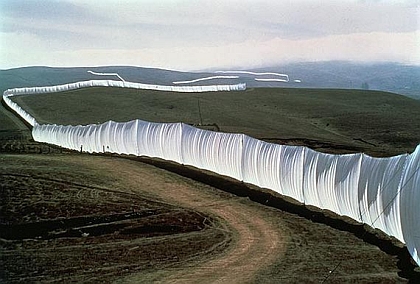 Most conceptual art you can "get" in an elevator pitch. The Running Fence was something to see.
Reconsideration: The Teabaggers are not the mob of racist yobs you accuse them of being. And even though Polatik's "CD sales on the Tea Party Express tour didn’t go as I had hoped...you can expect to see Polatik t-shirts, posters and videos very soon."
Everything else you wanted to know about zombified cockroaches but were afraid to ask: A Wasp Finds the Seat of the Cockroach Soul by Carl Zimmer (Discover blogs / The Loom 2010-04-20).
Department of Guilty Pleasures:
Crime Log: "If we were to take an honest look at America’s blasted landscape of 'losers' and the far shinier, spiffier world of 'winners,' we’d have to admit that it wasn’t signs of onrushing socialism or fascism that stood out, but of staggeringly self-aggrandizing greed and theft right in the here and now. We’d notice our public coffers being emptied to benefit major corporations and financial institutions working in close alliance with, and passing on remarkable sums of money to, the representatives of 'the people.' We’d see, in a word, kleptocracy on a scale to dazzle. We would suddenly see an almost magical disappearing act being performed, largely without comment, right before our eyes." -- American Kleptocracy: How Fears of Socialism and Fascism Hide Naked Theft by William J. Astore (TomDispatch 2010-04-20).
Putting the gross in Gross National Product: Six Banks Control 60% of GNP -- Is the U.S. at the Mercy of an Unstoppable Oligarchy? by Bill Moyers (Bill Moyers Journal 2010-04-23) Economists James Kwak and Simon Johnson wonder whether the financial powers are more profitable, and more resistant to regulation than ever.
Musical interlude: We've been talking about The National for nearly a decade. Will we still love them now that they have a major takeout (The National Agenda by Nicholas Dawidoff) in the Times' Magazine? Sure we will.
3-Card Monte: "The drumbeat about deficits has reached deafening levels. The president warns about 'out of control' spending. Fed Chair Ben Bernanke calls for bringing deficits down. The opinion pages bristle with rants about the U.S. turning into Greece, headed to default. Next week, the first session of the president's 'National Commission on Fiscal Responsibility and Reform' will convene. The next day, shamelessly, the two co-chairs and the staff director (all committed deficit hawks) will grace a forum sponsored by the Peterson Foundation, established by Wall Street billionaire Pete Peterson largely to gin up hysteria about America's long term deficits." - The Big Fix (Hold On To Your Wallets) by Robert Borosage (Campaign for America's Future 2010-04-21).
Oh, I get it now: Uses and Abuses of Gresham's Law in the History of Money by Robert Mundell (Columbia University 1998). The law is trivially easy to understand; so why does everybody get it wrong?
The Long War: Historian, international relations expert and former US Army Colonel Andrew J. Bacevich talks to Bill Moyers about how we got in to Iraq and Afghanistan and why we can't seem to get out (extended video, Bill Moyers Journal 2010-04-09).
The Long War: Rethinking Afghanistan’s Sticky Icky Quagmire by Josh Mull (FDL's The Seminal 2010-04-20). There is definitely a huge drug problem, and our strategy seems to be the cause of it. There are much easier ways to achieve our objectives in the region than an expensive and bloody policy of military aggression, but our leaders are stuck in failed policies born of a worldview that is at once arrogant and ignorant. Time to rethink Afghanistan?
More music: Here's a number from a B.B.King special I worked on a couple of decades back. My friend Douglas Brodoff aptly called this a rock opera in 5 minutes. An honor to have been there.
Collateral damage: "Education catastrophe" as states may cut 300,000 public school jobs by Tamar Lewin and Sam Dillon (New York Times 2010-04-21). The 2010-11 school term is shaping up as one of the most austere in the last half century. In addition to teacher layoffs, districts are planning to close schools, cut programs, enlarge classes and shorten the school day, week or year to save money. See, also: Tax Day and America’s Wars - What the Mayor of One Community Hard Hit by War Spending Is Doing by Jo Comerford (TomDispatch 2010-04-11).
Democracy in the Middle East: In spite of America's professed commitment to equality, the U.S. government makes an exception when it comes to Israel's insistence on being recognized as a Jewish state, which in theory and practice means privileging Jewish citizens over all other citizens: A State for All Its Citizens by Nadim N. Rouhana (Foreign Policy 2010-04-22). A country cannot be both democratic and theocratic.
Hubris: "We can't have it all. The belief that we can is one of the things that has driven us to this awful place. If insanity could be defined as having lost functional connection with physical reality, to believe we can have it all -- to believe we can simultaneously dismantle a world and live on it; to believe we can perpetually use more energy than arrives from the sun; to believe we can take more than the world gives willingly; to believe a finite world can support infinite growth,much less infinite economic growth, where economic growth consists of converting ever larger numbers of living beings to dead objects (industrial production, at core, is the conversion of the living -- trees or mountains -- into the dead -- two-by-fours and beer cans) -- is grotesquely insane. This insanity manifests partly as a potent disrespect for limits and for justice. It manifests in the pretension that neither limits nor justice exist. To pretend that civilization can exist without destroying its own landbase and the landbases and cultures of others is to be entirely ignorant of history, biology, thermodynamics, morality, and self-preservation. And it is to have paid absolutely no attention to the past six thousand years." -- No, We Can't Have It All by Derrick Jensen (excerpted from Endgame, Vol. 1: The Problem of Civilization (Common Dreams 2010-04-23).
Water is the new oil: Cochabamba, the Water Wars and Climate Change by Amy Goodman (TruthDig 2010-04-21). Bolivian President Evo Morales calls Cochabamba the heart of Bolivia. It was here, 10 years ago this month, that, as one observer put it, "the first rebellion of the 21st century" took place. In what was dubbed the Water Wars, people from around Bolivia converged on Cochabamba to overturn the privatization of the public water system.
Art & Design: Running Fence: Christo and Jeanne-Claude’s Masterpiece Revisited at the Smithsonian American Art Museum by Alix McKenna (California Literary Review 2010-04-19).
Most conceptual art you can "get" in an elevator pitch. The Running Fence was something to see.Reconsideration: The Teabaggers are not the mob of racist yobs you accuse them of being. And even though Polatik's "CD sales on the Tea Party Express tour didn’t go as I had hoped...you can expect to see Polatik t-shirts, posters and videos very soon."
Everything else you wanted to know about zombified cockroaches but were afraid to ask: A Wasp Finds the Seat of the Cockroach Soul by Carl Zimmer (Discover blogs / The Loom 2010-04-20).
Department of Guilty Pleasures:
Subscribe to:
Posts (Atom)


