


With this parody of The Sopranos finale, the effort to humanize Hillary Clinton takes a weird turn:

2008: The L.A. Times launches political blog
The Times' bloggers are Don Frederick and Andrew Malcolm. So, one professional journalist and one ideological conservative, about the best we can expect from the corporate media. Weirdly, there are links to the campaign sites of Tom Tancredo, Bill Richardson, Mike Gravel, Duncan Hunter, James Gilmore, Joseph Biden, Chris Dodd, Dennis Kucinich, Sam Brownback and Rudy Giuliani, but not to Mitt Romney, John McCain, Barack Obama, Hillary Clinton or John Edwards. <http://latimesblogs.latimes.com/washington/>
This Can't Be Good News Department: Lawrence Livermore seeks permit to release uranium dust into the air
A permit application has been filed with the San Joaquin Valley Air Pollution Control District (valleyair.org - 559-230-6000) by Lawrence Livermore National Laboratory to release as much as 450 pounds of radioactive uranium dust into the air every year.
See Tastes like burning by Mark Drolette in the Sacramento News and Review for 2007-06-14 and Uranium Dust by John Upton in the 2007-04-11 edition of Tracy Press.
"Depleted" uranium weapons are radioactive, and as such are considered to be weapons of mass destruction, illegal under international law. For more info: Axis of Logic.
Four hundred and fifty pounds doesn't sound like a lot. Maybe it could just be buried in Laboratory director George H. Miller's back yard.
We've stopped these irresponsible morons before. Let's do it again.
See Tastes like burning by Mark Drolette in the Sacramento News and Review for 2007-06-14 and Uranium Dust by John Upton in the 2007-04-11 edition of Tracy Press.
"Depleted" uranium weapons are radioactive, and as such are considered to be weapons of mass destruction, illegal under international law. For more info: Axis of Logic.
Four hundred and fifty pounds doesn't sound like a lot. Maybe it could just be buried in Laboratory director George H. Miller's back yard.
We've stopped these irresponsible morons before. Let's do it again.
2008: A big man for a big job
Anybody who still doubts Fred Thompson will be the next president should consider this: he's 6'7", and the tallest candidate almost always wins.
This held true even in 2000, when 6'1" Al Gore ran against 5'11" George W. Bush. If you think back, you'll recall that Gore won.
Harder to explain is the outcome in 2004, when 6'4" John Kerry ran against Bush, but it has to be said in his defense that Kerry managed to overcome many advantages that year on the road to defeat (also, let's not forget that there were disputes about the vote in 2004, too [2004 United States presidential election controversy and irregularities], with the states of Florida and Ohio certifying returns that varied nearly 20% from exit polling [2004 United States presidential election controversy, exit polls]).
Parenthetically, at his August 2001 physical, Bush was supposedly 6' tall (Health and Medical History of George W. Bush), but the doctors probably just rounded up to make him seem more presidential. Medical spin. USA Today says that Bush is 5'11 3/4" (Time-tested formulas suggest both Bush and Kerry will win on Nov. 2) and Bush's much-discussed National Guard records listed him at 5'11" in his mid-20s. He doesn't appear to have grown any since then.
This held true even in 2000, when 6'1" Al Gore ran against 5'11" George W. Bush. If you think back, you'll recall that Gore won.
Harder to explain is the outcome in 2004, when 6'4" John Kerry ran against Bush, but it has to be said in his defense that Kerry managed to overcome many advantages that year on the road to defeat (also, let's not forget that there were disputes about the vote in 2004, too [2004 United States presidential election controversy and irregularities], with the states of Florida and Ohio certifying returns that varied nearly 20% from exit polling [2004 United States presidential election controversy, exit polls]).
Parenthetically, at his August 2001 physical, Bush was supposedly 6' tall (Health and Medical History of George W. Bush), but the doctors probably just rounded up to make him seem more presidential. Medical spin. USA Today says that Bush is 5'11 3/4" (Time-tested formulas suggest both Bush and Kerry will win on Nov. 2) and Bush's much-discussed National Guard records listed him at 5'11" in his mid-20s. He doesn't appear to have grown any since then.
The fight against terrorism is not a war
Lee Casey, a veteran of the Reagan and first Bush Justice departments, is quoted in the WSJ (Terror War Legal Edifice Weakens) as saying the next president, whether a Republican or a Democrat, will be hard-pressed to relinquish the executive powers Mr. Bush has fought so hard to assert. "I don't think the next president will have much of a choice, whatever his or her instincts may be," Mr. Casey told the Journal. "You are either engaged in an armed conflict," where a country can use military force against its enemies, "or the laws of war don't apply."
But the laws of war don't apply to the effort to counter the scourge of terrorism. Many of us who have opposed as mistaken the "war on terror" in general -- in some cases since 9/12 -- and the invasion of Iraq in particular argue that "war" was never a useful organizing metaphor for combating terrorism. In the wake of 9/11, it would have been far more effective to treat Al-Qaeda and their ilk as international criminals instead of buying into their self-glorification as warriors. Had we spent our $billions arming and training the world's police departments instead of destabilizing great swatches of the Middle East and Southeast Asia, we'd not only be more secure, but we would have a lot more friends in the international community.
And we would not have unloosed the pernicious notion of preemptive war (if ever there was a policy guaranteed to come back to haunt us, that's it).
Undoing the mistakes of the Bush administration is obviously a herculean undertaking. But if s/he does nothing else, the next president must begin by ratcheting down the war rhetoric as a first step toward implementing a more effective policy against terrorism. If we are ever going to hunt down, disarm, prosecute, punish and neutralize the criminals who engage in terrorist activities, we need to be able to think more clearly about who they are -- murderers, extortionists, gangsters, lunatics -- and what tools -- intelligence, deterrence, incarceration -- will be most effective against them.
The Founders anticipated that there would be presidents who would overreach, who would attempt to wrest the powers of government away from legislators, but they never dreamed there would be legislatures as docious as the last several congresses. We still lack congressional leaders, especially in the Senate, with the spine to defend legislative prerogatives, but at least there is a growing perception, especially in the House, about the need to restore historical Constitutional restraints on the executive and to redress the balance of power between the branches.
The reason I worry about Hillary Clinton's candidacy is that she accepts the primacy of the executive as a given. Obviously, in a race between Sen. Clinton and Gingrich or some Thompson or other, there will be no alternative but to go all out for the Democrat. But we need to recognize that, should she win, she may be a disappointment to progressives because of her reluctance "to relinquish the executive powers Mr. Bush has fought so hard to assert."
But the laws of war don't apply to the effort to counter the scourge of terrorism. Many of us who have opposed as mistaken the "war on terror" in general -- in some cases since 9/12 -- and the invasion of Iraq in particular argue that "war" was never a useful organizing metaphor for combating terrorism. In the wake of 9/11, it would have been far more effective to treat Al-Qaeda and their ilk as international criminals instead of buying into their self-glorification as warriors. Had we spent our $billions arming and training the world's police departments instead of destabilizing great swatches of the Middle East and Southeast Asia, we'd not only be more secure, but we would have a lot more friends in the international community.
And we would not have unloosed the pernicious notion of preemptive war (if ever there was a policy guaranteed to come back to haunt us, that's it).
Undoing the mistakes of the Bush administration is obviously a herculean undertaking. But if s/he does nothing else, the next president must begin by ratcheting down the war rhetoric as a first step toward implementing a more effective policy against terrorism. If we are ever going to hunt down, disarm, prosecute, punish and neutralize the criminals who engage in terrorist activities, we need to be able to think more clearly about who they are -- murderers, extortionists, gangsters, lunatics -- and what tools -- intelligence, deterrence, incarceration -- will be most effective against them.
The Founders anticipated that there would be presidents who would overreach, who would attempt to wrest the powers of government away from legislators, but they never dreamed there would be legislatures as docious as the last several congresses. We still lack congressional leaders, especially in the Senate, with the spine to defend legislative prerogatives, but at least there is a growing perception, especially in the House, about the need to restore historical Constitutional restraints on the executive and to redress the balance of power between the branches.
The reason I worry about Hillary Clinton's candidacy is that she accepts the primacy of the executive as a given. Obviously, in a race between Sen. Clinton and Gingrich or some Thompson or other, there will be no alternative but to go all out for the Democrat. But we need to recognize that, should she win, she may be a disappointment to progressives because of her reluctance "to relinquish the executive powers Mr. Bush has fought so hard to assert."
Rust never sleeps
In case you're under the misapprehension that the neocons learned anything from their Iraq imbroglio, think again: "The Case for Bombing Iran: I hope and pray that President Bush will do it" by Norman Podhoretz on the WSJ's website.
American Civ: Political Assassination --
The Violent Side of American Political Life
"No other country with a population of over 50 million has had as high a number of political assassinations or attempted assassinations....Why has the United States, with its commitment to rule of law and due process, been so susceptible to assassination?...The most troubling issue raised by political assassinations is whether they alter the course of history." -- from the website. <http://www.digitalhistory.uh.edu/>
The Press: Can the L.A. Times be saved? (Central Library 2007-06-05)
The Los Angeles Times has struggled to fight declining circulation and to make up for it by capturing readers on line. Times publisher David Hiller, editor Jim O'Shea, innovation editor (egad!) Russ Stanton, and LATimes.com executive editor Meredith Artley mull over the decline of an essential civic institution Tuesday at the L.A. Public Library. Free; 7 p.m.; 630 W. 5th St., L.A.; 213-228-7000. <http://www.lapl.org>
Soul and Jazz 2006
I did quick takes on some of the best soul, rhythm & blues, jazz and blues albums I encountered last year. You can read them here.
I'm just sayin'
You know me as a champion of the DIY video and music revolutions and of YouTube-style creativity, and I'm not resigning from that position, but a visit today to the video portal did put me in mind of what Arthur Sullivan said to Thomas Edison about the invention of the phonograph: "I am astonished...at the wonderful power you have developed, and terrified at the thought that so much hideous and bad music may be put on record forever."
Second thoughts: Municipal Wi-Fi Easier Said Than Done
As you know if you've tried to use it, wi-fi access in Santa Monica is hit or miss. Instead of organizing wi-fi around the excess bandwidth of major users -- businesses such as Yahoo, Google, Sony; educational institutions such as SMCC; government entities such as the city itself -- Santa Monica is planning to hire a private service provider to build a system over the next few years (why it should take "years" to provide service to 8.3 square miles of flat terrain is a topic for another time).
According to reports, instead of contracting with a big player like Earthlink or a civic-minded company like Google, the city plans to hire AzulStar, a little Michigan-based company specializing in municipal access, to create a seamless city-wide network of hotspots.
According to AzulStar’s website, the company has built four city-wide systems to date, in such major metropolitan areas as Grand Haven, Michigan and Rio Rancho, New Mexico.
Although touted as a free service, in reality, relatively slow, advertising-supported public access will be available to residents and tourists for free, but they will be asked to pay for faster ad-free service. Businesses will required to pay for access separately, which will require the creation of some sort of enforcement mechanism to keep companies from logging on to the slower but costless version.
Any city-wide plan will be a big advance over the patchwork of public hotspots, now numbering 11 and growing, including City Hall, the Third Street Promenade, the Pier and Virginia Avenue Park, that make current access so spotty (at the end of May, three more parks -- Reed, Cloverfield, and the new park at the airport -- were scheduled to be on line).
A city-wide system will also enable the City of Santa Monica to tie all municipal services together on one wireless network.
Some of the problems with using a private company to provide a public service (instead of relying on a municipally owned system or a city-wide cooperative, two methods widely used in other parts of the world), as well as some of the technical difficulties particularly irksome to commercial providers, are outlined in an article published this week by The Economist (2007-05-25).
Azulstar is using in Santa Monica the same business model, attempting to recoup its investment in infrastructure and to turn a profit through subscriptions and advertising, that the Economist reports is a failure elsewhere. At least Earthlink and its ilk have the deep pockets that would enable them to live up to their commitments even while losing money for a while. How long will a little outfit like AzulStar be able to hang in without making a profit? I guess we're going to find out.
The Economist
According to reports, instead of contracting with a big player like Earthlink or a civic-minded company like Google, the city plans to hire AzulStar, a little Michigan-based company specializing in municipal access, to create a seamless city-wide network of hotspots.
According to AzulStar’s website, the company has built four city-wide systems to date, in such major metropolitan areas as Grand Haven, Michigan and Rio Rancho, New Mexico.
Although touted as a free service, in reality, relatively slow, advertising-supported public access will be available to residents and tourists for free, but they will be asked to pay for faster ad-free service. Businesses will required to pay for access separately, which will require the creation of some sort of enforcement mechanism to keep companies from logging on to the slower but costless version.
Any city-wide plan will be a big advance over the patchwork of public hotspots, now numbering 11 and growing, including City Hall, the Third Street Promenade, the Pier and Virginia Avenue Park, that make current access so spotty (at the end of May, three more parks -- Reed, Cloverfield, and the new park at the airport -- were scheduled to be on line).
A city-wide system will also enable the City of Santa Monica to tie all municipal services together on one wireless network.
Some of the problems with using a private company to provide a public service (instead of relying on a municipally owned system or a city-wide cooperative, two methods widely used in other parts of the world), as well as some of the technical difficulties particularly irksome to commercial providers, are outlined in an article published this week by The Economist (2007-05-25).
Long before Walt Disney built his theme park in Anaheim, this savvy little city 30 miles south of Los Angeles was deploying cutting-edge technology to improve its citizens’ lot and upstage neighbouring communities. It was one of the first cities in America to build its own electricity grid -- to illuminate its streets and lure late-night shoppers from nearby towns.
The innovation continued. Before most had even heard of the internet, Anaheim had networked the city with fat communications piping, so residents could have a variety of cable TV providers and telephone companies to choose from, while local utilities could automate their meter reading and businesses could provide all manner of online services. Now the city is in the process of blanketing itself with a wireless broadband network.
Anaheim is not the only city turning itself into a giant Wi-Fi hotspot. No fewer than 175 municipalities and metropolitan regions in America are building community-wide networks. A similar number are in the planning stage. But having blazed the trail in network services, Anaheim is the municipality that other cities are watching the closest -- all the more so because the company rolling out its wireless network is Earthlink.
Once the loudest booster of municipal Wi-Fi and still the biggest in the business, Earthlink is having second thoughts. Having turned in a $30m loss for its most recent quarter, Earthlink now says it is “re-evaluating its position in the muni-Wi-Fi market." The announcement has sent shivers through city halls across America.
Like Anaheim, most municipalities installing wireless networks are not paying for the privilege, but relying on providers like Earthlink to foot the bill. Having won the right to supply Wi-Fi services to a municipality, most companies expected to recoup the investment though subscriptions and advertising.
Neither revenue stream has lived up to expectation. Originally, Earthlink thought it would be in clover if 20-25% of households signed up for its wireless internet service. It now realises it will be lucky to get 15%. And without the eyeballs, advertisers have been slow to come aboard.
The trouble is that too many cities' schemes were half-baked to start with. In some cities, such as Philadelphia, the mission was to offer cheap (or even free) internet connections to the poor. In others, such as Anaheim, a more pragmatic, market-driven approach was adopted. Elsewhere, populist mayors and city councils pandered to voters with promises of universal internet access. In almost all cases, however, the reigning philosophy was “build it and they will come."
What no one seems to have bargained for was that, while Wi-Fi technology works perfectly well over short distances within a home, coffee shop or airport, it doesn’t work all that well outside. Wi-Fi’s popularity stems from its use of the unlicensed, 2.4 gigahertz part of the radio spectrum. But being unfettered by licences and regulations means that there are many PCs jostling for access. Adding to the mayhem are the domestic appliances, like cordless phones and microwave ovens, that radiate in the same frequency band.
This creates enough trouble inside a building. Outside, there are the added problems of foliage, tall buildings and hills. These can reflect, absorb or otherwise interfere with a municipal Wi-Fi’s signal, beamed from aerials on lamp-posts and traffic lights.
Because of these glitches, network operators have found that the old rule of 15-20 Wi-Fi aerial nodes per square mile is nowhere near good enough. Nowadays people expect to connect to the internet using low-powered devices such as laptops and Wi-Fi-enabled mobile phones. To meet this demand, operators must install twice as many nodes per square mile.
The cost escalation does not stop there. In opting for external Wi-Fi, municipal operators seem to have forgotten that the vast majority of dwellings in America use chicken wire in their walls. As every high-school physics student learns, a mesh of chicken wire can screen out electromagnetic fields, especially those caused by radio waves. For an external Wi-Fi beam to be detected indoors, homes have had to be kitted out with signal-boosting wireless modems.
These complications have made a mockery of service suppliers’ business plans. When Earthlink says it is re-evaluating its position in the municipal Wi-Fi market, what it really means is that it can’t make money out of communities with fewer than 2,500 households per square mile. Even then, it needs assurances that the city will commit to buying a big chunk of the network’s capacity for such “anchor tenancies” as emergency services, traffic and parking control, video surveillance and internet telephony, as well as automated meter reading and other utility services.
This is precisely how it should be. Internet access for residential users was never going to be the mainstay for municipal Wi-Fi. Most communities are pretty well served these days by cable, DSL and satellite internet services. As a result, competition has beaten broadband-access charges down to around $15 a month. And where such services are not competitive, they quickly become so the moment municipal Wi-Fi presses its nose to the window.
No, the future of municipal wireless broadband rests on making cities safer, saner and simpler to manage. Trivial pursuits like downloading songs or posting video clips can be safely left to phone and cable companies."
Azulstar is using in Santa Monica the same business model, attempting to recoup its investment in infrastructure and to turn a profit through subscriptions and advertising, that the Economist reports is a failure elsewhere. At least Earthlink and its ilk have the deep pockets that would enable them to live up to their commitments even while losing money for a while. How long will a little outfit like AzulStar be able to hang in without making a profit? I guess we're going to find out.
The Economist
Words: "quisling" or "paul revere"?
"...the New York Times article yesterday about a couple of Iraqi policemen who joined American forces on searches in Baghdad, but then turned quisling, running ahead to warn residents to hide their weapons and other incriminating evidence." -- from The Times.
Just to keep our language straight:
Aren't Iraqi police quislings when they go to work for the imperial power attempting to take over their country and don't they become paul reveres at the point where they decide to run ahead of the invader shouting, "The Yankees are coming, the Yankees are coming"?
Just asking.
Just to keep our language straight:
Aren't Iraqi police quislings when they go to work for the imperial power attempting to take over their country and don't they become paul reveres at the point where they decide to run ahead of the invader shouting, "The Yankees are coming, the Yankees are coming"?
Just asking.
A challenge to Bush's grab for power
A group of conservatives is confronting abuses of power by the Bush administration. Under the banner of the American Freedom Agenda, they have proposed a series of statutes designed to rein in the executive branch. They hope to make restoration of liberties mandated and protected by the Constitution central to the 2008 campaign for president and to the deliberations of Congress in the coming months. This is from the organization's website (I've added some bolding for emphasis):
These are matters crucial to our ability to conduct ourselves as a democracy. It is encouraging to see conservatives joining the fight to save the Constitution. And, although it's good to have them on board and all, it is a little discouraging to this progressive that even with a Democratic majority in Congress it should be necessary to look to the likes of Bruce Fein, Bob Barr, David Keene and Richard Viguerie for defense of our freedoms.
American Freedom Agenda:
<http://www.americanfreedomagenda.org/>
The American Freedom Agenda’s (AFA) mission is twofold: the enactment of a cluster of statutes that would restore the Constitution’s checks and balances as enshrined by the Founding Fathers; and, making the subject a staple of political campaigns and of foremost concern to Members of Congress and to voters and educators. Especially since 9/11, the executive branch has chronically usurped legislative or judicial power, and has repeatedly claimed that the President is the law. The constitutional grievances against the White House are chilling, reminiscent of the kingly abuses that provoked the Declaration of Independence.To advance this agenda during the 2008 campaign, the AFA has proposed a 10-point "Freedom Pledge" it hopes the candidates will agree to:
The 10-point American Freedom Agenda would work to restore the roles of Congress and the federal judiciary to prevent such abuses of power and protect against injustices that are the signature of civilized nations. In particular, the American Freedom Agenda would:* Prohibit military commissions whose verdicts are suspect except in places of active hostilities where a battlefield tribunal is necessary to obtain fresh testimony or to prevent anarchy;The mission of the AFA is explained further here
* Prohibit the use of secret evidence or evidence obtained by torture or coercion in military or civilian tribunals;
* Prohibit the detention of American citizens as unlawful enemy combatants without proof of criminal activity on the President’s say-so;
* Restore habeas corpus for alleged alien enemy combatants, i.e., non-citizens who have allegedly participated in active hostilities against the United States, to protect the innocent;
* Prohibit the National Security Agency from intercepting phone conversations or emails or breaking and entering homes on the President’s say-so in violation of federal law;
* Empower the House of Representatives and the Senate collectively to challenge in the Supreme Court the constitutionality of signing statements that declare the intent of the President to disregard duly enacted provisions of bills he has signed into law because he maintains they are unconstitutional;
* Prohibit the executive from invoking the state secrets privilege to deny justice to victims of constitutional violations perpetrated by government officers or agents; and, establish legislative-executive committees in the House and Senate to adjudicate the withholding of information from Congress based on executive privilege that obstructs oversight and government in the sunshine;
* Prohibit the President from kidnapping, detaining, and torturing persons abroad in collaboration with foreign governments;
* Amend the Espionage Act to permit journalists to report on classified national security matters without fear of prosecution; and;
* Prohibit the listing of individuals or organizations with a presence in the United States as global terrorists or global terrorist organizations based on secret evidence.
I, (candidate), hereby pledge that if elected President of the United States I will undertake the following to restore the Constitution’s checks and balances, to honor fundamental protections against injustice, and to eschew usurpations of legislative or judicial power.These are keystones of national security and individual freedom:______________ (signed: Hillary Clinton? John Edwards? Barack Obama? Bill Richardson? Al Gore? Mitt Romney? Rudy Giuliani? Sam Brownback? Fred Thompson? Newt Gingrich?)
1. No Military Commissions Except on the Battlefield. I will not employ military commissions to prosecute offenses against the laws of war except in places where active hostilities are ongoing and a battlefield tribunal is necessary to obtain fresh testimony and to prevent local anarchy or chaos.
2. No Evidence Extracted by Torture or Coercion. I will not permit the use of evidence obtained by torture or coercion to be admissible in a military commission or other tribunal.
3. No Detaining Citizens as Unlawful Enemy Combatants. I will not detain any American citizen as an unlawful enemy combatant. Citizens accused of terrorism-linked crimes will be prosecuted in federal civilian courts.
4. Restoring Habeas Corpus for Suspected Alien Enemy Combatants. I will detain non-citizens as enemy combatants only if they have actively participated in actual hostilities against the United States. I will urge Congress to amend the Military Commissions Act of 2006 to permit any individual detained under the custody or control of the United States government to file a petition for a writ of habeas corpus in federal courts.
5. Prohibiting Warrantless Spying by the National Security Agency in Violation of Law. I will prohibit the National Security Agency from gathering foreign intelligence except in conformity with the Foreign Intelligence Surveillance Act of 1978, and end the NSA’s domestic surveillance program that targets American citizens on American soil for warrantless electronic surveillance.
6. Renouncing Presidential Signing Statements. I will not issue presidential signing statements declaring the intent to disregard provisions of a bill that I have signed into law because I believe they are unconstitutional. Instead, I will veto any bill that I believe contains an unconstitutional provision and ask Congress to delete it and re-pass the legislation.
7. Ending Secret Government by Invoking State Secrets Privilege. I will not invoke the state secrets privilege to deny remedies to individuals victimized by constitutional violations perpetrated by government officials or agents. I will not assert executive privilege to deny Congress information relevant to oversight or legislation unless supreme state secrets are involved. In that case, I will submit the privilege claim to a legislative-executive committee for definitive resolution.
8. Stopping Extraordinary Renditions. I will order the cessation of extraordinary renditions except where the purpose of the capture and transportation of the suspected criminal is for prosecution according to internationally accepted standards of fairness and due process.
9. Stopping Threats to Prosecuting Journalists under the Espionage Act. I will urge Congress to amend the Espionage Act to create a journalistic exception for reporting on matters relating to the national defense. As a matter of prosecutorial discretion, until such an amendment is enacted I will not prosecute journalists for alleged Espionage Act violations except for the intentional disclosure of information that threatens immediate physical harm to American troops or citizens at home or abroad.
10. Ending the Listing of Individuals or Organizations as Terrorists Based on Secret Evidence. I will not list individuals or organizations as foreign terrorists or foreign terrorist organizations for purposes of United States or international law based on secret evidence.
I will issue a public report annually elaborating on how the actions enumerated in paragraphs 1-10 have strengthened the ability of the United States to defeat international terrorism, secure fundamental freedoms, and preserve the nation’s democratic dispensation.
These are matters crucial to our ability to conduct ourselves as a democracy. It is encouraging to see conservatives joining the fight to save the Constitution. And, although it's good to have them on board and all, it is a little discouraging to this progressive that even with a Democratic majority in Congress it should be necessary to look to the likes of Bruce Fein, Bob Barr, David Keene and Richard Viguerie for defense of our freedoms.
American Freedom Agenda:
<http://www.americanfreedomagenda.org/>
Bike to Work Week 2007 Event Calendar!
Here's a list of some events happening during Bike to Work Week 2007 (see next post).
Monday May 14, 2007
Downtown LA Bike Rally and Concert
City of Los Angeles City Hall, South Lawn
11:30 am to 1:30 pm
Festivities include Ed Begley, Jr. and other speakers, health and bike fair, custom bike show, and a live concert by the Ditty Bops!
Bike Week Pasadena
C.I.C.L.E. and the City of Pasadena along with Patagonia and Metro are hosting more than 15 events all week! Highlights include:
Mayor's Bike to Work Brigade led by Bill Bogaard, bicycling aficionado and Mayor of Pasadena.
Themed bike tours like the Sunset Sonata Ride: cycle to an enchanting overlook on the Arroyo Seco, complete with hors d'oeuvres and a live violin and cello duet.
Free bicycle-related films and documentaries screened outdoors nightly in the One Colorado Courtyard.
An Urban Bicycle Commuter Expo featuring folding and electric bicycles, accessories, cargo bikes and trailers that handle everything from shopping trips to hauling lumber. More info www.cicle.org/cicle_content/pivot/entry.php?id=1373
Tuesday May 15, 2007
4th Annual Blessing of the Bicycles
Good Samaritan Hospital, 616 S. Witmer Avenue, Los Angeles CA 90017
8:00 am to 9:30 am
More info www.goodsam.org
El Segundo Bike Challenge
El Segundo and surrounding areas
For more information call Devon Deming at 310 646-7775
Thursday May 17, 2007 — Bike to Work Day
IlluminateLA Bike to Work Day Pitstop and Bike Ride
Hollywood and Western Metro Station
7:00 am 10:00 am.
More info www.illuminatela.com/Calendar/Community.html
Free rides for bicyclists on transit www.metro.net/biketowork/free_rides.htm
Free countywide pit stops www.metro.net/biketowork/pit_stops.htm
Saturday May 19, 2007
4th Annual Bike Tour and Festival at Jesse Owens Park
More info http://www.richesbiz.com/cityweb/cityweb.htm
C.I.C.L.E. Urban Bicycle Commuter Expo
One Colorado Courtyard, Old Town Pasadena
10:00 am to 5:00 pm
More info www.cicle.org/cicle_content/pivot/entry.php?id=1373
Monday May 14, 2007
Downtown LA Bike Rally and Concert
City of Los Angeles City Hall, South Lawn
11:30 am to 1:30 pm
Festivities include Ed Begley, Jr. and other speakers, health and bike fair, custom bike show, and a live concert by the Ditty Bops!
Bike Week Pasadena
C.I.C.L.E. and the City of Pasadena along with Patagonia and Metro are hosting more than 15 events all week! Highlights include:
Mayor's Bike to Work Brigade led by Bill Bogaard, bicycling aficionado and Mayor of Pasadena.
Themed bike tours like the Sunset Sonata Ride: cycle to an enchanting overlook on the Arroyo Seco, complete with hors d'oeuvres and a live violin and cello duet.
Free bicycle-related films and documentaries screened outdoors nightly in the One Colorado Courtyard.
An Urban Bicycle Commuter Expo featuring folding and electric bicycles, accessories, cargo bikes and trailers that handle everything from shopping trips to hauling lumber. More info www.cicle.org/cicle_content/pivot/entry.php?id=1373
Tuesday May 15, 2007
4th Annual Blessing of the Bicycles
Good Samaritan Hospital, 616 S. Witmer Avenue, Los Angeles CA 90017
8:00 am to 9:30 am
More info www.goodsam.org
El Segundo Bike Challenge
El Segundo and surrounding areas
For more information call Devon Deming at 310 646-7775
Thursday May 17, 2007 — Bike to Work Day
IlluminateLA Bike to Work Day Pitstop and Bike Ride
Hollywood and Western Metro Station
7:00 am 10:00 am.
More info www.illuminatela.com/Calendar/Community.html
Free rides for bicyclists on transit www.metro.net/biketowork/free_rides.htm
Free countywide pit stops www.metro.net/biketowork/pit_stops.htm
Saturday May 19, 2007
4th Annual Bike Tour and Festival at Jesse Owens Park
More info http://www.richesbiz.com/cityweb/cityweb.htm
C.I.C.L.E. Urban Bicycle Commuter Expo
One Colorado Courtyard, Old Town Pasadena
10:00 am to 5:00 pm
More info www.cicle.org/cicle_content/pivot/entry.php?id=1373
Transportation: L.A. County Bike to Work Week May 14 - 18
(From the Metro website)
For the 13th straight year a record number of cyclists are expected to give bicycle commuting a try and leave their cars at home. Bike to Work Week is May 14 – 18, 2007.
Be part of the solution and PLEDGE not only to bike to work but pledge for a better you and for a better LA. Bicycling reduces traffic, improves the environment, improves your health and even saves you money on gas.Pledge online today! Get a free bicycle patch kit (while supplies last) just for pledging. And, be automatically entered to win prizes. Visit our Riders page for more on planning your ride to work.
Free Rides on Thursday, May 17 from participating transit agencies. Just board with your bike or helmet.
Stop by at Metro’s co-sponsored Pit Stops on Thursday, May 17! Metro is teaming up with a number of Los Angeles County organizations, employers and merchants to host local pit stops for all Bike to Work participants. Pit stops are locations for bicyclists to stop, relax, get energized, have snacks, receive give-aways (all for free), and obtain informational materials on bicycling to work. Check back for LA County Pit Stop locations.
Employers take action! Thank your employees for bicycling to work by setting-up food and refreshments for them or by going all out and having a fair. Whatever you decide on, REGISTER with Metro to receive free give-away items to support your event. See our Employers page to register and for more information.
Be part of the solution and use your pedal power on Bike to Work Day Thursday,
May 17!
2008: Newt's a beaut
Since we can expect the Republican Party will find it expedient to look for its nominee outside the current covey of self-declared bush league White House wannabes, we should consider keeping track of Newt Gingrich and Fred Thompson. Here, to get us started, is a tasty bit of racism from this year's gathering of the Conservative Political Action Committee:
Aside from what it suggests about how "uneducated" Newt is -- the people of the Ninth were not done in by wind and rain but by the failure of inadequately funded levees, the ex-speaker's remark is a classic example of the American ruling class' familiar stratagem of misdirecting attention from its own misdeeds by blaming the victims of its policies.
Because Gingrich appears loathsome to most progressives, they underestimate his chances. In polling at CPAC 2007, for example, even though Gingrich is undeclared, he came in a strong fourth, narrowly trailing Romney, Giuliani and Brownback. More interestingly, Gingrich tied Giuliani as the attendees' second choice. If the Democrats don't choose their candidate wisely, in 2008 he could be the nation's first choice.
"How can you have the mess we have in New Orleans,and not have had deep investigations of the federal government, the state government, the city government, and the failure of citizenship in the Ninth Ward, where 22,000 people were so uneducated and so unprepared, they literally couldn't get out of the way of a hurricane."
Aside from what it suggests about how "uneducated" Newt is -- the people of the Ninth were not done in by wind and rain but by the failure of inadequately funded levees, the ex-speaker's remark is a classic example of the American ruling class' familiar stratagem of misdirecting attention from its own misdeeds by blaming the victims of its policies.
Because Gingrich appears loathsome to most progressives, they underestimate his chances. In polling at CPAC 2007, for example, even though Gingrich is undeclared, he came in a strong fourth, narrowly trailing Romney, Giuliani and Brownback. More interestingly, Gingrich tied Giuliani as the attendees' second choice. If the Democrats don't choose their candidate wisely, in 2008 he could be the nation's first choice.
The Media: Jon Stewart on Bill Moyers Journal (video)
On Bill Moyers Journal, the "comedian" Jon Stewart offers a more serious analysis of the role of the media in covering the administration and the war in Iraq than you will hear in a month of Sunday morning bloviations:
<http://www.truthout.org/docs_2006/050107C.shtml>
<http://www.truthout.org/docs_2006/050107C.shtml>
The New Amore Bay Makes Outdoor Spas Hot and Sexy Again
Seductive Combination of Ultra-Modern Technology and Good Old-Fashioned Sex Appeal…
Warm Contact Induces Release of the “Cuddle Hormone”
(SAN DIEGO, CA) Dimension One Spas’ just-released Amore Bay luxury hot tubs – retailing for between $15,000 and $17,000 -- combines the pleasure principle of the 70’s with ultra-modern technology to get down to the basics: today’s hot tubs can be sexy and high-tech…and a secret tool to help melt away your lover’s defenses.
With curvaceous lines, strategically placed water jets, mood
 lighting, a “playground” area, a hand held massager and cup holders, the only thing left to do is download Barry White or Marvin Gaye on the Amore Bay’s wireless, iPod-friendly stereo!
But could such a watery Shangri-La really help your sex life?
According to findings in a 2005 study by the Department of Psychiatry, University of North Carolina at Chapel Hill, “warm contact…and frequent hugs between spouses/partners caused oxytocin levels to rise in premenopausal women.” So, any warm contact boosts oxytocin – known by sex researchers as the “cuddle hormone.”
This mammalian hormone also acts as a neurotransmitter in the brain and is involved in social recognition and bonding, and is thought to be involved in the formation of trust between people. Some researchers have also suggested a beneficial link between oxytocin and social anxiety, memory control, cardiovascular functions, and thermoregulation in menopausal women.
Did someone say, ‘Sexual Healing!'?
An irresistible backyard oasis, the Amore Bay also features his and her “hydronomically” designed, lounge chairs lined with massage jets, relaxing fountains, a remote control to select your underwater massage programs and a sleek, energy efficient design with average heating costs of only $15.00 a month (subject to individual heating costs). This year, couples can just relax and “Get their Sexy Back” in an Amore Bay!
About D-1 Spas: With high tech and design innovations reminiscent of each year’s developments in the automobile industry, this award-winning, California-based hot tub company holds over 30 patents, more than any other hot tub manufacturer.
The family-owned, $60 million a year business is known for introducing advances in materials science and water handling technology to bring customers the most advanced spas in the world.
Founded in Vista, California by Bob and Linda Hallam, D1 spas and aquatic fitness products are now sold through a network of more than 250 dealers in the United States, and 450 dealers worldwide in 30 countries. The company's three product lines include a range of home hydrotherapy and aquatic fitness products that meet a variety of consumer needs and budgets: D1 Reflections®, D1 Bay Collection®, AFS -- Aquatic Fitness Systems® and @ Home Hot Tubs®. Innovations include: hydronomics -- design based on human anatomy, ergonomics, acupressure, reflexology and fluid mechanics -- a wireless, totally submersible hot tub stereo system; a spa-within-a-spa lounge chair aqua massager; clean energy systems; and patented fountain & lighting systems.
For more information about Dimension One Spas, its products and practices, please visit: http://www.d1spas.com/.
The New Amore Bay Makes Outdoor Spas Hot and Sexy Again
Seductive Combination of Ultra-Modern Technology and Good Old-Fashioned Sex Appeal…
Warm Contact Induces Release of the “Cuddle Hormone”
(SAN DIEGO, CA) Dimension One Spas’ just-released Amore Bay luxury hot tubs – retailing for between $15,000 and $17,000 -- combines the pleasure principle of the 70’s with ultra-modern technology to get down to the basics: today’s hot tubs can be sexy and high-tech…and a secret tool to help melt away your lover’s defenses.
With curvaceous lines, strategically placed water jets, mood
lighting, a “playground” area, a hand held massager and cup holders, the only thing left to do is download Barry White or Marvin Gaye on the Amore Bay’s wireless, iPod-friendly stereo!But could such a watery Shangri-La really help your sex life?
According to findings in a 2005 study by the Department of Psychiatry, University of North Carolina at Chapel Hill, “warm contact…and frequent hugs between spouses/partners caused oxytocin levels to rise in premenopausal women.” So, any warm contact boosts oxytocin – known by sex researchers as the “cuddle hormone.”
This mammalian hormone also acts as a neurotransmitter in the brain and is involved in social recognition and bonding, and is thought to be involved in the formation of trust between people. Some researchers have also suggested a beneficial link between oxytocin and social anxiety, memory control, cardiovascular functions, and thermoregulation in menopausal women.
Did someone say, ‘Sexual Healing!'?
An irresistible backyard oasis, the Amore Bay also features his and her “hydronomically” designed, lounge chairs lined with massage jets, relaxing fountains, a remote control to select your underwater massage programs and a sleek, energy efficient design with average heating costs of only $15.00 a month (subject to individual heating costs). This year, couples can just relax and “Get their Sexy Back” in an Amore Bay!
About D-1 Spas: With high tech and design innovations reminiscent of each year’s developments in the automobile industry, this award-winning, California-based hot tub company holds over 30 patents, more than any other hot tub manufacturer.
The family-owned, $60 million a year business is known for introducing advances in materials science and water handling technology to bring customers the most advanced spas in the world.
Founded in Vista, California by Bob and Linda Hallam, D1 spas and aquatic fitness products are now sold through a network of more than 250 dealers in the United States, and 450 dealers worldwide in 30 countries. The company's three product lines include a range of home hydrotherapy and aquatic fitness products that meet a variety of consumer needs and budgets: D1 Reflections®, D1 Bay Collection®, AFS -- Aquatic Fitness Systems® and @ Home Hot Tubs®. Innovations include: hydronomics -- design based on human anatomy, ergonomics, acupressure, reflexology and fluid mechanics -- a wireless, totally submersible hot tub stereo system; a spa-within-a-spa lounge chair aqua massager; clean energy systems; and patented fountain & lighting systems.
For more information about Dimension One Spas, its products and practices, please visit: http://www.d1spas.com/.
2008: Campaign Contributions Database
OpenSecrets.org's Race for the White House: Banking on Becoming President page compiles data on campaign contributions for the 2008 presidential election. Candidate profiles include total funds raised and spent, cash on hand, debts, a breakdown of sources of funds (such as individual contributions), plus week-by-week comparisons, a donor lookup, contributions by industry, and other useful information. "After just three months of fundraising, the candidates for president in 2008 have already raised more than $150 million. No presidential money chase has ever started so quickly. By some predictions, the eventual nominees will need to raise $500 million apiece to compete -- a record sum. To find out where all this money is coming from, explore the options to the left." <http://www.opensecrets.org/>
S.M. Planning: "Placemaking" workshop Monday eve at the Civic
Santa Monica is once again going through the motions of seeking planning input from residents. The long-delayed public process to revise the Land Use and Circulation Element, the "blueprint" for development and transportation in our city for the next 20 years (it will be interesting to see if it is followed more closely than the last "blueprint" was), will start up again on Monday in an event at the Civic. Residents will be asked to choose among "principles" that will guide Santa Monica's development future. If you have the time, it's worth attending to gain insight into how the city staff pilots the process toward guidelines so vague as to be meaningless.
Below is an excerpt from City Hall's press release:
Emerging Themes Report (2005; pdf)
to revise the Land Use and Circulation Element, the "blueprint" for development and transportation in our city for the next 20 years (it will be interesting to see if it is followed more closely than the last "blueprint" was), will start up again on Monday in an event at the Civic. Residents will be asked to choose among "principles" that will guide Santa Monica's development future. If you have the time, it's worth attending to gain insight into how the city staff pilots the process toward guidelines so vague as to be meaningless.Below is an excerpt from City Hall's press release:
On Monday, May 7, at 7:00 pm in the Civic Auditorium, 1885 Main Street, the City of Santa Monica's Planning & Community Development Department will be holding a citywide Placemaking workshop - the last of a four part series. This event will provide an opportunity for participants to have a direct voice in endorsing Placemaking principles to guide long-term development through the Land Use and Circulation Elements and, in the nearer future, to be applied to proposed projects throughout the City. These principles come out of the input of residents and business owners in the Santa Monica community that participated in the first three workshops of this series.Information on the event is posted on the City's website.
Emerging Themes Report (2005; pdf)
NARAL is looking for a few good questions
NARAL Pro-Choice California is asking supporters to send in choice-related questions to the first Republican presidential debate in Los Angeles this Thursday, May 3rd. See What do You Want to Ask the GOP about Choice? on the national Impractical Proposals page.
What do you want to ask the GOP about choice?
NARAL Pro-Choice California is asking supporters to send in choice-related questions to the first Republican presidential debate in Los Angeles this Thursday, May 3rd.
Here’s the link: <http://www.politico.com/debate>.
NARAL wants to make choice a top issue in light of the Supreme Court’s recent ruling upholding the Bush Federal Abortion Ban, which trumps California’s pro-choice laws. All of the Republican candidates applauded this ruling and now they are coming to California, the most pro-choice state in the union, where this federal ban threatens California’s protections for women’s health. This is a chance for the candidates to hear from the state’s pro-choice majority.
Here is a link to statements made by presidential candidates regarding the Federal Abortion Ban decision: <http://www.prochoiceamerica>
Here’s the link: <http://www.politico.com/debate>.
NARAL wants to make choice a top issue in light of the Supreme Court’s recent ruling upholding the Bush Federal Abortion Ban, which trumps California’s pro-choice laws. All of the Republican candidates applauded this ruling and now they are coming to California, the most pro-choice state in the union, where this federal ban threatens California’s protections for women’s health. This is a chance for the candidates to hear from the state’s pro-choice majority.
Here is a link to statements made by presidential candidates regarding the Federal Abortion Ban decision: <http://www.prochoiceamerica>
Vonnegut, Halberstam, Imus, and the Good Germans
By Gary Gordon
Related article: The 'Good Germans' Among Us (Frank Rich, New York Times 2007-10-14)
When I was growing up I was taught, among other things, one of the worst things a person could be was “a good German.”
By that it was meant a citizen of a country engaged in war crimes who either knew about the crimes and ignored them, or was actively complicit.
Now, decades later, after actively opposing the Vietnam War and Reagan’s military exploits in Nicaragua and Grenada and Bush I’s aggressions in the Gulf War, I have become that worst thing.
I am a “good German.”
My country commits war crimes and I work to earn enough to afford health insurance, I read books, go to movies, hear music, watch too much TV, and write—but I do not, in the words of Mario Savio, reckon with the odiousness of the machine such that I put my body “upon the gears and upon the wheels, upon the levers, upon all the apparatus… to make it stop.” I have not, other than with words spoken and written, and votes, indicated “to the people who run the machine, to the people who own it, that unless (we’re) free, the machine will be prevented from working at all!”
If I were an Iraqi and somehow emerged victorious such that I could convene or participate in a War Crimes trial, I would try the leadership of the United States, then I would try the American people, and I would say, “Didn’t you know? Why didn’t you do all you could to stop it?”
I met and interviewed Vine DeLoria in April 1973, as the American Indian Movement seizure of Wounded Knee continued, and he said “We used to think if we showed the White man what he had done, he would care and do something. Now we know he just doesn’t care.”
That was almost a year after I met Kurt Vonnegut, Jr. at the Republican convention in 1972 in Miami Beach. It was on the last evening of the convention, demonstrators were trying to pull off very intricate mobile civil disobedience actions all around the convention hall, and I found myself inside the fence, outside the hall, with Yippie activist Jerry Rubin, who was asking me if he had the right credentials.
“Jerry, how’d you get these? I heard they weren’t going to let you and Abbie in.”
“Are these the right ones?”
I compared them with mine. “They look right to me.
Moments later we were joined by Vonnegut and Peter Schrag of Saturday Review. Vonnegut was taken with the size of the cops’ riot batons, longer than baseball bats.
“Look at the size of those,” he said as police and military choppers flew overhead and faint whiffs of tear gas began to infiltrate the yard.
Then we turned to watch a confrontation between a Miami Beach councilman and Rubin. The councilman had run up to us, furious, frustrated, demanding to know how things had gotten out of hand. “I voted to let you camp in the park,” he said. “Now they’re slashing tires. Why?”
Rubin shot him a cold look and answered, “In your heart you know they’re right.”
The councilman left, still furious and talk briefly turned to the demonstrations. Vonnegut asked what Rubin thought about the demonstrations; Rubin replied they had no power. Vonnegut was about to follow up when we were hit with pepper gas. The group broke up, fleeing into the convention hall.
In his November 1972 Harper’s Magazine piece on those political conventions in Miami Beach, Vonnegut imagined a visitor from another planet would observe: “The two real parties in America are the Winners and the Losers. The people do not acknowledge this. They claim membership in two imaginary parties, the Republicans and Democrats, instead.” He notes the Winner’s axiom: Ignore agony. And later in the piece he notes: “The Winners are at war with the Losers, and the fix is in.”
In a graduation speech he gave a two years earlier, he advocated keeping ROTC on campus, with their guns and tanks, so student activists could see what they’re up against.
His wisdom had its moments of humor and pessimism, or his pessimism had its moments of wisdom and humor, or his humor had its moments of pessimism and wisdom. Take your pick.
On April 21, another wise man died, David Halberstam, author of one of the most profound books on the Vietnam War, The Best And The Brightest, a seasoned reporter and author who got his training in skepticism and thick skin covering Civil Rights in the South, then covering Vietnam. John Kennedy wanted him fired, his reporting of the truth versus the official line was that good.
There is a section, a wrenching, heartbreaking, frustrating, mind-bending, twisted moment near the end of Halberstam’s The Best And The Brightest when he tells of two chance meetings between Walt Rostow, a national security advisor to Kennedy and Johnson and fervent supporter of the Vietnam War, and Daniel Ellsberg, who had doubts in 1965 and after returning in 1967 was sure the Vietnam misadventure was a failure, found on pages 773 and 774 of my dog-eared 1973 paperback edition:
In case you don’t get it, Iraq is Vietnam, as Vietnam is the Washita and Wounded Knee.
I looked up what Harper’s Magazine wrote about the Wounded Knee massacre in 1890 and found this, the only mention, in their Monthly Record of Current Events, in the March 1891 issue:
Maybe it is too harsh to judge myself a Good German, and too harsh to judge others that way, too, especially the ones who fancy they are making a difference with their marches and emails. Maybe we are all doing our best to end this war, to reverse the course of Empire… but deep down, in the places we don’t like to go, we know it isn’t so. We are not threatened enough, motivated enough, enraged enough, desperate enough to do what we know needs to be done to stop the extermination machine. We’ve even got reasons to make distinctions between what the Germans did and what Americans do; I have made these arguments myself, vigorously, arguing Hitler’s killing machine was targeted, vicious, efficient, determined to kill everyone not acceptable to his sense of what is pure Aryan, as if the fact that it was all of that really differentiates it from the bombs we drop in what Lewis Lapham believes is not a war to end terror or create democracy but is actually an entrepreneurial venture designed to line the pockets of the rich investors regardless of the human cost.
Ignore agony.
I know we are not desperate, because we don’t strap bombs to ourselves and blow ourselves up in an effort to drive the occupiers out. I know we are not doing all we can because we don’t want to risk all we have. We do not have the courage of the American revolutionaries who put their lives on the line for what they believed. I often imagine that level of desperation—well, not often, not when I’m watching Law & Order reruns or ballgames. I think about this as I listen to friends argue Israel should give up the land it took and yet they don’t give their land back to the Indians and argue “it’s not the same thing” as if it isn’t the same thing.
I have often thought that what separates us from other animals is not an opposing thumb but the sophisticated ability to rationalize.
My friend Nancy sings a song, “I don’t see no Saints around here…”
We are not saints. And we are not always wise. And we are not always as courageous as our values and principles demand. Which is why we need visionary artists and dogged reporters to at least show us an elevated plane of thought and truth, and why we should reflect, at least for a moment, when we lose a visionary artist or a dogged reporter.
Instead, all too often, we are left with the likes of Don Imus. I know there is no God because Halberstam was killed in a car crash, not Imus.
Imus, of course, is one of the American Goebbels, rotting minds, preoccupying minds, distracting minds, massaging minds, stirring minds with stupid redneck racism, a punk pied piper of pusillanimous prevaricating pseudo-punditry, enticing adults with eight-year-old mentalities, an alcoholic and drug addict filled with self-hate who foists his hatred on others and cons people into believing it’s satire (like Twain?) or profound humor (like Lenny?), totally incapable of making anything but false comparisons to those and other geniuses who turned their talents, as did Vonnegut and Halberstam, to fighting power, speaking truth to power, not shilling for it.
I have no ending for this piece other than to suggest that each of us must be less of a Good German than we already are. I say that having no confidence that minimal step will lead to the justice we want, just as reducing gas consumption by increasing mpg will not end Global Warming. But let’s be honest. We will deceive ourselves until we are desperate enough to act courageously.
[Gary Gordon is a writer, musician and activist living in Los Angeles. His last piece on Impractical Proposals was Iraq, McGovern & Me: Now It's Your Turn.]
Related article: The 'Good Germans' Among Us (Frank Rich, New York Times 2007-10-14)
When I was growing up I was taught, among other things, one of the worst things a person could be was “a good German.”
By that it was meant a citizen of a country engaged in war crimes who either knew about the crimes and ignored them, or was actively complicit.
Now, decades later, after actively opposing the Vietnam War and Reagan’s military exploits in Nicaragua and Grenada and Bush I’s aggressions in the Gulf War, I have become that worst thing.
I am a “good German.”
My country commits war crimes and I work to earn enough to afford health insurance, I read books, go to movies, hear music, watch too much TV, and write—but I do not, in the words of Mario Savio, reckon with the odiousness of the machine such that I put my body “upon the gears and upon the wheels, upon the levers, upon all the apparatus… to make it stop.” I have not, other than with words spoken and written, and votes, indicated “to the people who run the machine, to the people who own it, that unless (we’re) free, the machine will be prevented from working at all!”
If I were an Iraqi and somehow emerged victorious such that I could convene or participate in a War Crimes trial, I would try the leadership of the United States, then I would try the American people, and I would say, “Didn’t you know? Why didn’t you do all you could to stop it?”
I met and interviewed Vine DeLoria in April 1973, as the American Indian Movement seizure of Wounded Knee continued, and he said “We used to think if we showed the White man what he had done, he would care and do something. Now we know he just doesn’t care.”
That was almost a year after I met Kurt Vonnegut, Jr. at the Republican convention in 1972 in Miami Beach. It was on the last evening of the convention, demonstrators were trying to pull off very intricate mobile civil disobedience actions all around the convention hall, and I found myself inside the fence, outside the hall, with Yippie activist Jerry Rubin, who was asking me if he had the right credentials.
“Jerry, how’d you get these? I heard they weren’t going to let you and Abbie in.”
“Are these the right ones?”
I compared them with mine. “They look right to me.
Moments later we were joined by Vonnegut and Peter Schrag of Saturday Review. Vonnegut was taken with the size of the cops’ riot batons, longer than baseball bats.
“Look at the size of those,” he said as police and military choppers flew overhead and faint whiffs of tear gas began to infiltrate the yard.
Then we turned to watch a confrontation between a Miami Beach councilman and Rubin. The councilman had run up to us, furious, frustrated, demanding to know how things had gotten out of hand. “I voted to let you camp in the park,” he said. “Now they’re slashing tires. Why?”
Rubin shot him a cold look and answered, “In your heart you know they’re right.”
The councilman left, still furious and talk briefly turned to the demonstrations. Vonnegut asked what Rubin thought about the demonstrations; Rubin replied they had no power. Vonnegut was about to follow up when we were hit with pepper gas. The group broke up, fleeing into the convention hall.
In his November 1972 Harper’s Magazine piece on those political conventions in Miami Beach, Vonnegut imagined a visitor from another planet would observe: “The two real parties in America are the Winners and the Losers. The people do not acknowledge this. They claim membership in two imaginary parties, the Republicans and Democrats, instead.” He notes the Winner’s axiom: Ignore agony. And later in the piece he notes: “The Winners are at war with the Losers, and the fix is in.”
In a graduation speech he gave a two years earlier, he advocated keeping ROTC on campus, with their guns and tanks, so student activists could see what they’re up against.
His wisdom had its moments of humor and pessimism, or his pessimism had its moments of wisdom and humor, or his humor had its moments of pessimism and wisdom. Take your pick.
On April 21, another wise man died, David Halberstam, author of one of the most profound books on the Vietnam War, The Best And The Brightest, a seasoned reporter and author who got his training in skepticism and thick skin covering Civil Rights in the South, then covering Vietnam. John Kennedy wanted him fired, his reporting of the truth versus the official line was that good.
There is a section, a wrenching, heartbreaking, frustrating, mind-bending, twisted moment near the end of Halberstam’s The Best And The Brightest when he tells of two chance meetings between Walt Rostow, a national security advisor to Kennedy and Johnson and fervent supporter of the Vietnam War, and Daniel Ellsberg, who had doubts in 1965 and after returning in 1967 was sure the Vietnam misadventure was a failure, found on pages 773 and 774 of my dog-eared 1973 paperback edition:
[Rostow] made his predictions and nothing bothered him. He could grab Daniel Ellsberg in 1965 and excitedly pass on the news about the bombing (which to most experts in the CIA had already proven itself to be a failure): “Dan, it looks very good. The Vietcong are going to collapse within weeks. Not months but weeks. What we hear is that they’re already coming apart under the bombing.” They did not come apart in a few weeks, but neither did Rostow, and Ellsberg went off to Vietnam, where for two years he became something of an authority on the failure of the Vietcong to collapse. Two years later, tired, depressed, and thoroughly pessimistic about the lost cause in Vietnam, he returned to Washington, where he found Rostow just as upbeat as ever.
“Dan,” said Rostow, “it looks very good. The other side is near collapse. In my opinion victory is very near.”
Ellsberg, sick at heart with this kind of high level optimism which contrasted with everything he had seen in the field, turned away from Rostow, saying he just did not want to talk about it.
“No,” said Rostow, “you don’t understand. Victory is very near. I’ll show you the charts. The charts are very good.”
“Walt,” said Ellsberg, “I don’t want to hear it. Victory is not near. Victory is very far away. I’ve just come back from Vietnam. I’ve been there for two years. I don’t want to talk about it. I don’t want to see any charts…”Now our president says the “surge is working” and charges the Democrats with wanting to override the wisdom of his generals and play politics, as if Bush hadn’t already fired all the generals who disagreed with him and actually stood up and said this war was a crazy, tragic mistake.
“But the charts are very good…”
In case you don’t get it, Iraq is Vietnam, as Vietnam is the Washita and Wounded Knee.
I looked up what Harper’s Magazine wrote about the Wounded Knee massacre in 1890 and found this, the only mention, in their Monthly Record of Current Events, in the March 1891 issue:
Fears being felt of an uprising among the Sioux Indians in the northwest, large numbers of troops were sent to the frontier….Several conflicts occurred…between hostile Indians and United States troops -- one at Wounded Knee Creek, South Dakota, December 29th, in which 30 soldiers of the Seventh Cavalry…and nearly two hundred Indians were killed.Nothing to suggest the precursor of My Lai or the roughly 65,000 civilians killed in Iraq.
Maybe it is too harsh to judge myself a Good German, and too harsh to judge others that way, too, especially the ones who fancy they are making a difference with their marches and emails. Maybe we are all doing our best to end this war, to reverse the course of Empire… but deep down, in the places we don’t like to go, we know it isn’t so. We are not threatened enough, motivated enough, enraged enough, desperate enough to do what we know needs to be done to stop the extermination machine. We’ve even got reasons to make distinctions between what the Germans did and what Americans do; I have made these arguments myself, vigorously, arguing Hitler’s killing machine was targeted, vicious, efficient, determined to kill everyone not acceptable to his sense of what is pure Aryan, as if the fact that it was all of that really differentiates it from the bombs we drop in what Lewis Lapham believes is not a war to end terror or create democracy but is actually an entrepreneurial venture designed to line the pockets of the rich investors regardless of the human cost.
Ignore agony.
I know we are not desperate, because we don’t strap bombs to ourselves and blow ourselves up in an effort to drive the occupiers out. I know we are not doing all we can because we don’t want to risk all we have. We do not have the courage of the American revolutionaries who put their lives on the line for what they believed. I often imagine that level of desperation—well, not often, not when I’m watching Law & Order reruns or ballgames. I think about this as I listen to friends argue Israel should give up the land it took and yet they don’t give their land back to the Indians and argue “it’s not the same thing” as if it isn’t the same thing.
I have often thought that what separates us from other animals is not an opposing thumb but the sophisticated ability to rationalize.
My friend Nancy sings a song, “I don’t see no Saints around here…”
We are not saints. And we are not always wise. And we are not always as courageous as our values and principles demand. Which is why we need visionary artists and dogged reporters to at least show us an elevated plane of thought and truth, and why we should reflect, at least for a moment, when we lose a visionary artist or a dogged reporter.
Instead, all too often, we are left with the likes of Don Imus. I know there is no God because Halberstam was killed in a car crash, not Imus.
Imus, of course, is one of the American Goebbels, rotting minds, preoccupying minds, distracting minds, massaging minds, stirring minds with stupid redneck racism, a punk pied piper of pusillanimous prevaricating pseudo-punditry, enticing adults with eight-year-old mentalities, an alcoholic and drug addict filled with self-hate who foists his hatred on others and cons people into believing it’s satire (like Twain?) or profound humor (like Lenny?), totally incapable of making anything but false comparisons to those and other geniuses who turned their talents, as did Vonnegut and Halberstam, to fighting power, speaking truth to power, not shilling for it.
I have no ending for this piece other than to suggest that each of us must be less of a Good German than we already are. I say that having no confidence that minimal step will lead to the justice we want, just as reducing gas consumption by increasing mpg will not end Global Warming. But let’s be honest. We will deceive ourselves until we are desperate enough to act courageously.
[Gary Gordon is a writer, musician and activist living in Los Angeles. His last piece on Impractical Proposals was Iraq, McGovern & Me: Now It's Your Turn.]
Fish Wrap News: LATimes editor spikes story over alleged bias
Did the Los Angeles Times kill a front-page article about the dispute over acknowledgement of the Armenian genocide because its writer, Mark Arax, of Armenian descent, exhibited bias by co-signing a letter that asked the paper's editors to follow their own stylebook when referring to the slaughter by the Turks nearly a century ago? Or could it be that managing editor Douglas Frantz went native during his recent posting as the bureau chief in Ankara? Editor at the LAT Kills a Story on Armenian Genocide, Charges of Bias Fly (LA Weekly)
Ambience Chasers: The Lower East Side
Until you make it to the Lower East Side Tenement Museum, at 108 Orchard St. (below Delancey), console yourself with the museum's new CD, Folk Songs for the Five Points, a collection of experimental music capturing the sounds, and the spirit, of one of New York's oldest and most culturally diverse neighborhoods. The album was created from audio fragments caught on location in the Lower East Side and remixed by cross-disciplinary artist David Gunn. Featuring new compositions by Angolan composer and instrument-builder, Victor Gama, the CD combines oral histories, local music, and Alan Lomax-style ambient field recordings -- from the street cries of market sellers in Chinatown to the screech of the subway, from church sermons to buskers on Spring Street -- to create a unique document of my old stomping grounds. Gunn has reinterpreted and transformed these sounds, creating surprising and evocative pieces like a queasy re-imagining of ice cream van music and a deconstructed performance by celebrated Nuyorican poet Tato Laviera.
The CD has its roots in a Digital Artist in Residence Project commissioned by the museum and part of an ongoing series of works by The Folk Songs Project. For The Tenement, as it likes to be called, Gunn and his collaborators in the Folk Songs Project, Alastair Dant and Tom Davis, created an interactive site where users could remix various noises and music to create their own "folk songs." Gunn recorded a wide variety of sounds, based on the suggestions of local residents and chance events as he walked the streets of the Lower East Side. Gama was invited to New York to create a series of compositions inspired by the neighborhood. The results, performed on the "toha" (an instrument conceived and built by the artist), were recorded in one take on a hot evening in an unrestored apartment in the museum's historic tenement building. The album was conceived as a collection of "folk songs" -- field recordings is more like it -- not finished compositions, but snapshots of moments in time. With this in mind, Gunn avoided the rigid aesthetics of modern electronic music, using simple editing and effects processes to retain a sense of immediacy and the unpredictable aspects of the source recordings -- tape glitches, wind noise, and radio interference. The result is a powerful, compelling portrait of a living, breathing community of sounds: not for everybody, but fascinating if you like this sort of thing, and time-capsule ready, should the need arise.
The CD has its roots in a Digital Artist in Residence Project commissioned by the museum and part of an ongoing series of works by The Folk Songs Project. For The Tenement, as it likes to be called, Gunn and his collaborators in the Folk Songs Project, Alastair Dant and Tom Davis, created an interactive site where users could remix various noises and music to create their own "folk songs." Gunn recorded a wide variety of sounds, based on the suggestions of local residents and chance events as he walked the streets of the Lower East Side. Gama was invited to New York to create a series of compositions inspired by the neighborhood. The results, performed on the "toha" (an instrument conceived and built by the artist), were recorded in one take on a hot evening in an unrestored apartment in the museum's historic tenement building. The album was conceived as a collection of "folk songs" -- field recordings is more like it -- not finished compositions, but snapshots of moments in time. With this in mind, Gunn avoided the rigid aesthetics of modern electronic music, using simple editing and effects processes to retain a sense of immediacy and the unpredictable aspects of the source recordings -- tape glitches, wind noise, and radio interference. The result is a powerful, compelling portrait of a living, breathing community of sounds: not for everybody, but fascinating if you like this sort of thing, and time-capsule ready, should the need arise.
Wi-Fi: Be the first on your block to have a free hotspot
Finally, a big communications outfit gets it.
Unexpectedly, given how out of it it's looked given the difficult time it's had since taking over Adelphia, Time Warner Cable "will let its home broadband customers turn their connections into public wireless hotspots, a practice shunned by most U.S. internet service providers." The giant cable service provider has made a deal with the Iberian upstart Fon (see Impractical Proposals: Fon challenging Starbucks wi-fi), which has forged similar agreements with ISPs across Europe.
"For Fon,...the deal will boost its credibility with U.S. consumers," according to Business Week. "For Time Warner Cable, which has 6.6 million broadband subscribers, the move could help protect the company from an exodus as free or cheap municipal wireless becomes more readily available.
"Fon was founded in Spain in 2005 on the premise that people shouldn't have to pay twice -- once at home, then again in a coffee shop -- for internet access. At first, the company offered software that let members, called Foneros, turn wi-fi routers into shared access points, but it took hours to get up and running.
"In the fall of 2006, Fon, which counts Google Inc. and eBay Inc.'s Skype among its investors, started selling and sometimes giving away its own branded wireless router, called La Fonera. Since then, it has distributed about 370,000 of them worldwide."
The rest of the story: Business Week.
Unexpectedly, given how out of it it's looked given the difficult time it's had since taking over Adelphia, Time Warner Cable "will let its home broadband customers turn their connections into public wireless hotspots, a practice shunned by most U.S. internet service providers." The giant cable service provider has made a deal with the Iberian upstart Fon (see Impractical Proposals: Fon challenging Starbucks wi-fi), which has forged similar agreements with ISPs across Europe.
"For Fon,...the deal will boost its credibility with U.S. consumers," according to Business Week. "For Time Warner Cable, which has 6.6 million broadband subscribers, the move could help protect the company from an exodus as free or cheap municipal wireless becomes more readily available.
"Fon was founded in Spain in 2005 on the premise that people shouldn't have to pay twice -- once at home, then again in a coffee shop -- for internet access. At first, the company offered software that let members, called Foneros, turn wi-fi routers into shared access points, but it took hours to get up and running.
"In the fall of 2006, Fon, which counts Google Inc. and eBay Inc.'s Skype among its investors, started selling and sometimes giving away its own branded wireless router, called La Fonera. Since then, it has distributed about 370,000 of them worldwide."
The rest of the story: Business Week.
American Civ: The Apology Widget
Victim America's favorite national pastime now has its own app: <http://www.imsosorry.cc/>
Good Medicine: Clowns Without Borders
"Clowns Without Borders offers laughter to  relieve the suffering of all persons, especially children, who live in areas of crisis including refugee camps, conflict zones and territories in situations of emergency. We bring levity, contemporary clown/circus-oriented performances and workshops into communities so that they can celebrate together and forget for a moment the tensions that darken their daily lives." -- from the website.
<http://www.clownswithoutborders.org/>
relieve the suffering of all persons, especially children, who live in areas of crisis including refugee camps, conflict zones and territories in situations of emergency. We bring levity, contemporary clown/circus-oriented performances and workshops into communities so that they can celebrate together and forget for a moment the tensions that darken their daily lives." -- from the website.<http://www.clownswithoutborders.org/>
2008: Edwards Comes Closest To Facing Hard Issues (Mario Cuomo)
New York City's WNBC reports that former New York Governor Mario Cuomo, who famously wore down political reporters in the late 80s and early 90s with his seemingly endless internal dialogue over whether "to run or not to run" for president himself, has offered an assessment of the current field. According to Cuomo, all the Democratic presidential primary candidates, except John Edwards, are evading the difficult questions.
"Let's face it," he's quoted as saying, "the candidates are all ducking the really hard issues, how do you pay for this? How exactly do you get out of Iraq? What are you doing in Afghanistan?" New York's former chief executive suggests that Hillary Clinton and Barack Obama are trying to avoid the issues by focusing on the money race, and that Edwards comes closest to actually spelling out his positions.
In the New York City region, you can see the entire interview with Cuomo on Trend Breakers, a new show about polling data. Hosted by Marist College pollsters Lee Miringoff and Barbara Carvalho, the show will attempt not to be just for political junkies, though how they'll manage that is anybody's guess. Trend Breakers starts airing tonight at 8pm on WNBC 4 and will be rebroadcast throughout the week.
Click here to watch some of Cuomo's comments.
"Let's face it," he's quoted as saying, "the candidates are all ducking the really hard issues, how do you pay for this? How exactly do you get out of Iraq? What are you doing in Afghanistan?" New York's former chief executive suggests that Hillary Clinton and Barack Obama are trying to avoid the issues by focusing on the money race, and that Edwards comes closest to actually spelling out his positions.
In the New York City region, you can see the entire interview with Cuomo on Trend Breakers, a new show about polling data. Hosted by Marist College pollsters Lee Miringoff and Barbara Carvalho, the show will attempt not to be just for political junkies, though how they'll manage that is anybody's guess. Trend Breakers starts airing tonight at 8pm on WNBC 4 and will be rebroadcast throughout the week.
Click here to watch some of Cuomo's comments.
New Posting on "Take On The Media"
I've just put up "An Informed Electorate: from Walter Conkrite to Stephen Colbert" about the Pew Media Center for the People and the Press' new report, What Americans Know: 1989-2007.
Resource: Congressional Member Information Portal
A great collection of links from the University of Michigan Library Documents Center, intended for students but useful to any citizen, to sources of information on members of Congress: <http://www.lib.umich.edu/govdocs/member.html>
The Democratic Community: Meet the Theocrats
I don't imagine any of us completely comprehends how dire a threat to our open society the Christian Right is: they are intent, they are disciplined, and most of all they are righteous. Below, for your convenience, are links to a series of posts called Blog Against Theocracy. At the last is a link to an essay that you must read about Christian "sleeper cells" discovered by a reporter for Harper's and reported in an article entitled, "Jesus Plus Nothing: Undercover among America’s secret theocrats." If you missed it, and I don't doubt most people did, it is truly terrifying, and if you read nothing else linked from this post, read that. As anyone who knows me will testify (on a bible, if required), I am the farthest thing from a conspiracy theorist, having been immunized by growing up in the hermetic embrace of Christian paranoia (as a Roman Catholic, for whom American history is one long conspiracy against Rome), but this is real. In the short run, we are lucky that Bush and Cheney have made a botch of things and set back the cause, but we are dealing with true believers; as Ahnold might say, they'll be back.
Part I: Meet The Theocrats
Part II: A Taste Of Rushdoony
Part III: God's Law, Never Man's
Part IV: Takeover Of The Texas GOP
Part V: How A Christian Republic Punishes And Taxes
Part VI: The Continuing Influence Of Pat Robertson
Part VII: Culture Is Religion
And here is a link to the post about sleeper cells of christianists throughout the Bush administration.
Part I: Meet The Theocrats
Part II: A Taste Of Rushdoony
Part III: God's Law, Never Man's
Part IV: Takeover Of The Texas GOP
Part V: How A Christian Republic Punishes And Taxes
Part VI: The Continuing Influence Of Pat Robertson
Part VII: Culture Is Religion
And here is a link to the post about sleeper cells of christianists throughout the Bush administration.
Community: Cooperation Commons
 : "Problems of health care, economic development, political and interpersonal conflict, environmental sustainability, resource allocation, disaster relief, urban planning, civil society, democratic governance, technological innovation, intellectual property, public education—the most critical problems of our time—involve social dilemmas and institutions for collective action that are not yet well-understood.
"Evidence from biology, sociology, economics, political science, computer science, and psychology suggest the feasibility of building an interdisciplinary framework for understanding cooperation. Because of institutional specialization, a program of cooperation studies will not happen without purposeful action. In order to catalyze the growth of this enterprise, the Cooperation Project has created:
* An open, shared, knowledge base of insights and resources relevant to cooperation and collective action: the Knowledge Commons"The Cooperation Project has convened expert workshops, published a syllabus, launched online discussion communities, compiled reports, created and published video lectures, and built software prototypes—the beginnings of a Cooperation Toolset. Now we seek to:
* Several visual maps for customized navigation of the cooperation studies landscape
* A university course with publicly available lecture videos and readings
* A workshop and guidebook for re-perceiving the role of cooperation in business and the technologies that enable it
* The beginnings of a social network of cooperation researchers
* Test and refine these instruments through workshops and further research.-- from the website. <http://www.cooperationcommons.com/>
* Attract the best minds in cooperation-related disciplines to help.
* Learn how practitioners can use the knowledge and tools in their domains.
* Make these resources public and invite broad participation.
All of the video clips of the classes recorded during The Literacy of Cooperation Lecture Series are available for free: <http://www.cooperationcommons.com/resources>. About pdf.
2008: Seven Democratic Presidential Candidates Debate Health Care
Marc Cooper reports that John Edwards dominated the series of presentations by seven Democratic presidential candidates in Las Vegas Saturday sponsored by the Service Employees Union and the Center for American Progress (Edwards Stands Out On Health Care Debate, The Nation). While all the contenders "vowed to provide universal coverage if elected, only John Edwards presented a plan with any significant details."
Edward's personal difficulties and his work on poverty in America have made him think hard about the issue of health care. Although you might find his plan unnecessarily complex, it does have the virtue of being specific, a long step toward converting the platitudinous promise of universal health care into policy. Edwards, who has been speaking about the issue for months, has made health care the defining issue of his campaign.
Hillary Clinton, who can't be accused of not having given health care a lot of thought, "was more vague in how she would achieve universal coverage. She put her emphasis instead on ending the 'discrimination' exercised by insurance companies when they exclude or disenroll policyholders. 'Every health insurance company will have to insure everybody with no exclusions for pre-existing conditions,' she said." While this sounds like she's being tough on the insurance industry, it should be noted that, like the Clinton administration health plan, Hillary's emphasis puts the insurance business at the center of any "reform" and that insurance companies have been among the biggest contributors to her campaign.
Cooper quotes a high-ranking West Coast SEIU official, speaking off the record, as saying tellingly that, "If the election were held today, we'd be supporting Edwards. When he comes into town he asks what he can do for us. Hillary asks us what we can do for her."
Barack Obama, who so far seems to be running as a stand-in for Mr. Rogers, was characteristically platitudinous. Instead of concrete proposals, he listed a number of "principles" that would guide him toward covering all Americans. "The basic principles," he said, "are everybody is in it, there has to be more money for prevention, and some form of pooling of costs and risks. If we have another forum in a few months and my plan is still not on my website, I will be in trouble."
As he has been from the beginning of the campaign, Edwards is the only candidate who is honest about the cost of setting up universal health care -- estimated by his campaign as between $90-120 billion, and about the need for taxes to pay for it. Senator Obama didn't rule out raising taxes, saying he would do "whatever it takes" to get universal coverage by the end of his first term.
Richardson, Dodd, Gravel and Kucinich also made presentations -- Biden, who wasn't there, may have decided that decisions about national health care are a little above the SEIU's pay grade. The usually forthright Richardson, who at other venues has suggested universal health care can be funded through cost-cutting measures, said he would pay for coverage by using the billions now spent in Iraq, as if those expenditures weren't already being met with deficit spending. Kucinich, who supports a single-payer system, offered no details about how it would work or be paid for.
Kucinich got off the most quoted line of the day, however: "You need a president who didn't fall out of a Christmas tree," he said. "You need a president who doesn't have a key in the back being wound up by special interests."
See Impractical Proposals: "Update: Progress on Single-Payer Universal Healthcare"
Edward's personal difficulties and his work on poverty in America have made him think hard about the issue of health care. Although you might find his plan unnecessarily complex, it does have the virtue of being specific, a long step toward converting the platitudinous promise of universal health care into policy. Edwards, who has been speaking about the issue for months, has made health care the defining issue of his campaign.
Hillary Clinton, who can't be accused of not having given health care a lot of thought, "was more vague in how she would achieve universal coverage. She put her emphasis instead on ending the 'discrimination' exercised by insurance companies when they exclude or disenroll policyholders. 'Every health insurance company will have to insure everybody with no exclusions for pre-existing conditions,' she said." While this sounds like she's being tough on the insurance industry, it should be noted that, like the Clinton administration health plan, Hillary's emphasis puts the insurance business at the center of any "reform" and that insurance companies have been among the biggest contributors to her campaign.
Cooper quotes a high-ranking West Coast SEIU official, speaking off the record, as saying tellingly that, "If the election were held today, we'd be supporting Edwards. When he comes into town he asks what he can do for us. Hillary asks us what we can do for her."
Barack Obama, who so far seems to be running as a stand-in for Mr. Rogers, was characteristically platitudinous. Instead of concrete proposals, he listed a number of "principles" that would guide him toward covering all Americans. "The basic principles," he said, "are everybody is in it, there has to be more money for prevention, and some form of pooling of costs and risks. If we have another forum in a few months and my plan is still not on my website, I will be in trouble."
As he has been from the beginning of the campaign, Edwards is the only candidate who is honest about the cost of setting up universal health care -- estimated by his campaign as between $90-120 billion, and about the need for taxes to pay for it. Senator Obama didn't rule out raising taxes, saying he would do "whatever it takes" to get universal coverage by the end of his first term.
Richardson, Dodd, Gravel and Kucinich also made presentations -- Biden, who wasn't there, may have decided that decisions about national health care are a little above the SEIU's pay grade. The usually forthright Richardson, who at other venues has suggested universal health care can be funded through cost-cutting measures, said he would pay for coverage by using the billions now spent in Iraq, as if those expenditures weren't already being met with deficit spending. Kucinich, who supports a single-payer system, offered no details about how it would work or be paid for.
Kucinich got off the most quoted line of the day, however: "You need a president who didn't fall out of a Christmas tree," he said. "You need a president who doesn't have a key in the back being wound up by special interests."
See Impractical Proposals: "Update: Progress on Single-Payer Universal Healthcare"
Environment: Al Gore's Ten Point Plan for Global Warming, presented to Congress on 2007-03-21
When Al Gore testified to congressional committees last week, he endorsed decentralizing the distribution of power from renewable energy and alternative sources, and he called for policy changes to make it happen:
"We ought to have a law," Gore said, "that allows homeowners and small-business people to put up photovoltaic generators and small windmills and any other new sources of widely distributed generation that they can come up with and allow them to sell that electricity into the grid without any artificial caps, at a rate that is determined not by a monopsony -- that's the flip side of a monopoly. You can have the tyranny of a single seller; you can also have the tyranny of a single buyer, and if the utility sets the price then it'll never get off the ground. But if it's a tariff regulated according to what the market for electricity is...then, you might never need another central station generating plant. In the same way that the internet took off and stimulated the information revolution, we could see a revolution across this country with small-scale generation of electricity everywhere. Let people sell it! Don't reserve it for the single big seller."
Watch Gore's testimony on YouTube.
And here is Gore's summation of the recommendations he made to Congress:
1. Immediately freeze carbon at the existing level; then implement programs to reduce it 90 percent by 2050.
2. Reduce taxes on employment and production, instead taxing pollution (especially CO2). These pollution taxes would raise the same amount of money, but make us more competitive by encouraging employment while discouraging pollution.
3. A portion of the revenues must be earmarked for low-income and middle-class people who will have a difficult time making this transition.
4. Negotiate a strong global treaty to replace Kyoto, while working toward de facto compliance with Kyoto. Move the start date of this new treaty forward from 2012 to 2010, so the next president can start to act immediately, rather than wasting time trying to pass Kyoto right before it expires. We have to try to get China and India to participate in the treaty. If they don't immediately participate, we have to move forward with the treaty regardless, trusting that they will join sooner rather than later.
5. Impose a moratorium on construction of any new coal-fired power plant not compatible with carbon capture and sequestration.
6. Develop an "electranet" -- a smart grid that allows individual homeowners and small businesses to create green power and sell their excess power to the utility companies at a fair price. Just as widely distributed information processing led to a large new surge of productivity, we need a law that allows widely distributed energy generation to be sold into the grid, at a rate determined not by the utility companies, but by regulation. The goal is to create a grid that does not require huge, centralized power plants.
7. Raise CAFE standards for cars and trucks as part of a comprehensive package. Cars and trucks are a large part of the problem, but coal and buildings must be addressed at the same time.
8. Set a date for the ban of incandescent light bulbs that gives industry time to create alternatives. If the date is set, industry will meet this challenge.
9. Create Connie Mae, a carbon-neutral mortgage association. Connie Mae will defer the costs of things like insulation and energy-efficient windows that cut carbon but are often not used by builders or renovators because they add to the upfront costs of homes, only paying for themselves after several years of energy savings.
10. The SEC should require disclosure of carbon emissions in corporate reporting.
- from AlGore.org.
"We ought to have a law," Gore said, "that allows homeowners and small-business people to put up photovoltaic generators and small windmills and any other new sources of widely distributed generation that they can come up with and allow them to sell that electricity into the grid without any artificial caps, at a rate that is determined not by a monopsony -- that's the flip side of a monopoly. You can have the tyranny of a single seller; you can also have the tyranny of a single buyer, and if the utility sets the price then it'll never get off the ground. But if it's a tariff regulated according to what the market for electricity is...then, you might never need another central station generating plant. In the same way that the internet took off and stimulated the information revolution, we could see a revolution across this country with small-scale generation of electricity everywhere. Let people sell it! Don't reserve it for the single big seller."
Watch Gore's testimony on YouTube.
And here is Gore's summation of the recommendations he made to Congress:
1. Immediately freeze carbon at the existing level; then implement programs to reduce it 90 percent by 2050.
2. Reduce taxes on employment and production, instead taxing pollution (especially CO2). These pollution taxes would raise the same amount of money, but make us more competitive by encouraging employment while discouraging pollution.
3. A portion of the revenues must be earmarked for low-income and middle-class people who will have a difficult time making this transition.
4. Negotiate a strong global treaty to replace Kyoto, while working toward de facto compliance with Kyoto. Move the start date of this new treaty forward from 2012 to 2010, so the next president can start to act immediately, rather than wasting time trying to pass Kyoto right before it expires. We have to try to get China and India to participate in the treaty. If they don't immediately participate, we have to move forward with the treaty regardless, trusting that they will join sooner rather than later.
5. Impose a moratorium on construction of any new coal-fired power plant not compatible with carbon capture and sequestration.
6. Develop an "electranet" -- a smart grid that allows individual homeowners and small businesses to create green power and sell their excess power to the utility companies at a fair price. Just as widely distributed information processing led to a large new surge of productivity, we need a law that allows widely distributed energy generation to be sold into the grid, at a rate determined not by the utility companies, but by regulation. The goal is to create a grid that does not require huge, centralized power plants.
7. Raise CAFE standards for cars and trucks as part of a comprehensive package. Cars and trucks are a large part of the problem, but coal and buildings must be addressed at the same time.
8. Set a date for the ban of incandescent light bulbs that gives industry time to create alternatives. If the date is set, industry will meet this challenge.
9. Create Connie Mae, a carbon-neutral mortgage association. Connie Mae will defer the costs of things like insulation and energy-efficient windows that cut carbon but are often not used by builders or renovators because they add to the upfront costs of homes, only paying for themselves after several years of energy savings.
10. The SEC should require disclosure of carbon emissions in corporate reporting.
- from AlGore.org.
Hard Times
Difficult as it may be to take seriously the hullabaloo at the L.A. Times, it is nearly impossible for a municipality to support a viable political culture without a strong independent daily newspaper, thus it follows that the Times' troubles are our own. So read the Times' official take on the current "scandal" here, poke through Mickey Kaus' column in Slate for some facts and filler, and take a gander at the notoriously conflicted Michael Kinsley's essentially correct but typically smug commentary, What A Day, What A Day for an Auto-da-fe, on Time magazine's D.C. blog, Swampland.
Update: Progress on Single-Payer Universal Healthcare
Here's the latest communication from Marilyn Clement of Healthcare-NOW:
Many good things are happening across the nation as the single payer movement continues to develop. People ask the question, “How could this have happened?" How is it that there is only one healthcare plan in the nation that has a huge constituency of support? And we know the answer. It is because of your work.
Here are some of the exciting developments in the single payer movement:
1. We now have 62 co-sponsors of H.R. 676 in just two months following its reintroduction in this new Congress -- as a result of your efforts.
2. The AFL-CIO has joined us as an endorser of single payer. How did this happen? It happened because of the movement of local unions from the bottom up who studied the bill, endorsed it, and urged the AFL-CIO to join us over the past eighteen months. One volunteer, Kay Tillow, has worked tirelessly to make this happen.
3. Act-Up has joined us – one of the most militant organizations in the U.S. – the group that challenged Congress and the healthcare agencies to do the research and help to stem the tide of the AIDS epidemic in the 80’s and 90’s. Now they have made single payer, national healthcare their #1 issue.
4. The National Organization for Women has formally endorsed.
5. Newspapers all over the country are studying the issue, and many are endorsing. City councils are signing on. Two state democratic parties, New Hampshire and Washington State have endorsed single payer and will be pushing the national Democrats to move forward toward single payer in the coming election.
6. We met with the New York Times this week in a very good exchange on the issue.
7. And Congressman John Conyers is planning a briefing for Congress members and the public on April 24th in Washington, D.C. You are invited. Be in touch with joel.segal@mail.house.gov for more details.
One of the friends of single payer in the U.S. Congress is Maurice Hinchey. In addition to being a strong endorser of H.R. 676, he has introduced legislation that has forced the FDA to create new rules to protect us from the drug profiteers.
When we achieve a national single payer system in the United States, we will have a system where the single payer (probably Medicare) will negotiate the cost of all drugs for all of us and have a strong mechanism for protecting our people.
We will have several elements of good business practices as a part of our national healthcare program including “negotiating prices,” “eliminating the unnecessary middle man (the insurance companies)” and “purchasing in bulk” both durable medical equipment and prescription drugs since there will be 300 million of us in one large purchasing pool. This will be another of the great savings that will provide us with a quality healthcare system for all without spending any additional money.
Businesses, employees and employers will all save money. No more co-pays or deductibles and no more denials and out-of-pocket expenses for necessary medical care.
Hinchey’s legislation and the FDA’s response are described in today’s [NYTimes], F.D.A. Rule Limits Role of Advisers Tied to Industry. The new rules would bar government advisers who receive money from a drug or device maker from voting on that company's products. As the story notes, this is not the ultimate solution to the problem of FDA complicity with the drug profiteers, but it is a start.
H.R. 676, Conyers’ United States National Health Insurance Act, is the only bill in Congress that pushes for a non-profit national healthcare system that will serve us all. It is the only bill among the many that have been introduced recently and among the state bills that are being considered that eliminates the role of the insurance companies, both in government-funded programs such as Medicare and SCHIP (the child healthcare program) and in the healthcare fund that will provide excellent healthcare to all of us.
As a result of the elimination of the insurance companies’ role in healthcare, we will be able to cover one-third more healthcare. In other words, we could cover one-third more children if we didn’t have insurance companies in the middle of the SCHIP program. We can cover one-third more people in the United States and provide 100% better benefits for all of us with H.R. 676.
Under single payer, H.R. 676, we will eliminate the waiting lines that keep about 50 million of our people suffering and dying, and we will be able to provide much better benefits, doctors who don’t have to spend their time satisfying hundreds of insurance companies, hospitals that don’t have to spend billions of dollars on exacting payment for hundreds of insurance, government and individual payers, mental health care, drug and alcohol treatment for all who need it; payment for prescription drugs; long-term care (how many of us have no long-term care insurance now?) and more.
"Everybody in; nobody out!”
Here are some of the things that you can do immediately to push forward real single payer legislation, H.R. 676 (see more ideas at our website, http://www.healthcare-now.org):
1. Visit the editorial board of your newspaper;
2. Send letters to the editors and to columnists and writers of newspapers nationwide including the New York Times editorial board;
3. Get on the list for newspaper articles on a daily basis (write joykal1@aol.com)
4. Hold and event or hearing this coming month (April) or soon in your neighborhood or state (See guidelines for organizing on our website. http://www.healthcare-now.org/action/how_to.htm ). Invite your Congressmember. But don’t wait on Congress. It is the people’s movement rising up from the bottom that will get us a national single payer healthcare system. No Congress or Presidential candidate is going to provide us with the healthcare system we need without our massive efforts;
5. Call us for organizing suggestions. 1-800-453-1305 ; info@healthcare-now.org;
6. Make a contribution to Healthcare-NOW… now! Get a free book. We really need your support NOW. https://secure.groundspring.org/dn/index.php?aid=2264 ;
7. Order beautiful Martin Luther King, Jr National Healthcare Month posters and our “Improved Medicare for All” booklet in Spanish or English. Bulk copies from our printers. prioritypress@optonline.org;
8 Plan to visit your Member of Congress in his/her local office during the first two weeks of April. Thank your members if they have signed onto H.R. 676. Insist that they do so if they have not;
9. Call or Fax Congressman Pete Stark’s office to be sure that H.R. 676 is a part of the agenda for his healthcare hearings in May. Phone: (202) 225-5065; Fax: (202) 226-3805;
10. Get your City Council, State Legislature, Democratic or Republican State Committee, Union, Faith Community, Club, Community Organization or Local Business to endorse H.R. 676. See the growing list of endorsers at http://www.healthcare-now.org/endorse676.php :
11. Get a copy of John Conyers’ inspirational 6-minute dvd “Giant Steps” from Healthcare-NOW. See it on You Tube.
12. See our home page to read about or use the power point about the problems with all of the other proposals being offered: http://www.Healthcare-now.org.
Don’t Complain; Organize!
Remember “We are the Ones We Have Been Waiting For.”
http://www.healthcare-now.org
info@healthcare-now.org
See: Candidates Should Catch Up to American People on Universal Coverage (ThinkProgress.Org)
Many good things are happening across the nation as the single payer movement continues to develop. People ask the question, “How could this have happened?" How is it that there is only one healthcare plan in the nation that has a huge constituency of support? And we know the answer. It is because of your work.
Here are some of the exciting developments in the single payer movement:
1. We now have 62 co-sponsors of H.R. 676 in just two months following its reintroduction in this new Congress -- as a result of your efforts.
2. The AFL-CIO has joined us as an endorser of single payer. How did this happen? It happened because of the movement of local unions from the bottom up who studied the bill, endorsed it, and urged the AFL-CIO to join us over the past eighteen months. One volunteer, Kay Tillow, has worked tirelessly to make this happen.
3. Act-Up has joined us – one of the most militant organizations in the U.S. – the group that challenged Congress and the healthcare agencies to do the research and help to stem the tide of the AIDS epidemic in the 80’s and 90’s. Now they have made single payer, national healthcare their #1 issue.
4. The National Organization for Women has formally endorsed.
5. Newspapers all over the country are studying the issue, and many are endorsing. City councils are signing on. Two state democratic parties, New Hampshire and Washington State have endorsed single payer and will be pushing the national Democrats to move forward toward single payer in the coming election.
6. We met with the New York Times this week in a very good exchange on the issue.
7. And Congressman John Conyers is planning a briefing for Congress members and the public on April 24th in Washington, D.C. You are invited. Be in touch with joel.segal@mail.house.gov for more details.
One of the friends of single payer in the U.S. Congress is Maurice Hinchey. In addition to being a strong endorser of H.R. 676, he has introduced legislation that has forced the FDA to create new rules to protect us from the drug profiteers.
When we achieve a national single payer system in the United States, we will have a system where the single payer (probably Medicare) will negotiate the cost of all drugs for all of us and have a strong mechanism for protecting our people.
We will have several elements of good business practices as a part of our national healthcare program including “negotiating prices,” “eliminating the unnecessary middle man (the insurance companies)” and “purchasing in bulk” both durable medical equipment and prescription drugs since there will be 300 million of us in one large purchasing pool. This will be another of the great savings that will provide us with a quality healthcare system for all without spending any additional money.
Businesses, employees and employers will all save money. No more co-pays or deductibles and no more denials and out-of-pocket expenses for necessary medical care.
Hinchey’s legislation and the FDA’s response are described in today’s [NYTimes], F.D.A. Rule Limits Role of Advisers Tied to Industry. The new rules would bar government advisers who receive money from a drug or device maker from voting on that company's products. As the story notes, this is not the ultimate solution to the problem of FDA complicity with the drug profiteers, but it is a start.
H.R. 676, Conyers’ United States National Health Insurance Act, is the only bill in Congress that pushes for a non-profit national healthcare system that will serve us all. It is the only bill among the many that have been introduced recently and among the state bills that are being considered that eliminates the role of the insurance companies, both in government-funded programs such as Medicare and SCHIP (the child healthcare program) and in the healthcare fund that will provide excellent healthcare to all of us.
As a result of the elimination of the insurance companies’ role in healthcare, we will be able to cover one-third more healthcare. In other words, we could cover one-third more children if we didn’t have insurance companies in the middle of the SCHIP program. We can cover one-third more people in the United States and provide 100% better benefits for all of us with H.R. 676.
Under single payer, H.R. 676, we will eliminate the waiting lines that keep about 50 million of our people suffering and dying, and we will be able to provide much better benefits, doctors who don’t have to spend their time satisfying hundreds of insurance companies, hospitals that don’t have to spend billions of dollars on exacting payment for hundreds of insurance, government and individual payers, mental health care, drug and alcohol treatment for all who need it; payment for prescription drugs; long-term care (how many of us have no long-term care insurance now?) and more.
"Everybody in; nobody out!”
Here are some of the things that you can do immediately to push forward real single payer legislation, H.R. 676 (see more ideas at our website, http://www.healthcare-now.org):
1. Visit the editorial board of your newspaper;
2. Send letters to the editors and to columnists and writers of newspapers nationwide including the New York Times editorial board;
3. Get on the list for newspaper articles on a daily basis (write joykal1@aol.com)
4. Hold and event or hearing this coming month (April) or soon in your neighborhood or state (See guidelines for organizing on our website. http://www.healthcare-now.org
5. Call us for organizing suggestions. 1-800-453-1305 ; info@healthcare-now.org;
6. Make a contribution to Healthcare-NOW… now! Get a free book. We really need your support NOW. https://secure.groundspring
7. Order beautiful Martin Luther King, Jr National Healthcare Month posters and our “Improved Medicare for All” booklet in Spanish or English. Bulk copies from our printers. prioritypress@optonline.org;
8 Plan to visit your Member of Congress in his/her local office during the first two weeks of April. Thank your members if they have signed onto H.R. 676. Insist that they do so if they have not;
9. Call or Fax Congressman Pete Stark’s office to be sure that H.R. 676 is a part of the agenda for his healthcare hearings in May. Phone: (202) 225-5065; Fax: (202) 226-3805;
10. Get your City Council, State Legislature, Democratic or Republican State Committee, Union, Faith Community, Club, Community Organization or Local Business to endorse H.R. 676. See the growing list of endorsers at http://www.healthcare-now.org
11. Get a copy of John Conyers’ inspirational 6-minute dvd “Giant Steps” from Healthcare-NOW. See it on You Tube.
12. See our home page to read about or use the power point about the problems with all of the other proposals being offered: http://www.Healthcare-now.org.
Don’t Complain; Organize!
Remember “We are the Ones We Have Been Waiting For.”
http://www.healthcare-now.org
info@healthcare-now.org
See: Candidates Should Catch Up to American People on Universal Coverage (ThinkProgress.Org)
"I did it!"
The confession of Khalid Shaikh Mohammed -- or "KSM" as a terrorism expert on NPR kept calling him as though he were a celebrity like "Paris" or "Brangelina," which I guess to the terrorism crowd he probably is -- begins to take on the outline of a routine on Saturday Night Live. Before it's over, besides the many spectacular crimes he claims to have masterminded, expect him to 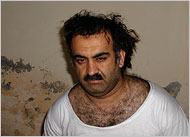 take responsibility for fathering the baby of Anna Nicole Smith,* breaking up the Beatles, and kidnapping Judge Crater.
As for his "plans" -- to destroy Israeli and American embassies, military vessels, oil tankers, the stock exchange, the Empire State Building, the Brooklyn Bridge, Heathrow and Big Ben, NATO headquarters in Brussels, and 12 -- exactly 12 -- civilian airplanes "full of passengers," etc.; to assassinate Jimmy Carter, Bill Clinton, Pope John Paul II (and to think the current pope was worried about Bob Dylan), Paki Prez Pervez Musharraf, et al; and...well...I "plan" to win the lottery.
The confession will clear a lot of cases and spruce up Bush's resume, which is all to the good, but what I really want to know is, is there actually an oil company in Sumatra, as the Times quotes the confession, "owned by the Jewish former secretary of state, Henry Kissinger"? How'd Henry the K pull that off? Now, as my dad used to say, that's interesting.
*"Please Note: No subscriptions for the Video Diary are being accepted." Is there no coffin cam?
take responsibility for fathering the baby of Anna Nicole Smith,* breaking up the Beatles, and kidnapping Judge Crater.As for his "plans" -- to destroy Israeli and American embassies, military vessels, oil tankers, the stock exchange, the Empire State Building, the Brooklyn Bridge, Heathrow and Big Ben, NATO headquarters in Brussels, and 12 -- exactly 12 -- civilian airplanes "full of passengers," etc.; to assassinate Jimmy Carter, Bill Clinton, Pope John Paul II (and to think the current pope was worried about Bob Dylan), Paki Prez Pervez Musharraf, et al; and...well...I "plan" to win the lottery.
The confession will clear a lot of cases and spruce up Bush's resume, which is all to the good, but what I really want to know is, is there actually an oil company in Sumatra, as the Times quotes the confession, "owned by the Jewish former secretary of state, Henry Kissinger"? How'd Henry the K pull that off? Now, as my dad used to say, that's interesting.
*"Please Note: No subscriptions for the Video Diary are being accepted." Is there no coffin cam?
Subscribe to:
Posts (Atom)


