Most Americans are financially totally unready for old age.
And something else Romney and Obama might have discussed:
Here's something left out of the debates:
The median duration of unemployment is now 18.5 weeks, compared to a 50-year average of 8.2 weeks. The unemployment rate for those aged 16-24 is nearly 16%. According to a Rutgers study, 12% of those who have graduated college since 2006 are either unemployed or can't find full-time work -- and they're the ones with college degrees. In a study of men graduating from college between 1979 and 1989, Yale economist Lisa Kahn found that those entering the labor market during poor economic times earned about 7% less than those who graduated when the economy was strong, and the gap persisted for years: 17 years after graduation, Kahn found that those who began their careers when the economy was in recession were still earning less than those who started their careers when the economy was strong, adjusted for inflation and age. Those who stepped into a world of high unemployment were never able to shake it off. Testifying before Congress in 2010, Til von Wachter of Columbia University offered another startling stat: "The average mature worker losing a stable job at a good employer will see earnings reductions of 20% lasting over 15 to 20 years" when laid off during a recession. The longer unemployment lasts, the harder it is to recover from. We need a massive New Deal-style employment program.
For the record
"By last year, family income was 8 percent lower than it had been 11 years earlier, at its peak in 2000, according to inflation-adjusted numbers from the Census Bureau. On average in 11-year periods in the decades just after World War II, inflation-adjusted median income rose by almost 30 percent." -- David Leonhardt (New York Times)
Just the facts, ma'm.
The average annual real total stock market return has been greater during Obama's first term -- 29.1% -- than any president since Teddy Roosevelt (for comparison: Gerald Ford is in 2nd place with a return of 16.7%). Average annual real corporate profit growth during Barak Obama's administration -- 77.9% (2nd place: Harding 17.7% -- and the sainted Reagan? 2.3%). If the business community was competent and rational, corporate America would be lining up to reward this administration (but they're as susceptible to the lesser-of-two-evils argument as anyone -- and, of course, many segments of industry are backing Obama or contributing to both sides and expecting to profit no matter which wins).
On the other hand, the average annual real GDP growth per capita under Obama (1.4%) puts him in 11th place between Nixon and Taft (No 1: FDR 8% -- the Depression provided a low starting point and war is good for business; No 3: Johnson 4.3% -- LBJ, not Reagan, Mr. President, is the model every Democratic should follow). When it comes to inflation, the average change in the consumer price index over the past four years is 2.2% (Obama is 12th in this category between Bush II and Roosevelt I; 1st place: Carter 10.1%). Obama is getting a lot of blame for unemployment (and, certainly, the stimulus should have been much, much bigger -- plus "austerity" and "tax cuts" should ever cross his lips), but consider the percentage changes in the unemployment rate under Obama (for all practical purposes 0.0%) and these other chief executives: FDR -32.8%; Clinton -2.9%; Reagan -2.0%; Ike +3.4%; Bush II +3.6%; Hoover 30.6%). So the worst you can say about the high unemployment rate in 2012 is that 1) Obama inherited it from Bush II and 2) he hasn't done enough about it.
Campaign
Foreign Policy and Tax Havens
Hurry, hurry, hurry. The show's about to start.
Barack Obama followed a criminal GOP presidency and upped the ante on his predecessor's worst policies -- expanding militarism, domestic spying, military adventurism, etc., while coming up with some of his own, like extrajudicial assassination and quasi-legal or more probably illegal and certainly immoral deployment of drones, torture of Bradley Manning, tightening government secrecy and prosecuting whistle-blowers, at the same time allowing the war criminals and financial gangsters of the Bush era to go free.
Why does this happen? The liberals and leftists in Congress, and there are more than a few, will fight tooth and nail against a Republican who pursues such policies; but conservative Democrats like Clinton and Obama, by "triangulating" between the two congressional parties, neutralize and emasculate progressive Democrats in Congress who find it difficult to oppose "our guy."
The differences between Mitt Romney and Obama are in matters of revenue and spending that are largely legislative in nature; in the policies that are in the purview of the executive -- the conduct of the Department of War, the Justice Department, etc. -- there is virtually no disagreement between the candidates or the presidential parties.
The Democrats run for president as the champions of economic justice, but in office they can never seem to get the job done; the Republicans are the upholders of family values and individual rights, yet they leave office with such matters pretty much where they found them.
In the meantime, it is business as usual for capitalists, militarists, the security state. Like Obama's newfound populism, Romney's weird embrace of teapartyism will disappear after the election; if he wins, he will govern from near the center-right inhabited by Obama now -- Romney will move left as president, just as Obama will move right. The game is kept going by bogus political theater in which both sides try to persuade a majority that they are the lesser-of-two-evils. And we fall for it every time.
Why reforming our undemocratic system is nearly impossible:
Sen. Bernie Sanders on the Independent in Politics
“What you are looking at is a nation with a grotesquely unequal distribution of wealth and income, tremendous economic power on Wall Street, and now added to all of that is big money interests, the billionaires and corporations now buying elections,” Sanders tells Bill. “I fear very much that if we don’t turn this around, we’re heading toward an oligarchic form of society.”
From Moyers and Company 2012-09-10
quote unquote: James Madison
"I believe there are more instances
of the abridgment of
the freedom of the people
by gradual and silent encroachments
of those in power,
than by violent and sudden usurpations."
-- James Madison, warning against Pres. Obama's signing into law of the National Defense Authorization Act on 2011/12/31. The law contains provisions that allow the indefinite military detention, without trial or appearance before a judge, of anyone -- even U.S. citizens and residents -- accused of a "belligerent act" or any terror-related offense.
Lesser of two evils? Really?
But, as troubling as the administration's domestic agenda has been, it is in the area of foreign policy that its behavior is most distressing. Not wishing to allow criticism from conservatives, Obama has not just continued George W. Bush's Long War, but has enlarged it both in scope and in ferocity. The legal and physical framework established during Bush's reign, from the P.A.T.R.I.O.T. Act thru Gitmo to drones, not only remains in place, but has been extended to include contract killings and a list of conflict points that looks like the departure board of an international airline.
So where does that leave the Left in November 2012? True to form, the presidential wing of the Democratic Party is campaigning on the shop-worn "lesser-of-two-evils" platform, even though it has become so threadbare the only part not in tatters is the fear-mongering about appointments to the Supreme Court. (And, by the way, how different is jazzing up the Democratic base over Roe V. Wade from the GOP's cynical use of "social issues" to get its base hyperventilating? Here's something you can put money on: whether Obama or Romney is president, the next appointee to the Supreme Court will be a reliable defender of corporate interests and the status quo.) Even if you're appalled, as you should be, by the idea of Mitt Romney in the White House (and Paul Ryan a heartbeat away), how can you vote for Obama without endorsing his policy choices?
The answer, of course, is that you can't. In 2008, it was possible to convince yourself that the Democratic candidate's general blandness ("hope," "change," "yes we can") and specific conservatism (missile attacks on Iran, more war in Afghanistan and Pakistan, advocacy of the death penalty, deliberate blurring of the clear language of the 2nd amendment, bipartisanship as a policy goal) was a disguise intended to slip him past voters on election day, a "whites of their eyes" strategy as it is (now wistfully) described to get hold of the reins of power before turning the carriage of state down the road to peace and economic justice. In 2012, deluding yourself that Obama is the candidate of change is no longer possible. No wonder the campaign is spending its millions demonizing the hapless Romney (Obama has been supremely lucky in his opponents, but never more so than this season); what else is there to talk about?
If you're not a supporter of fiscal austerity except when it comes to funding endless war, what do you do? In some states, third party candidates will be on the ballot (in California, no joke, Roseanne Barr was nominated for president last week by the Peace and Freedom Party, which also has in Marsha Feinland a first rate candidate for U.S. Senate against that pillar of the status quo, Sen. Diane Feinstein; Barr is also working hard to get on the ballot in other states; and the Green Party has a worthy candidate in Dr. Jill Stein). In most of the places where where liberal disappointment in the president is greatest -- New York, Illinois, California, New England and the Pacific Northwest, the distortions of the electoral college have rendered votes in the Obama-Romney contest so meaningless that even progressives persuaded by lesser-of-two-evils argument can cast a third party protest vote without worrying. There also are numerous opportunities to affect the much more important matter of who gets to serve in the national legislature: in addition to such obvious choices as Sen. Sherrod Brown, Elizabeth Warren, and Alan Grayson, scores of federal and local progressive candidates need your support: you'll find most (or all) of them at the fundraising site ActBlue. And you can work to build a third party more in tune with the your politics than the duopoly; get involved in local politics; join the struggle to create alternative power bases, for example in labor or community organizations; pursue change in specific policy areas (such as militarization or the environment); assist civil rights and civil liberties defenders like the Southern Poverty Law Center or the American Civil Liberties Union.
Or you can take to the streets.
What you can't do, it seems to me, is sit passively in the audience of our political theater; what you can't do is agree to business as usual; what you can't do is once again accept without resistance the lesser of two evils.
War, huh...
On foreign policy, every political leader, from Barack Obama and Bill Clinton to all the GOP possibles and wannabes save maybe Rand Paul, cites Ronald Reagan as the model commander in chief. In practice, however, they ignore that the Gipper ordered US fighting units to foreign ground only once, and that to a country so small and insignificant he might as well have invaded the Duchy of Grand Fenwick.
Reagan demonstrated that military force does not need to be our default setting in dealing with the rest of the world.
Discuss:
"Neither spending more nor taxing less will help the country pay its bills. What it can and must do is radically simplify its tax, health-care, retirement and financial systems, each of which is a complete mess. But this is the good news. It means they can each be redesigned to achieve their legitimate purposes at much lower cost and, in the process, revitalize the economy."
U.S. Is Bankrupt and We Don’t Even Know It by Laurence Kotlikoff (Bloomberg)
It'll pass Congress in a New York minute
Just call it the, I dunno, Ronald Reagan National System of Interstate and Defense Highspeed Rail.
With a new plan for a high-speed system, Amtrak execs hope they can revive both American rail and American cities: Why High-Speed Rail Could Spur a Golden Age in the Northeast by Yoni Appelbaum (The Atlantic)
Punditry
- Analects | China
- Americas view | The Americas
- Babbage | Science and technology
- Bagehot's notebook | British politics
- Banyan | Asia
- Baobab | Africa
- Blighty | Britain
- Buttonwood's notebook | Financial markets
- Charlemagne's notebook | European politics
- Clausewitz | Defence, security and diplomacy
- Democracy in America | American politics
- Eastern approaches | Ex-communist Europe
- Feast and famine | Demography and development
- Free exchange | Economics
- Game theory | Sports
- Graphic detail | Charts, maps and infographics
- Gulliver | Business travel
- Johnson | Language
- Leviathan | Public policy
- Lexington's notebook | American politics
- Newsbook | News analysis
- Prospero | Books, arts and culture
- Schumpeter | Business and management
Not having a root canal or colonoscopy tonite?
What's to be done?
Obviously, there are many problems -- the crumbling infrastructure, the slashing of budgets for public services, the unjust tax structure, the misallocation of public resources to military spending and corporate giveaways, the destruction of free public education, the absence of affordable universal health care -- that impact much more directly on people's lives. But the adoption of measures to make the country more democratic and thus more responsive to the demands of its citizens would be a solid beginning down the path to solving deeper and more intractable problems.
There is an army of outraged people in this nation, many of them unemployed and facing bleak futures. Are they ready to enlist?
The Fed: 11 Charts Prove The Economy Has Gone Ice Cold
The state of the economy will dictate the central bank's actions, if any, this month. With that reality in mind, Kienst presents some charts that suggest where we stand.
The most interesting fact to me is that retail sales reports are up sharply and so, apparently, is consumer confidence (although not according to the Conference Board), at the same time that durable goods purchases are down, real estate is down, and customers haven't returned to the retail stock market. So if people are spending more money, it's on essentials like bread and milk, and -- not learning from recent experience -- they're doing so with credit cards. With jobs still not in the offing (in fact, more public sector layoffs are coming in most states), that's a danger signal for the economy not a sign of recovery. Without proper savings, investment suffers and so does growth.
The rest of the story: These 11 Charts Prove The Economy Has Gone Ice Cold by Robert Kienst (Seeking Alpha 2012-06-14)
2012: Will voters "throw the bums out"?
It's true, though, that these "policies" are not Obama's alone. They have been been pursued through six administrations and a couple of dozen congresses controlled, it should not be forgotten, more often by Democrats than by Republicans. There is a lot of convenient buck passing in the nation's capital: the Republicans blame the Democrats for lack of "progress" on social issues; the Democrat's accuse the GOP of holding
economic reforms "hostage;" meanwhile, the oligarchs dictate the outcome of the legislative process, and the two parties get to go back to the electorate every couple of years with the same unresolved set of issues (we forget that the GOP agitates its base with "lesser of two evils" rhetoric familiar to us from Democratic propaganda).It was Democrat Bill Clinton, at the end of the day, who passed the stalled pro-corporate agenda -- banking "reform," telecom "reform," welfare "reform," trade "reform," NAFTA, etc. -- beyond the reach of Republican George Bush the Elder. It is Obama who has doubled-down on militarism and security abuses. As Bush the Younger did with al Queda, Obama inflated the GOP and the Blue Dogs for his own purposes, empowering them, attempting to partner with them instead of closing ranks with congressional liberals (and thus losing the House, just as Clinton did, and for the same reason: why vote for Democrats if they are going govern on behalf the corporate elite instead of the majority?), and blaming the conservatives as he caved on issue after issue without a fight.
If BHO was a liberal warrior in the mold of FDR, HST and LBJ, he would not be in danger of getting the boot in November, as he probably will. But the real victory this fall will not go to the Democrats or the Republicans; whether it is Obama or Mitt Romney who takes the oath of office in January, the true winners will be the militarists and the masters of the security state. Obama? Romney?: the victims of the shredded social contract, the unemployed and underemployed, the homeless, the graduates without prospects drowning in debt, the hundreds of thousands of youth whose futures are being sacrificed to the war on drugs, the young men and women who will die in exotic locales of interest only to war profiteers, the innocent victims of American guns and bombs and gameboy war toys, none of these will know the difference.
----
Return of the Body Count: Dissecting Obama's Standard on Drone Strike Deaths by Justin Elliott (ProPublica 2012-06-05)
Democratic Website Publishes List of Obama Accomplishments, Half of Them Are the Names of People He's Killed (Reason 2012-06-12)
Most voters favor slashing foreign economic & military aid; few would cut domestic programs like Social Security, education and health care (Good).
Bang! You're dead.
Killer Fact: Just six countries export 74% of the world's weapons! The world's most powerful countries must put human rights before profits and stop arming abusers.
Support a strong Arms Trade Treaty this July! http://amnestyusa.org/arms
Fracking incredible!
CNN Money says North Dakota is number one! The chilly state leads the states in economic growth.
The rest of the story:
State economic growth slowed in 2011 by Tami Luhby (CNNMoney)
RT
@ggreenwald: Yay! We killed "Al Qaeda's number 2" for the 83rd time. More bombing and onto 84! #WarOnTerrorForever
Let's really debate the issues
Here's a nice tweet I just saw: "@JohnGabree I think I am going to vote with you on Feinland and no on prop 28, whoever you are."
If you haven't voted yet, you too might consider supporting Marsha Feinland:
Diane Feinstein is in no danger of losing her seat, but in many ways, especially with regard to trade and financials, she is far more conservative than the average California Democrat.
In the state's new primary system, the top two vote-getters, regardless of party affiliation, are the only ones on the ballot in November. Since Feinstein will be headed back to DC in any event, it will serve us better as citizens if she is debated in the fall by a strong candidate from the Left, rather a tweedledum Republican or some Democrat careerist setting himself up for a future run.
Feinland is an intelligent and articulate candidate -- would make a fine senator, in fact -- and supports a different set of policy choices than the centrist Feinstein on such matters as military expenditures, the security state, banksters, trade, immigration reform, economic justice, the role of government, and more. Feinstein is a lock. What we're voting on is second place in the primary and a spot on the November ballot.
Bubble, bubble, toil and trouble
Sayeth George Soros:
I contend that the European Union itself is like a bubble. In the boom phase the EU was what the psychoanalyst David Tuckett calls a “fantastic object” – unreal but immensely attractive. The EU was the embodiment of an open society – an association of nations founded on the principles of democracy, human rights, and rule of law in which no nation or nationality would have a dominant position.
The process of integration was spearheaded by a small group of far sighted statesmen who practiced what Karl Popper called piecemeal social engineering. They recognized that perfection is unattainable; so they set limited objectives and firm timelines and then mobilized the political will for a small step forward, knowing full well that when they achieved it, its inadequacy would become apparent and require a further step. The process fed on its own success, very much like a financial bubble. That is how the Coal and Steel Community was gradually transformed into the European Union, step by step.
Germany used to be in the forefront of the effort. When the Soviet empire started to disintegrate, Germany’s leaders realized that reunification was possible only in the context of a more united Europe and they were willing to make considerable sacrifices to achieve it. When it came to bargaining they were willing to contribute a little more and take a little less than the others, thereby facilitating agreement. At that time, German statesmen used to assert that Germany has no independent foreign policy, only a European one.
The process culminated with the Maastricht Treaty and the introduction of the euro. It was followed by a period of stagnation which, after the crash of 2008, turned into a process of disintegration. The first step was taken by Germany when, after the bankruptcy of Lehman Brothers, Angela Merkel declared that the virtual guarantee extended to other financial institutions should come from each country acting separately, not by Europe acting jointly. It took financial markets more than a year to realize the implication of that declaration, showing that they are not perfect.
2012: Prop 29
I'm of two minds about Prop 29, the tobacco tax initiative.
Here's what's wrong with the ballot initiative process. More cancer research: great idea. Higher taxes: great idea. But: limiting the tax revenue generated by this measure to cancer research, anti-smoking programs and tobacco law enforcement is a bad idea; the money belongs in the general fund.
The whole point of representative government is to assure that tax revenues are allocated fairly across all needs and services and interests. Past initiatives have already made hash of the California budget process; do we want to make it worse?
Cancer research is vitally important, but is relatively well-funded; other diseases that are equally costly to society get far fewer dollars. Even limiting ourselves to a discussion of what to do about the harm caused by tobacco, we have to take account of the fact that Prop 29 does nothing to mitigate the huge medical costs already resulting from past and current smoking, and that's the point: We elect representatives to make those decisions; maybe anti-smoking programs are already well-enough funded -- they certainly appear to be -- but medical costs are under-addressed (they certainly appear to be); an informed legislature should make those choices.
Also: a $1 tax is insufficient, given the costs of tobacco to society; a referendum, if successful, will almost certainly close the door on higher taxes on tobacco products in the future.
Plus, this decision will be made by the tiny percentage of voters that bothers to turn out tomorrow, nothing like a majority.
Explanation of Prop 29 in the official CA state voter guide.
Keep Out
The wealth of top six family members who own Wal-Mart is equal to the wealth of 30% of the American people.
This has been accomplished by destroying thousands of local businesses and jobs and by denying adequate pay and benefits to its employees.
It's Henry Ford turned on his head. Ford provided good jobs to create customers for his cars; Wal-Mart destroys good jobs so people will have no choice but become customers of its stores.
It should not be allowed destroy businesses and jobs in Los Angeles County.
On June 30, join 10,000 to March Against Wal-Mart in Los Angeles.
Was ist in einem Namen?
Noting that, within its collection of "Component Agencies" to "protect the homeland," the Department of Homeland Security includes "The Directorate for National Protection and Programs," "The Directorate for Science and Technology" and "The Directorate for Management," you wonder if the agency's minions are tone-deaf or if someone, perhaps in the Directorate of Nomenclature, who was reading Orwell and Huxley at the moment of the agency's christening, has a terrific sense of humor.
Not The Onion: Hundreds of common words that could get you in trouble
The Dept. of Homeland Security was forced to release the list by a privacy watchdog group that filed a request under the Freedom of Information Act. Although DHS claims it only employs the list to detect legitimate security risks, "[t]he words are included in the department's 2011 'Analyst's Desktop Binder'* used by workers at their National Operations Center which instructs workers to identify 'media reports that reflect adversely on DHS and response activities'." Note that the avoidance of many of these words would make public discussion of security and military issues -- to say nothing of the weather -- impossible. But note also that your continued insistence on discussing such matters may attract the security state's interest.
Of course, you could decide to mess with them by putting references to "pork," "snow," "bridge," "tremor," "Tucson," "worm" and "metro" in all your communications.
The rest of the story: Revealed: Hundreds of words to avoid using online if you don't want the government spying on you by Daniel Miller (Mail Online 2012-05-26).
*Even "redacted," 'Analyst's Desktop Binder' makes for interesting reading.
Too controversial for TED: "The rich should pay more in taxes"
“Ideas Worth Spreading.”
Some, not so much.
If you need more evidence of how difficult it is for ideas that challenge the reigning political Weltanschauung to gain traction in mainstream media, take a look at this video of a presentation at TED, the conference that GOOD business editor Tim Fernholz describes as "for creative techies and do-gooding hipsters that vaulted the 18-minute lecture into an art form."
Like fish trying to make sense of water, it is impossible for most of us to comprehend how much misinformation we take for granted swimming as we do in the ocean of propaganda -- American exceptionalism, the greatest nation in history, fortress of democracy, Christian state, yadda yadda -- that envelops us.
At TED, Fernholz writes, "you’ll find speakers discussing everything from 'Sculpting Waves in Wood and Time' to 'Building U.S.-China relations … by Banjo.' What you won’t find is a recent TED talk by Nick Hanauer, a wealthy venture capitalist, that argues income inequality is a problem that threatens the economy, and that higher taxes on the wealthy are part of the solution."
"So here's an idea worth spreading," concludes Hanauer:
In a capitalist economy, the true job creators are consumers, the middle class. And taxing the rich to make investments that grow the middle class, is the single smartest thing we can do for the middle class, the poor and the rich.A transcript of Hanauer's speech is available here.
See, also: Too Hot for TED: Income Inequality by Jim Tankersley (National Journal 2012-05-22).
TED's Taboo: What's Too Controversial for the Hipster Confab? by Tim Fernholz (GOOD 2012-05-17)
In response to the brouhaha over his website's suppression of Hanauer's talk, TED "curator" Chris Anderson posted the video to Youtube himself, with a link to an apologia: TED and inequality: The real story (TEDChris: The untweetable 2012-05-17). However, Anderson's claim that the talk was rejected because it "framed the issue in a way that was explicitly partisan" is contradicted by the fact that TED has posted other "partisan" presentations, such as scoldings by Al Gore on the need to fight climate change or the Gates Foundation's Melinda Gates call for handing out contraceptives across the globe. These challenges to the status quo are apparently less bothersome to the wealthy attendees at TED than the simple idea that they should pay their fare share of taxes.
The economy: Professor Robert Reich Explains It All for You
Militarism: Americans are tiring of The Long War
Too late. Not only has the invasion lost support of the whole Democratic Party, but, as Robert Naiman wrote yesterday on his HuffPost blog (On Afghanistan, the Pentagon Has Lost the American People 2012-05-18), "a substantial part of the Republican Party as well; the majority of Republican voters, for example." Luckily for the president, his domestic allies are the GOP leaders, so the AfPak debacle probably won't be much of a factor in the fall election. Still, Obama seems to be anxious to control the narrative in Chicago.
Whatever the outcomes in Chicago this weekend and in Kabul some weekend in the future, the enthusiasm of security staters for the Long War will not diminish, whether Barack Obama continues in office or Mitt Romney becomes commander in chief. With access to oil and other resources the motivation and the failed "War on Drugs" the excuse, and no matter the harm that is being done at home, America's political elite will continue to bog the nation down in unwinnable conflicts big and small.
America's Pacific Century: The future of politics will be decided in Asia, not Afghanistan or Iraq, and the United States will be right at the center of the action by Hillary Clinton (Foreign Policy 2011-10-11)
The National Security State Wins (Again): Why the Real Victor in Campaign 2012 Won’t Be Obama or Romney by William J. Astore (Tom Dispatch 2012-05-15)
Out of Africa: An expat witnesses the end of halcyon days in Mali by Jennifer Swift-Mogan (ForeignPolicy 2012-04-13)
Unmanned and Dangerous: Why NATO's expanding use of drones is a disturbing trend by Louis Arbour (Foreign Policy 2012-05-18)
The Long War: Year Ten Lost in the Desert with the GPS on the Fritz by Andrew J. Bacevich (Tom Dispatch 2010-10-01)
Fact Sheet: History of U.S. Military Involvement in Africa (AfriCom/Congressional Research Service 2008-06-12)
U.S. Africa Command (AfriCom) History, Background and Fact Sheets
Here are some articles analyzing and debunking the "War on Terror," from a reading list on New Democracy:
- The Lockerbie Fraud Again by Dave Stratman
- Did 9/11 justify the war in Afghanistan? by David Ray Griffin
- PTSD, infertility, and other consequences of war by Bob Nichols
- Assassination by Government: An Exchange by Dave Stratman
- Whom Should We Support in Iran? by John Spritzler
- Obama's Afghanistan War: Morally Wrong, or Incompetently Waged?, by John Spritzler
- No War But the Class War
- Unethical Media Coverage of UK Events, by Elias Davidsson
- Concealing the Real Goals of War by John Spritzler
- Bosses and Workers, a poem by Dennis Serdel
- My Country & The Railroad Tracks: two poems by Dennis Serdel, Vietnam '67-68 purple heart
- Important link: 911 Video, "Loose Change, 2nd edition, recut
- The true significance of Bush's no-warrant domestic eavesdropping by John Spritzler
- The Antiwar Movement Isn’t Where You Think It Is by Dave Stratman
- The London Bombings and the Class War by Dave Stratman
- "What Bush's 'Freedom & Democracy' Means for Iraqi Farmers" by John Spritzler (March 17, 2005)
- "The Witchhunts Continue: Columbia University and the New Anti-Semitism" by M. Junaid Alam
- "Collateral Damage" a poem by Gary Corseri (February 2005)
- "The Triumph of Liberalism" by Dave Stratman (November 12, 2004)
- "Circles" and "BREAKING THE LAW TO WIN" poems by Dennis Serdel (September 28, 2004)
- "This Land Is Our Land" by John Spritzler (August 31, 2004)
- "Talking to the Wrong People: Lessons of the DNC" by Dave Stratman (August 26, 2004)
- Interview of Dave Stratman (focusing on his article Inventing the Enemy) on WING TV (August 18, 2004)
- "Inventing the Enemy" by Dave Stratman (July 26, 2004)
- "The 'Good War' Myth of World War II" by John Spritzler (July 22, 2004)
- "Beware the Liberal War on Terror" by Dave Stratman (July 5, 2004)
- "Abu Ghraib: We Have Met the Enemy and He Is NOT Us" by John Spritzler (June 2, 2004)
- "Abu Ghraib Prison Torture: a Few Bad Apples or Long Standing Policy?" by John Spritzler (May 12, 2004).
- "The Antiwar Movement Is Not Progressive -- And That's A Good Thing"by Dave Stratman. (March 18, 2004).
- "George Bush, The Anti-Family President" by Bill Kauffman. (October 27, 2003).
- "BULLETDUCKERS" -- poetry by Dennis Serdel. (November, 2003).
- Book Review: "The War On Freedom" by John Spritzler (October 5, 2003)
- "Bush and the 'Good War'" by John Spritzler (September 30, 2003)
- "No To Politics, Yes To Mass Refusal" by Dave Stratman. (September 26, 2003).
- "Making Connections: the War, the Budget, and the Crisis in Social Values" -- remarks by David Stratman at the Community Church of Boston (April 6, 2003).
- "Conspiracy Theory" by Floyd Rudmin. (April, 2003).
- "Free Asan Akbar And Put The System On Trial?" by Steve Hesske (April, 2003).
- "Rethinking Anti-War Strategy" by Jim Luken (April, 2003).
- "They Dare Not Speak Its Name" by Steve Hesske (March 25, 2003).
- "The Death March" by Al McKinnis (March, 2003).
- The Call of Workers for Peace (January, 2003). Workers for Peace -- Chinese translation. Workers for Peace -- German translation.
- "Stop The Endless War: Boycott The Volunteer Army" by Doug Fuda. (January 23, 2003).
- "Elite Spokesman Alarmed by Magnitude of Opposition to Iraq War" by John Spritzler (January 9, 2003).
- "Palestine & Iraq: Any Signs of Hope? The lessons we have learned" by Henry Lowi (November 10, 2002).
- "What Is War With Iraq Really About?" -- A New Democracy Flyer. (Fall 2002).
- "A War To Make Iraq Democratic?" by John Spritzler. (Oct '02).
- "The U.S. As Fourth Reich" by David Stratman. (September 2, 2002).
- "Useful Enemies" by Dave Stratman. (NDN* Nov. '01-Feb. '02).
- "Is It Really A 'War Against Terrorism?'" (NDN* Nov. '01-Feb. '02).
- "What Else Could He Have Done?" (NDN* Nov. '01-Feb. '02).
- "Why Is The US Bombing Yugoslavia?" by Dave Stratman. (NDN* May-June 1999).
- * "NDN" indicates that the article is from the New Democracy Newsletter.
quote unquote: Could it have been Will Rogers?
"If voting changed anything, they'd abolish it.
-- attributed variously to Emma Goldman, Ken Livingston, Mark Twain, Philip Berrigan and an anonymous anarchist.
Or was this the first: "If voting could change anything it would be made illegal!" (The Lowell Sun, Lowell, Massachusetts, 1976/09/24)?
2012: Lets have a real debate in the California U.S. Senate race
Marsha Feinland of the Peace & Freedom Party would fill this role perfectly: she is articulate, personable, dedicated, and right (that is to say, Left) on the issues. It would be illuminating if, before she heads back to Washington to act in our name, our senior senator was required to explain her positions on such matters as international trade, military adventurism, immigration, homeland security and the bankster crime wave (she's for aggressively prosecuting Julian Assange for espionage, for example, but much less enthusiastic about putting financial crooks in jail), to say nothing of addressing unresolved allegations of corruption stemming from her days on a military appropriations subcommittee.With Democrats and Republicans divvying up the primary ballots, it might not take very high numbers to grab second place; it would certainly make for a livelier debate in the general election to have a representative of the 99% sharing the stage with Sen. Feinstein rather than another one-percenter like herself from the GOP.Project VoteSmart's summary of Dianne Feinstein's key votes.
In a nutshell, you should pardon the expression,
... what today's conservatives believe:
"Let it be understood that we cannot go outside of this alternative: Liberty, inequality, survival of the fittest; not-liberty, equality, survival of the unfittest. The former carries society forward and favors all its best members; the latter carries society downwards and favors all its worst members." -- Professor William Graham Sumner ("What Social Classes Owe to Each Other," 1883).
Hope and (Small) Change
Resource: The Afghanistan Report the Pentagon Doesn't Want You to Read
For background, see The Afghanistan Report the Pentagon Doesn't Want You to Read by Michael Hastings (Rolling Stone 2012-02-10).
See, also: In Afghan War, Officer Becomes a Whistle-Blower by Scott Shane (New York Times 2012-02-05). Officer: U.S. paints false picture of Afghan war by Agence France-Presse (2012-02-06).
How Swedes and Norwegians Broke the Power of the '1 Percent'
While many of us are working to ensure that the Occupy movement will have a lasting impact, it’s worthwhile to consider other countries where masses of people succeeded in nonviolently bringing about a high degree of democracy and economic justice.
Sweden and Norway, for example, both experienced a major power shift in the 1930s after prolonged nonviolent struggle. They “fired” the top 1 percent of people who set the direction for society and created the basis for something different.
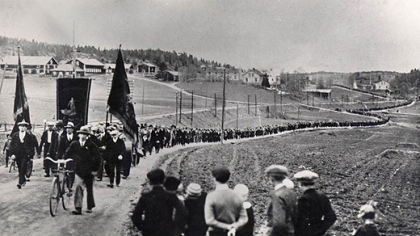
(A march in Ã…dalen, Sweden, in 1931.)
Both countries had a history of horrendous poverty. When the 1 percent was in charge, hundreds of thousands of people emigrated to avoid starvation. Under the leadership of the working class, however, both countries built robust and successful economies that nearly eliminated poverty, expanded free university education, abolished slums, provided excellent health care available to all as a matter of right and created a system of full employment. Unlike the Norwegians, the Swedes didn’t find oil, but that didn’t stop them from building what the latest CIA World Factbook calls “an enviable standard of living.”
Neither country is a utopia, as readers of the crime novels by Stieg Larsson, Henning Mankell and Jo Nesbro will know. Critical left-wing authors such as these try to push Sweden and Norway to continue on the path toward more fully just societies. However, as an American activist who first encountered Norway as a student in 1959 and learned some of its language and culture, the achievements I found amazed me. I remember, for example, bicycling for hours through a small industrial city, looking in vain for substandard housing. Sometimes resisting the evidence of my eyes, I made up stories that “accounted for” the differences I saw: “small country,” “homogeneous,” “a value consensus.” I finally gave up imposing my frameworks on these countries and learned the real reason: their own histories.
Then I began to learn that the Swedes and Norwegians paid a price for their standards of living through nonviolent struggle. There was a time when Scandinavian workers didn’t expect that the electoral arena could deliver the change they believed in. They realized that, with the 1 percent in charge, electoral “democracy” was stacked against them, so nonviolent direct action was needed to exert the power for change.
In both countries, the troops were called out to defend the 1 percent; people died. Award-winning Swedish filmmaker Bo Widerberg told the Swedish story vividly in Ã…dalen 31, which depicts the strikers killed in 1931 and the sparking of a nationwide general strike. (You can read more about this case in an entry by Max Rennebohm in the Global Nonviolent Action Database.)
The Norwegians had a harder time organizing a cohesive people’s movement because Norway’s small population—about three million—was spread out over a territory the size of Britain. People were divided by mountains and fjords, and they spoke regional dialects in isolated valleys. In the nineteenth century, Norway was ruled by Denmark and then by Sweden; in the context of Europe Norwegians were the “country rubes,” of little consequence. Not until 1905 did Norway finally become independent.
When workers formed unions in the early 1900s, they generally turned to Marxism, organizing for revolution as well as immediate gains. They were overjoyed by the overthrow of the czar in Russia, and the Norwegian Labor Party joined the Communist International organized by Lenin. Labor didn’t stay long, however. One way in which most Norwegians parted ways with Leninist strategy was on the role of violence: Norwegians wanted to win their revolution through collective nonviolent struggle, along with establishing co-ops and using the electoral arena.
In the 1920s strikes increased in intensity. The town of Hammerfest formed a commune in 1921, led by workers councils; the army intervened to crush it. The workers’ response verged toward a national general strike. The employers, backed by the state, beat back that strike, but workers erupted again in the ironworkers’ strike of 1923–24.
The Norwegian 1 percent decided not to rely simply on the army; in 1926 they formed a social movement called the Patriotic League, recruiting mainly from the middle class. By the 1930s, the League included as many as 100,000 people for armed protection of strike breakers—this in a country of only 3 million!
The Labor Party, in the meantime, opened its membership to anyone, whether or not in a unionized workplace. Middle-class Marxists and some reformers joined the party. Many rural farm workers joined the Labor Party, as well as some small landholders. Labor leadership understood that in a protracted struggle, constant outreach and organizing was needed to a nonviolent campaign. In the midst of the growing polarization, Norway’s workers launched another wave of strikes and boycotts in 1928.
The Depression hit bottom in 1931. More people were jobless there than in any other Nordic country. Unlike in the U.S., the Norwegian union movement kept the people thrown out of work as members, even though they couldn’t pay dues. This decision paid off in mass mobilizations. When the employers’ federation locked employees out of the factories to try to force a reduction of wages, the workers fought back with massive demonstrations.
Many people then found that their mortgages were in jeopardy. (Sound familiar?) The Depression continued, and farmers were unable to keep up payment on their debts. As turbulence hit the rural sector, crowds gathered nonviolently to prevent the eviction of families from their farms. The Agrarian Party, which included larger farmers and had previously been allied with the Conservative Party, began to distance itself from the 1 percent; some could see that the ability of the few to rule the many was in doubt.
By 1935, Norway was on the brink. The Conservative-led government was losing legitimacy daily; the 1 percent became increasingly desperate as militancy grew among workers and farmers. A complete overthrow might be just a couple years away, radical workers thought. However, the misery of the poor became more urgent daily, and the Labor Party felt increasing pressure from its members to alleviate their suffering, which it could do only if it took charge of the government in a compromise agreement with the other side.
This it did. In a compromise that allowed owners to retain the right to own and manage their firms, Labor in 1935 took the reins of government in coalition with the Agrarian Party. They expanded the economy and started public works projects to head toward a policy of full employment that became the keystone of Norwegian economic policy. Labor’s success and the continued militancy of workers enabled steady inroads against the privileges of the 1 percent, to the point that majority ownership of all large firms was taken by the public interest. (There is an entry on this case as well at the Global Nonviolent Action Database.)
The 1 percent thereby lost its historic power to dominate the economy and society. Not until three decades later could the Conservatives return to a governing coalition, having by then accepted the new rules of the game, including a high degree of public ownership of the means of production, extremely progressive taxation, strong business regulation for the public good and the virtual abolition of poverty. When Conservatives eventually tried a fling with neoliberal policies, the economy generated a bubble and headed for disaster. (Sound familiar?)
Labor stepped in, seized the three largest banks, fired the top management, left the stockholders without a dime and refused to bail out any of the smaller banks. The well-purged Norwegian financial sector was not one of those countries that lurched into crisis in 2008; carefully regulated and much of it publicly owned, the sector was solid.
Although Norwegians may not tell you about this the first time you meet them, the fact remains that their society’s high level of freedom and broadly-shared prosperity began when workers and farmers, along with middle class allies, waged a nonviolent struggle that empowered the people to govern for the common good.
This work is licensed under a Creative Commons Attribution-Share Alike 3.0 United States License
Democracy: Bulk up the House. Dump the Senate.
1540. (11-0067) Legislature Expansion. Legislative Process. Initiative Constitutional AmendmentI've proposed elsewhere that the federal legislature be reduced to one house and that the resultant unicameral congress be reconstituted with 30,000 members. Research has shown that beyond about 10,000 voters, districts are too big for citizens effectively to know their representatives. Given the reach of digital technology, participants in a 30K-member body would be able to remain in their district most of the time, meeting with other representatives virtually and conducting the people's business within the grasp of their constituents.
Increases size of Legislature almost 100-fold by dividing current Assembly and Senate districts into neighborhood districts such that each Assemblymember represents about 5,000 persons and each Senator represents about 10,000 persons. Provides for neighborhood district representatives to elect working committees the size of the current Assembly and Senate, 80 Assemblymembers and 40 Senators. Gives working committees the legislative power generally, and sole power to amend bills, but requires approval by appropriate vote of the full membership in each house for passage of any non-urgency bill. Reduces legislators' pay and expenditures. Summary of estimate by Legislative Analyst and Director of Finance of fiscal impact on state and local government: Decreased state spending on the Legislature of over $180 million annually. Increased county election costs, potentially in the range of tens of millions of dollars initially and lower amounts annually thereafter.
Democracy is badly in need of reform. What was practicable in the days of horses and buggies may be appropriate no longer. If the Founders were inventing the United States now, Paine would be tweeting, Hamilton, Madison and Jay would have a blog, and Jefferson and Adams would be arguing over at Constitution.Org. The system they would devise today would look nothing like the Rube Goldberg contraption they arrived at by compromise more than two centuries ago. For sure, they'd consider the current constitutional release as beta.
See, also:
The Big House by Sean Wilentz and Micheal Merrill (The New Republic 1992-11-16).
How Can the U.S. House Be Made More Representative? by J.F. Zimmerman and W. Rule (Political Science and Politics Volume 31, Number 1; 1998).
House of Representatives: Setting the Size at 435 by David C. Huckabee (pdf) (CRS Report for Congress 1995-07-11).
Beyond Administrative Apportionment: Rediscovering the Calculus of Representative Government by John A. Kromkowski (pdf) (Polity, Vol. XXIV, No. 3 Spring 1992).
A House of Our Own or A House We’ve Outgrown? An Argument for Increasing the Size of the House of Representatives by Christopher St. John Yates Columbia Journal of Law and Social Problems 1992).
How to build a better House: Why Not Have 1000 Congressmen? by Jeff Jacoby (Boston Globe 2009-11-08).
Political monopoly power by Walter Williams (Creators Syndicate 2008-10-15).
Why not have 1000 Congressman? by George Will (Townhall 2001-01-14).
Want to be more efficient? Increase number of politicians by Jonah Goldberg (Jewish World Review 2001-01-04).
Increasing the size of Congress could limit campaign spending by Andrew W. Cohen (CNN.com Law Center 200-06-30).
Growth in U.S. Population Calls for Larger House of Representatives by Margo Anderson (Population Today 2000-04).
Full Text 0f Legislature Expansion. Legislative Process. Initiative Constitutional Amendment.
Complete list of California Initiatives and Referenda Cleared for Circulation.