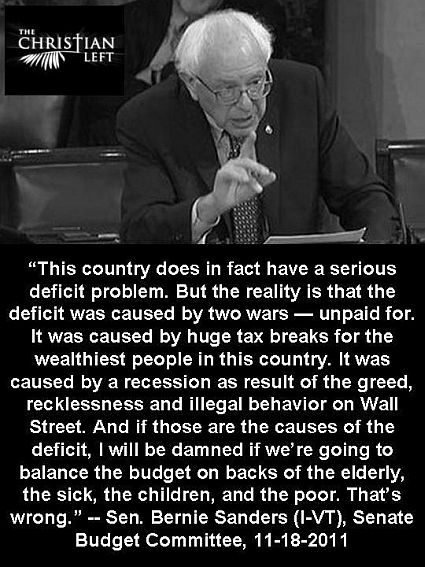
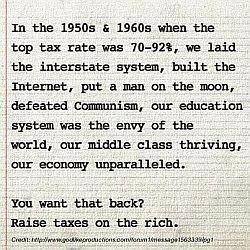
Discuss:

"Neither spending more nor taxing less will help the country pay its bills. What it can and must do is radically simplify its tax, health-care, retirement and financial systems, each of which is a complete mess. But this is the good news. It means they can each be redesigned to achieve their legitimate purposes at much lower cost and, in the process, revitalize the economy." 
U.S. Is Bankrupt and We Don’t Even Know It by Laurence Kotlikoff (Bloomberg)

It'll pass Congress in a New York minute


Just call it the, I dunno, Ronald Reagan National System of Interstate and Defense Highspeed Rail.

With a new plan for a high-speed system, Amtrak execs hope they can revive both American rail and American cities: Why High-Speed Rail Could Spur a Golden Age in the Northeast by Yoni Appelbaum (The Atlantic)

Not having a root canal or colonoscopy tonite?

Make do with the Planning Commission's 7pm discussion of Colorado Esplanade & Village Trailer Park.

What's to be done?

One idea: How about agreeing to a list of immediately achievable demands -- say, unfettered voter registration, weekend balloting, instant runoffs, election of the President and Vice President by majority vote not the electoral college, public financing of campaigns, free media for candidates, perhaps proportional representation -- driving a national march beginning in, say, San Diego, Los Angeles, San Francisco, Portland OR, Seattle, Houston, Miami and Portland ME -- merging in various centers along the way -- say, Denver, Chicago, Buffalo, Cleveland, St Louis, New Orleans, Atlanta, New York City and lesser venues in between -- and culminating on Pennsylvania Avenue with the firm commitment not to leave until all demands are met? The logistical problems would be formidable but not insurmountable, and the Occupy Movement already has organizers and infrastructure in place all over the country.

Obviously, there are many problems -- the crumbling infrastructure, the slashing of budgets for public services, the unjust tax structure, the misallocation of public resources to military spending and corporate giveaways, the destruction of free public education, the absence of affordable universal health care -- that impact much more directly on people's lives. But the adoption of measures to make the country more democratic and thus more responsive to the demands of its citizens would be a solid beginning down the path to solving deeper and more intractable problems.

There is an army of outraged people in this nation, many of them unemployed and facing bleak futures. Are they ready to enlist?

The Fed: 11 Charts Prove The Economy Has Gone Ice Cold

"With the June Fed meeting just around the corner," writes Robert Kienst, "the market is waiting with bated breath for the decision on Quantitative Easing 3. It is like a bad movie where they keep making sequels nobody wants to watch, but are forced to endure."

The state of the economy will dictate the central bank's actions, if any, this month. With that reality in mind, Kienst presents some charts that suggest where we stand.

The most interesting fact to me is that retail sales reports are up sharply and so, apparently, is consumer confidence (although not according to the Conference Board), at the same time that durable goods purchases are down, real estate is down, and customers haven't returned to the retail stock market. So if people are spending more money, it's on essentials like bread and milk, and -- not learning from recent experience -- they're doing so with credit cards. With jobs still not in the offing (in fact, more public sector layoffs are coming in most states), that's a danger signal for the economy not a sign of recovery. Without proper savings, investment suffers and so does growth.

The rest of the story: These 11 Charts Prove The Economy Has Gone Ice Cold by Robert Kienst (Seeking Alpha 2012-06-14)

2012: Will voters "throw the bums out"?

I'm taken to task for having the temerity to suggest that Barack Obama may be held accountable for the nation's problems -- in the instance, for the decline in average American's income and net worth, and that there may be some justice in his impending political demise: "It's not Obama's fault. It's the policies, peoples." As if, I guess, it is John Boehner who is running the country.

It's true, though, that these "policies" are not Obama's alone. They have been been pursued through six administrations and a couple of dozen congresses controlled, it should not be forgotten, more often by Democrats than by Republicans. There is a lot of convenient buck passing in the nation's capital: the Republicans blame the Democrats for lack of "progress" on social issues; the Democrat's accuse the GOP of holding Taxes and Progress are inextricably linked economic reforms "hostage;" meanwhile, the oligarchs dictate the outcome of the legislative process, and the two parties get to go back to the electorate every couple of years with the same unresolved set of issues (we forget that the GOP agitates its base with "lesser of two evils" rhetoric familiar to us from Democratic propaganda).

It was Democrat Bill Clinton, at the end of the day, who passed the stalled pro-corporate agenda -- banking "reform," telecom "reform," welfare "reform," trade "reform," NAFTA, etc. -- beyond the reach of Republican George Bush the Elder. It is Obama who has doubled-down on militarism and security abuses. As Bush the Younger did with al Queda, Obama inflated the GOP and the Blue Dogs for his own purposes, empowering them, attempting to partner with them instead of closing ranks with congressional liberals (and thus losing the House, just as Clinton did, and for the same reason: why vote for Democrats if they are going govern on behalf the corporate elite instead of the majority?), and blaming the conservatives as he caved on issue after issue without a fight.

If BHO was a liberal warrior in the mold of FDR, HST and LBJ, he would not be in danger of getting the boot in November, as he probably will. But the real victory this fall will not go to the Democrats or the Republicans; whether it is Obama or Mitt Romney who takes the oath of office in January, the true winners will be the militarists and the masters of the security state. Obama? Romney?: the victims of the shredded social contract, the unemployed and underemployed, the homeless, the graduates without prospects drowning in debt, the hundreds of thousands of youth whose futures are being sacrificed to the war on drugs, the young men and women who will die in exotic locales of interest only to war profiteers, the innocent victims of American guns and bombs and gameboy war toys, none of these will know the difference.
----
Return of the Body Count: Dissecting Obama's Standard on Drone Strike Deaths by Justin Elliott (ProPublica 2012-06-05)
Democratic Website Publishes List of Obama Accomplishments, Half of Them Are the Names of People He's Killed (Reason 2012-06-12)
Most voters favor slashing foreign economic & military aid; few would cut domestic programs like Social Security, education and health care (Good).

Keep the universal in universal health care


One of the many reasons why Obamacare should not be repealed.

Bang! You're dead.

]

Killer Fact: Just six countries export 74% of the world's weapons! The world's most powerful countries must put human rights before profits and stop arming abusers.

Support a strong Arms Trade Treaty this July! http://amnestyusa.org/arms

Fracking incredible!

CNN Money says North Dakota is number one! The chilly state leads the states in economic growth.
The rest of the story:
State economic growth slowed in 2011 by Tami Luhby (CNNMoney)

RT

@ggreenwald: Yay! We killed "Al Qaeda's number 2" for the 83rd time. More bombing and onto 84! #WarOnTerrorForever

Let's really debate the issues


Here's a nice tweet I just saw: "@JohnGabree I think I am going to vote with you on Feinland and no on prop 28, whoever you are."

If you haven't voted yet, you too might consider supporting Marsha Feinland:

Diane Feinstein is in no danger of losing her seat, but in many ways, especially with regard to trade and financials, she is far more conservative than the average California Democrat.

In the state's new primary system, the top two vote-getters, regardless of party affiliation, are the only ones on the ballot in November. Since Feinstein will be headed back to DC in any event, it will serve us better as citizens if she is debated in the fall by a strong candidate from the Left, rather a tweedledum Republican or some Democrat careerist setting himself up for a future run.

Feinland is an intelligent and articulate candidate -- would make a fine senator, in fact -- and supports a different set of policy choices than the centrist Feinstein on such matters as military expenditures, the security state, banksters, trade, immigration reform, economic justice, the role of government, and more. Feinstein is a lock. What we're voting on is second place in the primary and a spot on the November ballot.

Bubble, bubble, toil and trouble


Sayeth George Soros:

I contend that the European Union itself is like a bubble. In the boom phase the EU was what the psychoanalyst David Tuckett calls a “fantastic object” – unreal but immensely attractive. The EU was the embodiment of an open society – an association of nations founded on the principles of democracy, human rights, and rule of law in which no nation or nationality would have a dominant position.

The process of integration was spearheaded by a small group of far sighted statesmen who practiced what Karl Popper called piecemeal social engineering. They recognized that perfection is unattainable; so they set limited objectives and firm timelines and then mobilized the political will for a small step forward, knowing full well that when they achieved it, its inadequacy would become apparent and require a further step. The process fed on its own success, very much like a financial bubble. That is how the Coal and Steel Community was gradually transformed into the European Union, step by step.

Germany used to be in the forefront of the effort. When the Soviet empire started to disintegrate, Germany’s leaders realized that reunification was possible only in the context of a more united Europe and they were willing to make considerable sacrifices to achieve it. When it came to bargaining they were willing to contribute a little more and take a little less than the others, thereby facilitating agreement. At that time, German statesmen used to assert that Germany has no independent foreign policy, only a European one.

The process culminated with the Maastricht Treaty and the introduction of the euro. It was followed by a period of stagnation which, after the crash of 2008, turned into a process of disintegration. The first step was taken by Germany when, after the bankruptcy of Lehman Brothers, Angela Merkel declared that the virtual guarantee extended to other financial institutions should come from each country acting separately, not by Europe acting jointly. It took financial markets more than a year to realize the implication of that declaration, showing that they are not perfect.

2012: Prop 29


I'm of two minds about Prop 29, the tobacco tax initiative.

Here's what's wrong with the ballot initiative process. More cancer research: great idea. Higher taxes: great idea. But: limiting the tax revenue generated by this measure to cancer research, anti-smoking programs and tobacco law enforcement is a bad idea; the money belongs in the general fund.

The whole point of representative government is to assure that tax revenues are allocated fairly across all needs and services and interests. Past initiatives have already made hash of the California budget process; do we want to make it worse?

Cancer research is vitally important, but is relatively well-funded; other diseases that are equally costly to society get far fewer dollars. Even limiting ourselves to a discussion of what to do about the harm caused by tobacco, we have to take account of the fact that Prop 29 does nothing to mitigate the huge medical costs already resulting from past and current smoking, and that's the point: We elect representatives to make those decisions; maybe anti-smoking programs are already well-enough funded -- they certainly appear to be -- but medical costs are under-addressed (they certainly appear to be); an informed legislature should make those choices.

Also: a $1 tax is insufficient, given the costs of tobacco to society; a referendum, if successful, will almost certainly close the door on higher taxes on tobacco products in the future.

Plus, this decision will be made by the tiny percentage of voters that bothers to turn out tomorrow, nothing like a majority.

Explanation of Prop 29 in the official CA state voter guide.

Keep Out


The wealth of top six family members who own Wal-Mart is equal to the wealth of 30% of the American people.

This has been accomplished by destroying thousands of local businesses and jobs and by denying adequate pay and benefits to its employees.

It's Henry Ford turned on his head. Ford provided good jobs to create customers for his cars; Wal-Mart destroys good jobs so people will have no choice but become customers of its stores.

It should not be allowed destroy businesses and jobs in Los Angeles County.

On June 30, join 10,000 to March Against Wal-Mart in Los Angeles.

Was ist in einem Namen?


Noting that, within its collection of "Component Agencies" to "protect the homeland," the Department of Homeland Security includes "The Directorate for National Protection and Programs," "The Directorate for Science and Technology" and "The Directorate for Management," you wonder if the agency's minions are tone-deaf or if someone, perhaps in the Directorate of Nomenclature, who was reading Orwell and Huxley at the moment of the agency's christening, has a terrific sense of humor.

Not The Onion: Hundreds of common words that could get you in trouble

The Daily Mail reports that federal thought police have compiled an "intriguing" list of words and phrases to be used to "monitor social networking sites and online media for signs of terrorist or other threats against the U.S." The list includes "obvious choices such as 'attack', 'Al Qaeda', 'terrorism' and 'dirty bomb' alongside dozens of seemingly innocent words like 'pork', 'cloud', 'team' and 'Mexico'."

The Dept. of Homeland Security was forced to release the list by a privacy watchdog group that filed a request under the Freedom of Information Act. Although DHS claims it only employs the list to detect legitimate security risks, "[t]he words are included in the department's 2011 'Analyst's Desktop Binder'* used by workers at their National Operations Center which instructs workers to identify 'media reports that reflect adversely on DHS and response activities'."

Note that the avoidance of many of these words would make public discussion of security and military issues -- to say nothing of the weather -- impossible. But note also that your continued insistence on discussing such matters may attract the security state's interest.

Of course, you could decide to mess with them by putting references to "pork," "snow," "bridge," "tremor," "Tucson," "worm" and "metro" in all your communications.

The rest of the story: Revealed: Hundreds of words to avoid using online if you don't want the government spying on you by Daniel Miller (Mail Online 2012-05-26).

*Even "redacted," 'Analyst's Desktop Binder' makes for interesting reading.

Too controversial for TED: "The rich should pay more in taxes"


“Ideas Worth Spreading.”

Some, not so much.


If you need more evidence of how difficult it is for ideas that challenge the reigning political Weltanschauung to gain traction in mainstream media, take a look at this video of a presentation at TED, the conference that GOOD business editor Tim Fernholz describes as "for creative techies and do-gooding hipsters that vaulted the 18-minute lecture into an art form."

Like fish trying to make sense of water, it is impossible for most of us to comprehend how much misinformation we take for granted swimming as we do in the ocean of propaganda -- American exceptionalism, the greatest nation in history, fortress of democracy, Christian state, yadda yadda -- that envelops us.

At TED, Fernholz writes, "you’ll find speakers discussing everything from 'Sculpting Waves in Wood and Time' to 'Building U.S.-China relations … by Banjo.' What you won’t find is a recent TED talk by Nick Hanauer, a wealthy venture capitalist, that argues income inequality is a problem that threatens the economy, and that higher taxes on the wealthy are part of the solution."

"So here's an idea worth spreading," concludes Hanauer:
In a capitalist economy, the true job creators are consumers, the middle class. And taxing the rich to make investments that grow the middle class, is the single smartest thing we can do for the middle class, the poor and the rich.
A transcript of Hanauer's speech is available here.

See, also: Too Hot for TED: Income Inequality by Jim Tankersley (National Journal 2012-05-22).
TED's Taboo: What's Too Controversial for the Hipster Confab? by Tim Fernholz (GOOD 2012-05-17)

In response to the brouhaha over his website's suppression of Hanauer's talk, TED "curator" Chris Anderson posted the video to Youtube himself, with a link to an apologia: TED and inequality: The real story (TEDChris: The untweetable 2012-05-17). However, Anderson's claim that the talk was rejected because it "framed the issue in a way that was explicitly partisan" is contradicted by the fact that TED has posted other "partisan" presentations, such as scoldings by Al Gore on the need to fight climate change or the Gates Foundation's Melinda Gates call for handing out contraceptives across the globe. These challenges to the status quo are apparently less bothersome to the wealthy attendees at TED than the simple idea that they should pay their fare share of taxes.

The economy: Professor Robert Reich Explains It All for You

Got a couple of minutes? Want to understand what's up with the economy? Here you go:

Militarism: Americans are tiring of The Long War

Even as they enmesh the U.S. in other senseless, costly military adventures in Yemen, Honduras, West Africa, and the Philippines, to name but a few, Obama administration warriors are taking time off this weekend to try to persuade their erstwhile NATO allies that the war in Afghanistan has been worth the effort. "I can't let this be a war without end," the president is alleged to have said, "and I can't lose the whole Democratic Party."

Too late. Not only has the invasion lost support of the whole Democratic Party, but, as Robert Naiman wrote yesterday on his HuffPost blog (On Afghanistan, the Pentagon Has Lost the American People 2012-05-18), "a substantial part of the Republican Party as well; the majority of Republican voters, for example." Luckily for the president, his domestic allies are the GOP leaders, so the AfPak debacle probably won't be much of a factor in the fall election. Still, Obama seems to be anxious to control the narrative in Chicago.

Whatever the outcomes in Chicago this weekend and in Kabul some weekend in the future, the enthusiasm of security staters for the Long War will not diminish, whether Barack Obama continues in office or Mitt Romney becomes commander in chief. With access to oil and other resources the motivation and the failed "War on Drugs" the excuse, and no matter the harm that is being done at home, America's political elite will continue to bog the nation down in unwinnable conflicts big and small.

America's Pacific Century: The future of politics will be decided in Asia, not Afghanistan or Iraq, and the United States will be right at the center of the action by Hillary Clinton (Foreign Policy 2011-10-11)
The National Security State Wins (Again): Why the Real Victor in Campaign 2012 Won’t Be Obama or Romney by William J. Astore (Tom Dispatch 2012-05-15)
Out of Africa: An expat witnesses the end of halcyon days in Mali by Jennifer Swift-Mogan (ForeignPolicy 2012-04-13)
Unmanned and Dangerous: Why NATO's expanding use of drones is a disturbing trend by Louis Arbour (Foreign Policy 2012-05-18)
The Long War: Year Ten  Lost in the Desert with the GPS on the Fritz  by Andrew J. Bacevich (Tom Dispatch 2010-10-01)
Fact Sheet: History of U.S. Military Involvement in Africa  (AfriCom/Congressional Research Service 2008-06-12)
U.S. Africa Command (AfriCom) History, Background and Fact Sheets

Here are some articles analyzing and debunking the "War on Terror," from a reading list on New Democracy:

quote unquote: Could it have been Will Rogers?


"If voting changed anything, they'd abolish it.

-- attributed variously to Emma Goldman, Ken Livingston, Mark Twain, Philip Berrigan and an anonymous anarchist.

Or was this the first: "If voting could change anything it would be made illegal!" (The Lowell Sun, Lowell, Massachusetts, 1976/09/24)?

2012: Lets have a real debate in the California U.S. Senate race

The June 6, 2012 primary offers the voters of California a unique opportunity to stand against business as usual in Washington: with 24 candidates on the ballot for United States Senate, six of them Democrats, it's possible, at least in theory, that a unity candidate could win second place and the chance to debate centrist Diane Feinstein face-to-face in the run-off in November. Peace & Freedom Party Senate candidate Marsha FeinlandMarsha Feinland of the Peace & Freedom Party would fill this role perfectly: she is articulate, personable, dedicated, and right (that is to say, Left) on the issues. It would be illuminating if, before she heads back to Washington to act in our name, our senior senator was required to explain her positions on such matters as international trade, military adventurism, immigration, homeland security and the bankster crime wave (she's for aggressively prosecuting Julian Assange for espionage, for example, but much less enthusiastic about putting financial crooks in jail), to say nothing of addressing unresolved allegations of corruption stemming from her days on a military appropriations subcommittee.With Democrats and Republicans divvying up the primary ballots, it might not take very high numbers to grab second place; it would certainly make for a livelier debate in the general election to have a representative of the 99% sharing the stage with Sen. Feinstein rather than another one-percenter like herself from the GOP.

Project VoteSmart
's summary of Dianne Feinstein's key votes.

In a nutshell, you should pardon the expression,


... what today's conservatives believe:
"Let it be understood that we cannot go outside of this alternative: Liberty, inequality, survival of the fittest; not-liberty, equality, survival of the unfittest. The former carries society forward and favors all its best members; the latter carries society downwards and favors all its worst members." -- Professor William Graham Sumner ("What Social Classes Owe to Each Other," 1883).

Hope and (Small) Change

We needn't worry about the Republicans much longer. With the Obama Democrats cutting taxes, unemployment benefits, federal pensions and health programs, and supporting mandatory drug tests, there'll be no need for a second party on the Right. Big savings for the oligarchs, having to buy only one party.

Resource: The Afghanistan Report the Pentagon Doesn't Want You to Read

"Senior ranking US military leaders have so distorted the truth when communicating with the US Congress and American people in regards to conditions on the ground in Afghanistan that the truth has become unrecognizable. This deception has damaged America’s credibility among both our allies and enemies, severely limiting our ability to reach a political solution to the war in Afghanistan. It has likely cost American taxpayers hundreds of billions of dollars Congress might not otherwise have appropriated had it known the truth, and our senior leaders’ behavior has almost certainly extended the duration of this war. The single greatest penalty our Nation has suffered, however, has been that we have lost the blood, limbs and lives of tens of thousands of American Service Members with little to no gain to our country as a consequence of this deception." -- from Dereliction of Duty II: Senior Military Leaders’ Loss of Integrity Wounds Afghan War Effort, an unclassified summary of our failed military adventure in Afghanistan by Lt. Colonel Daniel Davis, posted by Rolling Stone.

For background, see The Afghanistan Report the Pentagon Doesn't Want You to Read by Michael Hastings (Rolling Stone 2012-02-10).

See, also: In Afghan War, Officer Becomes a Whistle-Blower by Scott Shane (New York Times 2012-02-05). Officer: U.S. paints false picture of Afghan war by Agence France-Presse (2012-02-06).

How Swedes and Norwegians Broke the Power of the '1 Percent'

by George Lakey (Waging Nonviolence 2012-01-25)

While many of us are working to ensure that the Occupy movement will have a lasting impact, it’s worthwhile to consider other countries where masses of people succeeded in nonviolently bringing about a high degree of democracy and economic justice.

Sweden and Norway, for example, both experienced a major power shift in the 1930s after prolonged nonviolent struggle. They “fired” the top 1 percent of people who set the direction for society and created the basis for something different.
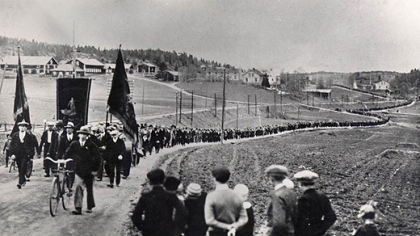
(A march in Ã…dalen, Sweden, in 1931.)


Both countries had a history of horrendous poverty. When the 1 percent was in charge, hundreds of thousands of people emigrated to avoid starvation. Under the leadership of the working class, however, both countries built robust and successful economies that nearly eliminated poverty, expanded free university education, abolished slums, provided excellent health care available to all as a matter of right and created a system of full employment. Unlike the Norwegians, the Swedes didn’t find oil, but that didn’t stop them from building what the latest CIA World Factbook calls “an enviable standard of living.”

Neither country is a utopia, as readers of the crime novels by Stieg Larsson, Henning Mankell and Jo Nesbro will know. Critical left-wing authors such as these try to push Sweden and Norway to continue on the path toward more fully just societies. However, as an American activist who first encountered Norway as a student in 1959 and learned some of its language and culture, the achievements I found amazed me. I remember, for example, bicycling for hours through a small industrial city, looking in vain for substandard housing. Sometimes resisting the evidence of my eyes, I made up stories that “accounted for” the differences I saw: “small country,” “homogeneous,” “a value consensus.” I finally gave up imposing my frameworks on these countries and learned the real reason: their own histories.

Then I began to learn that the Swedes and Norwegians paid a price for their standards of living through nonviolent struggle. There was a time when Scandinavian workers didn’t expect that the electoral arena could deliver the change they believed in. They realized that, with the 1 percent in charge, electoral “democracy” was stacked against them, so nonviolent direct action was needed to exert the power for change.

In both countries, the troops were called out to defend the 1 percent; people died. Award-winning Swedish filmmaker Bo Widerberg told the Swedish story vividly in Ã…dalen 31, which depicts the strikers killed in 1931 and the sparking of a nationwide general strike. (You can read more about this case in an entry by Max Rennebohm in the Global Nonviolent Action Database.)

The Norwegians had a harder time organizing a cohesive people’s movement because Norway’s small population—about three million—was spread out over a territory the size of Britain. People were divided by mountains and fjords, and they spoke regional dialects in isolated valleys. In the nineteenth century, Norway was ruled by Denmark and then by Sweden; in the context of Europe Norwegians were the “country rubes,” of little consequence. Not until 1905 did Norway finally become independent.

When workers formed unions in the early 1900s, they generally turned to Marxism, organizing for revolution as well as immediate gains. They were overjoyed by the overthrow of the czar in Russia, and the Norwegian Labor Party joined the Communist International organized by Lenin. Labor didn’t stay long, however. One way in which most Norwegians parted ways with Leninist strategy was on the role of violence: Norwegians wanted to win their revolution through collective nonviolent struggle, along with establishing co-ops and using the electoral arena.

In the 1920s strikes increased in intensity. The town of Hammerfest formed a commune in 1921, led by workers councils; the army intervened to crush it. The workers’ response verged toward a national general strike. The employers, backed by the state, beat back that strike, but workers erupted again in the ironworkers’ strike of 1923–24.

The Norwegian 1 percent decided not to rely simply on the army; in 1926 they formed a social movement called the Patriotic League, recruiting mainly from the middle class. By the 1930s, the League included as many as 100,000 people for armed protection of strike breakers—this in a country of only 3 million!

The Labor Party, in the meantime, opened its membership to anyone, whether or not in a unionized workplace. Middle-class Marxists and some reformers joined the party. Many rural farm workers joined the Labor Party, as well as some small landholders. Labor leadership understood that in a protracted struggle, constant outreach and organizing was needed to a nonviolent campaign. In the midst of the growing polarization, Norway’s workers launched another wave of strikes and boycotts in 1928.

The Depression hit bottom in 1931. More people were jobless there than in any other Nordic country. Unlike in the U.S., the Norwegian union movement kept the people thrown out of work as members, even though they couldn’t pay dues. This decision paid off in mass mobilizations. When the employers’ federation locked employees out of the factories to try to force a reduction of wages, the workers fought back with massive demonstrations.

Many people then found that their mortgages were in jeopardy. (Sound familiar?) The Depression continued, and farmers were unable to keep up payment on their debts. As turbulence hit the rural sector, crowds gathered nonviolently to prevent the eviction of families from their farms. The Agrarian Party, which included larger farmers and had previously been allied with the Conservative Party, began to distance itself from the 1 percent; some could see that the ability of the few to rule the many was in doubt.

By 1935, Norway was on the brink. The Conservative-led government was losing legitimacy daily; the 1 percent became increasingly desperate as militancy grew among workers and farmers. A complete overthrow might be just a couple years away, radical workers thought. However, the misery of the poor became more urgent daily, and the Labor Party felt increasing pressure from its members to alleviate their suffering, which it could do only if it took charge of the government in a compromise agreement with the other side.

This it did. In a compromise that allowed owners to retain the right to own and manage their firms, Labor in 1935 took the reins of government in coalition with the Agrarian Party. They expanded the economy and started public works projects to head toward a policy of full employment that became the keystone of Norwegian economic policy. Labor’s success and the continued militancy of workers enabled steady inroads against the privileges of the 1 percent, to the point that majority ownership of all large firms was taken by the public interest. (There is an entry on this case as well at the Global Nonviolent Action Database.)

The 1 percent thereby lost its historic power to dominate the economy and society. Not until three decades later could the Conservatives return to a governing coalition, having by then accepted the new rules of the game, including a high degree of public ownership of the means of production, extremely progressive taxation, strong business regulation for the public good and the virtual abolition of poverty. When Conservatives eventually tried a fling with neoliberal policies, the economy generated a bubble and headed for disaster. (Sound familiar?)

Labor stepped in, seized the three largest banks, fired the top management, left the stockholders without a dime and refused to bail out any of the smaller banks. The well-purged Norwegian financial sector was not one of those countries that lurched into crisis in 2008; carefully regulated and much of it publicly owned, the sector was solid.

Although Norwegians may not tell you about this the first time you meet them, the fact remains that their society’s high level of freedom and broadly-shared prosperity began when workers and farmers, along with middle class allies, waged a nonviolent struggle that empowered the people to govern for the common good.

This work is licensed under a Creative Commons Attribution-Share Alike 3.0 United States License

George Lakey
George Lakey is Visiting Professor at Swarthmore College and a Quaker. He has led 1,500 workshops on five continents and led activist projects on local, national, and international levels. Among many other books and articles, he is author of “Strategizing for a Living Revolution” in David Solnit’s book Globalize Liberation (City Lights, 2004). His first arrest was for a civil rights sit-in and most recent was with Earth Quaker Action Team while protesting mountain top removal coal mining. E-mail: glakey1@swarthmore.edu

Democracy: Bulk up the House. Dump the Senate.

A number of initiatives and referenda have been cleared for circulation by the California Secretary of State, including,
1540. (11-0067) Legislature Expansion. Legislative Process. Initiative Constitutional Amendment

Increases size of Legislature almost 100-fold by dividing current Assembly and Senate districts into neighborhood districts such that each Assemblymember represents about 5,000 persons and each Senator represents about 10,000 persons. Provides for neighborhood district representatives to elect working committees the size of the current Assembly and Senate, 80 Assemblymembers and 40 Senators. Gives working committees the legislative power generally, and sole power to amend bills, but requires approval by appropriate vote of the full membership in each house for passage of any non-urgency bill. Reduces legislators' pay and expenditures. Summary of estimate by Legislative Analyst and Director of Finance of fiscal impact on state and local government: Decreased state spending on the Legislature of over $180 million annually. Increased county election costs, potentially in the range of tens of millions of dollars initially and lower amounts annually thereafter.
I've proposed elsewhere that the federal legislature be reduced to one house and that the resultant unicameral congress be reconstituted with 30,000 members. Research has shown that beyond about 10,000 voters, districts are too big for citizens effectively to know their representatives. Given the reach of digital technology, participants in a 30K-member body would be able to remain in their district most of the time, meeting with other representatives virtually and conducting the people's business within the grasp of their constituents.

Democracy is badly in need of reform. What was practicable in the days of horses and buggies may be appropriate no longer. If the Founders were inventing the United States now, Paine would be tweeting, Hamilton, Madison and Jay would have a blog, and Jefferson and Adams would be arguing over at Constitution.Org. The system they would devise today would look nothing like the Rube Goldberg contraption they arrived at by compromise more than two centuries ago. For sure, they'd consider the current constitutional release as beta.

See, also:
The Big House by Sean Wilentz and Micheal Merrill (The New Republic 1992-11-16).
How Can the U.S. House Be Made More Representative? by J.F. Zimmerman and W. Rule (Political Science and Politics Volume 31, Number 1; 1998).
House of Representatives: Setting the Size at 435 by David C. Huckabee (pdf) (CRS Report for Congress 1995-07-11).
Beyond Administrative Apportionment: Rediscovering the Calculus of Representative Government by John A. Kromkowski (pdf) (Polity, Vol. XXIV, No. 3 Spring 1992).
A House of Our Own or A House We’ve Outgrown? An Argument for Increasing the Size of the House of Representatives by Christopher St. John Yates Columbia Journal of Law and Social Problems 1992).
How to build a better House: Why Not Have 1000 Congressmen? by Jeff Jacoby (Boston Globe 2009-11-08).
Political monopoly power by Walter Williams (Creators Syndicate 2008-10-15).
Why not have 1000 Congressman? by George Will (Townhall 2001-01-14).
Want to be more efficient? Increase number of politicians by Jonah Goldberg (Jewish World Review 2001-01-04).
Increasing the size of Congress could limit campaign spending by Andrew W. Cohen (CNN.com Law Center 200-06-30).
Growth in U.S. Population Calls for Larger House of Representatives by Margo Anderson (Population Today 2000-04).

Full Text 0f Legislature Expansion. Legislative Process. Initiative Constitutional Amendment.

Complete list of California Initiatives and Referenda Cleared for Circulation.

Reform: Four Smart State Laws Set to Move in 2012


Congress may be deadlocked, but practical, popular solutions are gaining momentum at the state level.

by Charles Monaco (Yes! 2012-01-13)

In the year since conservatives took control of the U.S. House of Representatives and legislative bodies in states across the nation, we’ve seen them move their agenda with alarming disregard for both democracy and the economic security of the nation. From the irresponsibly provoked debt ceiling “crisis” to the wholesale obstruction of job creation efforts, conservatives on the national stage took an approach of reckless political brinksmanship over the past year that put the entire economy at risk. And from Wisconsin to Alabama and beyond, 2011 saw conservatives in the states—buoyed by support from their corporate allies in the 1%—launch attack after attack on workers, women, voters, and immigrants.

But the new year brings new hope for progressives looking to turn the tide—hope that, for the time being, largely resides not in the halls of Congress but in the 50 states. Elections in every corner of the country last November—from Arizona to Maine to Ohio—saw voters decisively reject a range of right-wing legislative attacks. The shady practice of corporations writing state laws to benefit their own bottom lines (through organizations such as the American Legislative Exchange Council) has been subject to an increasing amount of sunlight and public attention. And the public sentiment behind the explosive growth of the Occupy movement last fall has remained, even as many physical occupations have been forcibly dismantled. On issue after issue, public opinion remains firmly in favor of policies that will begin to address the needs of the 99 percent.

While progressives in the states will be focused on a range of economic priorities, here are four specific policies that state lawmakers are advancing in 2012 that are practical, popular, and are set to gain real momentum as new legislative sessions kick off starting this month:

1. Jobs, Jobs, Jobs: Proposals that Can Pass in Red and Blue States Alike:

When President Obama introduced the American Jobs Act last fall, he included in it a handful of elements that had already been passed with bipartisan support—and proven successful—in many states. These included the banning of employer discrimination against the long-term unemployed, saving jobs by allowing work-sharing as part of unemployment insurance programs, and requiring that states “Buy American” in their contracting practices in order to create jobs here at home. These measures have shown both that they work and that they can pass even in conservative-controlled chambers.

Public opinion remains firmly in favor of policies that will begin to address the needs of the 99 percent.

In 2011, New Jersey passed a bill prohibiting employers from discriminating against job applicants based on their current employment status, and similar bills are set to move across the nation in 2012. Likewise, work-sharing—a pro-worker measure currently in place in 23 states that allows workers to keep their jobs and gives employers flexibility to weather a downturn by allowing workers to earn partial UI benefits while working part-time—passed in states, including Pennsylvania and Maine, with conservative legislatures. And “Buy American” provisions are also set to move in a slew of states (such as Nebraska) this year.

2. Creating State Banks to Foster Local Economic Growth:

With revenue and budget crises certain to be in the headlines once again in many states in 2012, lawmakers are increasingly looking towards structural changes that will ensure they can rebuild and sustain prosperity—even as conservatives once again look to cut much needed public services to the bone.

While demanding corporate transparency and accountability—and requiring that the 1 percent and corporations pay their fair share in taxes—will continue to be a priority for progressive state lawmakers in 2012, they will also be attempting to capitalize on widespread public frustration with big banks by proposing the creation of state development banks similar to the one in place for over 90 years in North Dakota. The creation of state banks would allow states to invest dollars in their local communities rather than line the pockets of Wall Street CEOs. Additionally, according to one study, state banks have the potential to close some current state deficits by anywhere from 10 - 20 percent. The measure will be hotly debated in Oregon this year, where it has the potential to pass, and introduced in many other states as well.

3. Restoring the Minimum Wage to Grow the Economy:

One of the simplest ways for states to jumpstart their economies and address the needs of the 99 percent—all without increasing spending—is through restoring the minimum wage. Studies have shown that raising the minimum wage provides a direct boost to economies by giving lower-income workers more purchasing power.

The basic principle that no one who works full-time should have to live in poverty clearly resonates with the public.

While proposals are under consideration in many states, including New York and Missouri, perhaps the most exciting development is in Illinois, where legislation is under consideration that would restore the minimum wage to its historic 1968 value: $10.50 per hour, after adjusting for inflation. Other states are considering measures that would index the minimum wage so that it rises with inflation, or to boost it by lower amounts. In 8 states, automatic increases took effect on January 1st, providing much needed economic stimulus; in Washington, the rate is now at $9 an hour.

Regardless of the specific proposals, raising the minimum wage has proven incredibly popular, with approval for the policy ranging from 75 to 90 percent in recent polls. The basic principle that no one who works full-time should have to live in poverty clearly resonates with the public, and bodes well for continuing efforts to raise the minimum wage and grow state economies in 2012.

4. Rejecting Arizona’s Immigration Approach, Businesses Line Up Behind Tuition Equity

After Arizona enacted SB1070, its controversial “show me your papers bill,” in the summer of 2010, conventional wisdom had it that states would be lining up to copy this destructive, enforcement-only approach to immigration. Prominent copycat bills in states like Alabama, Georgia, and South Carolina notwithstanding, the vast majority of states have rejected similar bills. This widespread rejection has been due in no small part to the efforts of the business community, which is acutely aware that the deep economic pain and social upheaval that has accompanied the passage of SB1070 copycats is simply not good for business, or for a state’s economic prospects.

Over the last two years, states have increasingly turned towards common-sense legislation that welcomes the economic contributions of (and taxes paid by) immigrants and non-immigrants alike. One of the chief ways they are doing so is by advancing tuition equity measures. Already enacted in 14 states, these laws allow talented undocumented students to attend state universities and colleges at the same tuition rate as their U.S. citizen or legal permanent resident classmates. Many are on the agenda again in 2012, including in Colorado, Hawaii, and New Mexico. Colorado State Sen. Mike Johnston, a former high school principal, reflected on the reason such laws see growing support: “Colorado’s future depends on forward-thinking approaches to immigration—ones that focus on nurturing talented youth and putting our tax dollars to better use than destroying immigrant families.”
_________________________________________
Charles Monaco wrote this article for YES! Magazine, a national, nonprofit media organization that fuses powerful ideas with practical actions. Charles is director of Communications and New Media with the Progressive States Network.

This article is reprinted under the the Creative Commons license.

Labor: The attack on unions is an attack on the middle class

Unionized workers earn more and get more generous benefits. In 2010, wages of workers in unionized manufacturing companies in Indiana were 16 percent higher than in nonunion plants. One study concluded that the decline in unionization since the 1970s is responsible for one-fifth to one-third of the growth in inequality in this country. Voters, unionized or not, should recognize the new "right to work" push for what it is: bad economics and cynical politics. -- New York Times editorial (2012-01-07).

See, also: Working hard to make Indiana look bad: The tortured, uphill case for ‘right-to-work’ by Gordon Lafer (Economic Policy Institute 2012-01-03).
Unions, Norms, and the Rise in American Wage Inequality by Bruce Western and Jake Rosenfeld (Department of Sociology, Harvard University 2011-03).

Update:
Collective bargaining…has played a major role in America’s economic miracle. Unions represent some of the freest institutions in this land. There are few finer examples of participatory democracy to be found anywhere. Too often, discussion about the labor movement concentrates on disputes, corruption and strikes. But while these things are headlines, there are thousands of good agreements reached and put into practice every year without a hitch. -- Ronald Reagan (New York Times 1981-09-04)
quoted in It's Scott Walker's Party: How anti-union zealotry defines GOP race by John Nichols (Nation of Change 2012-01-09).

See, also: Republicans Douse ‘Light of Democracy’ and Ram Through RTW Bill by Mike Hall (AFL-CIO Now Blog News 2012-01-10).

Empire: "They" just don't have our "values"

A benefit of Ron Paul's quixotic presidential run is realized when he asks his audiences to walk in the shoes of people on the receiving end of our program of "exporting democracy." How would we feel if a foreign army rolled down our streets, occupied our capital, used drones, missiles and Apache helicopters to rain terror on the heads of our children? As for the rest, as Winslow Myers writes,
candidate Mitt Romney demagogues the security issue by advocating more “full-spectrum dominance,” or candidate Rick Santorum waxes bellicose about doing more to stop Iran’s nuclear program; Barack Obama is forced to maintain his own cred by dubious if popular ventures like high-tech extra-judicial assassinations.
As we build toward a hot war with Iran, it is worth examining how our attitude toward nuclear arms is animated by the same cultural biases.
“Our” nuclear weapons are justified by our need for security, while “theirs” indicate an unacceptable aggressiveness.
Parenthetically, will there be a peace candidate -- will someone stand against militarism and empire -- in November?

The rest of the story: Occupying Fears About Iran by Winslow Myers (Consortium News 2012-01-07).

Winslow Myers, the author of Living Beyond War: A Citizen’s Guide, serves on the board of Beyond War, a non-profit educational foundation whose mission is to explore, model and promote the means for humanity to live without war.

See, also: Recognizing the "Unpeople" by Noam Chomsky (Truthout 2012-01-07)
End of the pro-democracy pretense by Glenn Greenwald (Salon 2012-01-03)

Today's lesson.


War, huh!

Elections: The Oscar for Best Voting System Goes To...

There's a new method for choosing Best Picture: instant runoff voting, a system that would also make political elections more fair.

by Rob Richie (Yes! 2010-03-05)

In 1939, the Academy of Motion Pictures used
Gone With the Wind film stillinstant runoff voting to select from ten strong Best Picture contenders, including The Wizard of Oz, Mr. Smith Goes to Washington, and Of Mice and Men. Gone with the Wind was the consensus choice.

A growing number of Americans resent the constraints of our dominant two-choice, two-party electoral system. It contributes to political gamesmanship in Washington, reinforces the power of established parties, and restricts the impact of independent candidates and voters, since voters are encouraged to choose “the lesser of two evils” rather than their preferred candidate.

So where can we turn? Surprisingly, part of the answer lies in Hollywood. The Academy of Motion Pictures and the Producers Guild of America are using a new method for selecting 2009’s Best Picture: instant runoff voting.

Last year, the Academy decided to nominate ten movies for best picture rather than five, as it did until 1943. But it wanted to make sure the final winner was representative of majority opinion among Academy voters—theoretically, an unpopular movie could still win a simple plurality vote if only eleven percent of voters picked it.

Enter instant runoff voting (IRV, also known as ranked choice voting). Academy voters this year ranked the ten nominated movies from their favorite to least favorite in order of preference, one to ten. Those rankings are being tallied according to an “American Idol” kind of algorithm. Every voter has one and only one vote, but they indicate their backup choices in case their first choice can’t win. In each round, the movie with the fewest votes is eliminated, and that movie’s backers have their vote added to the totals of their next ranked choice. This continues in a series of “instant runoffs” until the winner gains a majority of votes.

For the Oscars, that means the best picture won’t go to a movie that might lead in first choices, but which most Oscar voters see as undeserving. Instead, a movie will need to do well enough in first choices to stay in the running, but also keep building support as weaker movies are eliminated. At the end of the day, the winning movie will be more likely to be the consensus choice.

Oscar elections are headline-grabbing—the New York Times, Los Angeles Times, and USA Today (with an interactive animation) all ran profiles of the Oscars’ use of IRV—but what’s even more exciting is the prospect of similar changes in the way we choose our elected leaders. There, IRV can have a truly transformational impact, ensuring that a majority of voters actually support winning candidates and encouraging the growth of third parties by solving the spoiler problem (most famously illustrated by Ralph Nader’s 2000 presidential campaign, which tipped the race away from Al Gore).

IRV is still a winner-take-all voting system that doesn’t represent political minorities; it won’t fully provide the fair representation we should keep fighting for. But IRV does allow darkhorse candidates a chance to make their case—and to demonstrate their real levels of support, without results being skewed by fears of spoiling elections.

It’s a proven system: major cities such as Oakland, Minneapolis, and Memphis use it, pro-IRV laws have passed in North Carolina and Colorado, and many major private associations use it, including student governments at nearly 60 college and universities.

City councils in Berkeley, Oakland, and San Leandro, California recently voted to implement IRV in their November elections, including a highly competitive mayoral vote in Oakland. San Francisco will also hold its seventh IRV election, and with other California cities—including Los Angeles, Long Beach, and San Jose—seriously talking about IRV, a change in statewide elections may soon be within reach. IRV has also made headway in Vermont, Maine, Massachusetts, and Minnesota at both the city and state level.

IRV is gaining proponents around the world. It has been used for decades to elect leaders in Ireland and Australia. In February, the British House of Commons voted overwhelmingly to hold a national referendum in 2011 on adopting IRV (there called "the alternative vote") for its elections. The bill has to pass the House of Lords, but if it does, the United Kingdom will join New Zealand in allowing voters to decide how to elect their most powerful leaders (in the 1990s, New Zealanders voted to use proportional representation; in a referendum to take place next year they will choose between that system and IRV).

IRV has had to play defense as well. Frustrated losers in mayoral and county executive races in Pierce County, Washington, Burlington, Vermont, and Aspen, Colorado all led efforts in the past year to repeal IRV. With a state law change solving the “spoiler” issue in a different way in Pierce County, voters there repealed IRV in 2009. In Burlington, IRV was repealed by a narrow margin in a low turnout race that many saw as a referendum on an unpopular mayor who had been the only candidate ever to win an IRV election there.

Of course, IRV is not the only election reform that’s necessary; other ideas for fairer elections are also generating energy and excitement. Following the Supreme Court’s Citizens United ruling, which opened the door for huge increases in corporate spending in politics, broad and influential coalitions working toward constitutional change. Meanwhile, the filibuster rule in the Senate looks increasingly vulnerable, universal voter registration is gaining growing support, and the National Popular Vote plan for president continues its state-by-state progress toward effectively sidelining the Electoral College.

Change breeds change, and the 2010s are promising to be a decade of reform. Stay tuned on Oscar night!

Rob RichieRob Richie wrote this article for YES! Magazine, a national, nonprofit media organization that fuses powerful ideas with practical actions. Rob is the executive director of FairVote, a non-profit organization that researches and advocates election reforms that increase voter turnout, accountable governance, and fair representation.

See, also: Electoral Reform: Instant Runoffs by John Gabree (Impractical Proposals 2004-12-29)

Resource: Teaching about Employee Ownership

The Aspen Institute hosts the largest online academic repository of teaching and background materials on employee ownership. The Institute's Curriculum Library on Employee Ownership (CLEO) includes books, articles, case studies and teaching materials. The Aspen Institute’s Center for Business Education hosts CLEO with support from the Foundation for Enterprise Development and the Employee Ownership Foundation.

Federal Budget: "I would rather have no deal than a bad deal"

Wolf Blitzer appears never to have met a principled liberal before.

They're rare enough. Maybe he never has.

Resource: Citizens for Legitimate Government

"A multi-partisan activist group established to expose and resist US imperialism, corpora-terrorism, and the New World Order:" http://www.legitgov.org/index.html

Resource: Workers' Cooperatives

Cooperatives: A Tool for Community Economic Development, a manual produced by The University of Wisconsin Center for Cooperatives, is designed to provide a comprehensive overview of cooperatives: what they are, how they work, and how to start one. It includes numerous examples of co-ops in Wisconsin and other states that are successfully meeting the needs of their members and their communities.

Resources:
The University of Wisconsin Center for Cooperatives
Other academic centers that focus on cooperatives include The Ohio Employee Ownership Center at Kent State and Southern New Hampshire University's Community Economic Development Department
American Worker Cooperative: an inventory of people, organizations, writings, media, and tools
U.S. Federation of Worker Cooperatives
Regional federations and support organizations in the Bay Area, Madison, the Pioneer ValleyAustin, and New York City
The Canadian Worker Cooperative Federation
The Workers' Paradise
blog
Arizmendi Association of Cooperatives' worker cooperative resources
CooperationWorks!, a national organization of cooperative development centers and practitioners

Economy: Vast inequalities of wealth undermine society

Why is it important that, finally, a movement has arisen to resist the slo-mo counter-revolution that since the 1970s has seized political and economic control of the United States?

Since before the Revolutionary War, economic inequality has been a fact of American economic life, and indeed the Founders went out of their way to institutionalize the advantages of wealth, but in recent decades the gap between rich and poor has widened to a pathological degree. Today, more than 40% of total income is going to the wealthiest 10%, and the oligarchs have purchased control of government at every level to cement in place the status quo.

By every measure  -- infant mortality, longevity, health, productivity, democratic governance, crime -- the social and political repercussions on society of economic inequality are devastating. Like a cancer, economic injustice eats away at civil society, weakening democracy and destroying the quality of life for most citizens.

The evidence shows that it is not possible to have a functioning civil society and a vibrant economy when a tiny oligarchy absconds with nearly all the benefits. In this TED talk from Richard Wilkinson, who with Kate Pickett wrote The Spirit Level: Why Greater Equality Makes Societies Stronger, demonstrates graphically how inequality damages societies.

Until now, the majority of Americans has acquiesced in the corporate raid on America. We sat quietly for decades while the progressive tax was flattened; the labor unions were defanged; public education deteriorated; the infrastructure rotted away; public services were rolled back or privatized; the prison system metastasized. We watched as the public weal was stolen, tuning in while plane loads of cash -- sometimes literally -- vanished. We watched as democracy was transformed into kleptocracy.

Until now.

Occupy Wall Street is the middle class' way of shouting "I'm mad as hell and I'm not going to take it any more."  Americans are articulating, even as the oligarchs are too befuddled by greed to comprehend, the simple fact that the current system is unsustainable.

Welcome to the Golden Age of Signage

Although the media has done its best to obscure the message of the Occupy movement, anyone interested in finding out what the demonstrations are about has only to look at the astonishingly articulate signs in the "what do they want" videos and newsphotos. Or you can download the following video of Michael Moore being interviewed on lower Broadway by CNBC's Carl Quintanilla (to the network's credit, for a full eight minutes).

Moore isn't confused by the protests, as the pundits pretend to be. Don’t the American people deserve some answers and some justice?, he asks. Where did their money go? Who stole it?  Everybody down at Occupy Wall Street wants the wealthy to be taxed more. They want Glass-Steagall reinstated. They want the money out of politics. They want to know where the jobs went. They want to know if the jobs coming back.

“I’m not even sure equality of opportunity is there anymore," he says.

It's the Inequality, Stupid: Eleven charts that explain what's wrong with America by Dave Gilson and Carolyn Perot (Mother Jones March/April 2011)
Inequality.Org
 
Related Posts with Thumbnails