The answer to the question, "Why can't the United States have a grown-up, rational discussion about reasonable gun control measures anymore?" was actually provided before the Tucson, Arizona shooting – specifically, on January 3, at the National Press Club. The candidates for the Republican National Committee chairmanship were having a debate marked by numbingly dumb questions.
But one of the silliest moments had to be when
Grover Norquist, founder and president of Americans for Tax Reform (when you hear the word "reform," reach for your, um, weapon of choice), asked, "
How many guns do you own?"
If the asking of the question itself wasn't enough evidence that guns have ceased to be weapons and tools and become, instead, objects of worship on the right, the answers to the question put any lingering doubts to rest. Ironically, a woman,
Ann Wagner, "won" this mystical phallic power competition by having 16 guns. For those conservatives who scoff when liberals suggest that sometimes a cigar is more than a cigar, I would like to note candidate
Saul Anuzi tacitly conceded the point, describing himself as "inadequate" -- having only four. The rhetorical difference between guns and "guns" has collapsed in conservative circles.
With this sort of worshipful atmosphere around guns -- and with the ever-present threat of the NRA hanging over their shoulders -- Republicans (and quisling Democrats, afraid to get in a real fight) have basically made even the mildest discussion of the most commonsense restrictions on weaponry impossible. If anything could shift the political atmosphere in a more rational direction, it should be
the stunning news that a young man,
Jared Lee Loughner, with a history of mental disturbance was able legally to buy a semi-automatic Glock and load it with an extended magazine of 30 rounds. And that he was able, because he had 30 rounds in the magazine, to
hit 20 separate people with bullets, killing six, before he was wrestled to the ground while he attempted to reload.
You'd think it'd be stunningly obvious that if gun laws were even slightly more restrictive -- if background checks were more thorough, if semi-automatic weapons were more restricted, if you couldn't buy 30-round magazines, we would have more survivors of this attack today. Or we may have never had an attack at all.
But we can't even have a debate about whether or not we should minimise the number of casualties at these mass shootings, which have become numbingly routine events, much less make a collective decision through legislative action to actually doing anything realistic to stop them from happening in the first place. Republican House speaker
John Boehner has not only indicated he won't allow any gun control bills, no matter how mild, onto the floor, but also
that he'd try to damn any reasonable attempts at crime prevention with the poisonous but nonsensical word "politicizing" (Boehner has confused governance with team sports, it appears, where the point is to make sure your side "wins"; but in the real world, politics -- "politicizing" -- is about using government to solve social problems).
 |
| Jared Lee Loughner |
When Representative
Trent Franks of Arizona was asked about the gun issue,
he hid behind the nearly magical problem-solving powers which conservatives invest in guns,
claiming to wish "there had been one more gun there that day." The problem with this whine is that one of the people who helped immobilize Loughner
did have a gun, and, by his own admission, only a split-second decision that fortunately went the right way prevented him from
shooting an innocent man. The lesson here is surely that conservative fantasies of playing
Dirty Harry don't translate neatly to real-life situations of confronting of violent crime.
Most gun control advocates are so demoralized that they aren't even asking for new laws, just the
reinstatement of old laws that would have, most likely, limited Loughner to shooting off 15 rounds before he was stopped. And even this teeny-tiny "hey, maybe fewer people murdered in mass shootings?" suggestion has been stonewalled by Republicans, who are afraid of the over-the-top hysterical reaction from the NRA and its supporters.
Gun enthusiasts often take the stance of reasonable people who see guns as inanimate objects, chastising gun control advocates by saying, "Guns don't kill people; people kill people," as if any understanding of nuance and damage control is for silly children. But it's gun control advocates who are truly the ones in this debate who see guns for what they are, which are objects for sale that can be regulated because they're potentially dangerous, like fast cars or toxic chemicals. It's the pro-gun people who have elevated the gun into something more than what it is.
It's time to grow up and stop treading lightly around guns, fearful that we'll upset the tender-hearted who see guns as totems of power that cannot be viewed with rational eyes. Rationality needs to re-enter the debate about guns and minimizing the damage they can do.
(The above is adapted from a
righteous rant in The Guardian by
Amanda Marcotte).
-------------------------------------------
Recently, I posted
a poll showing the general public and gun owners agree that we have to take common sense steps to prevent future gun crime.
And
this below shows why those steps are important and needed.
Police in Arlington, MA this week seized a “large amount” of weapons and ammunition from local businessman Travis Corcoran after he wrote a blog post threatening U.S. lawmakers in the wake of the shooting of Rep. Gabrielle Giffords (D-AZ). In a post on his blog (which has since been removed) titled “1 down and 534 to go” — 1 referring to Giffords and 534 referring to the rest of the House of Representatives — Corcoran applauded the shooting of Giffords and justified the assassination of lawmakers because he argued the federal government has grown far beyond its constitutional limits. “It is absolutely, absolutely unacceptable to shoot indiscriminately. Target only politicians and their staff and leave regular citizens alone,” he wrote in the post.
The Republicans love saying how mental Jared Lee Loughner is. In reality, though, they do not mention one thing about guns -- because they have to cater to the gun lobby. But it really is surprising they’d care so much about Loughner’s mental capacity.
They don’t.
Conservatives don’t usually show such interest in the mentally ill. From the early 1980s, when President Reagan scrapped funding for community mental health clinics, through 2008, when most Republicans tried to kill parity for mental health insurance coverage in the healthcare bill, conservatives have shaped a system that denies essential services and discourages intervention when people like Loughner fall over the edge. Psychiatrist Frank Ochberg, former director of the Michigan Mental Health Department, puts it this way: “School officials want to protect their communities, so they expel students without follow-up. We grant these delusional young men privacy, freedom and civil rights. We do not adequately fund their care, nor do we compel treatment unless they go way over the line, and then we use forensic centers, jails and prisons.”
Republicans would rather defend their coffers the lobbyists who keep them filled over the innocent lives lost due to lax gun control and sharp-edged rhetoric. Both gun control
and readily accessible mental health care are desperately needed.
-------------------------------------
Shameful Inheritance: On the History of Political Violence in America by Stephen Eric Bronner (Reader Supported News)
Petition: Congressional Action on Political Violence Advocacy
Much has already been written about the crazed gunman with anti-government views, Jared Loughner, whose attack in Tucson left 6 dead including Federal Court Judge John Roll, and 19 wounded including moderate Democratic Congresswoman Gabrielle Giffords. Judge Roll was an opponent of conservative anti-immigrant policies and Rep. Giffords had voted for healthcare. That was apparently enough to induce payback. Right-wing media pundits were quick to note that this was an isolated incident. As usual, however, they made little reference to context: Arizona was the last state to treat the birthday of Rev. Martin Luther King, Jr. as a holiday; its most important national politicians have been Senator Barry Goldwater in 1964 and Senator John McCain, who served as arch-conservative presidential candidates for the Republican Party in 1964 and 2008; and its anti-immigration, anti-welfare and anti-union policies are notorious nation-wide. Arizona symbolizes the conservative mainstream that has been contaminated by the far right. Its politics also are heir to a long-standing reactionary tradition that is blossoming once more in the United States.
Establishmentarian thinking lies to present the United States as a non-ideological, pragmatic, society. Sometimes driven to the left, other times to the right, it always ultimately reaffirms its reliance on what the liberal historian Arthur Schlesinger termed the "vital center." Nothing could be further from the truth. Ideological divisions have always run deep - very deep - in the United States. Racist, anti-government and anti-union violence have either together or in combination been part of the country since its founding. Religious intolerance and genocidal eradication of Native Americans preceded slavery. Abolishing slavery required a civil war, the bloodiest of all our wars, which began with the Confederate attack in 1861 upon the federal government armory at Fort Sumter South in South Carolina. Organized terror maintained Jim Crow until people of color gained the vote in 1964 (!). Pitched battles between companies and unions, meanwhile, dotted the twentieth century, while the civil rights and poor people's movements were confronted with violence from their inception. Then, too, there is the tradition of political violence abroad that reaches back over Afghanistan and Iraq to El Salvador and Vietnam, Hiroshima and Nagasaki, the Philippines, the Spanish Civil War of 1898, and the Monroe Doctrine of 1812 that justified countless US interventions in Latin America. For many, however, this is too abstract. Better to make political violence more "human" by fastening on the political assassinations of major figures like King and the Kennedys - and the attempted assassinations of Presidents Gerald Ford and Ronald Reagan.
Not all of this can be blamed on the political right - but most of it can. The culture of political violence is part of the culture of America, and it has been poor people and people of color who have paid the highest price: notable is the extent to which the African-American community - the principal target of violence - has turned its back on political violence. Poverty is less the cause of political violence than the existential despair of those threatened by the most progressive tenets and possibilities of modernity. There is a reason why political violence has primarily (if not exclusively) flourished in the more traditional non-urban parts of the country like the South and the Midwest. What Richard Hofstadter once called the "paranoid style" has usually been directed against advocates of cosmopolitan values, democratic reform, and social equality. Liberals, socialists, free thinkers and - of course - intellectuals, are still seen as enemies of the "real" America: or, better, an imagined community composed of small towns whose citizens are white, straight, virtuous, friendly and - of course - Christian. That paranoid style has been expressed by the "know-nothings" of the 1840s, the Ku Klux Klan, the "America Firsters" who often preferred Hitler to Roosevelt, the partisans of Joseph McCarthy, as well as the "silent" majority of the 1960s and the "moral" majority of the 1980s. The paranoid style has been unrelenting in its appeal. It took hold once again with the anti-Muslim rhetoric that initially followed 9/11, simmered during the two terms of President George W. Bush, and then exploded with the right-wing populist upsurge that produced the new cult surrounding former Republican Vice Presidential candidate Sarah Palin (who put Congresswoman Giffords in the crosshairs of a rifle sight on her Facebook page), a host of wildly successful hate-filled and neo-fascist media commentators of whom Glenn Beck and Michael Savage are only the crudest, and - of course - the Tea Party. The media fascists defend their racism in the name of civil liberties, which they always seek to deny their opponents, even as they call for "revolution" - though, naturally, always a revolution that will leave their own privileges intact. Explicit calls for violence by the political mainstream of the Republican Party are rare. More pernicious is their integration not only of the Tea Party, but those even further to the right. The approving winks that the Republican leadership casts at those whose resentment against "the system" - or, better, progressives within the system - is impossible to ignore. Their irresponsibility is all the worse given the way in which resentment is now reaching a boiling point.
Centrist Democrats have not been as hard on those legitimating the far right as they should have been. Reactionaries were undoubtedly emboldened by their politics of consensus and compromise that have come under withering attack from the radical left. Blaming these centrist-liberals for the current cultural state of the nation, however, is as misguided as blaming Social Democrats rather than Nazis for the collapse of the Weimar Republic. Communists in 1928 termed them "twin brothers." Trotsky responded if there are two enemies, one with a knife and one with a gun, then first take out the guy with the gun. There is something to be learned here. Critique of the Obama administration and the Democratic Party is warranted on a number of grounds. But there is also the need for a broad form of solidarity. Not all those who oppose a more radical commitment to the poor and working people are the same. The proper tone - or progressive style - that expresses critical solidarity is necessary for dealing with Obama. Politics calls for setting priorities. It also calls for drawing distinctions not only between political policies, but cultural styles and values. There has been too much, if not sympathy, then, "understanding" for right-wing rage by elements of the left. Violence against doctors performing abortions, against homosexuals, against minorities, and now against liberal politicians has become a fact of life. Too often, it goes unreported. Such violence must be understood in conjunction with ever more acceptable anti-immigrant, racist and homophobic rhetoric. Neo-fascist ranting about alien, socialist and communist infiltration has also so deeply insinuated itself into our cultural and political life that one would need to be a fool to ignore it. Paranoia has become almost acceptable. Death threats have proliferated against leading left-wing intellectuals like Frances Fox Piven, Cornel West and others. There is too much talk of "understanding" the rage on the right by elements of the radical left. It would be nice if the political and media representatives of the political right evinced a bit of responsibility with respect to the rhetoric that they employ. It also would be nice if those on the far left emerged from the cloudy twilight in which all cats are gray. Until that happens, however, it is time to withdraw that fashionable sympathy and understanding from the proponents of what is actually an old-fashioned paranoid and provincial reaction. Even more contempt, however, should be shown to the hypocritical establishment of the Republican Party. The influence of their words on the violence of our time may be indirect: but it is undeniable. There is such a thing as indirect influence. What one reaps is, indeed, what one sows. The real enemy of liberty, civility and democracy is never hard to find.
Stephen Eric Bronner is the Senior Editor of Logos: A Journal of Modern Society and Culture as well as Distinguished Professor of Political Science and Director of Global Relations at the Center for the Study of Genocide, Conflict Resolution and Human Rights at Rutgers University. He is a Contributing Editor for Una Citta.
------------------------------
Tucson, Juarez and an Assault Weapons Ban by Amy Goodman (
Truthdig)
The Glock 19 semiautomatic pistol that Jared Loughner is accused of using in his rampage in Tucson, Ariz., is, according to Glock’s website, “ideal for versatile use through reduced dimensions” and is “suitable for concealed carry.” The site continues, “Compact and subcompact Glock pistol model magazines can be loaded with a convincing number of rounds,” from the standard 15 up to 33. The shooter was able to kill and wound to the extent that he did, with six dead and 13 injured, because he had a semiautomatic, concealed weapon, along with the “extended magazine.” He was attempting to reload the weapon with another extended magazine when a brave, unarmed woman knocked his next clip from his hand.
Jared Loughner confirmed Glock’s claim that 33 is a “convincing” number of rounds. Rep. Carolyn McCarthy, D-N.Y., doesn’t need convincing, though. Her husband, Dennis McCarthy, was gunned down on the Long Island Rail Road on Dec. 7, 1993, when Colin Ferguson pulled a semiautomatic pistol out of his bag and methodically made his way along the afternoon commuter train, randomly shooting passengers. He too killed six people and wounded 19, including McCarthy’s son, Kevin. Ferguson was tackled, as was Loughner, while reloading his weapon. In both cases, the act of reloading the gun created a pause in the shooting that allowed unarmed citizens to take action.
Carolyn McCarthy mourned the loss of her husband and nursed her critically injured son back to health. He had been shot in the head. Carolyn McCarthy then decided to go further, to try to heal the nation. She lobbied her Long Island member of Congress, Republican Daniel Frisa, to support the 1994 Federal Assault Weapons Ban. He refused. McCarthy had been a nurse for 30 years, and a lifelong Republican. Turning her anger into action, she switched to the Democratic Party, ran for Congress against Frisa and defeated him in 1996. She has been in Congress ever since, and is one of the staunchest supporters there of common sense gun laws.
The 1994 law prohibited a number of weapons outright, as well as extended-capacity magazines like Loughner used. The law expired in 2004 under President George W. Bush. In response to the Tucson shooting, McCarthy is introducing the Large Capacity Ammunition Feeding Devices Act. In a letter to other members of Congress seeking co-sponsors, she says the bill “will prohibit the transfer, importation, or possession of high-capacity magazines manufactured after the bill is enacted,” and, thus, “the increased difficulty in obtaining these devices will reduce their use and ultimately save lives.”
The ban on these bullet clips is a start. But ultimately, the guns themselves—semiautomatic weapons—are the personal weapons of mass destruction that are designed not to hunt animals, but to kill people. These guns need to be controlled. By controlling them, we will reduce violence not only in the United States, but across the border in Mexico as well.
In Ciudad Juarez, just 300 miles from Tucson, directly across the border from El Paso, Texas, Mexican officials say more than 3,100 people were killed in drug violence last year, the bloodiest year to date. In May 2010, President Felipe Calderon spoke before a joint session of the U.S. Congress and called for a reinstatement of the assault weapons ban. According to law enforcement officials, 90 percent of the guns picked up in Mexico from criminal activity are purchased in the United States.
Susana Chavez was a poet and activist in Ciudad Juarez. She popularized the phrase “Not one more dead.” She was buried last week in Mexico, just as the bodies of Tucson’s youngest victim, 9-year-old Christina Greene, and federal Judge John Roll were being prepared for burial in Arizona. A month earlier, anti-violence campaigner Marisela Escobedo Ortiz was shot in the head while maintaining a vigil to demand that the government take action in pursuit of the killers of her 17-year-old daughter, Rubi Frayre Escobedo.
The U.S. group Mayors Against Illegal Guns has just released the results of a bipartisan survey, which found that 86 percent of Americans and 81 percent of gun owners support background checks on all gun sales. The group maintains a website, Close the Loophole.org. Gun shows, the ready access to semiautomatic weapons and the additional availability of extended-capacity magazines are a recipe for the massacres that occur every few years in the U.S., and every few weeks in Mexico.
In the wake of the Tucson shooting, amidst calls for bipartisanship and civility, now is the time for Democrats and Republicans to join together to pass a permanent ban on assault weapons, and make us all safer. Denis Moynihan contributed research to this column.
------------------------------
The Right's Rising Tide of Violent Rhetoric by Eric Boehlert (
MediaMatters)
Rep. Gabrielle Giffords appears be the latest victim of
anti-government violence that has taken hold in America since 2009. It’s a wave of violence that’s cresting along with a tide of hateful,
insurrectionist rhetoric that far too many conservatives refuse to condemn. Instead, the toxic talk is routinely defended as being nothing more than spirited debate.
It’s not. It’s deadly. And until those in positions of power say so, the dangerous rhetoric is likely to continue.
Whether that rhetoric played a role in the gun massacre that erupted at the Tucson shopping center on Saturday, we don’t yet know. Note that over the weekend the local Arizona sheriff, Clarence Dupnik
, condemned “the vitriolic rhetoric that we hear day in and day out from people in the radio business and some people in the TV business,” and especially the influence it may have on “unbalanced” people, like the Tucson shooter.
What’s undeniable is that the attempted assassination of Giffords took place against a right-wing media backdrop that has been targeting the government, and specifically Democrats, in an unconscionable manner:
* “
The suicide-bomber-in-chief, Barack Obama”
*
Beck suggests Obama admin might kill "10 percent" of population
*
Quinn: "Yes," Obama is "trying to destroy the country"
As facts of the Giffords shooting continue to come in, let’s understand what has transpired in recent months as right-wing partisans have rushed past any sense of common decency and responsibility to endless attack and condemn Democrats. For instance, let’s recall that last March when Congress was preparing to vote on passing health care reform, partisans in the far-right press denounced the vote in apocalyptic language as they depicted Democrats as monsters who
deserved to be physically tortured.
Recall that at the same time, a surge of political violence erupted across the county as Democrats became the target of what were essentially terrorist attacks.
- Rep. Tom Perriello's (D-VA) brother's address was erroneously posted online by a Tea Party blogger who invited activists to descend on the house. A gas line outside the brother's house was cut.
- Rep. Bart Stupak (D-MI) was the target of threatening faxes and phone calls, including death threats.
- A brick was thrown through the window of the Democratic Party office in Rochester, New York.
- Rep. Anthony Weiner's office in Kew Gardens, New York, had to be evacuated after suspicious white powder was found in an envelope mailed to the office.
- A thrown brick smashed a window at Rep. Louise Slaughter's district office in Niagara Falls, New York.
- Slaughter also received a message claiming that "snipers were being deployed to kill those members who voted yes for health care," according to Politico.
- The FBI arrested a California man for making threatening phone calls to House Speaker Nancy Pelosi.
- A tossed brick demolished a window at the Sedgwick County Democratic Party headquarters in Wichita, Kansas.
- A devoted Glenn Beck fan left a serious of death threats (“Kill the fucking Senator! “) on the voice mail at the office of Sen. Patty Murray
And of course, there was the attack on Gifford’s Tucson office last March. Hours after voting in favor of health care reform, vandals smashed the front door, along with a headquarters window. Days later, Gifford spoke about being targeted.
“Our office corner has become a place where the Tea Party has congregated. And the rhetoric has become incredibly heated. Not just the calls, but the emails, the slurs,”
she told MSNBC. “We’re on Sarah Palin’s targeted list, but the way she has it depicted has the crosshairs of a gun sight over our district. And when people do that, they’ve gotta realize there’s consequences to that action.”
Perhaps most telling at the time was the fact that veteran members of Congress told Giffords that they’d never seen the kind of angry, anti-government madness that was unleashed surrounding the health care vote.
But rather than
unequivocally condemn, or even rationally discuss how the violent rhetoric had become increasingly indefensible, and rather than encouraging partisan activists to dial it down before somebody got hurt, conservative pundits urged followers to forge ahead with their calls to arms, even
blaming Democrats for bringing the deadly threats and acts of violence upon themselves by voting in favor of health care reform.
Indeed, after bricks were being thrown through offices windows and audible death threats left on answer machines, the conservative media mocked the idea that Democrats were being targeted and suggested the well-documented incidents had been somehow manufactured. Last March, Glenn Beck
complained, “It's almost as if the left is trumping all of this up just for the politics."
Rush Limbaugh
agreed: “Our side doesn't do this kind of stuff. It's all made up -- 95 percent of it's made up and it's being done to divert everybody's attention."
And
from Andrew Breitbart's site, Big Government: "We doubt these threats are actually real and, certainly wouldn't condone them."
Chilling.
For those who didn’t get the point, Fox News’ Stephen Hayes
shrugged off the acts of violence and threats, suggesting, "This happens all the time," while his Fox News colleague Charles Krauthammer said, "I'm sure a lot of this is trumped up."
Or as the
Daily Caller’s S.E. Cupp
put it on Fox News at the time, "Democrats who did this, who sort of rammed this down our throats regardless of the fact that it actually won't save us any money -- it's is going to bankrupt us and that the American people didn't want it -- want us to feel sorry for them that they've gotten a couple of angry, you know, voice mails. They should read my e-mail. You know, what did they expect? No one condones threats. No one condones the violence, but I'm glad people are angry. I hope they stay angry.”
Even after Byron Williams, in a jailhouse interview,
told reporter John Hamilton that he was
heavily influenced by Glenn Beck’s conspiratorial rants at the time when Williams plotted to assassinate leaders at the Tides Foundation and the ACLU, what did Sarah Palin do? What did Fox News’ Palin do in response to a
direct request that she act as a true leader and call for a cooling off of the increasingly deadly rhetoric that had become a cornerstone of the conservative movement? Palin
reaffirmed her support of the talker’s incendiary fear mongering: “I stand with you, Glenn.”
Whatever the reason for Saturday’s semi-automatic killing spree in Tucson, what’s inescapable is that the government and government officials have been elevated to prime targets of physical attack in the last two years. We’ve certainly never seen them targeted so casually within segments of the popular media. The spike in attacks, both the actual attacks and threatened ones, comes amidst a spike in explicit, insurrectionist rhetoric that singles out the government as being a source of intentional evil within America.
There’s a political and media movement in this country that’s eagerly painting a bull’s-eyes on the back of the U.S. government and its representatives. Not surprisingly, more and more marksmen are taking aim.
------------------------
Experts: Violent Rhetoric Can Spark Violent Behavior by Joe Strupp (
MediaMatters)
In the wake of the Arizona shooting, experts on media and societal response to rhetoric say it is important to remember the impact violent and extreme commentary can have.
Although it is unclear what motivated alleged gunman Jared Loughner prior to the Jan. 8 shootings in Tucson, observers warned that violent media rhetoric has the potential to lead to very real violent results.
Nathaniel Cordova, associate professor in rhetoric and media studies, at Willamette University in Salem, Oregon, said the impact of harsh language in the media is clear:
"Violent rhetoric from the media has a powerful effect, it sets a tone, sets an agenda. Discourse does not have to directly say, 'Let's do this to harm this' it just has to set an agenda to frame issues in a way that legitimizes a certain course of action," he said. "Fox News has been particularly horrible at this, they have been for a long time peddling a cultural war and they rely on pushing that political discourse."
Media Matters has reported on several recent instances in which violent acts or threatened actions were linked, in some way, to angry media messages.
*Alleged gunman Byron Williams admitted last fall he had been influenced by a Glenn Beck program when he set out to attack members of the Tides Foundation in San Francisco and got into a gun fight with police.
Three psychiatrists who spoke with Media Matters after viewing a clip of Beck's program that Williams had said he viewed prior to the shooting voiced concern that it could have a negative effect on viewers.
"I could imagine that for a section of the population looking for a consensus to confirm their own suspicions of government in general, this is good fodder for them," Psychiatrist Steven Levine of Princeton, N.J., said at the time. "Because of his style, for those who are less inclined to be naturally skeptical, who are looking for someone to support their views, it adds fuel to the fire."
*Charles Wilson, who was convicted in October after threatening Sen. Patty Murray, was "under the spell that Glenn Beck cast," according to a relative.
*Gregory Lee Giusti was sentenced to a year and nine months in federal prison in December for threatening to destroy former House Speaker Nancy Pelosi's home if she voted in support of health care reform.
His mother told a San Francisco television station that Fox News was a factor in his actions: "Greg has -- frequently gets in with a group of people that have really radical ideas and that are not consistent with myself or the rest of the family and -- which gets him into problems. And apparently I would say this must be another one that somehow he's gotten onto either by -- I'd say Fox News or all of those that are really radical, and he -- that's where he comes from."
"There is plenty of reason why our politicians and media do our nation a disservice with ugly rhetoric," said Joel Dvoskin, PhD, assistant clinical professor of psychiatry at the University of Arizona college of medicine, later adding, "What is on television influences behavior."
In a recent
Q&A for the American Psychological Association on the Arizona shooting, he had also said: "There is a great deal of research suggesting that the media people consume influences their behavior, including violence and aggression." Asked about this statement, he confirmed it, but added: "The saturation publicity and the dramatized national coverage across all media of these events increases the likelihood of these events, generally."
Martin Medhurst, distinguished professor of rhetoric and communication at Baylor University, said such rhetoric can affect those who are mentally imbalanced:
"It creates a climate, a rhetorical climate that may be more conducive to people who are not able to balance messages that they hear. The mind of a disturbed person, anything can affect it. They react differently to all messages."
Robert M. Entman, a professor of media and public affairs at George Washington University, said the danger of harsh rhetoric becomes worse when other news outlets give Fox News credibility after it offers such comments.
"Obviously Fox and Limbaugh, etc., are acting irresponsibly," he said. "But when the other media treat Fox News as the right-wing equivalent of MSNBC, and therefore as a legitimate journalistic organization, they are encouraging Fox and legitimizing Fox and even legitimizing Fox in the eyes of some of these crazy people."
Douglas Kellner, a professor in the Graduate School of Education & Information Studies at UCLA and the author of several studies on media's impact on society, cited the use by some media commentators of firearms imagery, such as Sarah Palin's infamous map marked with crosshairs and her instructions to "RELOAD!"
"There is no question that these violent gun metaphors can trigger violent episodes, it is basically a command and enticement to act," he told Media Matters.
"People like Glenn Beck and Sarah Palin thrive in this kind of atmosphere because they are [portrayed as] victims and the people they appeal to see themselves as being victims," said Andrew Rojecki, professor of communication at the University of Illinois, Chicago and author of several media behavior studies. "People are angry and scared and very insecure about the country's economic position and their future."
------------------------
Why We Should Take Jared Loughner's Politics Seriously by Steve Striffler
(T r u t h o u t )
Jared Loughner apparently drew political ideas from the radical right and radical left, listing (fascist) Hitler's "Mein Kampf" and (communist) Karl Marx's "Communist Manifesto" among his favorite books. He was also attracted to conspiracy theories, thought we should be on a gold standard (because the government was trying to control us through currency), and at times just believed life was meaningless and nothing could be done.
Contrary to the prevailing wisdom, however, holding muddled political views does not in and of itself necessarily make Loughner mentally ill, unstable, crazy, or even particularly unusual. It makes him American and peculiarly so. In the college classroom, at political events and in grassroots organizing meetings, it does not take long to find many young (and not so young) people who hold what many of us consider to be an oddly contradictory collection of political views. After more than a decade of teaching, I can say that very few of today's college students have any sense of what "the left" or "the right" are or have traditionally stood for, what "liberal" and "conservative" have historically meant or where on the political spectrum we might place fascism and communism. When asked, most students - most Americans - "know" that Hitler and Marx are "bad," but very few can articulate what they stood for politically and many often assume that Nazi and Communist are synonymous.
Like Loughner, a significant portion of young people are, for very good reasons, profoundly anti-establishment, distrustful of anything they hear from the government or mainstream media. But this does not make them crazy anymore than it automatically leads them toward a coherent critique of the political system. Rather, in a world where fragments of information come from so many sources, it often leads them to the odd place where any explanation of the world is as good as any other, where there is no conceptual rudder for judging one theory or idea against another. Hence, they draw from wildly opposing political ideologies and are attracted to conspiracy theories. And it often leaves them in a frustrated place where public figures cannot be trusted, and to the conclusion that nothing can be done to change the world (except perhaps something chaotic and dramatic). Hence, the tendency toward apathy and (after a philosophy class or two) nihilism.
How the hell could we expect otherwise? It is bit ridiculous to ask why so few Americans are politically literate, much less hold politically coherent ideas, after we have gutted public education, turned schools into learning prisons and told young people over and over again they are consumers and not citizens. Political literacy, we learn, is no longer even a requirement for seeking political office, but is in fact seen as a drawback. And an important source of such political guidance, the left, has all but disappeared from mainstream life.
Within this context, it is amazing that any person in their twenties is able to develop anything resembling a coherent political framework for understanding the world, let alone acquire the tools to decipher between news and entertainment, to critically evaluate the fragments of information flying at them 24 hours a day from their TVs, computers and smart phones. Most do not have these tools by the time they arrive to college, and I long ago stopped expecting them to. But neither do I hold it against them, or dismiss their views simply because they are (from my perspective) muddled, incoherent and frequently go in completely opposite directions. I take them seriously both because it is my job as an educator and because I know a better future depends on equipping them with the ability to piece together a critical framework for understanding the world.
It is a bit ironic that at the same time as many commentators are urging us to listen more closely to our opponents' ideas and resist the urge to demonize them, that we are dismissing Loughner's political views without even so much as a real discussion. What he did is horrible, but the commentary has gone too quickly from "Loughner's actions were politically motivated" to "it had nothing to do with politics." We are now told that because his political views do not fall seamlessly into a neat box labeled "left" or "right" that they were irrelevant for understanding events in Arizona and, by connection, for understanding the current political situation in the United States. We should take Loughner's political views seriously. His mental state may have led him down a particularly destructive path, but his political confusion is by no means unique.
________________________________________________
Stochastic Terrorism? by
Larry Wohlgemuth
Everybody was certain it would happen, and in the wake of the shooting in Tucson last week only the most militant teabagger was able to deny that incendiary rhetoric played a role. We knew this talk of crosshairs, Second Amendment remedies and lock and load eventually would have repercussions, and it did.
Only the most obtuse can deny that, if you talk long enough about picking up a gun and shooting people, marginal personalities and the mentally ill will respond to that suggestion. Feebleminded and disturbed people DO exist, and to believe these words wouldn’t effect them seemed inauthentic at best and criminal at worst.
Now that the unthinkable has happened, people on the left want to shove it down the throats of wingers that are denying culpability. Suddenly, like Manna from heaven, a radical new “meme” was gifted to people intended to buttress their arguments that incendiary rhetoric does indeed result in violent actions.
It begs the question, what is stochastic terrorism, and how does it apply to the shooting in Tucson.
This diary on Daily Kos by a member who calls himself G2geek was posted Monday, January 10, two days after the tragedy in Tucson. It describes in detail the mechanisms whereby “stochastic terrorism” works, and who’s vulnerable to it. Here’s the diarist’s own words in explaining stochastic terrorism:
“Stochastic terrorism is the use of mass communications to stir up random lone wolves to carry out violent or terrorist acts that are statistically predictable but individually unpredictable.”
So the diarist claims that stochastic terrorism in fact exists, and is being used systematically with predictable results. It’s a strong condemnation of the right, one that fits hand in glove with the events of January 8, and the left was all over it. This radical new theory was the talk of progressive websites across the country, but should it have been?
Whenever something is introduced into the discussion that perfectly fits the needs of one side or the other, I’m always cautious. The first indication there might be problems with the diarist’s claims was the lack of citations or links to any peer-reviewed studies on the subject. What he did have was links to anecdotal evidence that particular cases of violence had been precipitated by the rhetoric of the right. This made me nervous, so it was time to do some more digging.
This is the definition of stochastic:
1. Random; specifically involving a random variable; a stochastic process
2. Involving chance or probability; probabilistic; a stochastic model of radiation-induced mutation
Next I Googled stochastic terrorism using quotes, and began the laborious grunt work of sifting through the results to locate any scientific studies on the subject. Most of the results on the first 6 to 8 pages were progressive websites spreading the word about this new discovery, and linking back to the original article at Daily Kos. I went through 15 pages of results, and I did find a couple of hits that referred specifically to “stochastic terrorism” as a phenomenon, but they didn’t buttress the diarist’s claims.
The first was a report done by Samrat Chatterjee, Graduate Research Assistant, and Mark D. Abkowitz, PhD, Professor at Vanderbilt University, titled
A Methodology for Modeling Regional Terrorism Risk. The second was a report done by Dr. Gordon Woo, Risk Management Solutions, LTD, titled
Quantitative Terrorism Risk Assessment. Neither of these studies came close documenting the phenomenon the diarist had outlined.
One appear to be concerned with plotting random terrorist attacks for the purpose of predicting potential monetary losses for insurance purposes. It had nothing to do with lone wolves, incendiary rhetoric or anything else in the diary. The other had a single reference regarding how an act of terrorism was multiplied by the reach of the media, but not that the media had any causal effect for terrorist acts. Fifteen pages of search results on Google revealed nothing on stochastic terrorism per the diarist’s claims.
It’s not a problem if someone’s forwarding their own hypotheses as a potential explanation, however there should be a disclaimer. The diarist presented it not as his own creation, rather as a fact having some level of acceptance in the scientific community. Unless the results are so obscure that they are buried past page 15 of the Google search results, there’s nothing to support his diary. Apparently written by a relatively intelligent and lucid individual, he should understand the need to document his claims. Absent any supporting or corroborating documentation, I am forced to put this into the receptacle labeled bullshit.
The question is, why would he do it? What possible motivation would someone have to concoct or fabricate out of thin air 2700 words not supported by any studies, and present them as scientific fact? I can think of a couple of reasons.
The most generous is that he’s well-meaning, but simply took several anecdotal incidents and wove them together in support of what he desperately wanted to be true. The most condemning would be that it was a blatant attempt to make all those on the left who fail to practice due diligence look like idiots. The truth probably falls somewhere in between those two extremes.
Hopefully this article prompts him to provide any existing academic studies and research to support his argument. Should he do that I’d gladly retract everything I’ve said and issue a profound apology for my cynicism. The problem is, to invest so much effort without citing the original study leads one to believe that such documentation doesn’t exist. I don’t imagine I’ll be issuing any retractions or apologies.
We have a problem in this country, and it’s that the intellectual level of the discussion has been lowered to a point where people no longer consider their words. We stand breathlessly waiting for someone to hand us yet another club which we can use to bash our opponents, never considering its truthfulness. Unfortunately the left can now be labeled as knee-jerk reactionaries in the same way that the right can be labeled mean-spirited and hateful. No longer does anyone occupy the moral high ground, rather we’re all in the manure pile throwing feces at each other, not smart enough to realize that’s exactly what our corporate masters want.
It’s the politics of distraction to keep the idiots at the bottom arguing about things that may matter, but are not the root of the problem. Stochastic terrorism? It’s all made up and inserted into the narrative just like another ton of feces being dropped on the manure pile, and people aren’t smart enough to open their eyes and realize that they’re being covered with shit.
We’ve been trained like so many fleas, and we act predictably just like the diary said. Will we ever learn, or will we continue to rip each other to shreds while corporations and the wealthy systematically separate us from all we own? I don’t know about you all, but I’m getting out of the manure pile because it’s getting pretty stinky here.
----------------------------------------------------------------------------------
The Killer in Me Is the Killer in You by John Morlino (
t r u t h o u t)
As much as we'd like to believe otherwise, Jared Loughner's shooting of US District Judge John Roll, Arizona Congresswoman Gabrielle Giffords and 18 of Giffords' constituents on January 8, 2011, was not an aberration. Instead, it was merely the latest and most highly publicized of three recent gun-related incidents that have, however fleetingly, captured public attention.
There was the incident involving Clay Duke, whose December 14, 2010 takeover of a Florida school board meeting ended when he fatally shot himself. Samuel Hengel met a similar fate after holding two dozen people hostage at a Wisconsin high school on November 10, 2010. Loughner was, by all accounts, a deeply troubled man whose skewed view of the world led him to do the unthinkable.
When the final reports are written about these cases, authorities will note that Loughner, Duke and Hengel each acted alone - but the truth of the matter is that they had plenty of help from the rest of us.
We would, of course, prefer to absolve ourselves of any responsibility for their actions. but the fact remains that we've created a society in which millions of children and adults suffering from severe emotional pain not only go untreated, but also have access to the most efficient manner ever invented to harm themselves or others. Our roles in tolerating this kind of society indicate that we've moved beyond the realm of collective negligence to the ranks of full-fledged accomplices.
We've reached this point, in part, by genuflecting for decades to the health insurance lobby and to the most outspoken supporters of gun ownership. As a result, it is often easier for someone to get his or her hands on one of the nearly 300 million firearms in this country than to successfully obtain comprehensive psychological or psychiatric support.
According to the National Institute of Mental Health, fewer than 20 percent of Americans needing treatment receive even minimally adequate services - a much lower rate than in any other developed country. And, judging from the lack of public outcry, few of us seem willing to challenge the status quo.
The upshot of this arrangement - murder-suicides of entire families, workers shooting colleagues at the office, children killing children in our streets and in schools - plays out across a nation that leads the western world in both civilian gun ownership (according to the 2007 Small Arms Survey) and untreated mental illness.
Reversing this momentum won't be easy, as it will require not only a shift in our priorities, but also a concerted effort to better understand ourselves and our obligation to each other.
A crucial element of this equation involves coming to grips with the fact that, legal definitions notwithstanding, no one of sound mind commits a crime of extreme violence. Rather, it is an act born of profound psychological distress. Reaching such a dark place -where the unimaginable becomes plausible - is not a common occurrence. It is, however, something that can happen to any one of us, at any point in our lives, for any number of reasons.
Adding guns to the mix ups the ante immeasurably, creating a truth few of us wish to acknowledge: that the fragile nature of the human psyche renders background checks, registration and permits an exercise in futility when it comes to saving lives.
Reaching consensus on this reality will get us just so far, as a substantive change in the way we address gun violence will come about only if it is accompanied by a measure of resolve heretofore unseen on this issue.
Galvanizing the will of the masses to halt widespread violence is by no means unheard of. In fact, one need look no further than one's own backyard to witness such an expression of will, albeit one intended to confront a crisis half a world away.
In an uncommon display of solidarity, millions of Americans, young and old, have raised their voices to protest the genocide in Darfur, where more than 200,000 Sudanese have been slaughtered during the past seven years. People of faith have responded to the carnage by leading an unprecedented humanitarian aid effort. Celebrities have come out of the woodwork to lend their names to the cause. And, in a unique show of bipartisanship, politicians on both sides of the aisle have joined the struggle by issuing a joint call to action.
Which raises the question: Why haven't we responded to the 200,000 gun-related deaths that have taken place in the US during the same seven-year stretch with the same level of urgency and commitment? Where are the millions of voices renouncing gun ownership and demanding universal health care? Where are the faith-based leaders? The courageous politicians? The Hollywood stars? Why have the only high-profile demonstrations to link guns with medical insurance involved citizens brandishing firearms in opposition to health care reform? Is the perpetual gun violence taking place in our communities that much more tolerable to us than genocide in western Sudan?
Maybe so. Perhaps the discrepancy lies in our desire to avoid the guilt and shame associated with our complicity in tragedies like the ones involving Loughner, Duke and Hengel.
Or, to put it another way, maybe it is easier for us to pour our energy into ending the violence in Darfur because, in Sudan, we're not the ones doing the killing.
----------------------------------------------------------------------------------
Tucson: Time for Another Examination of Conscience by Robert F. Kennedy Jr. (HuffPost)
On November 22, 1963, Mummy picked me up early from Sidwell Friends School in Washington, D.C. Driving home to Hickory Hill in northern Virginia, I noticed that all the District flags were at half staff. Mummy told us that a bad man had shot Uncle Jack and that he was in heaven. Daddy's friend and former football teammate, Dean Markham, a Justice Department Rackets Division Attorney picked up my little brother David at Our Lady of Victory. "Why did they kill Uncle Jack?" David asked him. Dean, an ex-marine, combat veteran, known as the toughest linesmen on the "GI-Bill Squad," -- the toughest football team in Harvard University's history -- wasn't tough enough to field that question. He wept silently all the way to our driveway. When I got home, Daddy was walking in the yard with Brumus, our giant black Newfoundland and Rusty, the Irish Setter. We ran and hugged him. We were all crying. He told us, "He had the most wonderful life, and he never had a sad day."
Neither Beck, Hannity nor Savage nor the hate merchants at
Fox News and talk radio can claim to have invented their genre. Toxic right-wing vitriol so dominated the public airwaves from the McCarthy era until 1963 that President Kennedy, that year, launched a citizen's campaign to enforce the Fairness Doctrine, which required accuracy and balance in the broadcast media. Students, civic and religious groups filed more than 500 complaints against right-wing extremists and hate-mongering commentators before the FCC.
The Dallas, Texas, airwaves were particularly radioactive; preachers and political leaders and local businessmen spewed extremist vitriol on the city's radio and TV stations, inflaming the passions of the city's legions of unhinged fanatics. There was something about the city -- a rage or craziness, that, whether sensible or not, seemed to have set the stage for Jack's murder. The
Voice of America, half an hour after the assassination, described Dallas as "the center of extreme right wing." The Texas town was such a seething cauldron of right-wing depravity that historian William Manchester portrayed it as recalling the final days of the Weimar Republic. "Mad things happened," reported Manchester. "Huge billboards screamed 'Impeach Earl Warren.'" Jewish stores were smeared with crude swastikas. Fanatical young matrons swayed in public to the chant "Stevenson's going to die -- his heart will stop stop stop and he will burn burn burn!" The mercantile elite that ruled the city carefully cultivated the seeds of hate. Radical-right broadsides were distributed in public schools; the Kennedy name was booed in classrooms; junior executives who refused to attend radical seminars were blackballed and fired. Manchester continued:
Dallas had become the mecca for medicine show evangelists of the National Independence Convention, the Christian Crusades, the Minutemen, the John Birch Society and Patrick Henry Societies and the headquarters of right wing oil man H.L. Hunt and his dubious activities... The city's mayor, Earl Carroll, a right wing co-founder of the John Birch Society, was known as 'the socialist mayor of Dallas' because he maintained his affiliation with the Democratic Party.
Dallas's oil and gas barons who routinely denounced JFK as a "comsymp" had unbottled the genie of populist rage and harnessed it to the cause of radical ideology, anti-government fervor and corporate dominion.
Uncle Jack's speech in Dallas was to have been an explosive broadside against the right wing. He found Dallas' streets packed five deep with Kennedy Democrats, but among them were the familiar ornaments of presidential hatred; high-flying confederate flags and hundreds of posters adorning the walls and streets of Dallas showing Jack's picture inscribed with "Wanted for Treason." One man held a posterboard saying, "you a traitor [sic]." Other placards accused him of being a communist. When public school P.A. systems announced Jack's assassination, Dallas school children as young as the fourth grade applauded. A Birmingham radio caller declared that "any white man who did what he did for niggers should be shot." As my siblings and I visited the White House to console my cousins John and Caroline, a picket paraded out front with a sign, "God punished JFK."
Jack had received myriad warnings against visiting the right-wing Texas city. Indeed, there had been a sense of foreboding even within our family as he and Aunt Jackie prepared for the trip. Jack made an unscheduled trip to Cape Cod to say goodbye to my ailing grandfather. The night before the trip, Mummy found Jack distant and brooding at a dinner for the Supreme Court Justices. He was very fond of Mummy, but for the first time ever, he looked right through her.
Jack's death forced a national bout of self-examination. In 1964, Americans repudiated the forces of right-wing hatred and violence with an historic landslide in the presidential election between LBJ and Goldwater. For a while, the advocates of right-wing extremism receded from the public forum. Now they have returned with a vengeance -- to the broadcast media and to prominent positions in the political landscape.
Gabrielle Giffords lies in a hospital room fighting for her life, and a precious nine-year-old girl is dead along with five others. Let's pray for them and for our country and hope this tragedy prompts another round of examination of conscience.
------------------------------------
Paranoia as Prelude: Conspiracism and the Cost of Political Rage by
Tim Wise
Unlike some, I will not attempt to make murderer and would-be political assassin Jared Loughner into a poster-boy for the Tea Party. As it turns out, such a feat would do Mr. Loughner an injustice, ascribing to him a level of sane, if yet disturbing philosophical coherence that he apparently lacks, rather than recognizing him for what he is: a deeply disturbed, likely schizophrenic young man, whose attempt to claim the life of Congresswoman Gabrielle Giffords was motivated by a bizarre and toxic stream-of-consciousness conspiracism, rather than a commitment to conservatism per se.
That said, his acts cannot be fully divorced from the current political moment either, and specifically that part of said moment dominated by reactionary and right-wing voices, among which are many whose speakers adhere to Tea Party thinking. It is not that Loughner is, literally, a devotee of the right or its organizational edifices. In all likelihood he is not. Rather, it is pertinent — and should not be ignored by those who are trying to de-politicize his crimes — that his paranoid lunacy, the contours of which one can explore thanks to the wonders of the internet, transpired in a nation where paranoia and its peddling have become common fare. In such a place, the Jared Loughners of the world become ever-more dangerous. And it is this about which we should be rightly concerned.
For while Loughner would never have likely contemplated political assassination in a culture where the most pressing issue was, say, a simple philosophical disagreement over tax policy, or the proper balance between interest rates and full employment, or the percentage of GDP dedicated to debt service as opposed to long-term infrastructure investment, that is not the culture in which he (or any of us) lives. Rather, we live in a nation in which it is commonplace, and considered completely rational, for elected officials to believe the President is a foreign interloper. We live in a culture where the nation’s most powerful Republican, House Speaker John Boehner, cannot bring himself to condemn the maniacal derangement that is birtherism, but is reduced instead to a mere acknowledgement that since Hawaii says the President is a citizen, that’s “good enough for him.”
We live in a culture in which it is utterly normal, to a degree that has sadly made it nearly banal, to hear multi-million dollar, best-selling authors and talk show hosts suggest that the nation is on the verge of total fascism, death panels for the elderly,
door-to-door gun confiscation, and the reconquest of the American southwest by Latinos bent on ethnic war. In short, in a society where paranoia is the daily currency of mainstream commentators, and pseudo-schizophrenic ramblings are elevated to the level of persuasive argument, we ought not be surprised that such a tragedy as occurred on Saturday might happen.
After all, there are many people in any society who suffer from mental illness. Many, indeed, who battle the kinds of demons that appear, from all evidence, to afflict Jared Loughner. Yet hardly any of them act upon their delusions by lashing out at political figures. Most often, when mentally ill individuals become violent, their rage is either focused on persons close by in their lives whom they feel have hurt them (family, colleagues, fellow students, a therapist, a former boss), or it is entirely random and without any seeming pattern or purpose (think Charles Whitman at the University of Texas in 1966, or Mark David Chapman shooting John Lennon). That Loughner’s derangement led him to kill a judge and attempt the same with a lawmaker is unlikely a mere coincidence. Events such as this happen at particular times for a reason. There is a reason that Tim McVeigh’s bombing of the Oklahoma City Federal Building happened in 1995, amid the last national bout with reactionary paranoia: a time in which the right was bubbling with theories about black UN helicopters planning midnight raids on patriotic Americans, gun grabs, and a supposedly liberal president who was gearing up for the mass persecution of tax protesters and Bible-believing Christians, among others.
It is not necessary to show that Loughner is a follower of Glenn Beck, or Michael Savage, or any of a hundred or more local variants of the same. It is not, in the end, all that important whether he spent time on right-wing websites, or is (as a Department of Homeland Security memo
seems to suggest) a follower of the white nationalist group, American Renaissance, or whether he believes (as some of his internet postings hint) that the Constitution is being usurped by the current government because of its reliance on paper money: a prominent meme among the far-right. What matters is that Loughner, like all of us, has been exposed day in and day out, for several years, to the unhinged and paranoiac ravings of persons who believe America is in its “end days,” and that the sky is falling, at least metaphorically — and not because of global warming, which is just one more piece of the left-wing conspiratorial plot to confiscate all wealth in the name of nature-worship — but because of the communist/socialist/fascist/Marxist/Nazi/Muslim/Kenyan/terrorist/anti-Christ who occupies the White House.
It is that daily stream of poisonous vitriol from which it is nearly impossible to escape.
In a culture where Glenn Beck plays “Six Degrees of Chairman Mao” every night on his chalkboard, uncannily managing to convince his flock that even the most moderate of Democrats likely hums the Internationale to his or her children rather than regaling them with bedtime stories, we can truly say that paranoia has become not only the prelude to something deadly, but sadly a form of pedantry so everyday in its appearance that we write it off as entertainment, rather than the poison it truly is.
In a culture where political rallies attended by thousands feature prominent speakers who suggest the President might
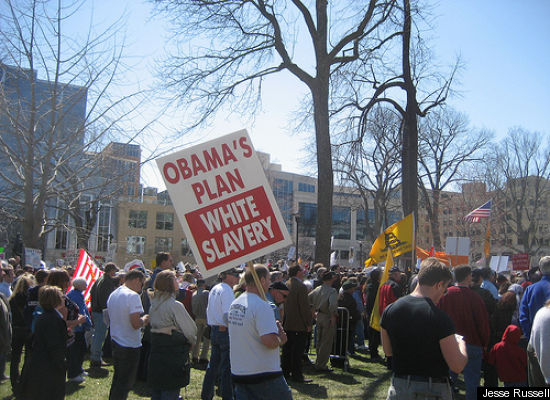
well be Satan in the flesh, and marchers who carry signs suggesting “Taxpayers are the Jews for Obama’s Ovens,” or that the President intends to
put whites into slavery, nothing should surprise us anymore.
In a media environment where highly paid commentators can keep their jobs even as they insist that those who call for the shooting of government agents so as to stop a world government takeover are
“beginning to have a case,” or that a national service initiative is just a run-up to the implementation of a literal stormtrooper corps
like the Nazi SS, or that
“multicultural people” are “destroying the culture of this country,” or that Latino migrants are an
“invasive species,” that seeks to undermine the nation, or that the President is
intentionally “destroying the economy” so as to pay white people back for slavery, or that, worse,
he and other Democrats are vampires, the only solution for which is a “stake through the heart,” to feign shock at the acts of a Jared Loughner is a precious and naive conceit that we can no longer afford.
Whether or not Loughner was influenced directly by any of these words, these verbal daggers aimed at civil discourse, is quite beside the point. For these words, these daggers, are the very ether of the political culture in which he has come of age. They comprise the fabric of the larger ideological tapestry to which he has been exposed. And they are, like any toxin, bio-accumulative in the cells of the human animal, even more so for those whose chemical balance is already dicey at best. Especially when such persons have the misfortune of living in a society that has so completely stigmatized mental illness as to guarantee that most who suffer will receive no treatment.
In such a place as this, to claim that Americans may need to turn to “Second Amendment Remedies” for political change — as defeated Tea Party favorite Sharron Angle did in Nevada — or that
Americans should be “armed and dangerous” to resist policies aimed at reducing climate change — as another Tea Party Republican, Michele Bachmann has — or that perhaps liberal politicians
should be beaten to death with shovels — as Glenn Beck said about Congressman Charlie Rangel in 2001 — is to invite chaos. It is to invite murder, whether by loners like Loughner or someone else down the line. It is inevitable. To insist, as Congressman Boehner did,
that health care reform is tantamount to “armageddon” — not merely a matter of philosophical difference but the literal end of the world — is to all but invite the unbalanced to start slaughtering the forces of presumptive evil.
That full-grown adults should require a reminder that words have consequences — something even most five-year old children can understand — is pathetic. It would be humorous were the reasons for its present import not so tragic and heartbreaking. Sadly, for those whose entire careers hinge on the hurling of rage-filled pathos, and who have indeed grown rich on the waves of hate for which they have become famous, no lesson is likely to be learned. Because for them, the cost of the lesson is too high. Better to ignore it, to deny that there is any connection between the apocalyptic verbiage to which their lives and livelihoods have become tethered, and the crazed violence of those upon whom their miasma of misanthropy descends.
But if we are to survive as a nation, a culture — or as a planet, ultimately — we’d best begin to demand better of ourselves and others. We’d best commit to a recognition that most of us are just trying to do the best we can, in a world that can be tough and unforgiving. Trying to raise families, keep our heads above water, and do what we think is right. Occasionally we get it wrong, and so do our neighbors. But that doesn’t make us, or them, terrorists, or zombies, or stealth Stalinists, or baby-killers, or gun nuts, or Klansmen, or whatever. It makes us, and them, human.
And what is saddest about our present condition, is that this ability to recognize our common humanity, and the decency of most folks, regardless of political philosophy, is seen by too many as a weakness, as compromise, collaboration, impurity, pathology, as evidence that one is no better than the evil on the other side. We have surrounded ourselves with amplified noise machines, which pump only those tunes we are already predisposed to hear, and in so doing we make enemies of our brothers and sisters. We turn politics and the larger, existential fight for justice into a blood sport. Kill or be killed. Or perhaps both.
-----------------------------------------------------
The blindspot (updated) by Freddie DeBoer
I'm sorry, but I feel compelled.
The last week has seen an endless discussion, within the political blogosphere, about the meaning of rhetoric, extremism, and what is acceptable discourse. I'm on break now, so I've been more attentive than usual. I find I can barely express what a profound failure, on balance, the conversation has been. Bloggers fail to have this conversation honestly because they are incapable of seeing or unwilling to admit that the political discourse, in our punditry, lacks a left-wing.
There are many myths within the political blogosphere, but none is so deeply troubling or so highly treasured by mainstream political bloggers than this: that the political blogosphere contains within it the whole range of respectable political opinion, and that once an issue has been thoroughly debated therein, it has had a full and fair hearing. The truth is that almost anything resembling an actual left wing has been systematically written out of the conversation within the political blogosphere, both intentionally and not, while those writing within it congratulate themselves for having answered all left-wing criticism.
That the blogosphere is a flagrantly anti-leftist space should be clear to anyone who has paid a remote amount of attention. Who, exactly, represents the left extreme in the establishment blogosphere? You'd likely hear names like Jane Hamsher or Glenn Greenwald. But these examples are instructive. Is Hamsher a socialist? A revolutionary anti-capitalist? In any historical or international context-- in the context of a country that once had a robust socialist left, and in a world where there are straightforwardly socialist parties in almost every other democracy-- is Hamsher particularly left-wing? Not at all. It's only because her rhetoric is rather inflamed that she is seen as particularly far to the left. This is what makes this whole discourse/extremism conversation such a failure; there is a meticulous sorting of far right-wing rhetoric from far right-wing politics, but no similar sorting on the left. Hamsher says bad words and is mean in print, so she is a far leftist. That her politics are largely mainstream American liberalism that would have been considered moderate for much of the 20th century is immaterial.
Meanwhile, consider Tim Carney and Mark Levin. Levin has outsized, ugly rhetoric. Carney is, by all impressions, a remarkably sweet and friendly guy. But Carney, in an international and historical context, is a
reactionary. Those who sort various forms of extremism differentiate Levin and Carney because Levin's extremism is marked in language, and Carney's extremism is marked in policy. The distinction matters to bloggy taste makers. Meanwhile, Hamsher's extremism in language is considered proof positive of extreme left-wing policy platform. No distinction matters; genuinely left-wing politics are forbidden and as such are a piece with angry vitriol.
Greenwald, meanwhile, might very well have actually left-wing domestic policy preferences. I honestly have no idea; Greenwald blogs almost exclusively about foreign policy and privacy issues. In other words, his voice is permitted into the range of the respectable (when it is permitted at all; ask Joe Klein if Greenwald belongs at the adult table) exactly to the degree that it tracks with libertarian ideology. Someone whose domestic policy might (but might not) represent a coherent left-wing policy platform has entrance into the broader conversation precisely because that domestic policy preference remains unspoken.
I hardly even need to explain the example of Markos Moulitsas. Moulitsas is a blogging pioneer and one with a large audience. But within the establishmentarian blogosphere, the professional blogosphere of magazines, think tanks, and the DC media establishment, he amounts to an exiled figure. See how many times supposedly leftist bloggers within this establishment approvingly quote Moulitsas, compared to those who approvingly quote, say, Will Wilkinson, Ross Douthat, or John Cole. Do some of these bloggers have legitimate beef with Kos? Sure. But the fact that his blog is a no-go zone for so many publications, while bad behavior from those of different ideological persuasions is permitted, ensures that the effects of this will be asymmetrical. I believe that people have to create positive change by changing their own behavior, but I also am aware that the nominal left capitulates to demands that they know the right absolutely will not capitulate to themselves. And so the right wins, again and again.
No, the nominal left of the blogosphere is almost exclusively neoliberal. Ask for a prominent left-wing blogger and people are likely to respond with the names of Matt Yglesias, Jon Chait, Kevin Drum.... Each of them, as I understand it, believe in the general paternalistic neoliberal policy platform, where labor rights are undercut everywhere for the creation of economic growth (that 21st century deity), and then, if things go to plan, wealth is redistributed from the top to those whose earnings and quality of life have been devastated by the attack on labor. That there are deep and cogent criticisms of the analytic, moral, and predictive elements of neoliberalism is an argument for another day. That those criticisms
exist, and that they emanate from a genuine left-wing position, is a point I find perfectly banal but largely undiscussed in political blogs. And that's the problem. Whatever those bloggers are, they are not left-wing, and the fact that they are the best people can generally come up with is indicative of the great imbalance.
There are two axes of neoliberalism. The first, substantive neoliberalism, means fidelity to the economic policy platform of globalization in the elimination of tariff walls and other impediments to the "free market," incredible antipathy towards organized labor (and, effectively if not intentionally, towards workers in general), resistance to the regulatory apparatus that has protected workers for decades, and the general belief that the way to ameliorate the moral outrages of capitalism is to pursue more capitalism.
The second axis of neoliberalism, constitutional neoliberalism, is the reflexive antileftism within the ideology. This is the tendency of the neoliberal to assume the superior seriousness of the man to his right and the utter moral and intellectual bankruptcy of the man to his left. This is the sneering, superior neoliberalism, the neoliberalism obsessed with status and authority, the neoliberalism that is utterly in thrall to the idea of Intellectually Seriousness and the notion that possessing it means falling all over yourself to dismiss the actual, historical, socialist left. This is Peter Beinart
calling for culls in liberalism to ostracize and silence anyone who dares question American aggression. This is Mickey Kaus doing his elaborate dance, calling himself a Democrat and liberal while he mouths every anti-leftist screed possible, calling unions the cause of all of our problems while unions are a dessicated, impotent shell of what they once were. This is the Atlantic publishing
a post full of faux-concern over the fate of the labor movement as if its leadership hadn't spent decades, secure in their upper-middle class comfort, attacking the ability of working people to provide for their own interests. This is Tom Friedman and Michael Kinsley and the whole crew of careerists at
The New Republic, all of them possessed of the notion that their real enemies are not the people who create the conditions of poverty and inequity in the world but the ones most vocal and dedicated to fighting those conditions by attacking the root cause.
The two intermingle, of course. The neoliberal economic platform is enforced by the attitude that anyone embracing a left-wing critique of that platform is a Stalinist or a misbehaving adolescent. This is the critique of the Very Serious Person: there is a very narrow slice of opinion that is worthy of being considered reasonable or mature, and that anyone who argues outside of it should not be given a seat at the table of serious discussion. Genuinely left-wing opinion is not to be debated but to be dismissed out of hand. Those who argue for a robust series of labor protections, an unapologetic and proud left, a meaningful alternative to the capture of our economic apparatus by corporate power, or (god forbid) something resembling genuine socialism-- even to speak as if their arguments require rebuttal is too much. Far better to demonstrate true repudiation by assuming away the left-wing critic than to assume that his or her position is at least worthy of attention. In this sense, conservative bloggers and pundits are actually fairer than their neoliberal brethren. I've found that they'll actually debate with me, albeit while usually holding their noses. Many neoliberal bloggers maintain an unspoken but meticulously curated policy of not allowing left-wing criticism to enter their rhetorical space.
All of this sounds merely like an indictment, but I genuinely have a great deal of sympathy for those young rising politicos and bloggers who are constitutionally disposed to be left-wing. What they find, as they rise, is a blogging establishment that delivers the message again and again that to be professionally successful, they must march ever-rightward. That's where the money is, after all. For every
Nation or FireDogLake, there is an
Atlantic or Slate, buttressed by money from the ruling class whose interests are defended with gusto by the neoliberal order. I have followed more than a few eager young bloggers as they have been steadily pushed to the right by the institutional culture of Washington DC, where professional entitlement and social success come part and parcel with an acceptance that "this is a center-right nation" is God's will. I wish they wouldn't move in that direction, but I don't know what great choice many of them have; blogging is an aspirational culture, and there is an endless number of young strivers, emboldened by unexamined privilege and the kind of confidence that can only come from having money you didn't earn, ready to take the place of those who step out of line.
Those who are already firmly ensconced within the upper reaches of bloggy success have less excuse. Many of the young, upwardly-mobile bloggers out there take their cues from Matt Yglesias and Ezra Klein. I don't begrudge either of them their policy preferences, even while I disagree with them. But each represents, in his own, the corruption and capitulation that comes with prominence and success in this culture. I genuinely don't know what the hell happened to Matt Yglesias. I long called him my favorite blogger. I've never mistaken him for someone who shares my politics. But he was, once, part of the resurgence of pride in leftism. He was one of the voices, in the midst of the Bush-era darkness, making it plain that he was unapologetic about being a creature of the left. In the last year or so, that stand has completely disappeared. He is now one of the most vocal of the neoliberal scolds, forever ready to define the "neoliberal consensus" as the truth of man and to ignore left-wing criticism. Indeed, I'm not sure that you could even understand that he has critics from his left, judging by what he chooses to discuss on his blog. This is a particularly cruel way to erase the left-wing from the discourse: to pretend that it doesn't exist. Look over his archives even briefly and you'll find, time after time, that he asserts that
everyone largely agrees with him. This is one example, but this has basically been his jam since Obama took office. When he posts about the sublime rationality of deregulation (which, we must take care to remember, always seems like a good idea to those whose workspace contains nothing more dangerous than a laptop), or when he says (I'm not joking) that American workers are overcompensated, I want to tell him that everyone most certainly does not agree with him.
I don't know what compelled this change. Perhaps the Center for American Progress has influenced him; that kind of run-of-the-mill centrist organization inevitably redounds to the benefit of the moneyed class that makes it possible. Or perhaps it comes from spending too much time in DC, where there is always another party with folks from Cato or Reason. I'm not saying people shouldn't socialize; I am saying that those on the nominal left should take notes from their friends across the aisle who are able to have drinks with someone without moderating their message.
Klein, meanwhile, means well. That is 90% of what people say about Klein; he is smart and means well and has those all-American good looks and dammit, if you can't respect him, you're a bastard or an ideologue. (Mickey Kaus is obsessed with bashing him, if that tells you anything.) I don't doubt that he's a good guy. I don't doubt that almost all of them are good people. I just find him so bloodless and conciliatory that I don't know what good can come of liberalism if it takes its cues from him. This was at its worst during the Journolist imbroglio; everyday, there would be more mean meanies being mean about Journolist members, and there would be more aggrieved sighing from Klein. At his best, he is probing and incisive. At his worst, he does his Saint Ezra routine, where being correct on policy is supposed to flow directly from his moral rectitude. I can't dismiss his preference for a genial globalized social order out of hand, much as I may want to, but I wish he understood that his lack of fire, combined with his considerable access and influence teaches young liberal pundits that there is more to be gained from being a caricature of a Very Reasonable Fellow than there is from sticking to principle.
I don't know what's to be done about all this. On a personal level, I like many of the people I'm critiquing very well. If good intentions were enough this world would be a different place. And I definitely don't enjoy constantly feeling compelled to fight with people with whom I would much rather agree. But I operate within the blogosphere as it is, not as I wish it would be, and unlike people from other ideological stripes I cannot rest in the knowledge that someone out there will forcefully articulate my position. I can expect just opposite, that a genuinely left-wing position-- one from the socialist left, the internationalist left, of the kind that can be found in force in almost every other democracy in the world-- will go unsaid. Worse, the fact that it goes unsaid will be taken by those within the blogosphere that no such position exists.
I was finally driven to write this post by the recent discussions, driven by Chris Beam's
article, on libertarianism. I am someone who frequently develops great hope for a hypothetical libertarianism and is consistently disappointed by the actual libertarianism. I'm sorry to say that, if the reaction to Beam's piece is any indication, what libertarians have taken from their tempestuous love affair with movement conservatism is the political salience of constantly complaining about how oppressed you are. I ask, and I wonder, if libertarians ever stop to ponder what it's like to operate from an actually forbidden perspective. I take it that there isn't, actually, a great imbalance in the number of American libertarians (in any sense amenable to the Cato and Reason crowd) and the number of Americans who would consider themselves leftists, or very liberal, or the like. The ranks of American minarchism, after all, are quite small in number. Bush's compassionate conservatism, the inverse of the standard libertarian platform, was a real winner. But while libertarians are tiny in number they are mammoth in influence. This is the case because they've got money, money to fund enterprises like Cato or Reason or smaller outfits. I'm not saying that this is illegitimate. (There's something awfully poetic about libertarianism getting influence by buying it.) I'm just saying that there's no sense in which the lack of a leftist blogosphere is necessarily the product of small demographic representation.
If there was a different libertarianism.... I frequently imagine that an ideology with "liberty" right in the title might be a mad, teeming collection of every flavor of crazy and dreamer, a loose confederation rife with difference and disagreement. Difference so vast that it might, by god, lead some to find common ground with someone like, well, me.
Instead, we have only the libertarianism that exists. And that libertarianism is the America ideology least accepting of difference, most committed to policing orthodoxy. It is, on balance, a model of lockstep adherence to the standard libertarian cause. Who could be a better symbol of today's libertarianism than Matt Welch, the snarling head of Reason, a man notorious for keeping those under Reason's banner within the small grounds of the libertarian reservation? I have searched but found no libertarians particularly amenable to seeing the tension between an ideology dedicated to freedom and an institutional apparatus that enforces orthodoxy. I bring all this up because I have always thought that there is room for libertarians to at once disagree totally with left-wing policy but to support the idea that the left-wing should be given a seat at the table. The reality, I'm sorry to say, is the opposite. I find it so hard to take, when libertarians complain about how misunderstood and oppressed they are, because
nobody redbaits like libertarians do. Nobody. Nobody is more eager to excise the dirty commies from the realm of acceptable opinion than your average libertarian, while the similarly berate the powers that be for confining them to the intellectual ghetto of their imagination.
So you can imagine why I might be compelled to pull my hair out by something like
this Bloggingheads episode with Adam Serwer and Michael Moynihan, where, in a discussion about acceptable rhetoric, Moynihan laments the use of the term "eliminationist" in political dialogue. On the merits, I think he has a point, but perhaps Moynihan would find the term less in use if he wasn't someone who so enthusiastically participated in the behavior that people usually describe as eliminationist. I have a hard time imagining someone less hospitable to far left opinion than Moynihan. He constantly is declaring international thinkers, politicians, and authors communists, and assuming that this terminology alone is enough to dismiss them. Meanwhile, I like Serwer, but he is in many ways exactly the kind of establishmentarian liberal who is least able to rebut someone like Moynihan-- conciliatory rather than aggressive, more likely to look for compromise than to stand his ground. Perhaps that's maturity and strength. But I look around and see a liberal dialogue that is dangerously self-marginalizing because of its refusal to take commitment to ideals as a point of pride in the same way that conservatives and libertarians do. Again, I can't fault Serwer for being who he is, and he is justly successful. But I lament the fact that he operates in a context where there are so few left-wing warriors equivalent to Moynhian, which the right seems to produce in throngs.
I long ago had to come to terms with a political era and a political machine that is not my own and never likely to please me. I do wonder what a critique like this one might accomplish, were it to penetrate the greater bloggy consciousness. It would take someone with publicity and access to bring it into the conversation, and as I've said, very, very few of genuinely left-wing socialist policy preferences are ever allowed into the Club. Even if it got there-- even if, somehow, a critique like this one could puncture the carefully constructed bubble of blogospheric consciousness, the one which limits debate and sets the boundaries of "acceptable" discourse so narrowly-- I can predict a sad response. Many would set out to deny the possibility that political blogs contain anything less than the full panoply of human political opinion, and would do so with exactly the mechanism I'm describing here: the existence of a nominal left-wing that represents merely a slightly different flavor of neoliberal doctrine would provide cover for those not even nominally left-wing. The Matt Yglesiases, the Ezra Kleins, the Jon Chaits, the Kevin Drums-- they would likely support the neoliberal orthodoxy that has captured the debate by denying that any such dynamic could exist. That would give an out to the conservatives and libertarians to say "see, even the Liberal Ezra Klein says...." Every time there is agreement between, say, Yglesias, Ross Douthat, and Will Wilkinson, this is taken as a sign that of a lack of disagreement to their position, rather than as an indicator of the narrow confines of blogger opinion. Once again, the idea that there is some sort of genuine ideological disagreement within the space would paper over the fact that little such disagreement exists.
I'm not a proponent of any kind of a Fairness Doctrine. Yes, it's true; I think the blogosphere would be a truer, more productive, more interesting, more entertaining, more generative, more self-effacing, more American place, were it to permit an actual left-wing. But you couldn't force such a thing and I wouldn't want. People are always permitted to take their ball and go home. But once they do, it would be polite for them to stop pretending that this is the same as winning the game. The blogosphere will go on being what it is, but it could at least have the self-knowledge and the probity to admit its bias and its lack of balance. I often find myself wondering of Matt Yglesias-- when he talks about a world without serious disagreement with his policy preferences, is he talking about just the world of blogs and punditry, or the wider, wilder world of political thought? And is he talking about the way things sadly are, or the way he wishes it to be? The difference means everything.
I'm a lefty. I wish I could pretend that I have the intelligence and the perspective necessary to divide my beliefs from my appraisal of the situation, but I have neither. All I know is that I look out onto an America that seems to me to desperately require a left-wing. American workers have taken it on the chin for thirty years. They have been faced for years with stagnant wages, rising costs, and the hollowing out of the middle class. They are now confronted with that and a cratered job market, where desperate people compete to show how hard they will work in bad conditions for less compensation. Meanwhile, the neoliberal policy apparatus that brought us here refuses even to consider the possibility that it is culpable, so certain of its inherent righteousness and its place in the inevitable march of progress. And the blogosphere protects and parrots that certainty, weeding out left-wing detractors with ruthless efficiency, while around it orbits the gradual extinction of the American dream.
---------------------------------
Sorry, right-wing talkers. Loughner's rampage was a clear act of political terrorism directed at a liberal 'government' target by David Neiwert (
Crooks & Liars)
Folks on the right are feeling quite confident that their tracks leading up to last weekend's tragedy in Arizona have all been covered, now that the Village has reached a consensus that, because Jared Loughner was probably mentally ill (and at a bare minimum profoundly unstable), his killing rampage couldn't possibly have been politically motivated.
The running line is that liberals who dared point out that vicious right-wing rhetoric directed at people like Giffords played a role in this "jumped to conclusions" before "the evidence was in". We think they may want to look in the mirror -- because as the evidence comes in, it's looking more and more like those liberals were right all along.
Like the crew of right-wing wankers who populate Fox's
Journal Editorial Report, led by Paul Gigot and Dan Henninger, as well as the execrable James Taranto and Dorothy Rabinowitz:
GIGOT: Let's give an example of this. I want to read an excerpt from Monday's editorial of "The New York Times." "It is facile and mistaken to attribute this particular madman's act to Republicans or Tea Party members. But it is legitimate to hold Republicans and particularly their most virulent supporters in the media responsible for the gale of anger that has produced the vast majority of these threats, setting the nation on edge." Dan, your response.
HENNINGER: My response is that it has not only produced the vast majority of the anger that did that, it has produced the vast majority of anger that defeated them in the November elections, OK.
GIGOT: But it's not violent, Dan.
HENNINGER: Look, what Jared Loughner did has nothing to do with what we're talking about. Everybody agrees. But we're talking about it.
GIGOT: Right.
Actually, as we
explained to Jennifer Rubin, not only is it violent, the violence is well documented, as has been the role of right-wing extremist rhetoric in inspiring the violence. We document 19 cases of extremist domestic-terror violence just in the past two and a half years; this does not even begin to take into account the
litany of criminal violent threats against liberals in the past year.
Gigot also elucidated their core insight with which the entire panel was in agreement, since it seems to be received wisdom among the Beltway Villagers now:
GIGOT: Is this going to hurt the people on the left who walked out on this limb? Because there's really no evidence that Loughner was motivated by anything political.
Then there was the crew at Fox News Watch, particularly host Jon Scott, who was similarly certain that Loughner's rampage was "not political":
I hate to break it to these folks, but there is indeed
an abundance of evidence that not only was Loughner's rampage a political act, it was an act of domestic terrorism committed by someone who had been unhinged by far-right conspiracy theories.
Let's review just the facts we already had in hand, even before this weekend:
-- Loughner self-identifies as a terrorist. (See the videos he left behind; in our version, the page in which he identifies himself as a "terrorist" is at the 1:00 mark).
-- He also clearly has adopted two strands of right-wing conspiracism: He believes that American currency is "phony" because it no longer is on the gold standard, and he believes Alex Jones-esque conspiracy theories about "mind control." The SPLC's Mark Potok has more on this.
-- He had developed an unhealthy fixation on Giffords, but his hatred of her was largely political in nature and not personal.
-- There was a powerful campaign of demonization directed at Giffords throughout the 2010 campaign, including but hardly limited to Sarah Palin's attack ads -- much of it featuring rhetoric condoning the idea of targeting Giffords with guns.
-- Giffords was a mainstream moderate Democrat -- a classic target of hatred from the conspiracist right, which despises real liberals but reserves its special venom for centrist Democrats like Bill Clinton and Barack Obama.
If you have any doubt that this was an act of terrorism -- and is thus inherently political -- just consider one of the basic criteria of the definition of the word: Were people -- not just the public generally, but the target group as well -- terrorized by the act? Clearly the answer is yes: Democrats in Arizona, who already feel on edge, are clearly feeling terrorized now.
It cannot be emphasized enough that
the target of a political act is a powerful indicator of the perpetrator's intent. Terrorists always intend to send a message with their acts, and the message is conveyed in the persons who are are targeted and become victims of their violence. There's no doubt that Jared Loughner sent a message with these killings: The lives of government-coddling Democrats and their enablers are forfeit.
And if there was any doubt that Loughner was unhinged by right-wing conspiracism, there was the report on Wednesday's Good Morning America:

One of Loughner's friends, a fellow named Zach Osler, says that the internet movie Zeitgeist “poured gasoline on his fire” and had “a profound impact on Jared Loughner's mindset and how he views the world that he lives in.”
We've written a lot about how Alex Jones' crackpot views, his connection to Ron Paul and his John Bircherite conspiracy theory websites and radio program are mainstreaming many of the most extreme beliefs in Conservativeland. (The ADL has
a complete dossier in Jones.)
Michelle Goldberg explains in her piece,
"Zeitgeist, the documentary that may have shaped Jared Loughners worldview""
We now know a little bit more about the matrix of ideas that helped inspire Jared Loughner’s murderous rampage on Saturday. According to a friend of his interviewed on Good Morning America on Wednesday, the conspiracy documentary Zeitgeist “poured gasoline on his fire” and had “a profound impact on Jared Loughner's mindset and how he views the world that he lives in.” He was also, according to his friend’s father, influenced by the documentary Loose Change, a classic of the 9/11 Truth movement. This does not mean that either of these movies is responsible for making Loughner do what he did, but it does show how his madness was shaped by a broader climate of paranoia, and offers a clue as to why he targeted Gabrielle Giffords.
Indeed, as
we said a couple of days ago:
What most of us said from the start is that it was undeniable that the killings took place in a charged atmosphere in which all kinds of violent rhetoric had created an environment in which nearly everyone present on the ground felt something like this was inevitable -- because it creates permission for violent acts, and fuels the irrationality that makes violence possible. Sarah Palin's "target map" was only the most obvious example. So, for that matter, was that "target shoot" fundraiser by her Tea Partying opponent.
... But in the end, Loughner's motive matters less than the realities that people like Pima County Sheriff Clarence Dupnik are well acquainted with already.
Dupnik had all the evidence he needed to make the kinds of remarks he made about the political and social environment in Arizona -- one that has gotten so virulently ugly that Democrats and liberals in Arizona increasingly are fearful for their physical well-being and are reluctant to self-identify as liberals. (Will Bunch had a terrific piece at Media Matters recently on this very subject; as someone with family and friends in Arizona, I can personally attest to this reality.)
Unlike Bill O'Reilly or Megyn Kelly or Monica Crowley, Dupnik actually lives in Arizona, and does know whereof he speaks. Moreover, there is abundant evidence about the vicious eliminationist hatred, some of it officially sanctioned by the GOP and Tea Parties, that was directed at Giffords personally.
I think this Danziger cartoon neatly sums the situation up:

--------------------------------------------------------
We can both protect our second amendment rights and keep our communities safe from illegal gun sales.
I was given an “A rating” by the NRA eight times during my years as Lt. Governor and then Governor of Vermont. Guns and hunting are part of our way of life in Vermont. But I don’t think any Vermonter or gun owners anywhere can argue against common sense changes to our background check system to make our communities safer and more secure.
And common sense changes are exactly what Mayors Against Illegal Guns is proposing that President Obama and Congress take action on right now. They have a two-part goal. First, we already have laws that make it illegal for guns to be sold to felons, drug abusers or the mentally ill. The problem is that states and federal agencies are not required to make sure these prohibited purchasers are included in the background check database. That must change.
Second, it’s time to stop the sales of guns without a background check at all. Right now, anyone can go to a gun show and purchase as many guns as they want no questions asked, no background check, nothing.
It’s common sense to fix these two loopholes and make America safer from illegal gun sales.
Join me in adding your name right now
Every day now it seems more news comes out about how these background check loopholes make America less safe. In the last week alone, the Federal government discovered that hundreds of guns bought in Arizona made their way to Mexico to help drug cartels destabilize the Mexican Government. This is not only a threat to the people of Mexico. When loopholes in our laws allow drug cartels in Mexico to stockpile guns, we can all agree it is also a threat to the United States. It’s not just the conclusion of progressive Democrats, it’s a conclusion drawn by Republican officeholders in the southwest as well.
Now, The Washington Post reports that President Obama is planning t speak out on guns in a special address soon, but it’s not clear what actions he plans to take or goals he plans to set.
President Obama is listening.
Now’s the time to make sure the President and Congress know exactly where we stand.
Please join me now in calling on President Obama and Congress to fix gun check loopholes today
When progressives stand up for our core values of strong communities, security and liberty, America wins.
Please join us today and thank you for everything you do. - Howard
Gov. Howard Dean, M.D.
Founder, Democracy for America